
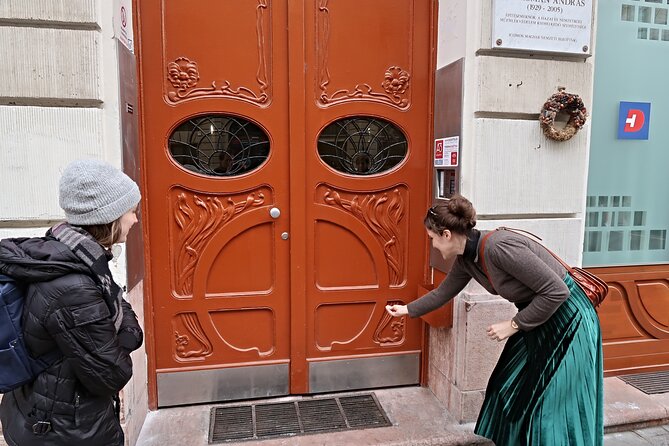
Review · BUDAPEST
Budapest Art Nouveau Walking Tour
Budapest’s Art Nouveau is not shy. Look up and you’ll find palace fronts covered in colorful ceramics, banks dressed in floral stonework, and bold Hungarian designs shaped by both European fashion and imagined Asian origins. This three-hour walk focuses on that particular Budapest style, often called Hungarian Secession, with an art and architecture historian explaining what you are seeing.
I like the way the tour combines famous buildings such as Gresham Palace with smaller interiors, including a flower shop, café, museum, and bank offices. I also like the focus on Ödön Lechner, Hungary’s great Art Nouveau architect, and the Zsolnay porcelain that gives many façades their color. The main consideration is the changing access schedule: some interiors close on weekends, and two optional sites cost extra.
Key points to know before booking
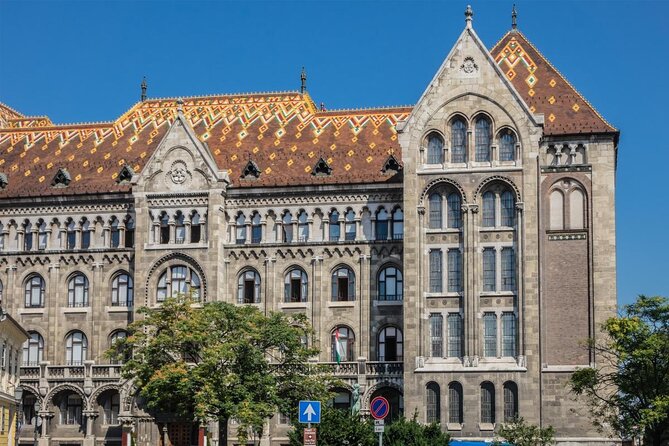
- See Lechner’s flamboyant Postal Bank: The building’s colorful roof and Hungarian design language make it one of the walk’s main visual rewards.
- Enter Gresham Palace: You can see parts of the grand entrance hall and learn how its decorative details fit the Art Nouveau style.
- Track Zsolnay ceramics: The famous Pécs factory supplied the durable, glossy tiles used on many Hungarian buildings.
- Look for Asian-inspired details: Your guide explains why Hungarian designers used eastern motifs and how this fit wider European Orientalism.
- Finish at an unusual synagogue: The Orthodox Synagogue on Kazinczy Street has a fine Art Nouveau interior, although it is closed Saturdays.
- Choose a private or small group: The format suits travelers who want time for questions rather than a large, fast-moving crowd.
Why Budapest’s Art Nouveau feels distinctly Hungarian
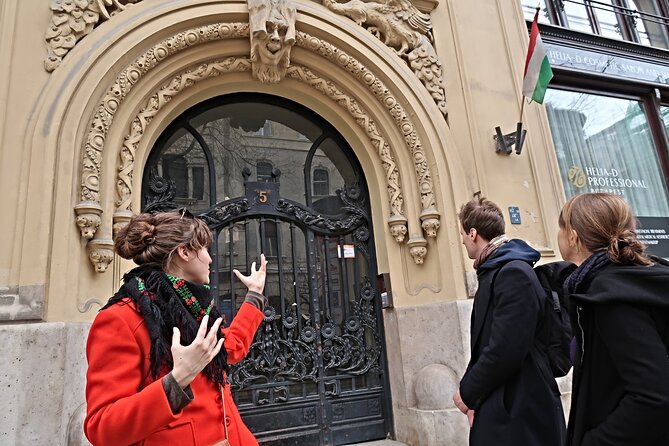
Art Nouveau spread through Europe around the turn of the 20th century. Architects rejected rigid historic styles and reached for flowing lines, plants, animals, new materials, and bold decoration. Budapest embraced the movement during a period when the city was growing wealthy, ambitious, and eager to present itself as a modern European capital.
Hungarian designers added their own visual language. Ödön Lechner, often called Hungary’s Gaudi, looked to folk art, Hungarian identity, and Asian motifs for inspiration. His buildings can feel almost folkloric, yet they also use modern materials and daring engineering.
The most useful thing about this tour is that it does not treat Art Nouveau as a parade of pretty façades. Your guide points out the choices behind them. Why is porcelain used here? Why does a bank have a peacock or a stylized flower? Why do certain patterns feel eastern? Those questions help you read the buildings instead of simply photographing them.
More Art Nouveau tours in the world:
- Walking Tour of Riga’s Beautiful Art Nouveau Architecture
★ 4.8 · 20 reviews - Riga’s Architecture: A self-guided audio tour of the city’s art nouveau history
★ 5.0 · 3 reviews - Mexico City origins and architecture: Art Nouveau, Deco,Eclectic
★ 3.0 · 2 reviews
Starting the walk and setting the route
The exact starting point depends on the option you select. If you prefer a central meeting place rather than pickup from your hotel or holiday flat, the arranged meeting point is Madal Café at Alkotmány u. 4.
The walk lasts three hours. That is enough time to cover several central sights without turning the experience into an exhausting architecture lecture. You should still expect a steady city walk, with time spent outdoors and short visits into buildings when access allows.
Public transport tickets are not included. Tram or metro use may be needed for part of the route, so keep a small transport budget separate from the $123 tour price. Pickup is optional, which gives you a choice between convenience and a central meeting point.
The tour is offered in English, with private and small-group formats available. A private or smaller group is especially useful here because many details are easy to miss. You can stop to ask about a tile, a symbol, or a façade without holding up a large crowd.
Bedő House and the smaller details
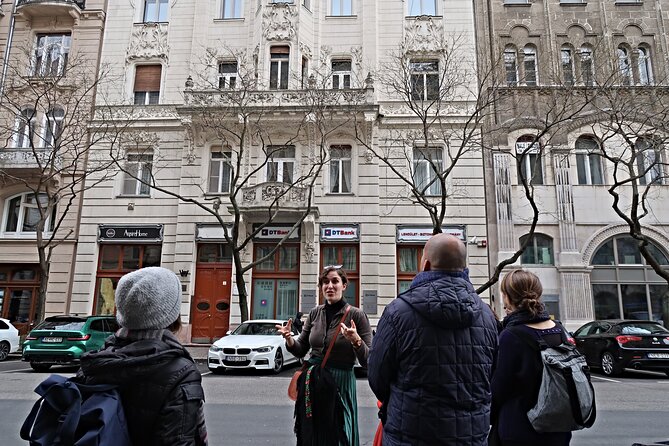
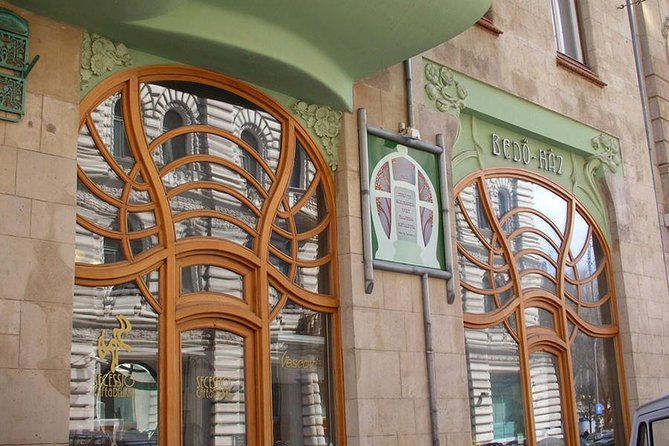
Bedő House is one of the early stops listed for the walk. It gives your guide a chance to introduce the local version of Art Nouveau before the tour reaches the biggest landmarks.
The value of a stop like this is scale. Monumental buildings can make Art Nouveau seem like a style reserved for palaces and grand institutions. A residential or smaller urban building shows how the movement reached ordinary city streets, entrances, decoration, and practical design.
You may notice that the tour is not only about one architect. Hungarian Art Nouveau developed through a range of designers, clients, craftspeople, and factories. The guide helps connect the pieces, so a motif seen at Bedő House can make more sense when you encounter it again on a bank, department store, or synagogue.
The Hungarian State Treasury and Lechner’s Postal Bank
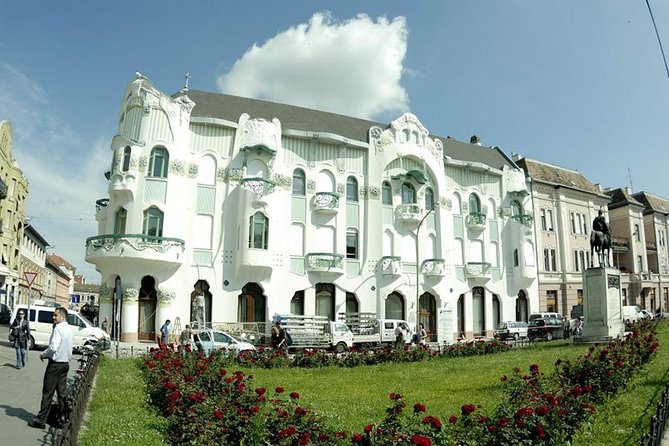
The Hungarian State Treasury, also known as the Palace of the Royal Post, is one of the essential stops. It is associated with Ödön Lechner and is famous for its lively roofline, colorful decoration, and use of Hungarian design ideas.
This is where you see why Lechner earned his reputation. The building is not a restrained copy of French or Belgian Art Nouveau. Its surfaces use color, pattern, and ceramic decoration to create something more specific to Hungary.
The building’s roof is especially important. Zsolnay ceramics could handle strong colors and unusual shapes, allowing architects to decorate a roof as carefully as a façade. Look for the relationship between the roof, wall surfaces, and ornamental details. Your guide can point out how the materials work together rather than treating each decoration as a separate flourish.
The tour information also describes the Hungarian National Bank as a place with fine Zsolnay porcelain examples, though weekend access can affect the route. Ask about the exact plan when booking, since the State Treasury and National Bank references may reflect different access points or adaptations of the walk.
More architecture walks in the world:
- Lecce: Baroque Architecture and Underground Walking Tour
★ 4.6 · 1,248 reviews - Chicago in a Day: Food, History & Architecture Walking Tour
★ 5.0 · 1,153 reviews - Ramblas, Old Town, Gothic and Gaudi Architecture Walking Tour
★ 5.0 · 723 reviews - Chicago’s Secret Interiors Architectural Walking Tour
★ 5.0 · 635 reviews
Gresham Palace and the grand entrance hall
Gresham Palace is the tour’s other major building. Located near the Danube, it is one of Budapest’s best-known Art Nouveau landmarks and a useful counterpoint to Lechner’s more distinctly Hungarian work.
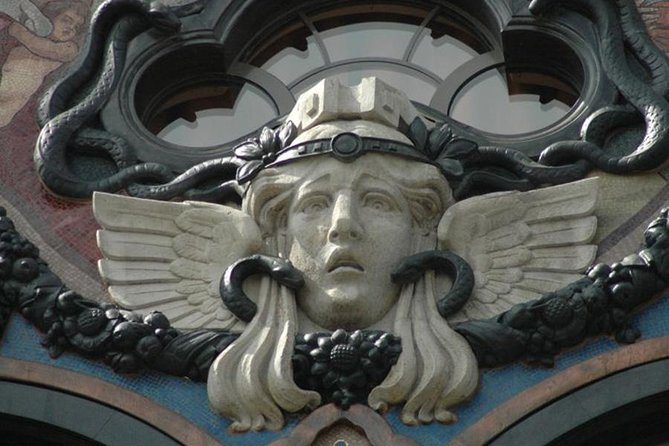
The exterior gives you plenty to study: elaborate stonework, iron details, decorative figures, and a carefully designed entrance. Fortunately, visitors can enter the entrance hall, allowing you to see how the style continues indoors.
I particularly like this part of the route because it shows that Art Nouveau was not limited to façades. Doors, stairways, mosaics, metalwork, and lighting were meant to form one visual experience. Your guide can explain how the building’s public spaces projected wealth and modern taste during Budapest’s Belle Époque.
Gresham Palace also helps place the style in a wider social setting. These were not modest buildings created only for artistic pleasure. Banks, offices, commercial firms, and wealthy residents wanted architecture that announced success. Art Nouveau gave Budapest a way to look fashionable, prosperous, and unmistakably itself.
Rózsavölgyi utca and the working city
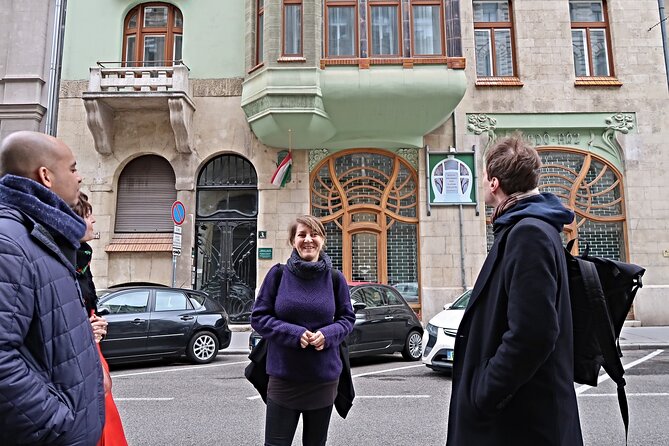
Rózsavölgyi utca is another listed stop. The route here shifts from major landmarks to the smaller commercial and urban details that make a walking tour worthwhile.
The wider experience includes a flower shop with its original interior, a department store, several bank offices, and a small Art Nouveau museum and coffee house. These places help you see how the movement reached daily life. Art Nouveau was not simply an architectural costume for government buildings. It shaped shop interiors, furnishings, signs, ceramics, and the way customers encountered businesses.
Access can vary, so do not assume every interior will be open at the exact moment you walk past. The strength of the tour is the guide’s ability to adapt the route and explain what can be seen on that day.
Paris Passage and decorative interiors
Paris Passage provides another look at Budapest’s commercial architecture. Passages and department stores were places where people shopped, met, and watched the modern city take shape.
Here, pay attention to the balance between function and decoration. Art Nouveau designers brought curves, plant forms, patterned surfaces, and crafted details into spaces that still had practical jobs. A shopping area could be useful and theatrical at the same time.
The stop also gives your guide a chance to discuss the city’s cosmopolitan side. Budapest was connected to wider European design trends, but Hungarian architects did not simply repeat what they saw abroad. The most interesting buildings borrow from international Art Nouveau while adding local symbols, materials, and historical ideas.
Zsolnay porcelain and the art of the façade
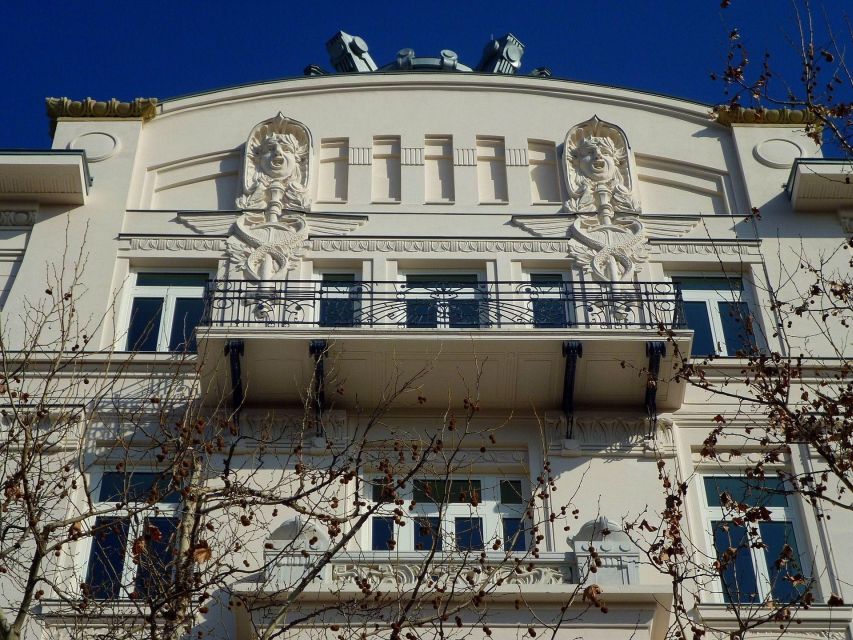
Zsolnay porcelain from Pécs is one of the tour’s most useful subjects. The factory became famous for ceramics that could withstand weather while offering strong color and decorative freedom.
On a building, these tiles do more than add surface decoration. They protect parts of the structure, catch changing light, and give architects a way to create patterns that would be difficult in ordinary stone or painted plaster.
You will examine examples of Zsolnay ceramics during the walk, especially in connection with bank buildings and other public architecture. If you enjoy craft and materials, this may be the section that makes the $123 price easier to justify. A guide can explain what you are looking at, while a standard sightseeing walk may leave the tiles as colorful background.
The House of Hungarian Art Nouveau may also be included, with an additional entrance fee of 1,000 HUF, about $3.50. It offers another chance to see period design and applied arts in a smaller setting.
Asian motifs and Hungarian identity
One of the more unusual themes is the use of Asian motifs and forms. Hungarian designers referred to the supposed eastern origins of the Hungarian people, using that idea as part of a national design language.
Your guide also places this in a broader European context. Around the same period, designers across Europe were fascinated by Japanese, Indian, Middle Eastern, and other Asian visual traditions. Budapest’s version combined that wider fashion with local ideas about national identity.
This is a good example of why context matters. A pointed shape, repeating pattern, or unusual animal figure can look decorative until you learn why the designer selected it. The tour encourages you to ask how architecture expresses identity, not only how it looks.
The Kazinczy Street Orthodox Synagogue
The walk can finish at the Orthodox Synagogue on Kazinczy Street, an especially appealing ending for anyone interested in interiors and religious architecture. Its Art Nouveau design is smaller and more intimate than Gresham Palace, but the decoration is no less important.
The synagogue’s interior shows how Art Nouveau ideas could be adapted to a religious setting. Instead of treating the building as a purely secular display of modern style, the designers worked with a space shaped by worship, community, and tradition.
The synagogue is closed on Saturdays. If it cannot be visited, the route can be changed or extended with other Budapest Art Nouveau sites, including the Gellért Bath Hotel, the Museum of Applied Arts, or the Geology Museum.
An entrance fee of 2,000 HUF, about $7, may apply when the synagogue is open. Include that in your budget if seeing the interior is a priority.
How much value do you get for $123?
At $123 per person, this is not a cheap orientation walk. You are paying for a three-hour specialist tour with a historian guide, not simply for transportation between buildings.
The price makes the most sense if you care about architecture, decorative arts, or Budapest’s early 20th-century culture. A guide can turn a series of façades into a connected story about Lechner, Zsolnay ceramics, national identity, business wealth, and European design.
The value is also stronger in a private or small group, where you can ask questions and adjust the emphasis. If you only want to see Budapest’s main sights from the outside, you could walk through the city independently for far less. You would miss much of the explanation, though, and some interiors may be difficult to find or understand without help.
Remember to allow extra money for tram or metro tickets and possible entrance fees. The tour offers free cancellation up to 24 hours before the start and reserve-now, pay-later booking, which helps if your Budapest schedule is still changing.
Who will enjoy this walk most?
I would recommend this experience to you if you:
- Enjoy architecture, interiors, or decorative arts.
- Want to understand what makes Hungarian Art Nouveau different.
- Prefer a guide-led walk to reading plaques on your own.
- Like smaller museums, commercial buildings, and less obvious details.
- Are comfortable walking for three hours in central Budapest.
- Want a private or small-group setting for questions.
It may be less suitable if your main aim is Budapest’s medieval history, communist-era sights, or a broad first-time city introduction. This is a focused specialist walk, and it spends much of its time looking upward, at façades, roofs, ornaments, and entrance halls.
The limited number of published ratings is worth noting, but the available feedback is very positive. Anna was praised for being friendly and well informed about Budapest’s art and history. Another booking described the guide as highly competent with very good German, though the advertised tour language is English. If you need another language, confirm it before booking.
My verdict on the Budapest Art Nouveau Walking Tour
Book this tour if Budapest’s buildings catch your eye and you want someone to explain the choices behind them. The strongest parts are the Postal Bank, Gresham Palace, the Zsolnay ceramics, and the connection between Asian motifs and Hungarian identity.
Before paying, check the day of the week and confirm which interiors will be open. Saturday is the weakest choice if the Orthodox Synagogue matters to you, and weekend access to the National Bank can also change the route. With the schedule confirmed, this is a focused, thoughtful way to see a side of Budapest that is easy to miss from street level.
FAQ
Where does the Budapest Art Nouveau Walking Tour start?
The starting location depends on the option selected. If you choose a central meeting point instead of hotel or holiday-flat pickup, the meeting point is Madal Café at Budapest, Alkotmány u. 4.
How long does the tour last?
The walking tour lasts three hours.
What language is the tour offered in?
The advertised live tour language is English.
Is the tour private or shared?
Private and small-group options are available.
Is hotel pickup included?
Pickup is optional. You can choose a central meeting point instead of personal pickup.
Are public transport tickets included?
No. Tram and metro tickets are not included.
Is the Orthodox Synagogue open every day?
No. The Orthodox Synagogue on Kazinczy Street is closed on Saturdays.
Are entrance fees included?
Some additional entrance fees may apply. The House of Hungarian Art Nouveau costs 1,000 HUF per person, and the Orthodox Synagogue costs 2,000 HUF per person when open.
Can the route change if a site is closed?
Yes. The tour can be adapted to your interests or extended to include places such as the Gellért Bath Hotel, the Museum of Applied Arts, and the Geology Museum.
Just added around the world
- Wilmington History and Architecture Tour★ 4.8 · 18 reviews
- Washington, DC: Georgetown Architecture Walking Tour★ 5.0 · 8 reviews
- New Orleans : Garden District Architecture Walking tour★ 4.8 · 5 reviews
- Washington DC: Dupont Circle & Embassy Row Architecture Tour★ 5.0 · 6 reviews
- Vicenza: Palladian Architecture Private Walking Tour★ 3.3 · 3 reviews
- Walk & Discover KL’s Architectural and Heritage Gems★ 5.0 · 7 reviews
- Vicenza: discovering the city of Palladio by e-bike★ 5.0 · 4 reviews
- Unveiling Brno: History, Culture & Architectural Delights★ 5.0 · 2 reviews
Art Nouveau Tours, compared.
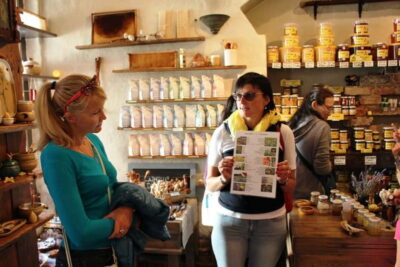
Riga: Old Town Walking Tour with Art Nouveau Highlights
Read our review →
Riga: 2-Hour History of Art Nouveau Walking Tour
Read our review →
Brussels: Art Nouveau Pass – Entry to Three Locations
Read our review →
Small Group Tour in Ålesund: Art Nouveau, Sea Views & Insider Tips
Read our review →
Browse the lists this tour appears in