
Review · THE USA
Washington, DC: Georgetown Architecture Walking Tour
Georgetown’s best stories are written into its buildings. On this 150-minute architecture walk, you move from canal warehouses and old taverns to pastel row houses, university halls, and the Potomac waterfront. The neighborhood’s rise from a working port to one of Washington’s most desirable addresses gives the tour a clear human story.
I like the careful route through lesser-known buildings, including the Laird-Dunlop House, Lydia English Seminary School for Girls, and Pomander Walk. I also like the mix of architecture and local characters, with guides such as Sam and Ellyn adding fun facts to the formal history. The main consideration is pace: two miles is manageable, but you will be on your feet in all weather and the tour leaves on time.
Key points to know before you book
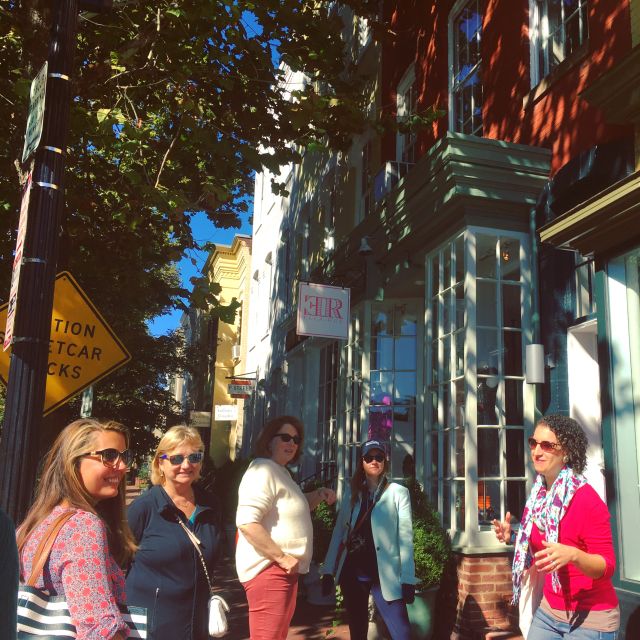
- The route covers about 2 miles in 150 minutes, with a leisurely pace and many stops.
- The C&O Canal gives the tour a working-port beginning, rather than starting with only grand homes.
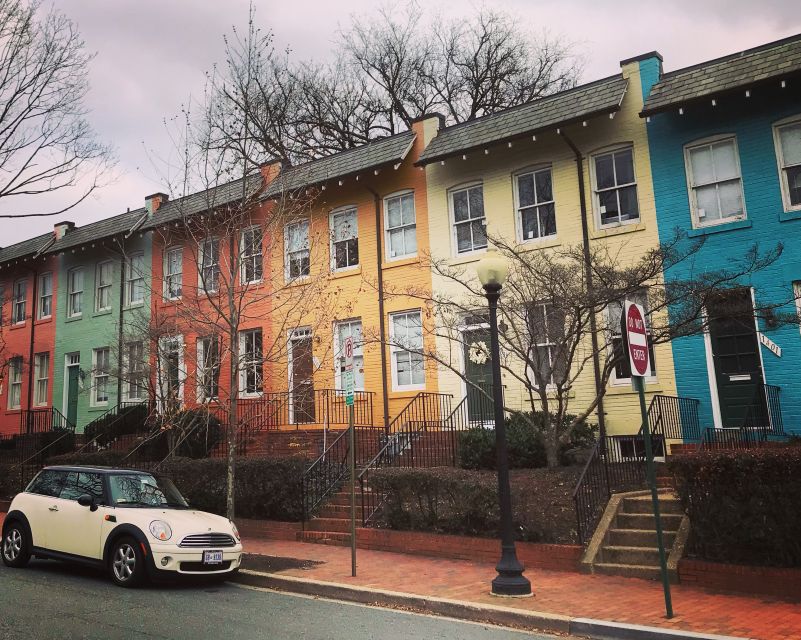
- Pomander Walk adds a colorful change of scene, with tiny pastel row houses.
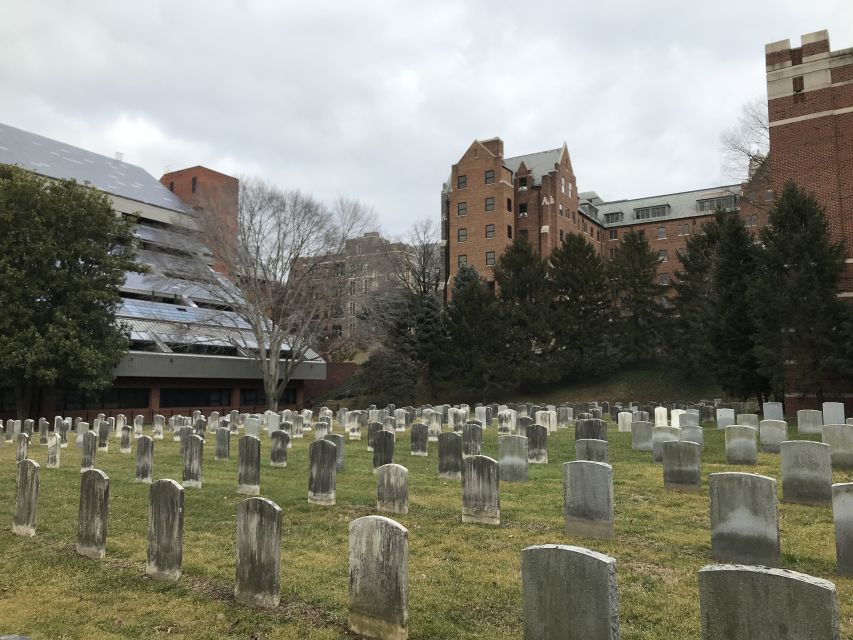
- The academic section includes Healy Hall, the University Library, and The Tombs, giving you a look at Georgetown’s student side.
- The tour finishes at the Georgetown Waterfront, a useful place to continue your afternoon.
- Sam and Ellyn are named guides associated with especially engaging tours, though your guide may be someone else.
Why Georgetown works so well as an architecture walk
Georgetown rewards slow looking. Its streets hold homes, schools, churches, shops, and old commercial buildings close together, so the tour can cover a lot without sending you across a huge area.
The route also has a useful shape. You begin with the Chesapeake and Ohio Canal, follow historic houses and civic buildings, move toward Georgetown University, then finish near the Potomac. That progression helps explain how the neighborhood changed over time.
This is not only a parade of pretty facades. You hear about Georgetown’s rags to riches tale and the forces that made the area important. The canal connected Potomac River communities with markets and goods, giving the neighborhood a practical role before it became known for polished homes and fashionable streets.
I find that context important. Without it, an old building can look like a nice backdrop for photographs. With it, a canal, tavern, school, or warehouse becomes part of a larger story about work, education, religion, transport, and status.
The tour is conducted in English by a live local guide. The guides Sam and Ellyn have been singled out for clear explanations, engaging delivery, and amusing facts. That matters here because Georgetown’s architecture is full of details you could easily walk past on your own.
More architecture walks in the USA:
- The Official Art Deco Walking Tour by The Miami Design Preservation League
★ 5.0 · 1,580 reviews - Chicago in a Day: Food, History & Architecture Walking Tour
★ 5.0 · 1,153 reviews - Miami South Beach Art Deco Walking Tour
★ 5.0 · 1,039 reviews
Starting at Baked & Wired and the C&O Canal
Meet outside Baked & Wired in central Georgetown. Look for a guide wearing a DC Design Tour T-shirt, and arrive five minutes early. The group departs on time, so this is not the moment to rely on a last-minute coffee stop.
The opening stop at the Chesapeake and Ohio Canal gives the walk a strong sense of place. The canal connected communities along the Potomac River with markets and goods, so Georgetown’s early identity was tied to commerce and transport.
You can expect the guide to use the canal as a starting point for the neighborhood’s wider story. It sets up the contrast that runs through the tour: Georgetown began as a practical port community, then developed into a district filled with homes, schools, churches, and institutions.
The canal section should appeal to you if you like urban history that explains why a place grew where it did. It is also a useful early reminder that Georgetown is more than elegant streets and expensive-looking houses.
Historic houses and the Lydia English Seminary
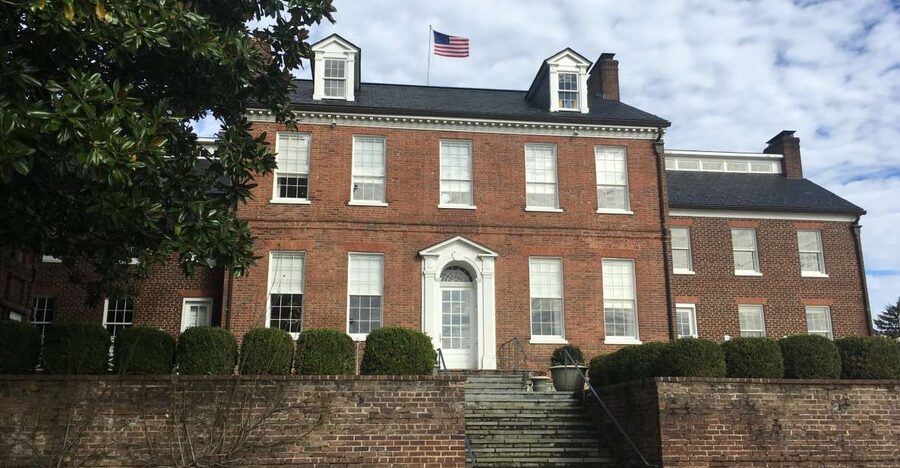
The route continues to the Laird-Dunlop House and the Newton D. Baker House. These stops bring the focus back to domestic architecture and the people who lived in Georgetown’s prominent residences.
You are not simply looking at one house after another. The guide explains the stories behind these places, using buildings as evidence of changing fortunes and social life. This is where the neighborhood’s move from working port to affluent district becomes easier to picture.
The Lydia English Seminary School for Girls adds another angle. It was a boarding school serving the upper class, and its presence points to the role Georgetown played in education as well as business and residence.
I like this part because it broadens the idea of architecture. A school building tells you about the families who could afford such education, the expectations placed on young women, and the kind of community Georgetown had become. You get more than a row of attractive facades.
As with any walking tour, the exact time spent at each building depends on the guide and group. If you want a long photo stop at every house, you may find the steady route a little quick. One past participant specifically wished the group had waited a few more minutes for pictures, so keep your camera ready and take photos during the explanations when practical.
The Double House, Christ Church, and Hyde-Addison School
Next comes the Grafton Tyler Double House, followed by Christ Episcopal Church and the Hyde-Addison School. These stops continue the tour’s broad look at how Georgetown served different parts of community life.
The Grafton Tyler Double House is particularly useful for understanding how a building can reflect social arrangements as well as style. The name itself hints at a structure with two residences, and the guide uses its story to explain another piece of Georgetown’s past.
Christ Episcopal Church adds a religious landmark to the route. Hyde-Addison School returns the focus to public education. Taken together, these stops help you see the neighborhood as a lived-in district, not a museum of private homes.
The strength of a local guide shows here. A self-guided walk can tell you when a building was built, if you have the right notes. It is harder to explain why that building mattered to the people around it, or connect it to the houses and institutions you have already seen.
The supplied feedback on this tour repeatedly highlights clear, well-informed guiding. I would put that at the center of the experience. The architecture is the hook, but the stories are what make the two and a half hours worthwhile.
A few more architecture tours around the USA worth a look
- Chicago Architecture River Cruise
★ 5.0 · 15,756 reviews - Chicago River 90-Minute Architecture Tour
★ 4.5 · 9,629 reviews - Chicago River: 1.5-Hour Guided Architecture Cruise
★ 4.8 · 8,046 reviews - Chicago Architecture Center River Cruise aboard First Lady
★ 5.0 · 5,536 reviews
Yellow Tavern and the pastel houses of Pomander Walk
The historic Yellow Tavern, also called the White Horse Tavern, brings a more social note to the route. Taverns help you imagine Georgetown as a place where people met, traded news, ate, and conducted business, not just a district of quiet residential streets.
The double name is a small but memorable detail. It also gives the guide a chance to explain how one local place could be known by more than one name over time.
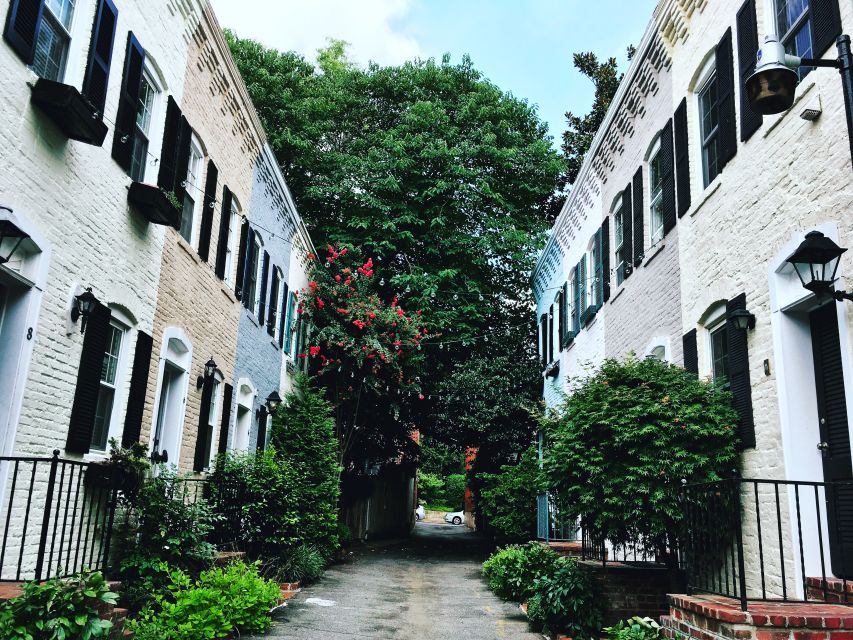
Then you pass through Pomander Walk, where tiny pastel row houses create one of the tour’s most distinctive visual moments. After the larger houses and institutional buildings, these compact homes offer a change in scale and color.
This is likely one of the best parts of the route for photographs. Still, remember that the tour is designed to keep moving. You can take in the details, but the guide may not pause for an extended photo session at every attractive corner.
Pomander Walk also shows why an architecture tour is more useful than a simple list of famous addresses. The appeal comes from the contrast between forms: grand houses, schools, churches, taverns, and small colorful row homes all within the same neighborhood.
Alexander Graham Bell and Georgetown’s academic landmarks
The story changes direction when you reach the place where Alexander Graham Bell founded Volta Laboratory. This stop adds science and invention to a route that has already covered trade, domestic life, religion, education, and hospitality.
It is a good reminder that Georgetown’s past is not limited to eighteenth and nineteenth century streetscapes. The neighborhood also provided a setting for serious academic and technical work.
The route then takes in Georgetown Preparatory School, Healy Hall, and the University Library. These academic destinations give you a stronger sense of the educational institutions that shape the area’s identity.
Healy Hall is likely to draw your eye, but do not let the most imposing building make you ignore the surrounding details. The value of the stop is the group of places together. You see how formal academic buildings fit into the neighborhood and how Georgetown’s educational role became part of its public image.
You also get a look at campus nightlife at The Tombs. That detail keeps the university section from becoming too formal. It connects the grand halls and libraries with the everyday student life that continues around them.
The university portion may be especially useful if you are interested in how a working neighborhood and an academic district overlap. It also breaks up the house-by-house rhythm with larger institutional buildings and a different kind of local story.
The Car Barn, Key Memorial, and Cady’s Alley
The Car Barn is another strong stop because it links architecture with transportation. It was a streetcar depot and has since been renovated, giving you a clear example of an old structure finding a new use.
Adaptive reuse can be hard to understand from a photograph. Seeing a former transport building as part of present-day Georgetown makes the idea more concrete. You can consider how an old building survives by changing purpose rather than remaining frozen in its original role.
The route then reaches the Francis Scott Key Memorial. This adds a notable public memorial to the walk and keeps the focus on people connected with the wider Washington story.
Cady’s Alley follows, offering another shift in atmosphere and building use. By this stage, you have seen residential streets, religious sites, schools, university buildings, a tavern, and a former depot. Cady’s Alley helps round out that picture with a more contemporary commercial setting.
I appreciate this variety because it prevents the tour from becoming a narrow lesson in one architectural style. You get a broad look at how Georgetown’s buildings have served different needs across time.
Ending at the Georgetown Waterfront
The tour concludes at the Georgetown Waterfront. This is a satisfying finish because the route began with the C&O Canal and ends beside the Potomac, bringing the water story full circle.
The waterfront also gives you a natural place to pause after two miles of walking. You can use the ending to review the route in your mind, take more photographs, or continue exploring Georgetown on your own.
The tour does not include a meal, transport, or another scheduled activity after the waterfront. That is useful to know when planning your day. Treat the walk as a focused half-day activity, then decide what you want to do next.
The ending location is practical for anyone who wants to remain in Georgetown. It also means you are not returned to the starting point, so plan your next move with that in mind. The supplied details identify the waterfront as the final stop but do not promise transport back to Baked & Wired.
Is $43 a fair price for 150 minutes?
At $43 per person, this tour is priced above a casual self-guided stroll but below many full-day sightseeing activities. The value depends on how much you want from the neighborhood.
If you only want to wander, photograph colorful houses, and stop for coffee, you can explore Georgetown without paying for a guide. But you will need to do the research yourself to connect the canal, historic houses, seminary, tavern, university, and waterfront.
The fee pays for a professional local guide and a planned route covering a wide range of sites. I see the strongest value in the interpretation. Guides such as Sam and Ellyn have been praised for making the architecture clear and adding fun facts, which can turn familiar streets into a more meaningful walk.
The tour also offers free cancellation up to 24 hours before departure and lets you reserve while paying later. That flexibility is useful when your Washington schedule is still changing, though you should still confirm the available starting time when booking.
Weather, shoes, and the real walking commitment
The route covers about two miles at a leisurely pace. That is not a punishing distance, but the 150-minute duration means you will spend a long time standing and walking on city streets.
Wear comfortable shoes. Bring water, and dress for the weather. The tour runs rain or shine unless conditions become dangerous, so do not assume a light forecast change will cancel it.
There is no promise of shelter at every stop. If rain is possible, carry suitable protection. In hot weather, water matters more than the modest distance suggests because the tour includes frequent pauses and outdoor explanations.
The pace should suit you if you like time to look around and hear stories. It may not suit you if you want a rapid checklist of landmarks or long private stops for photography. The guide controls the route and the group leaves on time.
Who will get the most from this walk?
I would choose this tour if you want Georgetown’s buildings explained rather than simply photographed. It is a good fit for first-time visitors, architecture fans, history-minded walkers, and anyone who wants a clear introduction to the neighborhood in one outing.
It also suits people who enjoy variety. You see the canal, homes, a girls’ school, church, public school, tavern, row houses, laboratory site, academic buildings, a nightlife spot, former streetcar depot, memorial, alley, and waterfront.
Families and mixed-interest groups may find that range helpful because the route is not focused on one narrow subject. The amusing facts noted by past customers may also keep the history moving for people who do not usually seek out architecture tours.
I would hesitate if you dislike outdoor walking, need a fully weatherproof activity, or want guaranteed time for careful photography. The tour runs in changing conditions, covers two miles, and leaves on schedule.
Should you book the Georgetown Architecture Walking Tour?
Book it if you want Georgetown explained through its buildings and you value a local guide who can connect small details to the neighborhood’s larger story. The route is varied, the pace is described as leisurely, and the finish at the waterfront gives the afternoon a natural endpoint.
The strongest reason to go is the interpretation. You could pass the Yellow Tavern, Pomander Walk, Healy Hall, or the Car Barn on your own and see attractive buildings. With the tour, you get the stories linking Georgetown’s working-port past to its schools, homes, university, and modern uses.
Skip it if your priority is an unhurried photo walk or an indoor activity. For most people who can manage two miles outdoors, $43 is a reasonable price for two and a half hours of focused local history, especially with the option to cancel up to 24 hours ahead.
FAQ
How long is the Georgetown Architecture Walking Tour?
The tour lasts 150 minutes, or two and a half hours.
How far do you walk?
The tour involves about 2 miles of walking at a leisurely pace.
Where does the tour meet?
Meet your guide outside Baked & Wired in Georgetown.
How do I identify the guide?
The guide will be wearing a DC Design Tour T-shirt.
What language is the tour conducted in?
The live guided tour is conducted in English.
What does the tour include?
The price includes a professional local guide.
What should I bring?
Bring comfortable shoes, water, and clothing suitable for the weather.
Does the tour run in bad weather?
The tour operates rain or shine unless conditions are dangerous.
Can I cancel for a refund?
You can cancel up to 24 hours in advance for a full refund. You can also reserve now and pay later.
Just added around the USA
- Wilmington History and Architecture Tour★ 4.8 · 18 reviews
- New Orleans : Garden District Architecture Walking tour★ 4.8 · 5 reviews
- Washington DC: Dupont Circle & Embassy Row Architecture Tour★ 5.0 · 6 reviews
- Tulsa: Art Deco Walking Tour of Tulsa★ 5.0 · 8 reviews
- Castle to Capitol: Museums of the National Mall Architecture Tour★ 4.5 · 9 reviews
- Private Colonial Williamsburg Architectural Tour★ 5.0 · 5 reviews
- Iconic Capitol Hill Architectural Walking Tour★ 5.0 · 21 reviews
- Monuments and Memorials Architectural Walking Tour★ 5.0 · 17 reviews
Walking Tours, compared.
The Official Art Deco Walking Tour by The Miami Design Preservation League
Read our review →
Barcelona: Gothic Quarter Ghosts and Legends Walking Tour
Read our review →
Barcelona: Old Town and Gothic Quarter Walking Tour
Read our review →
Lecce: Baroque Architecture and Underground Walking Tour
Read our review →
Chicago in a Day: Food, History & Architecture Walking Tour
Read our review →

Ramblas, Old Town, Gothic and Gaudi Architecture Walking Tour
Read our review →
Chicago’s Secret Interiors Architectural Walking Tour
Read our review →Browse the lists this tour appears in