
Review · BRUSSELS
Brussels 3-Hour Guided Art Nouveau Tour
Brussels saves some of its best architecture for ordinary streets. This tour takes you from the Grand-Place to the Bailli district, where iron curves, stained glass, carved stone, and flowing woodwork turn townhouses into works of art. Guides such as Maria bring the buildings to life with city history, design clues, and even printed interior photos when you can only see the façades.
I like two things right away. First, the tour gets you beyond the usual central Brussels route into a neighborhood most short city walks skip. Second, it explains why Art Nouveau looks the way it does, linking new building methods with social and political change. The main drawback is clear: most buildings are viewed from outside, and the walk includes a tram ride and some uphill walking before the architecture really gathers pace.
Key points
- Hotel Tassel begins the architectural story: Victor Horta’s 1893 to 1894 townhouse shows how Art Nouveau broke away from stiff, historic designs.
- The Bailli district has the strongest concentration: You see a string of notable homes rather than one isolated landmark.
- Guides add interior details: Printed photographs help you understand rooms you cannot enter during the tour.
- The tour covers more than decoration: Expect discussion of iron, glass, wood, stone, city growth, and political life.
- The final stop is the Victor Horta Museum: Plan ahead if you want to visit inside after the walk.
- The $35 price is fair for guided context: It is best value for visitors who want help spotting details rather than simply photographing façades.
Why Brussels is the right city for an Art Nouveau walk
Brussels is closely tied to the early development of Art Nouveau, and this tour gives you a useful introduction without treating the style as a parade of pretty doorways. You learn how architects used iron, glass, wood, and stone in fresh ways, often blending structure and decoration into one design.
That distinction matters. An Art Nouveau building is not simply an old house with fancy trim. Curving lines, plant forms, unusual staircases, colored glass, metalwork, and carefully matched materials were part of a larger attempt to create a modern style for modern city life.
Your guide also puts the buildings into their social setting. The strongest tours on this route connect architecture with the people who commissioned the houses, the architects who designed them, and the period’s political currents. Maria has been especially praised for making those links clear, while also bringing her own research and interior photographs.
You meet at the Grand-Place at 10:00. Look for the guide holding a white umbrella. That simple marker matters in a busy square, especially if several walking tours are gathering nearby.
More Art Nouveau tours in the world:
- Walking Tour of Riga’s Beautiful Art Nouveau Architecture
★ 4.8 · 20 reviews - Riga’s Architecture: A self-guided audio tour of the city’s art nouveau history
★ 5.0 · 3 reviews - Mexico City origins and architecture: Art Nouveau, Deco,Eclectic
★ 3.0 · 2 reviews
From Grand-Place to the Bailli district
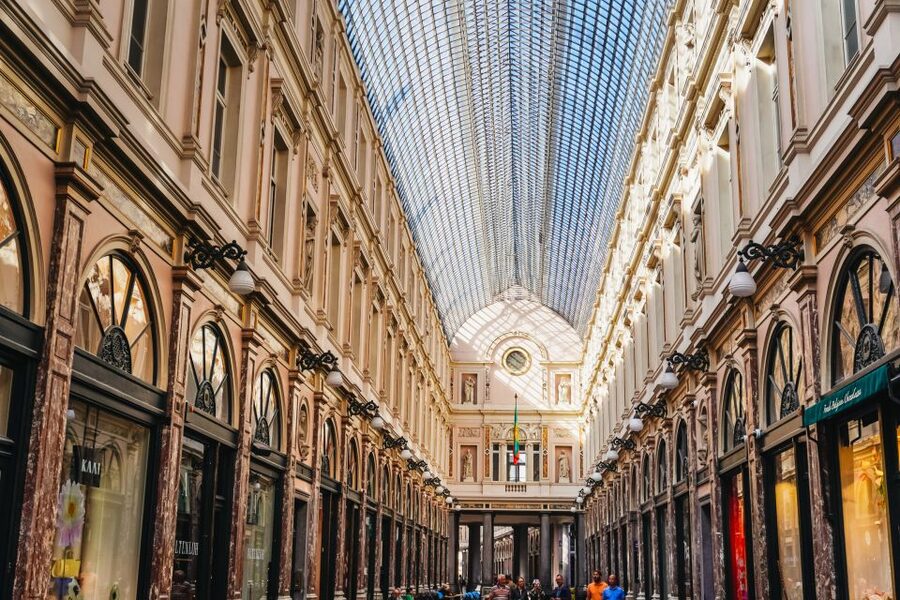
The tour begins in central Brussels, but the main architectural portion is not concentrated around the Grand-Place. You take public transport toward Bailli, a district described as a village within the city because of its local feel and large number of Art Nouveau buildings.
This change of setting is part of the experience. You move from Brussels’s grand historic center to residential streets where the architecture is woven into everyday city life. It also means the outing is not a museum visit with a fixed collection. You are walking through active neighborhoods, looking carefully at façades that people still use as homes and businesses.
The early section includes some uphill walking. If you prefer a flat stroll, take the guide’s three-hour timing seriously and wear comfortable shoes. One account found that the first hour had less Art Nouveau than expected, with the route becoming more rewarding as it reached the main cluster. That is useful context: the tour builds toward its strongest section rather than delivering famous façades immediately.
The tram ride is also part of the route, not an optional scenic extra. Transportation costs are not included, so check the exact fare arrangements before setting out. The activity details mention train transportation as excluded, while the itinerary specifically refers to a tram, so it is sensible to budget separately for public transport.
Old England House and the opening design lesson
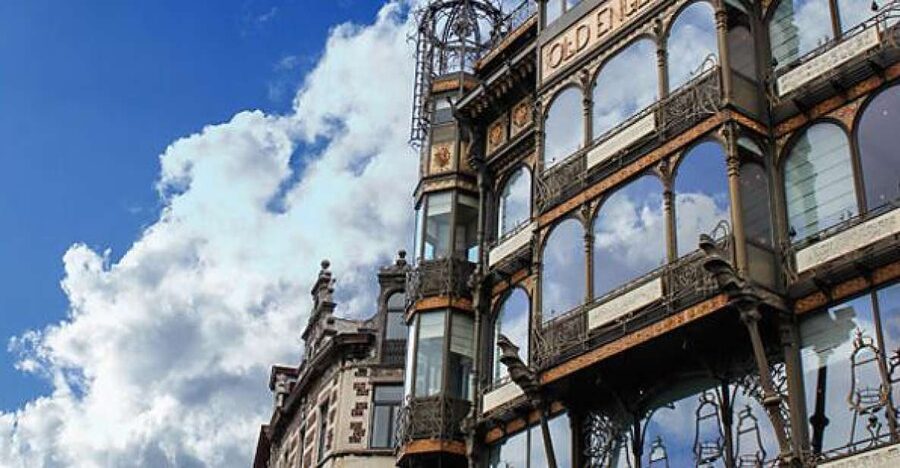
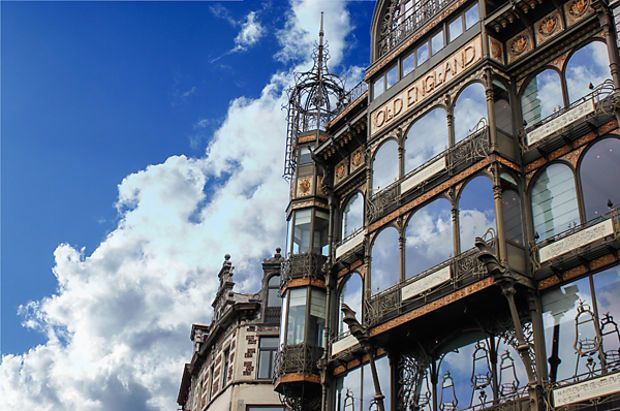
One of the first listed sights is Old England House, now associated with the Musical Instrument Museum. Its metalwork and decorative façade make it a good early example of how Art Nouveau could be playful without losing its practical purpose.
Here, your guide begins showing you how to read the style. Instead of admiring a building only as a whole, you learn to look at the relationship between its materials and details. Iron may frame a balcony, glass may bring color into a stairwell, and stone may be shaped to echo the curves found in the metalwork.
You should not expect a long interior visit at this stop. The tour is mainly an exterior route, so the value comes from the guide’s explanation and your ability to examine the façade at close range.
Hotel Tassel, where Victor Horta changed the townhouse
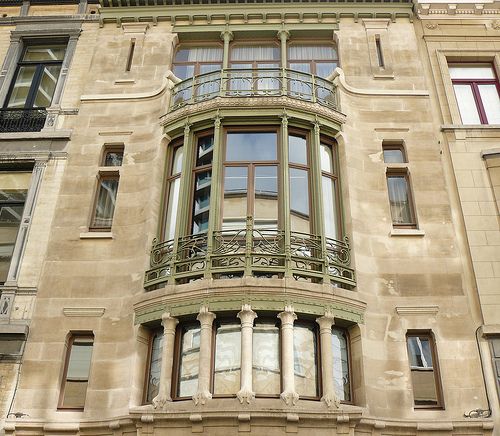
Hotel Tassel is the architectural anchor of the route. Victor Horta built it in 1893 and 1894, and it is one of the key buildings for understanding how Art Nouveau took shape in Brussels.
The important point is not simply that the house is old or ornate. Horta treated the building as a complete design, bringing structure, decoration, and movement together. The tour explains how materials were combined into an overall effect rather than applied as surface decoration at the end.
Because you normally view Hotel Tassel from outside, this is where interior photographs are especially useful. A guide who carries images of staircases, rooms, or decorative details can help you picture the full design instead of judging the building by its street front alone.
If you are particularly interested in Horta, this stop makes the Victor Horta Museum at the end of the route more meaningful. You have already heard the design principles and seen one of his major projects before reaching his former home and studio.
A few more architecture tours around the world worth a look
- Munich 3-Hour Segway Tour: Nazi Munich & Royal Architecture
★ 4.9 · 194 reviews - 3 Hour Midtown Manhattan Architectural Tour
★ 5.0 · 81 reviews - Prague 3-Hour Architectural Tour
★ 4.7 · 18 reviews - Porto Tour: Street Art & Architecture Experience 3h
★ 5.0 · 4 reviews
The Van Rysselberghe and Otlet houses
The Van Rysselberghe House, built by Octave Van Rysselberghe in 1912, shows that Brussels Art Nouveau did not end with the first wave of experiments. Its later date lets your guide explain how the movement developed over time.
Hotel Otlet was built between 1894 and 1898 by Octave Van Rysselberghe and Henry van de Velde. The combination of architects gives the stop extra interest, since you are not looking only at one designer’s personal signature. You can listen for how the building handles line, proportion, entrance details, and the balance between decoration and function.
These houses also show why this tour suits people who already know a little about architecture. You get several examples close together, making it easier to compare methods. The guide can point out details that look similar at first but serve different visual or structural roles.
The limitation remains access. You are not touring the interiors of these private buildings. If your priority is walking through Art Nouveau rooms, this outing will feel incomplete. If your goal is to understand the street architecture and see a wide range of façades, the route works much better.
Hotel Goblet d’Alviella and Paul Hankar’s bold approach
Hotel Goblet d’Alviella, built by Octave Van Rysselberghe in 1882, adds another early example to the route. Its inclusion helps place the later buildings in sequence and gives you a chance to consider how quickly Brussels architecture was changing.
The tour then turns to Paul Hankar, including Hotel Ciamberlani from 1897 and the home of painter René Janssens from 1898. Hankar’s work is useful for showing that Art Nouveau was not one fixed formula. Architects could share a taste for organic lines and new materials while producing very different façades.
The Ciamberlani House is named for the painter Albert Ciamberlani, and the René Janssens house connects the architecture to Brussels’s artistic world. These are not just buildings to tick off. They help explain the close relationship between architects, painters, designers, and patrons at the time.
The route also points out architect Armand Van Waesberghe and the private home of Paul Hankar. Seeing an architect’s own residence can be especially revealing, since it offers a glimpse of the ideas he chose to live with rather than only the commissions he created for others.
The Beukman House and the value of looking slowly
The Beukman House, built by Albert Roosenboom in 1900, is another chance to compare designers. By this point in the walk, you have seen enough buildings for small differences to become easier to spot.
This is where a good guide earns the price of the tour. On your own, you might photograph the most obvious doorway and move on. With clear instruction, you begin noticing windows, balconies, metal railings, lettering, color, and the way upper floors relate to the street.
The tour is not rushed in the manner of a quick photo stop. However, group size and language can affect the pace. If the guide presents everything in English and French, the same explanation may be repeated, making the outing longer. That can be tiring, but it also means the guide is trying to give every person a fair chance to follow along.
Spanish, English, and French are offered. If you are joining a multilingual group, expect a little more time at each stop.
Ending at the Victor Horta Museum
The route finishes in front of the Victor Horta Museum, in the former home and studio of the architect. This is a smart ending because the museum provides the interior experience that the street walk generally cannot.
Admission is not included, and you should arrange your museum ticket separately if you want to go inside after the tour. One of the most practical lessons from the route is to pre-book the museum in advance. The tour can end at the door, but that does not guarantee that you will be able to enter immediately.
Even if you do not visit the museum, finishing there gives the tour a clear endpoint. You have moved from public streets and outside façades to the architect’s own domestic and working environment. If you do enter, the earlier discussion of materials, staircases, decorative lines, and interior unity should make the museum easier to appreciate.
What the $35 price really buys you
At $35 per person, this is reasonably priced for a three-hour specialist walk. You are paying less for entry tickets than for the guide’s ability to connect separate buildings into a story.
The value is strongest if you would otherwise wander through the Bailli district without knowing which homes matter or what to look for. The route includes several named architects and buildings, plus the transport between central Brussels and the residential district. A printed guidebook can show you addresses, but it cannot answer questions as you walk.
The price is less attractive if you want indoor access. Museum admission is separate, and the tour does not include visits inside the private houses. You should think of it as an architectural orientation walk, not a series of house museums.
The activity allows free cancellation up to 24 hours before departure and offers reserve now, pay later booking. It is wheelchair accessible, though the uphill sections, tram transfer, and street conditions are still worth considering for your own comfort.
Who should book this Brussels architecture tour?
I would recommend it to anyone who likes buildings but wants help reading them. It is especially useful for first-time visitors who know Victor Horta’s name but do not yet understand how Belgian Art Nouveau differs from Art Deco or older historic styles.
It also suits repeat visitors who have already seen the Grand-Place and central Brussels. The Bailli district takes you into a part of the city that standard sightseeing routes often miss.
You should consider another option if you need a fully indoor experience, dislike public transport, or want a short, flat walk with immediate highlights. The first part can feel like a warm-up, and the route does not cover every Art Nouveau house in Brussels.
Should you book the tour?
Book it if you want context, comparison, and a local route rather than a quick list of famous buildings. The strongest guides explain how iron, glass, wood, and stone work together, and they connect architecture with the city’s social and political life.
Go in knowing that the buildings are mostly viewed from the street. Wear comfortable shoes, budget for the tram, and reserve the Victor Horta Museum separately if you want to continue indoors. At $35, the tour is a solid choice for curious architecture fans and a useful first step into Brussels Art Nouveau.
FAQ
Where does the Brussels Art Nouveau tour begin?
The tour begins at the Grand-Place in Brussels at 10:00. The guide will be holding a white umbrella.
How long does the tour last?
The guided experience lasts three hours.
Which languages are available?
The tour is offered in Spanish, English, and French.
Does the tour include the Victor Horta Museum?
The tour ends in front of the Victor Horta Museum, but museum admission is not included.
Can I visit the Horta Museum after the tour?
You can plan to visit it after the walk, but you need to arrange and pay for admission separately. Booking ahead is recommended because reaching the museum does not guarantee immediate entry.
Does the tour go inside the Art Nouveau houses?
The listed route focuses mainly on viewing the buildings from outside. Interior photographs may be shown by the guide, but admission to the private houses is not included.
Is transportation included?
The route includes a tram ride from the Grand-Place area to the Bailli district. Transportation is not included in the price, so plan for a separate public transport fare.
Is the tour wheelchair accessible?
The activity is listed as wheelchair accessible.
What should I bring?
Wear comfortable shoes. The tour involves walking, including uphill sections, as well as a tram ride.
Just added around the world
- Wilmington History and Architecture Tour★ 4.8 · 18 reviews
- Washington, DC: Georgetown Architecture Walking Tour★ 5.0 · 8 reviews
- New Orleans : Garden District Architecture Walking tour★ 4.8 · 5 reviews
- Washington DC: Dupont Circle & Embassy Row Architecture Tour★ 5.0 · 6 reviews
- Vicenza: discovering the city of Palladio by e-bike★ 5.0 · 4 reviews
- Vicenza: Palladian Architecture Private Walking Tour★ 3.3 · 3 reviews
- Walk & Discover KL’s Architectural and Heritage Gems★ 5.0 · 7 reviews
- Unveiling Brno: History, Culture & Architectural Delights★ 5.0 · 2 reviews
Art Nouveau Tours, compared.
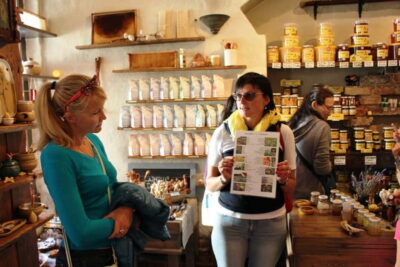
Riga: Old Town Walking Tour with Art Nouveau Highlights
Read our review →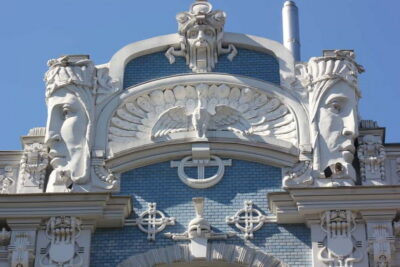
Riga: 2-Hour History of Art Nouveau Walking Tour
Read our review →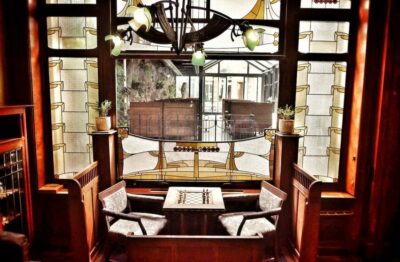
Brussels: Art Nouveau Pass – Entry to Three Locations
Read our review →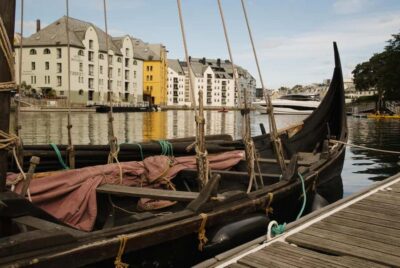
Small Group Tour in Ålesund: Art Nouveau, Sea Views & Insider Tips
Read our review →
Browse the lists this tour appears in