
Review · ARCHITECTURE TOURS
Belgrade: Space architecture tour – brutalist architecture
Belgrade’s brutalist architecture makes the city’s political past visible in concrete, glass, and huge geometric forms. This four-hour tour links the Avala Tower and Monument to the Unknown Hero with New Belgrade’s grand state buildings, so you see both the mountain setting and the city built to express Yugoslav power.
I like the clear mix of architecture and history, especially the chance to enter Avala Tower and look across Belgrade. I also like the small group, private van, and strong English-speaking guides, with Nemanja singled out for his warm manner and sharp explanations. The main drawback is that most major buildings are viewed from outside, since several are government or residential properties.
- Avala Tower combines mountain views with Yugoslav design and a dramatic postwar story.
- The Western Gate and Eastern Gate reveal two very different forms of brutalist housing.
- Ada Bridge gives you a close look at one of Belgrade’s major modern engineering projects.
- Sava Center and Palace of Serbia show how architecture served diplomacy and state power.
- A small group of no more than 10 keeps the tour easier to follow than a large coach outing.
- The four-hour route works best for architecture lovers who also want political and cultural context.
Why Belgrade’s concrete tells a political story
This is not simply a drive past unusual buildings. The route explains how architecture helped present Yugoslavia as modern, independent, and powerful after the Second World War.
Socialist Yugoslavia did not copy one single architectural style. Its architects worked with late modernism, brutalism, and structuralism, producing buildings that could feel severe, futuristic, or surprisingly elegant. You will see raw concrete and massive forms, but also glass, open interiors, unusual angles, and carefully planned public spaces.
I find that context important because brutalist buildings can look cold when seen without explanation. With a guide, the size and shape of each structure begin to make sense. A government building is not just large for the sake of being large. Its scale was meant to communicate order, authority, and the strength of a newly formed country.
The tour also gives you a useful contrast between Avala Mountain and New Belgrade. One part places Yugoslav symbolism in a wooded mountain setting. The other shows an urban project built on a huge scale, with offices, housing, bridges, and conference buildings spread across the flat area beside the Sava and Danube rivers.
Avala Mountain and the Monument to the Unknown Hero
After hotel pickup in Belgrade, you spend about 30 minutes in the van before reaching Avala Mountain. The ride matters because it takes you beyond the central city and gives the tour a change of pace before the dense architecture stops begin.
The first major visit is the Monument to the Unknown Hero. You have about 30 minutes for a guided visit, sightseeing, walking, and photographs.
The monument was designed to honor unidentified soldiers, and its setting on Avala gives it a solemn, ceremonial quality. It is a good opening stop because it introduces the way Yugoslav public design used scale, symmetry, and symbolism. You are not looking at an ordinary memorial tucked into a city square. The mountain location adds distance and drama.
Wear shoes you can walk in comfortably. This is partly a walking tour, and the ground around outdoor monuments may not feel as easy as a pavement stroll through central Belgrade. The tour operates in rain or shine, so bring suitable clothing rather than relying on perfect weather.
More Bauhaus and Brutalist tours in the world:
- London: Brutalist Architecture & History Walking Tour
★ 4.8 · 42 reviews - Le Corbusier’s Chandigarh : A Complete Architecture Tour
★ 4.7 · 25 reviews - Architecture of New Belgrade – Brutalism Decoded
★ 4.5 · 24 reviews
Looking over Belgrade from Avala Tower
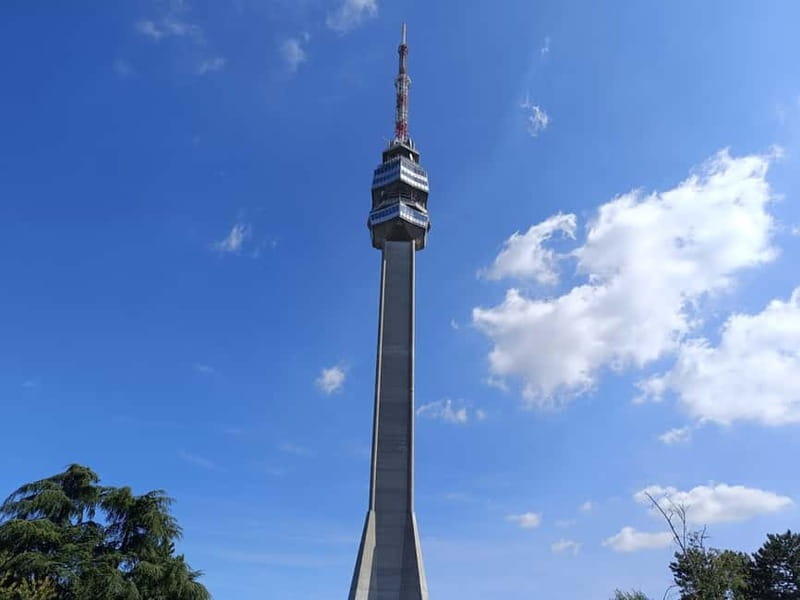
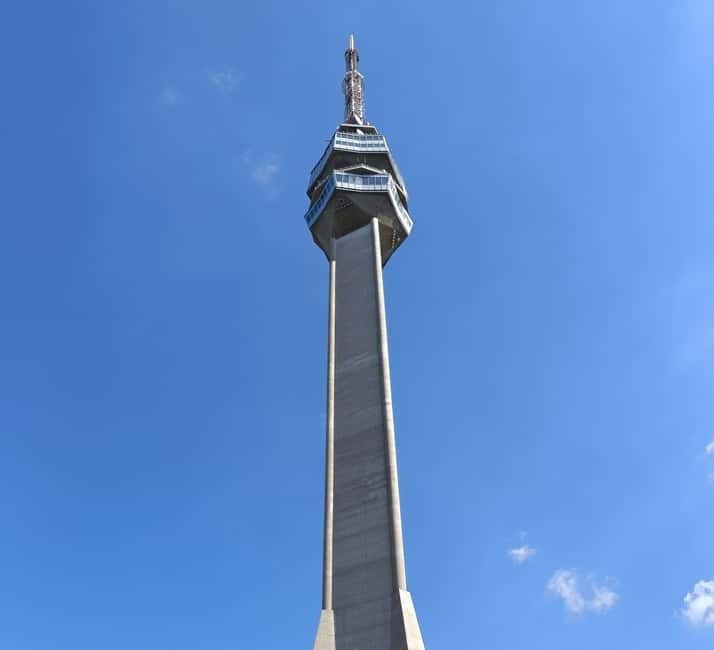
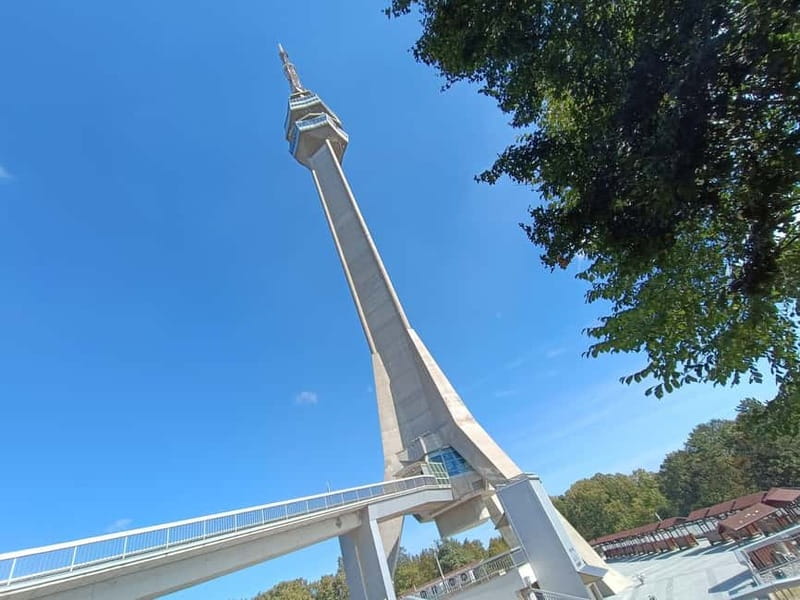
The next stop is Avala Tower, with around 30 minutes for a guided visit, photos, and sightseeing. Entry is included, which makes this more than a quick roadside photo stop.
The tower was destroyed during the NATO bombing in 1999 and rebuilt in 2010. That fact gives the structure a particular weight. You are seeing both a landmark of Yugoslav-era communications and a building that was brought back after destruction.
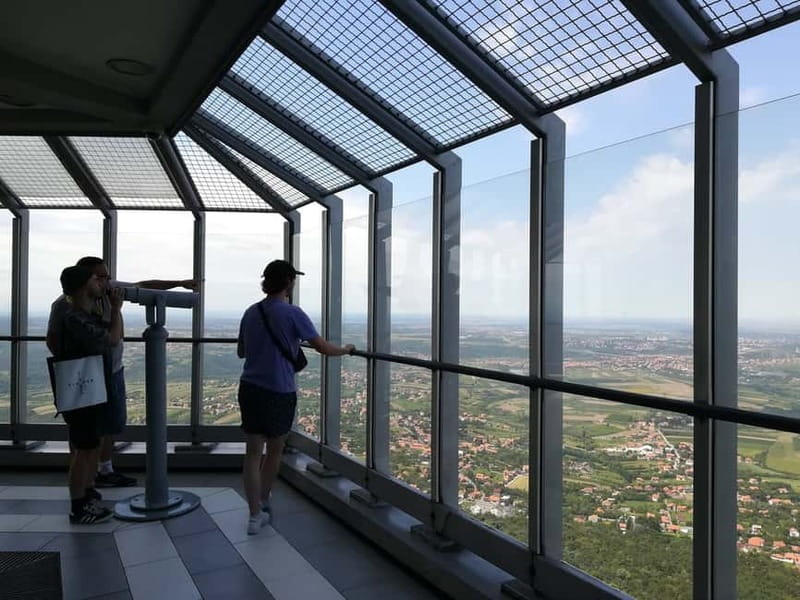
The observation deck offers a view over Belgrade and the surrounding area. How much you see depends on the weather, so keep expectations sensible on a gray or rainy day. The tower visit is still worthwhile for its design and story, but the wide view is at its best when the air is clear.
I especially like this stop because it puts the later city architecture into perspective. After looking down from the tower, you have a better sense of Belgrade’s scale and of how far New Belgrade extends. It also gives you a useful visual break from close-up concrete buildings.
Eastern Gate: three towers with a strong silhouette
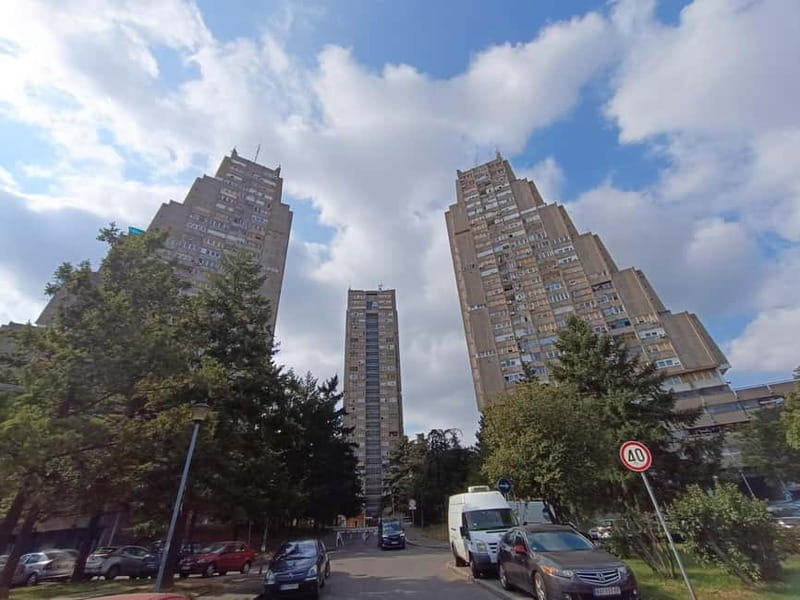
Back in the van, the route takes about 20 minutes to the Eastern Gate, also known as the Rudo buildings. You have roughly 20 minutes for a guided photo stop.
The Rudo buildings are residential towers built in a brutalist style. Their repeated forms create a powerful group silhouette, and they show how bold socialist-era design could be applied to ordinary housing rather than only to monuments or government offices.
This is an exterior visit, so you should not expect to enter the buildings. That limitation applies to several stops on the route, but it is understandable: some sites are active residential or government properties. The value here is in seeing the overall shape, the relationship between the towers, and the explanation of why the buildings look the way they do.
For photographers, this stop is useful because brutalism depends heavily on angles, repetition, and shadows. Your guide can also help you notice features that are easy to miss from a passing car.
Ada Bridge and the route across the Sava
The van then takes about 20 minutes to Ada Bridge. The visit itself is short, around 10 minutes, and is mainly for photographs.
Ada Bridge crosses the Sava River and is described as Europe’s largest single-pylon bridge. Its construction was shown on the Discovery Channel, a detail that helps explain its place in Belgrade’s modern engineering story.
This stop is different from the mountain and building visits. Here, the focus is on structure, engineering, and the way a bridge changes the view of a city. You will not spend a long time walking around the bridge, so think of it as a carefully chosen visual pause rather than a full bridge tour.
The crossing also carries you toward New Belgrade, where the tour shifts from individual landmarks to a much larger planned urban district.
A few more architecture tours around the world worth a look
- Chicago Architecture River Cruise
★ 5.0 · 15,756 reviews - Chicago River 90-Minute Architecture Tour
★ 4.5 · 9,629 reviews - Chicago River: 1.5-Hour Guided Architecture Cruise
★ 4.8 · 8,046 reviews - Chicago Architecture Center River Cruise aboard First Lady
★ 5.0 · 5,536 reviews
Sava Center and the architecture of international diplomacy
Sava Center receives about 10 minutes for photos. The building was created for the Conference on European Security and Cooperation held in Belgrade in 1977. It was the first and largest conference center in former Yugoslavia.
Its large polyhedral forms are the key feature to watch. Rather than presenting a simple rectangular block, the complex uses angular volumes and a structural design that gives it a more complex outline. Your guide can explain how the building was planned for international meetings and why its appearance suited Yugoslavia’s desire to present itself as a modern country with a place in world affairs.
The short visit is enough to grasp the exterior design, but not enough for an extended architectural study. If Sava Center is your main reason for booking, keep that in mind. The strength of the tour is the connection between several buildings, not long interior access at any one site.
New Belgrade by van
The route continues through New Belgrade with a scenic drive of about 10 minutes, followed by another drive later in the itinerary. This is where you see the area as a planned whole rather than a collection of isolated buildings.
New Belgrade was developed after the Second World War, and the district’s broad scale reflects that period. The planning and architecture were intended to represent a new social and political order. Even from the van, you can begin to read the relationship between housing, public buildings, major roads, and open areas.
The van is a practical advantage here. New Belgrade covers a wide area, and walking between every stop would take much longer than four hours. A small group also makes it easier to hear the guide and ask questions without competing with a full coach.
The Western Gate and Geneks twin towers
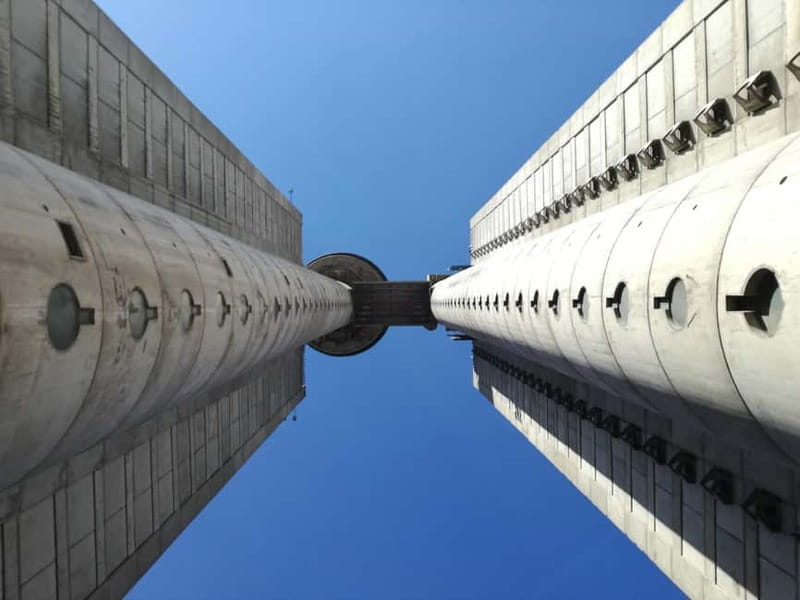
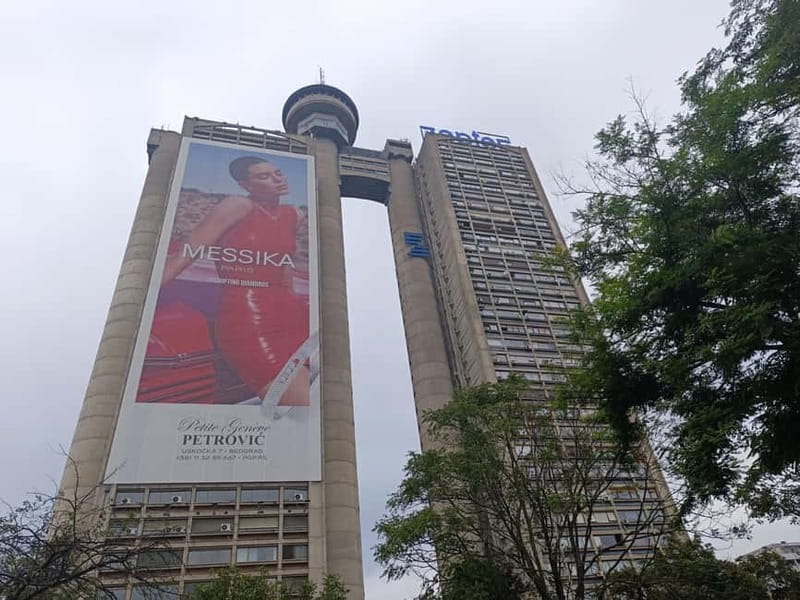
The Western Gate is one of the tour’s most memorable stops. You have about 30 minutes for photos, sightseeing, walking, and a guided explanation.
The complex is made up of twin towers connected by a bridge on the 26th floor. Known as the Geneks twin towers, it functions as one of the great gateway images of New Belgrade. Its height, unusual connection, and strong vertical lines make it easy to understand why it is associated with the entrance to the city.
This is a good example of architecture that is both practical and theatrical. The towers served a real urban purpose, but their shape also created a dramatic visual marker for people arriving in Belgrade.
Again, expect an exterior visit. You can study the form from ground level, but you are not promised entry into the towers. Bring a camera with enough space for wide shots, since the full structure is difficult to capture from very close up.
Palace of Serbia and the language of power
The final major stop is the Palace of Serbia, with around 20 minutes for photos, sightseeing, walking, and a guided talk.
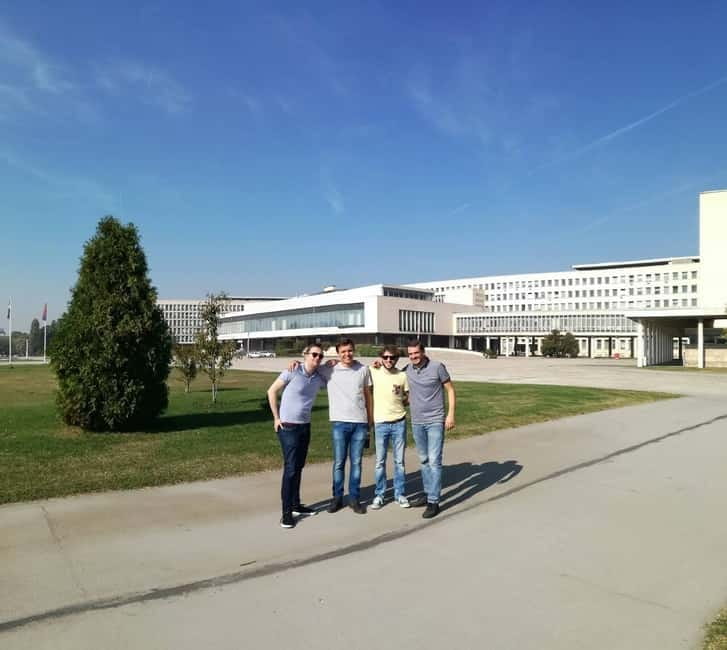
The building was formerly the Federal Executive Council, and it was the first project in New Belgrade after the Second World War. Its late modernist design is enormous but controlled, with a formal appearance suited to a national government headquarters.
This is perhaps the clearest place to think about architecture as political language. The Palace of Serbia was designed to represent the ruling system, not just to house offices. Its size and order suggest stability, unity, and official authority.
You will view the building from outside. That is a limitation, but the exterior offers plenty to discuss. The point is not simply to admire a façade. It is to ask what a government wants its buildings to say, and how those messages change when the political system changes.
What the $88 price includes
At $88 per person, this tour is priced as a guided half-day outing rather than a basic city sightseeing ride. The cost includes hotel pickup and drop-off, private transportation, an English-speaking professional guide, and the Avala Tower entry ticket.
I think the value is strongest if you want several distant sites in one morning or afternoon. Avala Mountain sits away from the main central sights, and New Belgrade’s buildings are spread across a large area. Organizing the same route yourself would require more transport planning and would not give you the architectural interpretation.
Food and drinks are not included, but the four-hour duration is short enough that this is not a major issue. Eat before pickup or plan your meal after returning to Belgrade.
The small-group limit is 10 people. That is large enough to keep the price lower than a fully private one-to-one tour, while still giving you a better chance to hear the guide than you would on a large coach. The most praised quality is the guiding. Nemanja is noted for his friendly, engaging explanations, and other feedback highlights guides who bring strong background knowledge and genuine enthusiasm to the subject.
Who should book this architecture tour?
I would choose this tour if you have already seen central Belgrade and want to understand the city’s Yugoslav period through buildings and public space. It is also a good fit if you have only a few days in Serbia and want to combine a mountain outing with a concentrated look at New Belgrade.
You do not need a formal architecture background. The guide explains the buildings in relation to history and ideology, so you can follow the tour even if brutalism and structuralism are new to you.
You may want to skip it if your main goal is interior access. The major stops are largely exterior visits, and some buildings cannot reasonably be opened to a tour group because they are residential or government properties.
Plan for walking at the monument, tower, gates, and Palace of Serbia. The route runs in all weather, and the Avala view can be limited by clouds or rain. Free cancellation is available up to 24 hours before departure, and you can reserve while paying later, which helps if your Belgrade schedule is still shifting.
Should you book it?
Book this tour if you want the story behind Belgrade’s concrete giants, not just a list of photo stops. The strongest reasons are the range of sites, the Avala Tower viewpoint, the efficient van route, and the guides’ ability to connect design with Yugoslav politics.
The main tradeoff is simple: you see many buildings from outside, and some visits are brief. For an architecture enthusiast who values context and variety, that is a fair exchange. For someone seeking long interior tours, it will feel limited. At $88, I consider it good value when you want a focused introduction to Belgrade’s brutalist and late modernist architecture without spending the day arranging transport.
FAQ
How long does the Belgrade brutalist architecture tour last?
The tour lasts four hours, including transportation between Belgrade, Avala Mountain, and New Belgrade.
What language is the tour conducted in?
The live tour guide speaks English.
Is hotel pickup included?
Yes. Hotel pickup and drop-off in Belgrade are included. You should wait in your hotel lobby five minutes before the scheduled pickup time.
Is transportation included?
Yes. The tour uses private transportation, with van rides between the stops.
Is entry to Avala Tower included?
Yes. The entry ticket to Avala Tower is included in the price.
Will I be able to go inside all the buildings?
No. Most stops are exterior visits, and some buildings are residential or government properties. The tour focuses on their design, history, and setting.
Does the tour include food or drinks?
No. Food and drinks are not included.
Does the tour operate in bad weather?
Yes. The tour takes place rain or shine. The view from Avala Tower depends on weather conditions.
How large is the group?
The group is limited to 10 participants.
Just added around the world
- Wilmington History and Architecture Tour★ 4.8 · 18 reviews
- New Orleans : Garden District Architecture Walking tour★ 4.8 · 5 reviews
- Washington, DC: Georgetown Architecture Walking Tour★ 5.0 · 8 reviews
- Washington DC: Dupont Circle & Embassy Row Architecture Tour★ 5.0 · 6 reviews
- Vicenza: discovering the city of Palladio by e-bike★ 5.0 · 4 reviews
- Vicenza: Palladian Architecture Private Walking Tour★ 3.3 · 3 reviews
- Walk & Discover KL’s Architectural and Heritage Gems★ 5.0 · 7 reviews
- Unveiling Brno: History, Culture & Architectural Delights★ 5.0 · 2 reviews
Bauhaus and Brutalist Architecture Tours, compared.
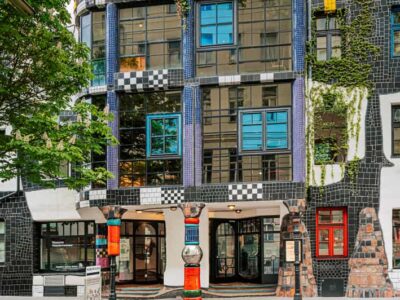
Vienna: Tickets for Kunst Haus Wien: Museum Hundertwasser
Read our review →
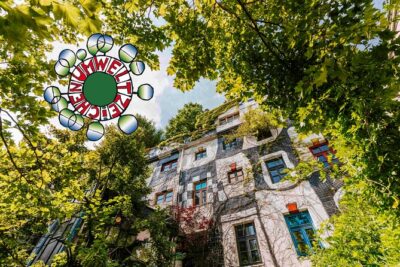
Entrance tickets for the KunstHausWien. Museum Hundertwasser
Read our review →
Brutalist Tbilisi: Urban exploration and untold stories
Read our review →
London: Brutalist Architecture & History Walking Tour
Read our review →
FALLINGWATER – America’s UNESCO World Heritage Masterpiece!
Read our review →
Le Corbusier’s Chandigarh : A Complete Architecture Tour
Read our review →Browse the lists this tour appears in