
Review · ARCHITECTURE TOURS
Architecture of New Belgrade – Brutalism Decoded
New Belgrade is where Belgrade’s grand socialist experiment becomes easiest to read. This private tour connects polished marble, giant concrete forms, Non-Aligned Movement history, and ordinary apartment life, so you see more than striking buildings. You learn why this planned district looks the way it does.
I like the close look at Genex Tower, one of the city’s most memorable landmarks, and the stop in Block 23, where architecture meets daily life. I also like the small group format: your guide can focus on your questions instead of delivering a fixed speech to a crowd.
The main caution is timing. The tour is advertised at about two and a half hours, but one critical account described an experience lasting under two hours. The itinerary also includes several short stops, so this is a brisk architectural introduction, not an exhaustive examination of every building.
Key points to know before booking
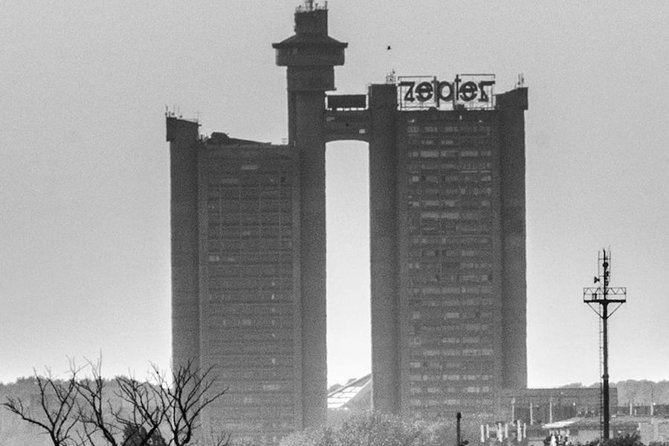
- Genex Tower is the visual star: See the Western City Gate up close and hear why it mattered in Balkan architecture.
- Block 23 adds a human scale: Learn how apartments, a school, kindergarten, sports courts, and shops were planned together.
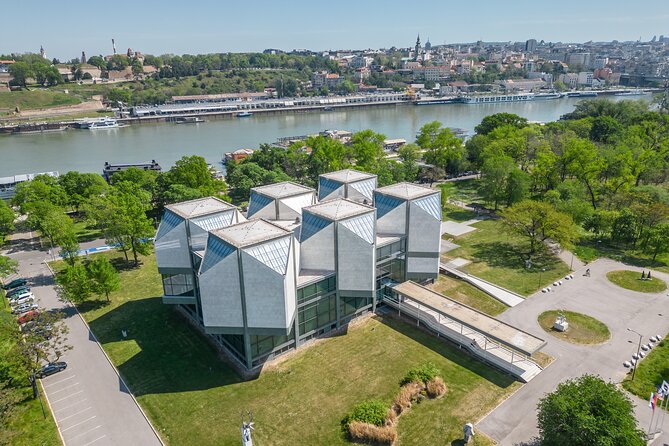
- The Museum of Contemporary Art starts the story: Its 1960s design uses valuable marble in a way that challenges familiar ideas about socialist buildings.
- The Park of Friendship links design and diplomacy: Tree planting by heads of state recalls the founding of the Non-Aligned Movement in Belgrade.
- It is a private English-language tour: Only your group takes part, which allows a more personal conversation.
- The route ends at Sava Center: The final stop is a working congress complex with notable interior design, not just an exterior photo stop.
Why New Belgrade makes a good architecture tour
Old Belgrade gathers around hills, fortress walls, cafés, and older streets. New Belgrade is different. It was planned on flatter ground as a modern district of wide spaces, large housing blocks, public institutions, and bold civic buildings.
That change in setting matters. Here, architecture was meant to organize a whole society. Buildings were not isolated works of art. They were tied to transport, schools, shopping, sports, work, and public life.
The tour helps you read that larger idea. You are not simply shown a concrete tower and told when it was built. You hear how Yugoslavia’s political position influenced design, how the country moved away from Stalin’s model, and how the ideals of the 1960s, 1970s, and 1980s later met the harder realities of the 1990s.
The experience is especially useful if you have already seen Belgrade’s historic center and want a different side of the city. It is also a good fit if you enjoy architecture but do not want a lecture filled only with technical terms. The strongest parts connect structure to people.
More Bauhaus and Brutalist tours in the world:
- London: Brutalist Architecture & History Walking Tour
★ 4.8 · 42 reviews - Le Corbusier’s Chandigarh : A Complete Architecture Tour
★ 4.7 · 25 reviews - Secret Split: Socialist Architecture & brutalism – Urban Utopia
★ 5.0 · 17 reviews
Starting at the Museum of Contemporary Art
Meet your guide in front of the Museum of Contemporary Art at Ušće. This is a sensible starting point because the museum introduces New Belgrade’s modernist language without beginning with its largest and most famous tower.
You spend about 20 minutes looking at the museum’s 1960s volumes. Its marble facades are an important detail. Precious stone is not what many people expect from a building associated with socialist Yugoslavia, and that contrast gives the guide a useful way to explain the period.
The building helps correct a common shortcut: socialist architecture was not one single style, and it was not always rough, cheap, or purely functional. Yugoslavia had its own political and cultural position, and its public buildings could be ambitious, polished, and internationally minded.
Admission to the museum is not included. The tour focuses on the exterior and architectural setting, so you should not assume that an interior museum visit forms part of the experience.
The Park of Friendship and Yugoslavia’s independent path
The next stop is the Park of Friendship, or Park Prijateljstva. You spend about 15 minutes here, and admission is free.
This is where the tour turns from architecture to diplomacy. The park recalls the Non-Aligned Movement, founded in Belgrade in 1961 by countries that sought a position outside the main Cold War blocs. Heads of state planted trees here as symbols of peace.
That detail gives New Belgrade a broader frame. The district was not merely a housing project on the edge of town. It belonged to a country trying to define its own place between East and West, and its public architecture often reflected that confidence.
Do not expect a long stop with many formal monuments to inspect. The value lies in the explanation and the connection between the park, Yugoslav politics, and the buildings you see afterward. If political history interests you, this short pause may be more useful than its modest length suggests.
The Government Building and a political change in concrete
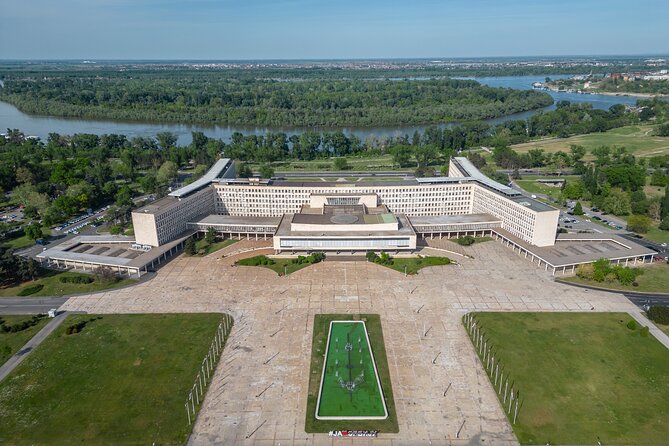
The route passes the large Government Building, an important marker of an earlier phase of Yugoslav politics. The building was under construction when Yugoslavia shifted away from Stalin’s influence.
That small piece of timing is worth hearing in front of the structure. A change in foreign policy was not just something discussed by politicians. It affected the country’s public image, institutions, and built environment.
The building is a drive-by point rather than one of the main extended stops. You should treat it as context between the park and Genex Tower, not as a separate visit with time for a full architectural inspection.
A few more architecture tours around the world worth a look
- Chicago Architecture River Cruise
★ 5.0 · 15,756 reviews - Chicago River 90-Minute Architecture Tour
★ 4.5 · 9,629 reviews - Chicago River: 1.5-Hour Guided Architecture Cruise
★ 4.8 · 8,046 reviews - Chicago Architecture Center River Cruise aboard First Lady
★ 5.0 · 5,536 reviews
Genex Tower, the Western City Gate
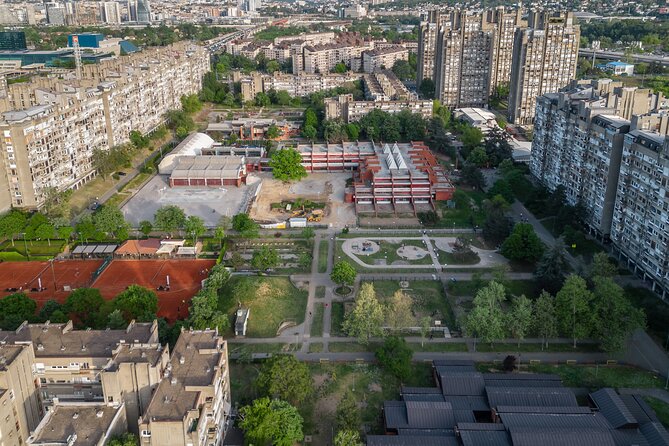
At Narodnih heroja 45, you get a close look at Genex Tower, also called the Western City Gate of Belgrade. The stop lasts about 20 minutes and costs nothing beyond the tour price.
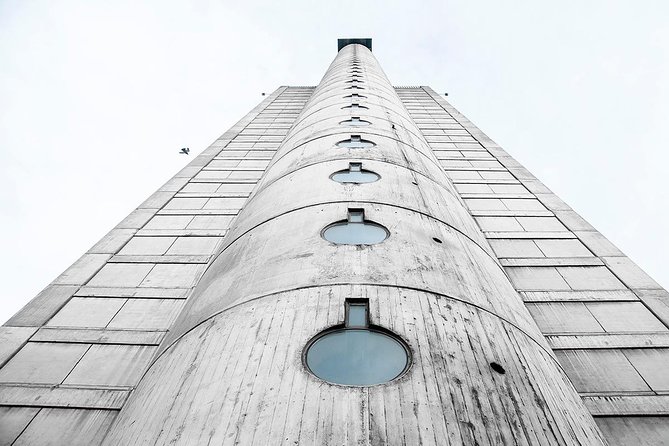
This is likely the most immediately memorable building on the route. The 30-floor structure has two tall elements linked by a high connection, giving it the force of a monumental gateway. Even if you know little about architecture, its shape is easy to understand from a distance and rewarding to inspect nearby.
The guide explains why Genex Tower earned attention in international architecture circles. It was built about 40 years ago and is described as the first smart building in the Balkans. The important point is not just the label. The tower represents a period when Yugoslavia wanted modern technology, bold design, and a clear public identity.
Take time to look beyond the silhouette. The building works both as an object and as a piece of city planning. It marks the western approach to Belgrade and gives New Belgrade a recognizable entrance.
The stop is outside, and the tour does not promise access to the tower. That is not a serious weakness for most people, since the exterior is the main attraction. Still, if you want to go inside every major building, this is not that kind of tour.
Sava Center and the feel of late-1970s ambition
Sava Center is the final major building stop and one of the route’s best examples of Yugoslav confidence. It was built at the end of the 1970s in record time and was the first facility of its type in this part of Europe.
The scale is huge, but the guide also points out interior solutions that remain surprisingly fresh after more than 40 years. That balance matters. The building is not presented only as a giant concrete shell. You get a chance to consider how its spaces were designed for conferences, public events, circulation, and large crowds.
Sava Center remains in use, which gives the stop a practical edge. You are looking at a functioning civic building rather than a frozen relic. Depending on access and the day’s arrangement, your attention may be split between the exterior and selected interior areas, so do not book expecting a full behind-the-scenes tour.
The experience ends at Sava Center, at Milentija Popovića 9. This makes the route convenient if you plan to continue around New Belgrade from there, though the tour does not include a return to the starting point.
Block 23 and the daily life behind the design
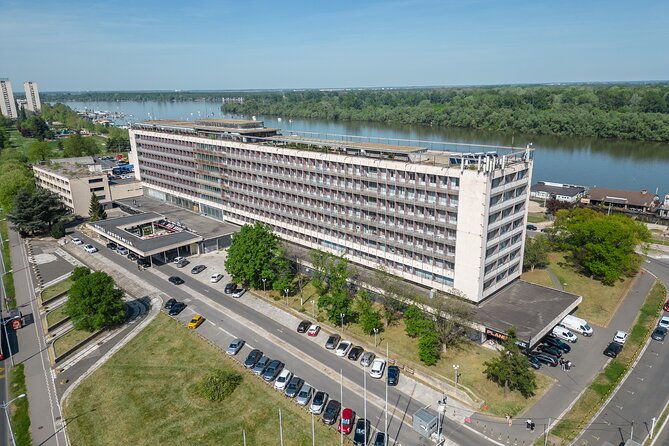
The stop at Primary School Laza Kostić brings the tour closest to everyday life. It takes place in Block 23, described as the most representative public housing project on the route and an example of concrete expressionism.
The key idea is planning at the neighborhood level. The block was designed to provide more than apartment towers. It included a school, kindergarten, sports courts, and a small shopping center, placing basic services near the people who lived there.
That is the difference between seeing a housing block as a photograph and understanding it as a social plan. The buildings were meant to support a whole daily routine. Children could attend school nearby, families could shop locally, and residents had access to recreation within the neighborhood.
This is also where the guide’s personal stories can make the subject more human. The tour includes accounts of life in the blocks during their stronger decades, particularly the 1960s, 1970s, and 1980s, followed by stories of more difficult living conditions in the 1990s.
Those details are valuable because New Belgrade is not only an architecture subject. It is a place where several generations lived through changing political and economic conditions. A guide who can connect the concrete forms to school runs, shopping, sports, and later hardship gives you a better sense of what the buildings meant.
The itinerary lists Primary School Laza Kostić as the stop, but the emphasis is the wider Block 23 concept. You should expect an exterior and neighborhood-focused visit, not a school tour.
What the private format changes
This is a private activity, so only your group takes part. That matters most at places where the subject needs explanation, such as the Park of Friendship or Block 23.
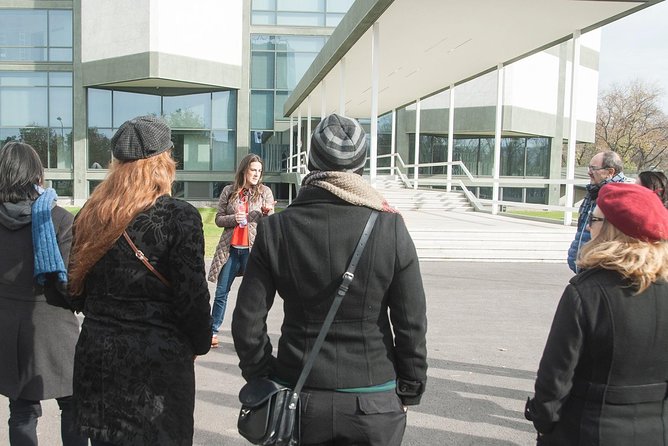
A private guide can adjust the pace, spend longer at Genex Tower, or answer questions about Yugoslav politics and design. If your group includes one person who loves concrete architecture and another who is mainly interested in daily life, that flexibility can help.
The format also makes the guide’s style more important. One named guide associated with this experience is Xenia. If she leads your tour, you can expect the possibility of a personal approach, including stories about life in the blocks. Guide assignments can change, so treat that name as useful information, not a guarantee.
The experience is offered in English. Most people can participate, and the route is near public transportation. The supplied details do not specify the exact vehicle arrangement or walking distance, so ask the operator if those points matter to you.
Is $86.42 a fair price?
At $86.42 per person, this is not a cheap casual walk. The value depends on how much you want interpretation rather than simple sightseeing.
You are paying for a private guide, a focused route through several major buildings, political and architectural context, and a chance to ask questions. If you would otherwise pass Genex Tower, Sava Center, and the housing blocks without understanding their purpose, the fee can make sense.
The value is weaker if you only want photographs. Most stops are free, the museum admission is not included, and some locations are viewed from outside. You could see several of the buildings independently, but you would lose the connections between them and the personal stories attached to Block 23.
For architecture students, design fans, and people curious about socialist Yugoslavia, the price is easier to justify. For a couple mainly seeking a general introduction to Belgrade, the historic center may offer more familiar sights for less money.
The tour is rated 4.6 from 24 ratings, with 92 percent recommending it. That points to a generally strong experience, but the sample is not large. The one very negative account focused on a short duration, limited empathy, and weak preparation, which is a useful reminder to confirm the meeting time and expected length.
Timing, transport, and practical planning
The advertised duration is about two hours and 30 minutes. The short stops keep the pace moving:
- Museum of Contemporary Art: about 20 minutes
- Park of Friendship: about 15 minutes
- Genex Tower: about 20 minutes
- Sava Center: about 15 minutes
- Primary School Laza Kostić and Block 23: about 15 minutes
The Government Building is passed along the way rather than listed as a full timed stop. The total route therefore includes several brief explanations and transitions. You should arrive ready for an overview, not a slow architectural study.
Meet at the Museum of Contemporary Art, Ušće 10, in Belgrade. The tour ends at Sava Center, Milentija Popovića 9. Both points are near public transportation, and the mobile ticket makes the meeting details easy to keep on your phone.
Free cancellation is available if you cancel at least 24 hours before the start time. Changes or cancellations inside that window are not accepted for a refund.
Who should book this experience?
I would choose this tour if you have already seen central Belgrade and want to understand the city’s postwar identity. It suits people who like architecture, Cold War-era politics, urban planning, and personal stories about city life.
It also works well for a private group with mixed interests. The buildings are visually strong enough for design fans, while the Non-Aligned Movement and Block 23 give the tour substance for anyone more interested in history and society.
You may want to skip it if your priority is museum interiors, long visits inside buildings, or a relaxed pace. The tour covers a lot in 150 minutes, and the stops are short. You should also confirm the current guide and transport details before paying if those points affect your choice.
Should you book the New Belgrade architecture tour?
Book it if you want to see Belgrade beyond its old center and understand why New Belgrade was built as a planned modern society. Genex Tower, Sava Center, and Block 23 give you three distinct ways to read the district: technology and symbolism, public ambition, and ordinary life.
The strongest reason to go is the connection between design and people. The route does not stop at concrete shapes. It explains Yugoslavia’s political position and how residents lived through the district’s best and hardest years.
Skip it if you want a broad city tour or a long interior visit. For the right audience, though, this is a focused and personal way to make sense of one of Belgrade’s most unusual districts.
FAQ
Where does the tour begin?
It begins in front of the Museum of Contemporary Art at Ušće 10 in Belgrade.
Where does the tour end?
The tour ends at Sava Center, Milentija Popovića 9, Belgrade 11000.
How long does the experience last?
The stated duration is approximately two hours and 30 minutes.
Is the tour private?
Yes. Only your group participates in the activity.
Is the tour offered in English?
Yes. English is the listed language.
What is the price?
The listed price is $86.42 per person.
Is museum admission included?
No. Admission to the Museum of Contemporary Art is not included.
Which major buildings are visited?
The route includes the Museum of Contemporary Art, Genex Tower, Sava Center, and the Primary School Laza Kostić area in Block 23. It also includes the Park of Friendship and a drive-by view of the Government Building.
Is the tour near public transportation?
Yes. The meeting and ending areas are near public transportation.
Can I cancel for a full refund?
Yes, if you cancel at least 24 hours before the experience begins. Cancellations or changes made less than 24 hours before the start time are not accepted for a refund.
Just added around the world
- Wilmington History and Architecture Tour★ 4.8 · 18 reviews
- Washington, DC: Georgetown Architecture Walking Tour★ 5.0 · 8 reviews
- New Orleans : Garden District Architecture Walking tour★ 4.8 · 5 reviews
- Washington DC: Dupont Circle & Embassy Row Architecture Tour★ 5.0 · 6 reviews
- Vicenza: discovering the city of Palladio by e-bike★ 5.0 · 4 reviews
- Vicenza: Palladian Architecture Private Walking Tour★ 3.3 · 3 reviews
- Walk & Discover KL’s Architectural and Heritage Gems★ 5.0 · 7 reviews
- Unveiling Brno: History, Culture & Architectural Delights★ 5.0 · 2 reviews
Bauhaus and Brutalist Architecture Tours, compared.
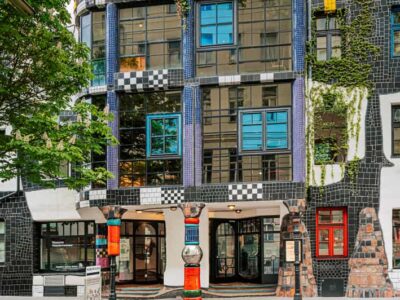
Vienna: Tickets for Kunst Haus Wien: Museum Hundertwasser
Read our review →
Entrance tickets for the KunstHausWien. Museum Hundertwasser
Read our review →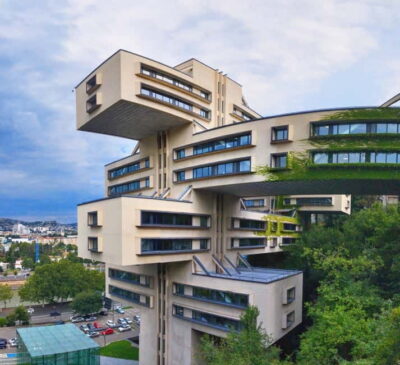
Brutalist Tbilisi: Urban exploration and untold stories
Read our review →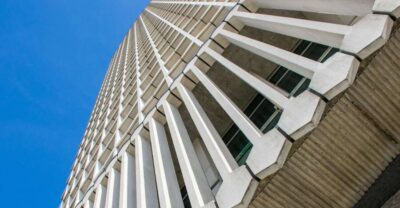
London: Brutalist Architecture & History Walking Tour
Read our review →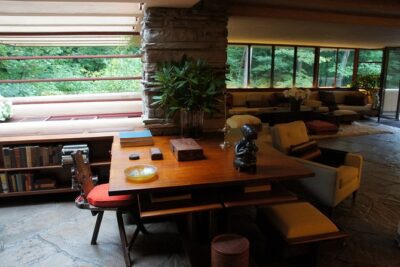
FALLINGWATER – America’s UNESCO World Heritage Masterpiece!
Read our review →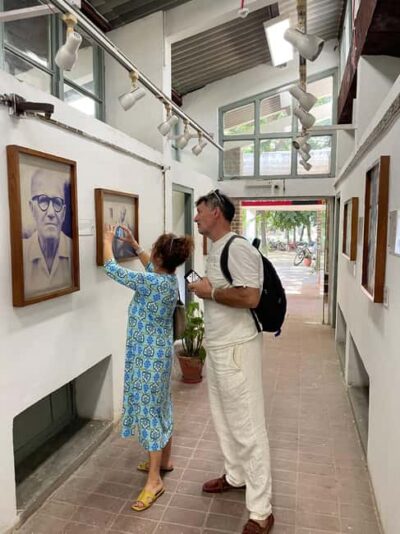
Le Corbusier’s Chandigarh : A Complete Architecture Tour
Read our review →Browse the lists this tour appears in