
Review · ARCHITECTURE TOURS
Small Group Tour in Ålesund: Art Nouveau, Sea Views & Insider Tips
Ålesund’s most surprising story begins with a disaster. After the 1904 fire, the city was rebuilt in a unified Art Nouveau style, filling its center with turrets, curved facades, and symbolic details. This tour puts that architecture into its historical setting, then connects it to fishing, oil, tunnels, bridges, and ordinary life on Norway’s coast.
I like two things in particular: the small-group format, which leaves room for real questions, and the easy viewpoint at Grimmerhaugen, which gives you a fine city view without the famous 418-step climb up Aksla. Guide Lukas Klein also adds personal perspective as someone who chose Norway as home.
The main drawback is the walking. The route includes short climbs, stairs, and uneven ground, and it is not suitable for wheelchair users, people with mobility impairments, children under 10, or anyone with low fitness. At $61 per person, it is good value if you want context and conversation, less so if you only want a quick photo walk.
Key points at a glance
- The 1904 fire explains the city you see today: Ålesund’s Art Nouveau center was rebuilt in a remarkably consistent style after the old town burned.
- Lukas Klein brings a local-but-outsider view: He discusses Norwegian culture, oil and gas, resistance history, architecture, and daily life with plenty of room for questions.
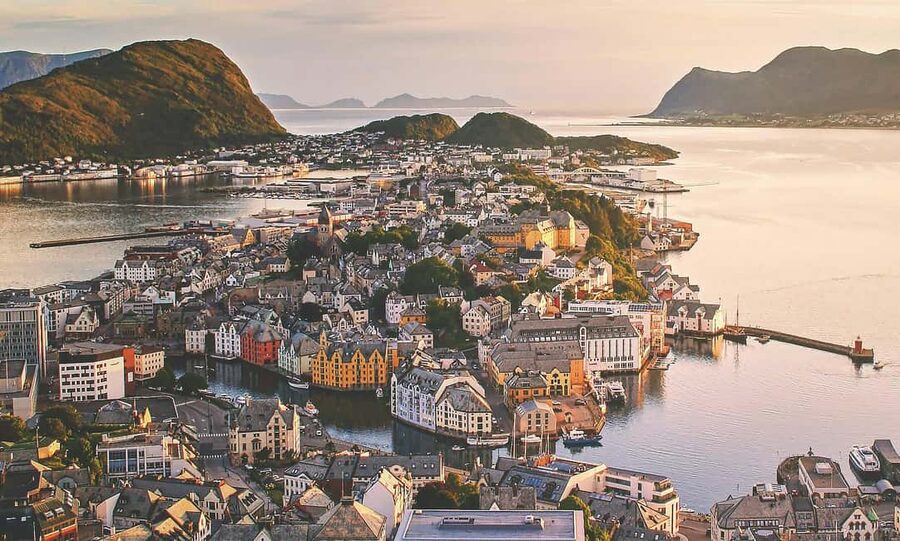
- You avoid Aksla’s 418 steps: Grimmerhaugen offers a smaller, easier viewpoint over the harbor, islands, mountains, and city.
- The route begins beside the cruise port: Meet at the fisher boy statue near the Art Nouveau center, then finish at Grimmerhaugen.
- You get more than sightseeing: Restaurant, café, shop, hiking, and activity suggestions are included, along with a free digital brochure.
- A kiosk stop adds a local treat: Coffee, ice cream, and even Norwegian brown cheese ice cream may enter the conversation.
Why Ålesund’s Art Nouveau needs a story
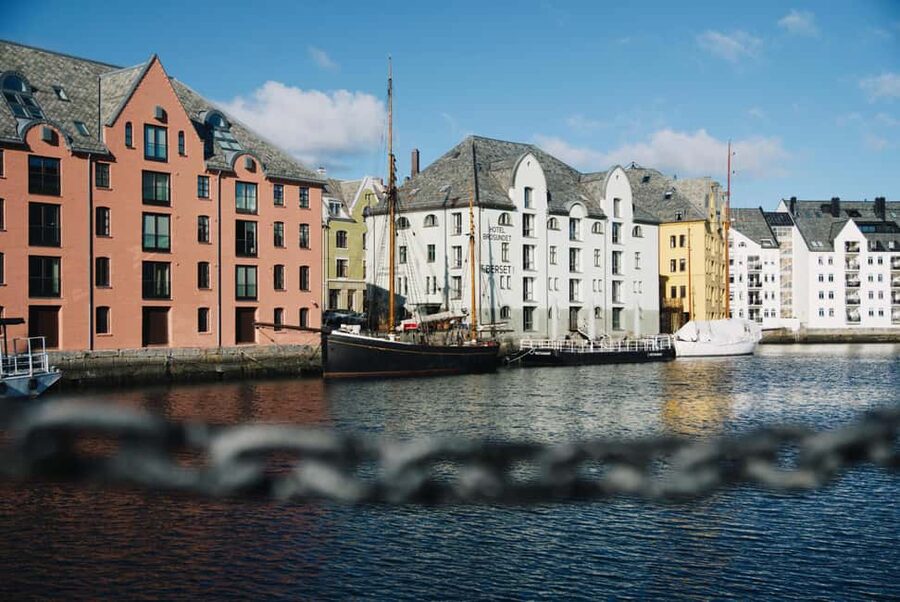
Ålesund can look almost too polished at first glance. Its center is full of decorative towers, rounded corners, carved details, and bright facades. Without context, it is easy to stroll, take photographs, and miss why the city looks this way.
The key date is 1904, when a major fire destroyed much of the town. The rebuilding that followed created the Art Nouveau cityscape that defines Ålesund today. On this walk, you do not just hear that the buildings are attractive. You learn how the fire shaped the city and why the rebuilt streets have such a strong visual unity.
Kongens gate is the architectural high point. This street has one of the city’s densest collections of ornate facades, turrets, and symbolic decoration. I like that the tour focuses on individual buildings rather than treating the whole center as one large postcard. Look up as you walk. The most interesting details are often above street level.
Lukas also places Ålesund’s architecture beside wider European trends from the early 20th century. He has used photographs and comparisons to show how the city’s buildings relate to Art Nouveau elsewhere. That helps you see Ålesund as part of a wider movement, not an isolated curiosity in western Norway.
The pace matters here. Two hours gives you enough time to stop for photographs, ask why a building looks a certain way, and hear the story without racing from facade to facade. If you have already walked through the center on your own, the guided route can still reveal streets and viewpoints you might have missed.
More Art Nouveau tours in the world:
- Walking Tour of Riga’s Beautiful Art Nouveau Architecture
★ 4.8 · 20 reviews - Riga’s Architecture: A self-guided audio tour of the city’s art nouveau history
★ 5.0 · 3 reviews - Mexico City origins and architecture: Art Nouveau, Deco,Eclectic
★ 3.0 · 2 reviews
Starting beside the fisher boy statue
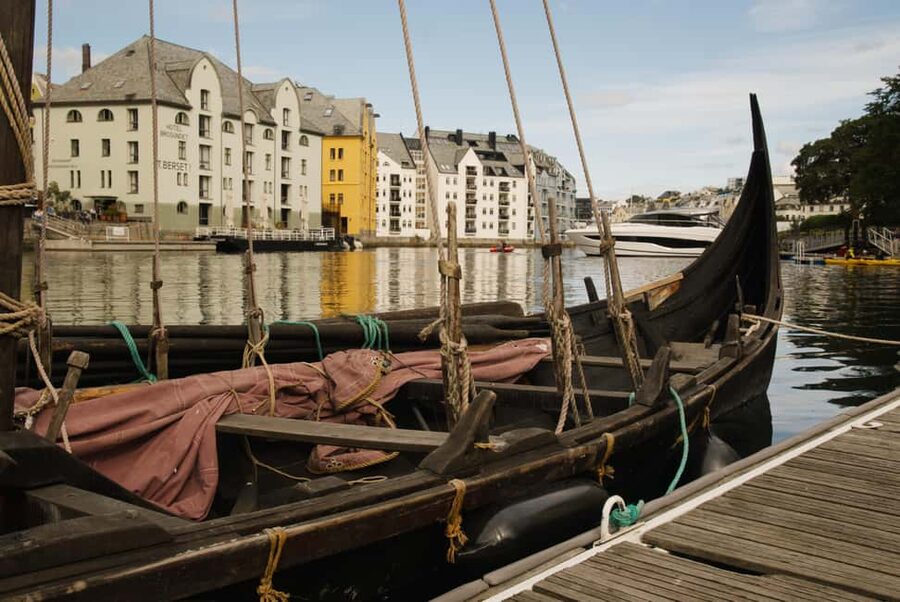
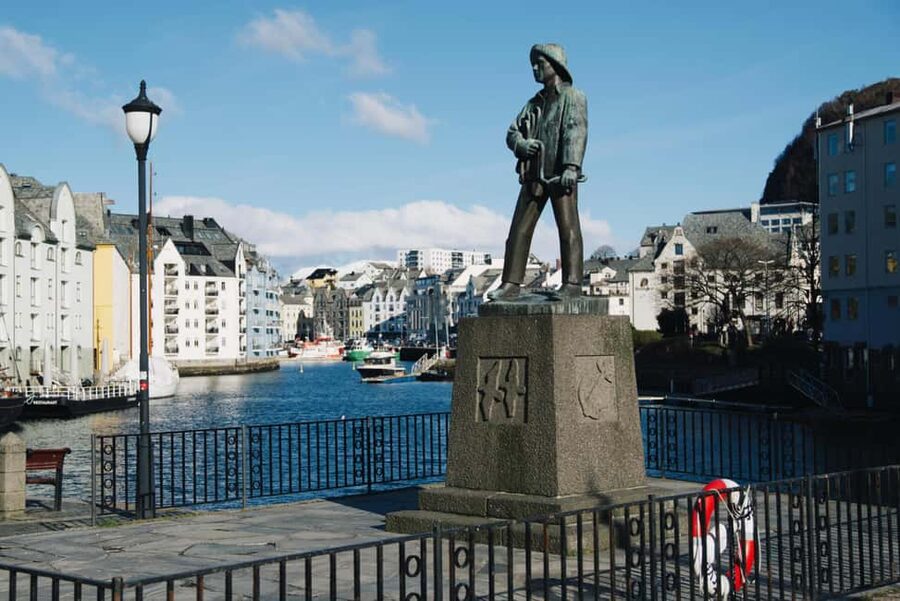
The meeting point is the large statue of the fisher boy, called Fiskergutten, beside the bridge and directly across from the Art Nouveau center. It is a practical place to begin because it is easy to identify and close to the cruise port.
The statue also gives the tour a useful opening theme. Ålesund grew through its close relationship with the sea, fishing, and the harbor. The fisher boy is more than a convenient meeting marker. It points you toward the city’s working identity, which can otherwise get lost behind the pretty architecture.
The start and finish are about a five or ten-minute walk from the cruise port. That makes this a sensible shore excursion for people with a limited stop in town. Still, check your ship’s schedule before booking a time. The stated return windows are 12:15 PM or 3:45 PM at the latest, depending on the tour timing and ship schedule.
Apotekertorget and the city’s working past
Apotekertorget is one of the first major stops, with roughly 30 minutes set aside for guided sightseeing and walking. This part of the route helps bridge the gap between Ålesund as a fishing town and Ålesund as a modern Norwegian city.
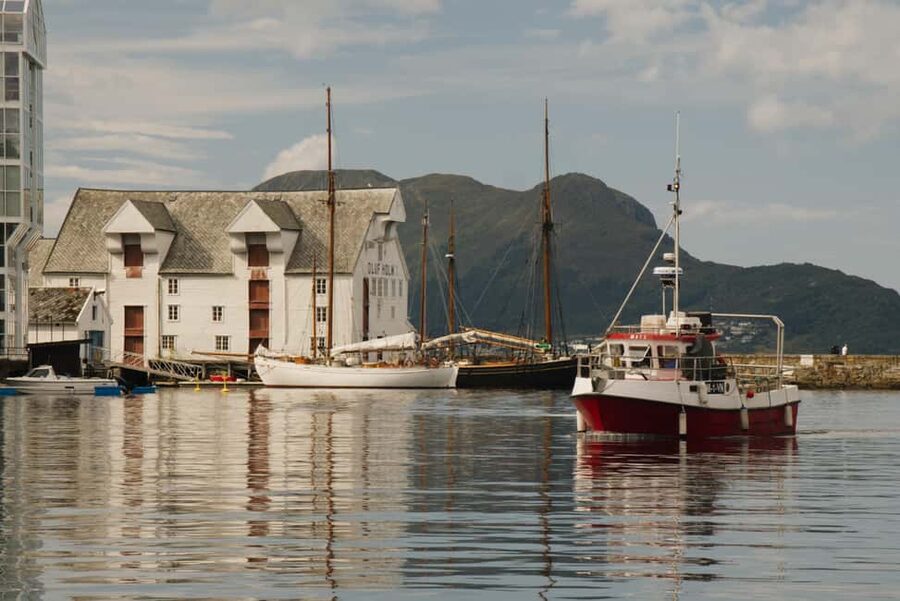
You will hear about the salted and dried fish trade, the harbor’s role, and the practical business that supported the town. This is useful context because the decorative center was not created as a stage set. These streets served a working port and a community whose fortunes were tied to the sea.
The stop is also a good chance to ask about everyday life. Lukas has been praised for covering more than dates and buildings, including Norwegian culture, the economy, oil and gas, and what it is like to live in the country. I find that breadth valuable because it turns a city walk into an introduction to present-day Norway.
Do not expect a museum visit here. The experience is outdoors, and the emphasis is on explanation while walking. If you want a long indoor look at historic objects, this is not the right tour. If you want the city itself to be the exhibit, it works well.
The harbor and Norway’s remarkable infrastructure
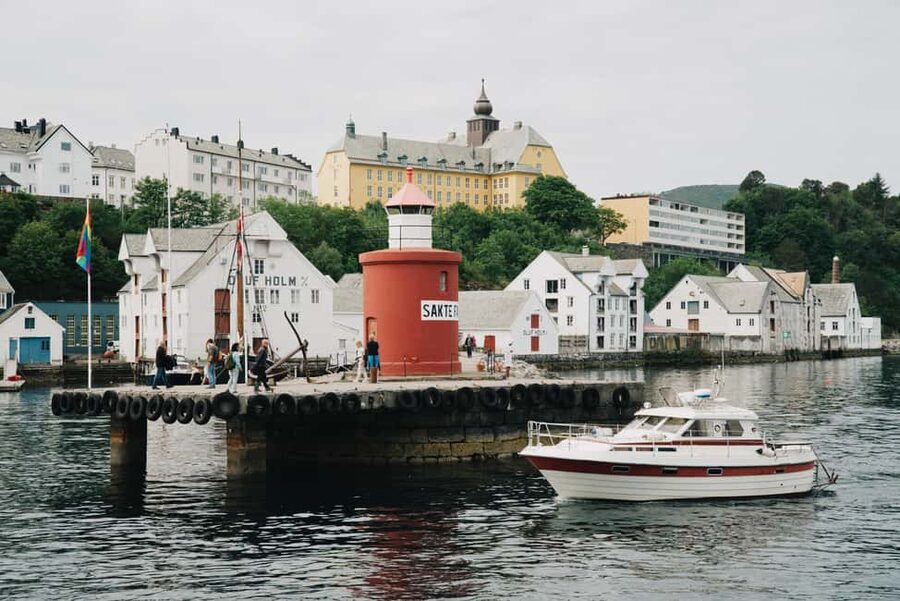
The next section takes you along the waterfront and around Ålesundregionens Havnevesen, the regional harbor authority area. Allow about 30 minutes for this part.
Here the focus shifts from old trade to modern infrastructure. Norway’s coastal geography creates real engineering challenges, and the tour discusses tunnels under the sea, floating bridges, and major plans such as a proposed tunnel for passenger ships. These details add scale to your understanding of the country. Norway is not only fjords and fishing villages. It is also a nation that spends heavily on connecting scattered communities.
This is one of the tour’s strongest features for curious adults and older children. You can ask practical questions about how people move around the coast, how industry shapes local life, and how Ålesund fits into the wider region. The discussion may also touch on the oil and gas industry and the way Norway has handled its natural-resource income.
The waterfront section should also be one of the easier parts of the walk. Even so, the full route later includes hills, steps, and uneven surfaces. Wear shoes with a firm grip, and bring clothing suited to changing coastal weather.
Same city, a completely different century:
- Chicago Architecture River Cruise
★ 5.0 · 15,756 reviews - Chicago River 90-Minute Architecture Tour
★ 4.5 · 9,629 reviews - Chicago River: 1.5-Hour Guided Architecture Cruise
★ 4.8 · 8,046 reviews - Chicago Architecture Center River Cruise aboard First Lady
★ 5.0 · 5,536 reviews
Kongens gate and the best concentration of ornate facades
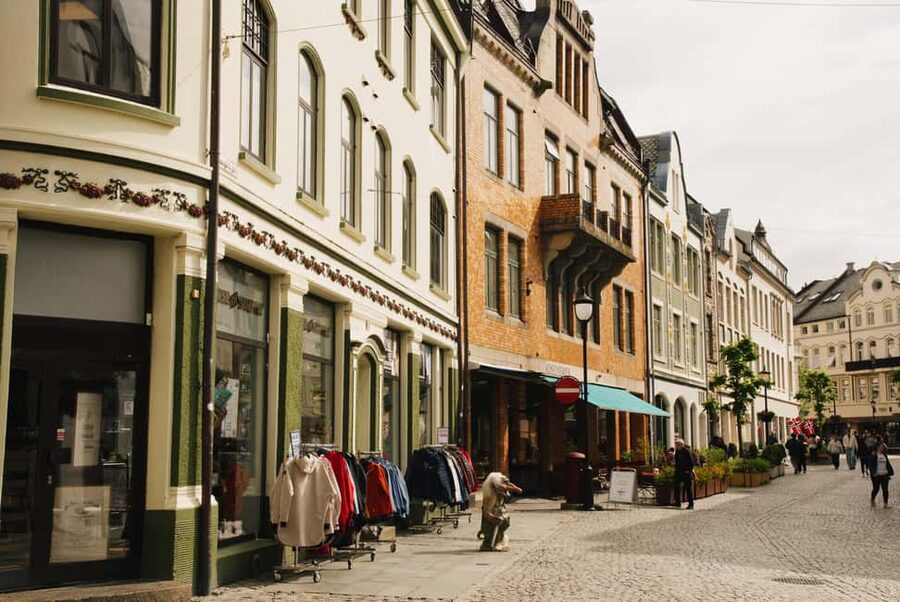
Kongens gate is where the Art Nouveau theme becomes most visual. Plan on another 30 minutes of guided walking and sightseeing.
This is the place to slow down and examine the details: turrets, curved lines, decorative motifs, and ornaments with symbolic meaning. The street’s high concentration of ornate buildings makes it a natural outdoor gallery, but the guide’s explanations give the details purpose.
I especially like this kind of stop because architecture can become passive sightseeing. You see a pretty building, take a picture, and move on. With a guide, you can ask what changed after the fire, why the rebuild took the form it did, and how the city’s style compares with other early 20th-century European cities.
Lukas is also a photographer, and several people have found his photo help useful during the walk. He may offer to take pictures at different stops, and photographs have sometimes been sent afterward at no extra cost. Treat this as a pleasant possibility rather than a guaranteed part of the formal inclusions, but it is worth asking if you would like a picture of your group.
Museums-parken, history beyond the facades
The route then reaches Museums-parken for a photo stop and further guided sightseeing. The park gives you a change of pace from the close-packed streets and another place to look at Ålesund’s public spaces.
This stop broadens the historical discussion. The tour can include Norway’s resistance during the Second World War, local monuments, culture, art, and music. That range is one reason the experience feels more personal than a standard architecture loop. You are not limited to one subject, and you can steer the conversation toward the things you find most interesting.
The group format helps here. With only a small number of people, questions are easier to ask and the guide can adjust the emphasis. Private tours for up to four people can also be customized, which may suit a family or a couple with a particular interest in architecture, Norwegian life, or photography.
The drawback is that a small group does not mean a completely private experience unless you book the private option. If you prefer to wander alone and set your own pace, two hours with a guide may feel structured. For most people who want to make sense of Ålesund quickly, that structure is useful.
Grimmerhaugen gives you a view without the famous staircase

The final stop is Grimmerhaugen, a small and accessible hill with views over the harbor, town, mountains, and surrounding islands. The important comparison is Aksla, Ålesund’s famous viewpoint reached by 418 steps. This tour does not take you there.
That is a benefit if you want a scenic finish without turning a city walk into a workout. Grimmerhaugen still requires some uphill walking, and the route is not suitable for people with mobility limitations, but it is the gentler choice of the two.
The viewpoint is also a good place to ask for practical advice. You can get suggestions for restaurants, cafés, small shops, hikes, and other things to do during the rest of your stay. I would save your most specific questions for this final stretch. Ask where to spend an extra hour, what to do in poor weather, or which parts of town deserve a second look.
You also receive a free digital brochure with tips for exploring Ålesund independently. That adds value after the formal tour ends. The brochure cannot replace local conversation, but it gives you a way to remember suggestions once you are back on your own.
What $61 buys you
At $61 per person for two hours, this is not the cheapest way to walk around Ålesund. You can see the streets, harbor, and public spaces without paying for a guide.
The value comes from the amount of context packed into a short route. You get the 1904 fire, Art Nouveau design, fishing and trade, harbor infrastructure, Norwegian economics, resistance history, local life, and a viewpoint. You also get time for questions rather than a one-way speech.
I would call the price fair for people arriving by cruise ship or visiting Ålesund for only a day. You can get your bearings quickly and use the rest of your time with a clearer plan. It is also a sensible first activity for a longer stay because the restaurant, shop, hike, and activity suggestions can shape the days that follow.
The value is weaker if you already know Ålesund well, dislike guided walks, or mainly want Aksla. The tour does not include drinks or snacks, though you stop at a small kiosk where you can buy coffee or ice cream. Food and beverages are extra.
How hard is the walk?
You need comfortable shoes and weather-appropriate clothing. The route includes short climbs, stairs, and uneven passages, so basic mobility and the ability to walk for a longer period are required.
The tour is not suitable for wheelchair users, people with mobility impairments, people with low fitness, or children under 10. That is worth taking seriously. The Grimmerhaugen viewpoint is easier than Aksla, but this is still an active walking tour, not a vehicle-based city tour.
The pace appears designed to allow photographs and conversation rather than a fast march. Even so, a two-hour outdoor walk in coastal weather can feel demanding if rain or wind arrives. Bring a waterproof layer and do not rely on a forecast that promises perfect conditions.
Who will get the most from this tour?
I would choose this for a first visit, especially if you have a cruise-port stop and want more than a quick circuit of photogenic streets. It suits people who like architecture but also want to understand work, infrastructure, economics, and daily life.
It is a particularly good match for:
- Couples and small groups who enjoy asking questions
- Cruise passengers with a carefully timed shore visit
- Visitors interested in Art Nouveau architecture
- People who want local suggestions for food, shops, hikes, and activities
- Anyone who prefers a manageable viewpoint instead of 418 stairs
- Private groups of up to four who want a customized route
It may not suit you if you need step-free access, cannot walk for two hours, want a fully private experience without booking one, or are looking specifically for a climb up Aksla.
Lukas’s style also seems best for people who enjoy conversation. He covers a lot, from architecture and history to oil, gas, nature, infrastructure, and Norwegian culture. His passion for Norway is part of the experience, especially because he chose the country as his home rather than being born there.
Practical details before you book
The tour is available in English and German. It lasts two hours, and small-group and private options are offered. The formal meeting point is Fiskergutten, the fisher boy statue beside the bridge across from the Art Nouveau center.
Free cancellation is available up to 24 hours before the start, and you can reserve now and pay later. Drinks and snacks are not included, but the kiosk stop lets you buy something during the walk.
Alcohol, drugs, video recording, audio recording, and party groups are not allowed. Those rules keep the outing focused on walking and conversation.
For cruise passengers, compare the start time with your onboard schedule. The short distance between the port and the meeting point is helpful, but you remain responsible for returning to your ship on time.
Should you book the Ålesund small-group tour?
Book it if you want Ålesund explained rather than simply photographed. The best parts are the clear account of the 1904 rebuilding, the concentration of Art Nouveau buildings along Kongens gate, the harbor discussion, and the chance to ask Lukas about life in Norway today.
The tour is also a smart use of limited time. At $61, you pay for a compact introduction, a scenic finish, practical local advice, and a guide who can connect architecture with the city’s working past and modern economy.
Skip it if your mobility is limited, you want a completely self-guided walk, or your main goal is the 418-step Aksla viewpoint. For most first-time visitors who can manage the hills, this is a friendly and useful way to get oriented in Ålesund.
FAQ
Where does the Ålesund walking tour begin?
It begins at Fiskergutten, the large fisher boy statue beside the bridge, across from the Art Nouveau center.
Where does the tour finish?
The walk finishes at Grimmerhaugen, a hill with views over Ålesund, the harbor, mountains, and surrounding islands.
How long does the tour last?
The tour lasts two hours.
How much does the tour cost?
The listed price is $61 per person.
Which languages are available?
The live guide is available in English and German. Some content may be presented in its original language.
Is the tour suitable for cruise passengers?
Yes. The meeting and finish points are about a five or ten-minute walk from the cruise port, and tour times are planned around usual ship layovers. Check your onboard schedule before booking.
Does the tour climb Aksla?
No. The route finishes at Grimmerhaugen and does not include Aksla’s 418 steps.
Is the walking route accessible for wheelchair users?
No. The route includes short climbs, stairs, and uneven surfaces, and it is not suitable for wheelchair users or people with mobility impairments.
Are food and drinks included?
No. Drinks and snacks cost extra, but the route includes a stop at a small kiosk where you can buy coffee or ice cream.
Is a private tour available?
Yes. Private tours for up to four people can be arranged, and small-group options are also available.
Just added around the world
- Wilmington History and Architecture Tour★ 4.8 · 18 reviews
- Washington, DC: Georgetown Architecture Walking Tour★ 5.0 · 8 reviews
- New Orleans : Garden District Architecture Walking tour★ 4.8 · 5 reviews
- Washington DC: Dupont Circle & Embassy Row Architecture Tour★ 5.0 · 6 reviews
- Vicenza: discovering the city of Palladio by e-bike★ 5.0 · 4 reviews
- Vicenza: Palladian Architecture Private Walking Tour★ 3.3 · 3 reviews
- Walk & Discover KL’s Architectural and Heritage Gems★ 5.0 · 7 reviews
- Unveiling Brno: History, Culture & Architectural Delights★ 5.0 · 2 reviews
Art Nouveau Tours, compared.
Riga: Old Town Walking Tour with Art Nouveau Highlights
Read our review →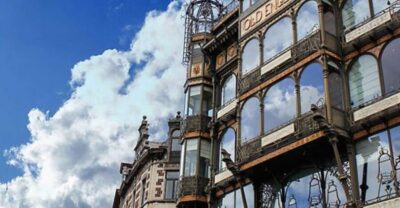
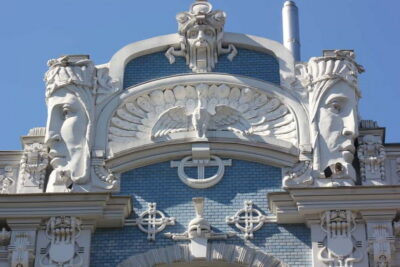
Riga: 2-Hour History of Art Nouveau Walking Tour
Read our review →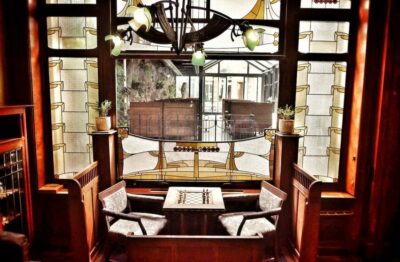
Brussels: Art Nouveau Pass – Entry to Three Locations
Read our review →
Browse the lists this tour appears in