
Review · FRANCE
Contemporary Architecture in Bordeaux city center!
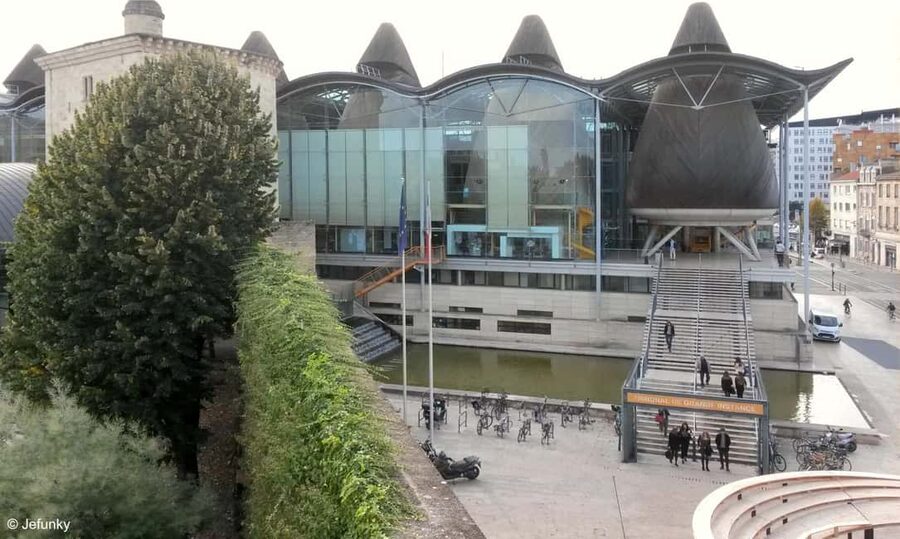
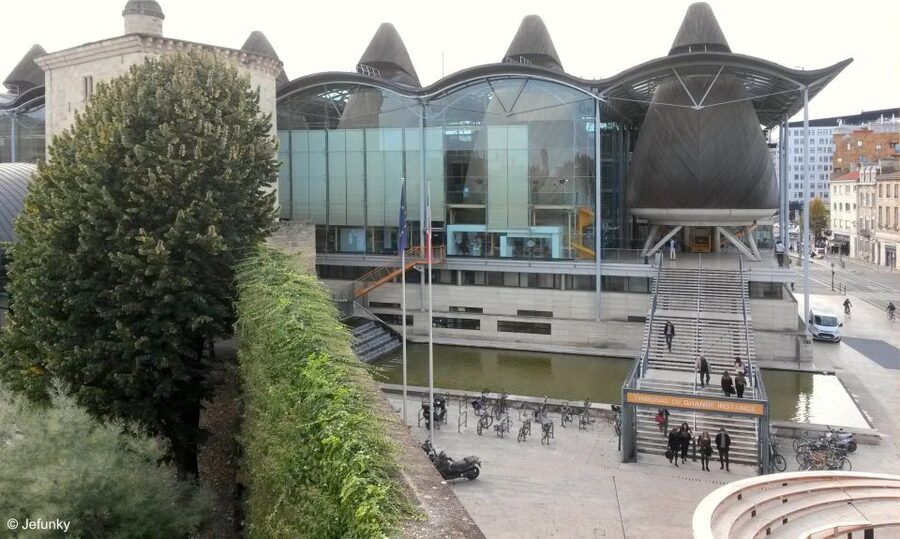
Richard Rogers’ Bordeaux Law Courts are the star here: a row of large glass eggshell-shaped courtrooms set inside a bold modern building. You meet at the foot of its entrance stairs, then use this striking place to understand how Bordeaux moved beyond its old Sleeping Beauty image.
I like the mix of serious architecture and small urban surprises, from the grand Water Mirror to the tiny Square Vinet. I also like the guide format: an architect leads the walk, and David has been described as relaxed, kind, friendly, and good at balancing detail with unusual stories.
The main caution is pace. Two hours is enough for a focused introduction, not a full architectural study of Bordeaux. The tour is also not suitable for children under 10 or people with mobility impairments, and the planned route includes city walking and stairs.
Key points to know
- Richard Rogers’ Law Courts: Enter Bordeaux’s most unusual major civic building and examine its glass courtroom forms.
- The Water Mirror: Use the famous reflecting pool as a starting point for Bordeaux’s modern urban changes.
- Square Vinet: Find a small pocket square with vertical green walls and a playful design.
- Mama Shelter: See how a 1934 office building was turned into a lively Philippe Starck hotel.
- Place Pey-Berland: Compare contemporary planning with Bordeaux’s historic monuments and public spaces.
- Euratlantique and MECA: Connect the central walk with the city’s larger development plans, including a building by BIG.
Why Bordeaux needed a modern architectural story
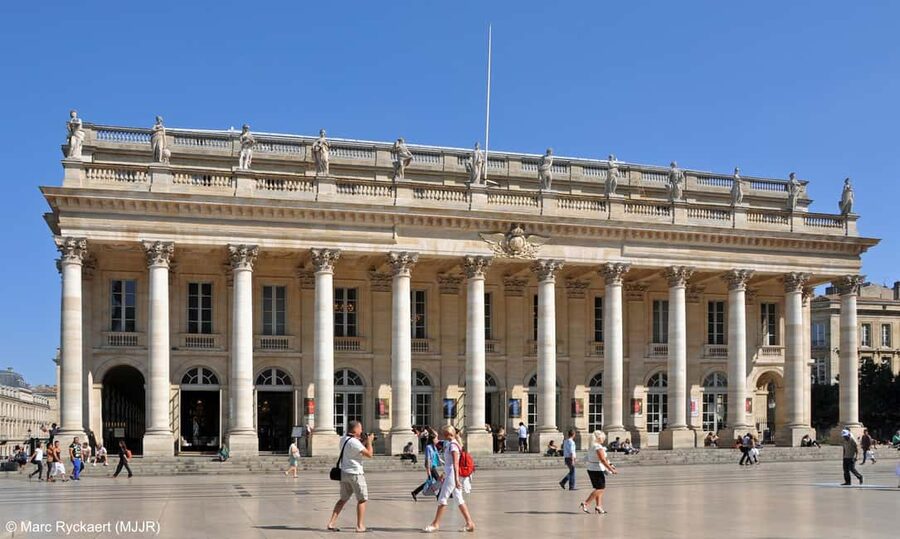
Bordeaux is easy to read as an 18th-century city. The riverfront facades, Place de la Bourse, Grand Théâtre, and broad classical streets give it a polished old-city identity. For many years, though, that image hid a city that had lost energy and investment.
The change gathered speed over the last 25 years. Bordeaux cleaned up and reworked its central areas, gained UNESCO World Heritage status in 2007, and regained its place as the capital of the Nouvelle-Aquitaine region. The city now expects its wider population to reach one million by 2030.
That growth creates a useful question: how do you add new buildings and public spaces without flattening the old city? This walk is built around that question. You will not just look at modern shapes. You will consider how the historic center, riverfront, public squares, and new development zones are being fitted together.
I find that approach more useful than a simple list of famous architects. A building can be attractive or odd, but its real value often appears in how it changes a street, invites people to stop, or gives a neglected area a new purpose.
A few more architecture tours around France worth a look
- Bastille’s Architecture & Artisans Self-Guided Walking Tour
★ 4.5 · 18 reviews - Strasbourg : Neustadt Architecture Walking Tour
★ 5.0 · 14 reviews - Neoclassical Paris Architecture 2-Hour Private Walking Tour
★ 5.0 · 7 reviews
Start at Richard Rogers’ Bordeaux Law Courts
The meeting point is at the foot of the entrance stairs to the Bordeaux Law Courts. This is practical for two reasons. You begin with a clear landmark, and you start with one of the city’s strongest examples of late 20th-century public architecture.
The building was designed by Richard Rogers, the British architect also known for large, technologically expressive civic buildings. In Bordeaux, the courtrooms are the main visual event. Their rounded forms are enclosed in glass, creating an immediate contrast with the formal stone architecture found elsewhere in the center.
You can expect the guide to use the building as more than a photo stop. The point is to understand how a courthouse can express its function through its design, how public institutions present themselves, and why this building feels so different from a traditional European court.
This is also the place where a guide with architectural training matters. An architect can explain materials, scale, circulation, and the relationship between the public entrance and the courtrooms without reducing the building to a few dates and a famous name.
The entrance stairs are worth noting before you book. They are part of the meeting point, and the activity is not suitable for people with mobility impairments. If stairs or extended city walking are a concern, this is not the right tour for you.
The Water Mirror and Bordeaux’s riverfront revival
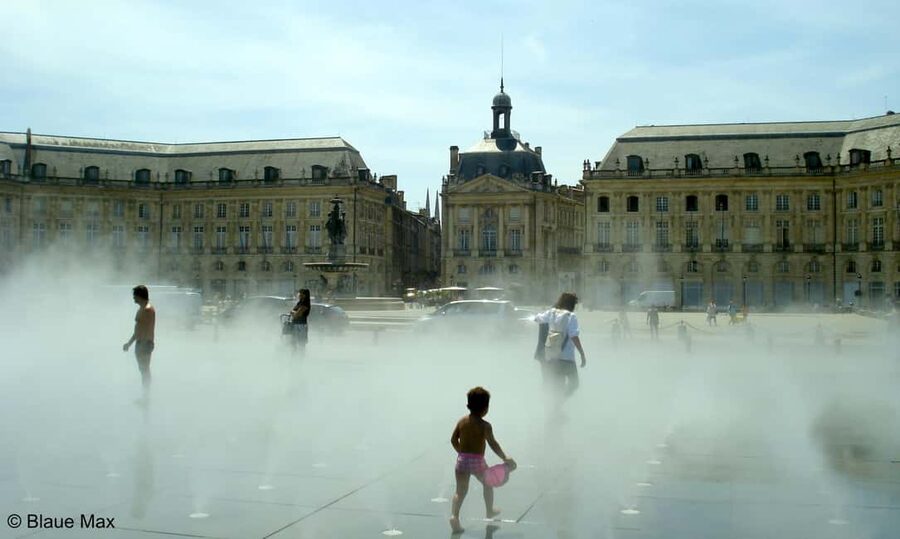
The walk begins around the Garonne quays and the Water Mirror, designed by Michel Corajoud. The Water Mirror is the thin sheet of water opposite Place de la Bourse, where reflections and mist create one of Bordeaux’s best-known public spaces.
Its appeal is visual, but its role is larger. The riverfront became a key part of Bordeaux’s renewal, giving residents and visitors a broad public area where traffic, historic facades, water, and open space meet.
At this stop, you can expect discussion of the major planning ideas used since 1995. The focus is not only on what you see in front of you. It is also on why the quays matter as the city changes and how a public space can help reconnect Bordeaux with the Garonne.
I like this beginning because it gives the rest of the walk a clear frame. The Water Mirror is a memorable place to visit on its own, but with context, you can read it as part of a larger plan rather than as a stand-alone attraction.
The stop is also a good reminder that modern architecture is not always a single building. Sometimes it is a change in the way a city handles open space, public access, and movement along the river.
Place Pey-Berland beside Bordeaux’s older monuments
From the riverfront, the urban walk moves through the city center and includes Place Pey-Berland. This square places contemporary planning beside major historic landmarks, including the Rohan Palace and the Grand Théâtre elsewhere along the route.
That contrast is one of the strongest features of the experience. Bordeaux does not present its new architecture in a separate modern district only. Contemporary projects appear inside a city known for neoclassical streets and monumental 18th-century buildings.
At Place Pey-Berland, the discussion can help you notice how a historic square is managed today. A high-end contemporary masterplan must work around old stone facades, established sightlines, public foot traffic, and the expectations of a city protected for its heritage value.
The square also gives you a useful way to compare two kinds of urban ambition. Bordeaux’s older buildings expressed commercial success and civic power through grand scale and ornament. Newer work often makes its point through glass, exposed structure, unusual forms, or careful public space design.
You should not expect every modern project to please you. That is part of the value of seeing them with an architect. You can ask why a design was made as it was, then decide for yourself if it improves the setting.
Same city, a completely different century:
- Train Exp. through the Alps (Royal Baroque Route from Nice)
★ 5.0 · 682 reviews - Paris: Splendors of the Baroque at the Jacquemart-André Museum – Entry Ticket
★ 4.5 · 99 reviews - Reims Art Deco guided tour
★ 4.5 · 26 reviews - Guided Tour of Nancy, French Capital of Art Nouveau
★ 5.0 · 18 reviews
Square Vinet, a small space with a big lesson
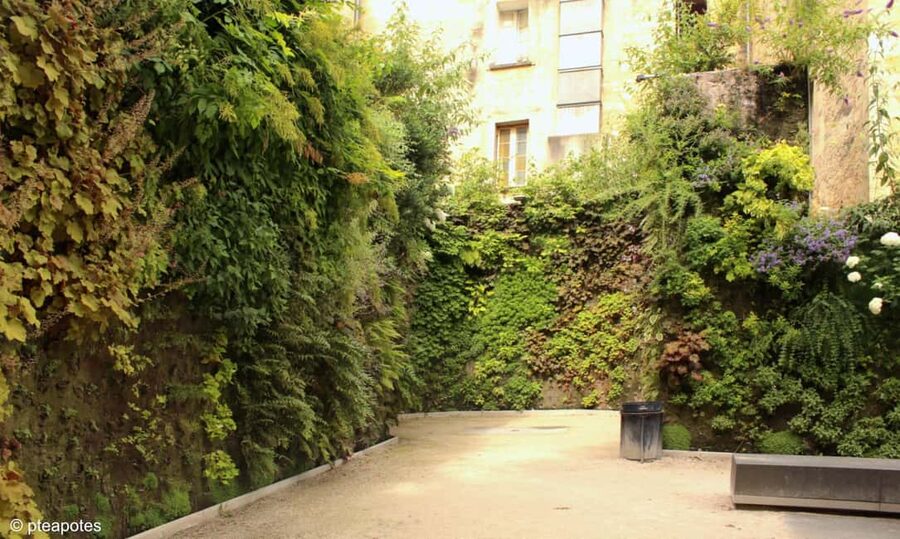
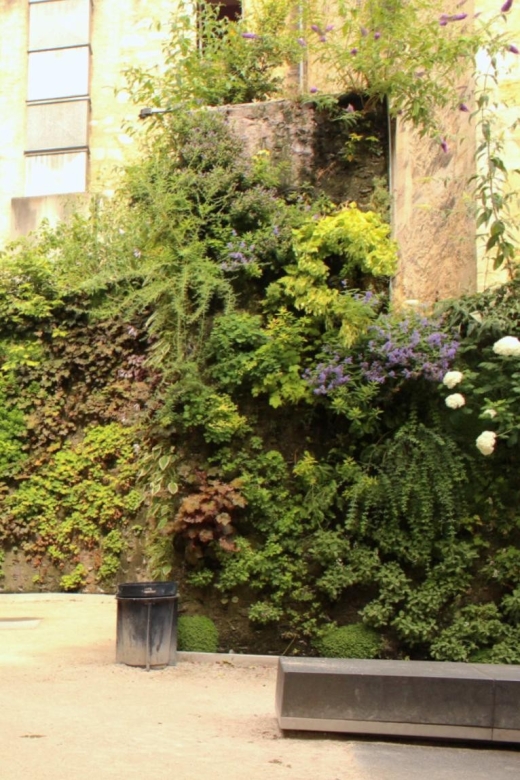
Square Vinet is one of the more appealing stops because it is modest. It is a tiny, tucked-away playground with vertical green walls, designed by Michel Desvigne and Patrick Blanc.
This is not a grand monument. It is a compact public-space project that shows how design can work at neighborhood scale. Instead of filling every open area with paving or leaving a leftover corner unused, the square gives a small site its own identity.
The vertical planting is the obvious visual feature. It also makes the stop useful for understanding how greenery can be introduced where there is little room for a conventional park. The result is more intimate than the Water Mirror and less formal than the city’s historic squares.
I like the change of scale. After the large riverfront and the Law Courts, Square Vinet asks you to pay attention to details: a wall, a narrow public space, planting, and the way a small playground fits into the surrounding streets.
Do not expect a long visit here. It is a quick, focused stop rather than a place where you spend an afternoon. Its value is in the design idea and in the contrast with Bordeaux’s monumental center.
Mama Shelter and the reuse of a 1934 office building
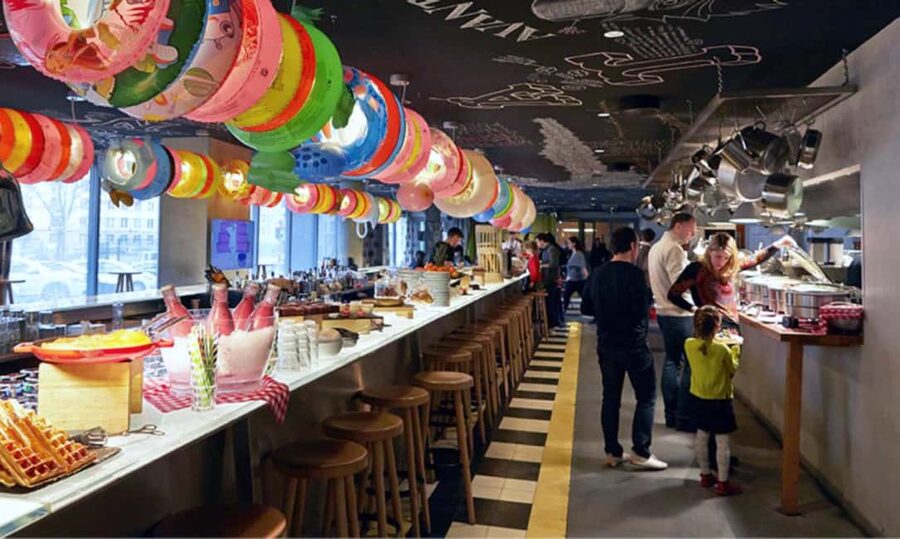
The walk also includes a look at Mama Shelter, the funky hotel created from a 1934 office building. Philippe Starck shaped the hotel’s interiors and identity, giving an older commercial structure a new use and a more playful public face.
This stop is useful because it moves the discussion from new construction to adaptive reuse. Cities do not always need to replace an old building to make it useful again. Sometimes the smarter move is to keep the shell and change what happens inside.
Mama Shelter brings a different mood from the Law Courts. The courthouse is civic, formal, and tied to the justice system. The hotel is social, commercial, and designed to encourage a more casual atmosphere. Seeing both during one short walk helps you compare how architecture responds to purpose.
You may only peek at the hotel rather than receive a full interior tour. That distinction matters. This is an architectural walk through the city, not a hotel inspection or a design museum visit.
Still, the building makes a good talking point. It shows how a 1934 office building can become part of Bordeaux’s current city life instead of remaining a relic of an earlier period.
From central projects to Euratlantique and MECA
The latter part of the experience focuses on major development operations, especially Euratlantique. This is where the tour moves from individual buildings and small squares to the question of how Bordeaux will grow.
Euratlantique is linked to major development around Bordeaux’s rail and southern city areas. The experience may include some of its emblematic buildings, including MECA, designed by the Danish architecture firm BIG.
MECA gives the tour a newer architectural marker to compare with the central projects. Its design belongs to a city looking ahead, while the Water Mirror and Place Pey-Berland help explain how Bordeaux has reworked its existing center.
Because this is a two-hour tour, you should treat the Euratlantique portion as an introduction rather than a full survey of the district. The exact balance between the central walk and the newer development area may depend on the route and the starting time.
That limitation is reasonable. Bordeaux’s architectural change covers too much ground for a single compact walk. The advantage is that you get a connected story: riverfront renewal, historic-center interventions, building reuse, and large-scale growth.
What the guide adds to the experience
The guide is an architect, and that shapes the tone. You can expect attention to building types, design choices, and the layered past of each location rather than a standard sightseeing script.
David led one recorded experience and was described as relaxed, kind, and friendly. Those qualities matter on an architecture tour. A stiff lecture can make even a beautiful building feel like homework, while an overly casual walk may skip the ideas that make the buildings worth seeing.
The best balance is a guide who gives you enough detail to understand the work, then leaves room for your own judgment. This tour is designed around that balance, with stops that range from a major courthouse to a tiny planted square.
There are also several possible stops for drinks. These are optional opportunities to pause and talk, not a promise of included food or drink. If you enjoy asking questions, a short break can make the walk feel more conversational and less like a march between landmarks.
The tour is offered in English or French. That gives you a practical choice when booking, especially if you want technical ideas explained in the language you follow most easily.
Is $40 a fair price for two hours?
At $40 per person, this is not the cheapest way to walk around Bordeaux. You can see the Water Mirror, Place Pey-Berland, and many historic streets without paying for a guide.
The value comes from the interpretation and access to a more focused architectural point of view. You are paying for an architect-guide, a planned route, discussion of Bordeaux’s redevelopment since 1995, and a chance to enter the Law Courts rather than simply photograph the exterior.
The price makes the most sense if you already enjoy architecture, city planning, or design. It is also useful if you have visited Bordeaux’s classic sights and want a different way to understand the city.
It makes less sense if you want a general introduction to Bordeaux, a food walk, or a long visit inside each building. The tour has a clear subject and moves at a city-walk pace.
Free cancellation up to 24 hours before the activity and reserve-now, pay-later booking make the decision easier for visitors still arranging their schedule. The basic practical facts are simple: allow two hours, meet at the Law Courts stairs, and choose English or French.
Who should book this architecture walk?
I would recommend it most to adults and older teenagers interested in buildings, public spaces, and urban change. The age limit is children under 10, so families with younger children should choose another activity.
It also suits repeat visitors. If you have already seen the riverfront and central monuments, the tour gives familiar places a new frame. You will notice how the Water Mirror connects to city planning, how Square Vinet uses a small site, and how Mama Shelter represents building reuse.
First-time visitors can enjoy it too, but I would not make it your only Bordeaux activity. It does not replace a general orientation tour or a visit to the city’s major historic interiors.
The walk is a poor fit for anyone who needs step-free access or cannot manage urban walking. The meeting point includes stairs, and the tour does not list accommodation for mobility impairments.
Should you book it?
Book this tour if you want to understand why Bordeaux feels different from the old postcard version of itself. The combination of the Water Mirror, Richard Rogers’ Law Courts, Square Vinet, Mama Shelter, and newer Euratlantique projects gives you a clear look at the city’s recent direction.
I especially like the mixture of scales. You move from a major civic building to a tiny green square, then from a reused office building to large regional development plans. That variety keeps two hours from becoming a lecture on glass and concrete.
Skip it if you want a broad history tour, a relaxed café crawl, or an activity without stairs. At $40, the tour earns its price through the guide’s architectural focus, not through the number of sights packed into the route.
For the right audience, it is a smart addition to a Bordeaux visit. You leave with more than a set of photographs. You gain a way to read the city’s old center, new buildings, and future plans together.
FAQ
Where does the tour meet?
The meeting point is at the foot of the entrance stairs of the Bordeaux Law Courts building.
How long does the experience last?
The tour lasts two hours.
What is the price?
The listed price is $40 per person.
Which languages are available?
The live guide offers the tour in English or French.
Who leads the experience?
The experience is led by a guide and architect. David is one guide associated with the tour.
Does the tour enter the Bordeaux Law Courts?
Yes. Entering Richard Rogers’ Bordeaux Law Courts is one of the main highlights.
What modern sites are included?
The route includes the Water Mirror, Square Vinet, Mama Shelter, the Bordeaux Law Courts, and current development areas connected with Euratlantique. It may also include MECA.
Does the tour include historic Bordeaux sights?
Yes. The route passes historic locations such as Place Pey-Berland, Rohan Palace, and the Grand Théâtre while focusing on contemporary projects.
Is the tour suitable for children?
Children under 10 are not suitable for this activity.
Is the tour suitable for people with mobility impairments?
No. The activity is listed as unsuitable for people with mobility impairments, and the meeting point is at the entrance stairs of the Law Courts.
Just added around France
- Architectural Strasbourg: Private Tour with a Local Expert★ 5.0 · 2 reviews
- Neoclassical Paris Architecture 2-Hour Private Walking Tour★ 5.0 · 7 reviews
- Gothic Paris – Castles & Cathedrals (Marais History Walk-Small Group Tour)★ 5.0 · 3 reviews
- Architectural Bourgeois Paris 19th Century★ 4.0 · 4 reviews
- Architectural Paris: Private Tour with a Local Expert★ 5.0 · 2 reviews
- Paris Art Nouveau Private Tour★ 5.0 · 7 reviews
- Art Nouveau visit to Nancy★ 5.0 · 13 reviews
- Dijon Signature Walk: Gothic Landmarks & Ducal Grandeur★ 4.5 · 9 reviews
France Architecture Tours, compared.
Train Exp. through the Alps (Royal Baroque Route from Nice)
Read our review →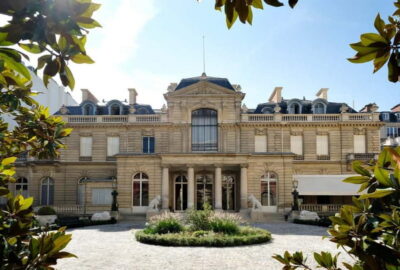
Paris: Splendors of the Baroque at the Jacquemart-André Museum – Entry Ticket
Read our review →
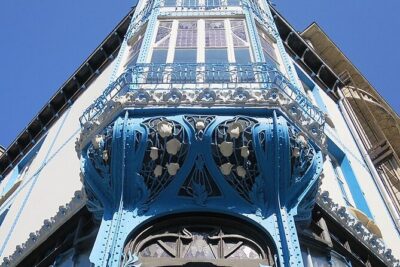
Guided Tour of Nancy, French Capital of Art Nouveau
Read our review →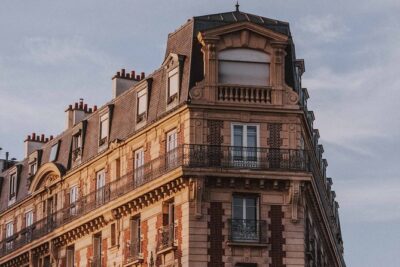
Bastille’s Architecture & Artisans Self-Guided Walking Tour
Read our review →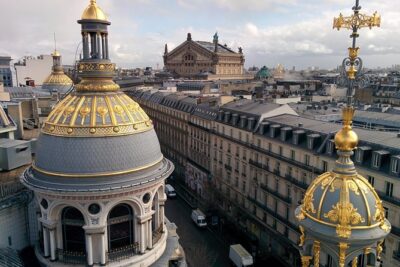
Private Art Nouveau and Art Deco tour near Opera
Read our review →
Paris – Private Guided Tour with Art nouveau Theme
Read our review →Browse the lists this tour appears in