
Review · FRANCE
Dijon Signature Walk: Gothic Landmarks & Ducal Grandeur
Dijon’s old center unfolds in a compact two-hour walk, from the grand Porte Guillaume to Gothic churches, ducal buildings, and the famous owl carving on Notre-Dame. You get the city’s key sights without wrestling with a map or guessing which alley matters.
I like the private format, which lets your group ask questions and set the pace. I also like the useful historical frame, especially the link between Dijon’s streets, the Dukes of Burgundy, and the French monarchy. The main caution is that two hours on foot can feel long for young children or anyone who needs frequent rests.
Key points at a glance
- Porte Guillaume begins the story: Start at an 18th-century arch built over an older medieval gateway.
- Rue de la Liberté leads into old Dijon: This pedestrian street connects grand façades with the lively Place François-Rude.
- The Ducal Palace anchors the route: See the former residence of Burgundy’s dukes, now home to city government and the Musée des Beaux-Arts.
- Notre-Dame rewards close looking: Find its Jacquemart clock, flat Gothic front, Our Lady of Good Hope, and carved owl.
- Tour Philippe le Bon offers a choice: The 45-meter tower has 316 steps and city views, but the climb is not part of the ordinary walking route.
- The price works best for a group: At $444.32 for up to 15 people, the per-person cost improves sharply as your party grows.
Starting at Porte Guillaume on Place Darcy
The tour opens at 2 Place Darcy, beside Porte Guillaume. This is a smart starting point because the arch gives you an immediate sense of Dijon as a city with layers rather than a collection of isolated monuments.
The present gate dates from the 18th century and was built on the site of a 12th-century entrance. It was raised in tribute to the Prince de Condé, then Governor of Burgundy. That detail helps explain the tone of the city center: Dijon was not merely a provincial market town, but an important seat of power.
I like beginning here because you can see the shift from modern Dijon toward the old center in just a few steps. Place Darcy also sits near public transportation, which makes the meeting point practical if you are arriving without a car.
Your guide can use the arch to set up the rest of the walk: medieval defenses, ducal authority, royal influence, and the polished civic buildings that followed. It is a better introduction than simply beginning in front of a church and listing dates.
More Gothic quarter walks in France:
- Gothic Paris – Castles & Cathedrals (Marais History Walk-Small Group Tour)
★ 5.0 · 3 reviews - Barcelona all included: Sagrada, Park Güell, Montjuic & Gothic
★ 5.0 · 2,169 reviews - Barcelona Gothic Quarter Tapas & Taverns Food & Wine Tour
★ 5.0 · 1,470 reviews
Rue de la Liberté and the first old-town views
From Porte Guillaume, the route follows Rue de la Liberté, Dijon’s main pedestrian street. This is not a quiet medieval lane. It is the city’s central shopping route, so you get both daily life and historic architecture in the same stretch.
Look up as you walk. Elegant façades line the street, and the architecture becomes more distinctly old-town as you approach Place François-Rude. The route then brings you near notable 15th-century buildings, including Maison aux Trois Visages and Hôtel Milliere.
This part of the walk is valuable because it teaches you how to read Dijon between the major landmarks. The grand palace and churches get the photographs, but the ordinary façades fill in the city’s character. A guide can point out details you might otherwise pass without noticing.
You should also expect some pedestrian traffic here. The street is easy to walk, but it is not a museum corridor. Shops, passersby, and city noise are part of the setting. That can make the introduction feel more genuine, though visitors seeking a quiet architectural tour may find this section less calm.
Place de la Libération and the power of Louis XIV
The route continues to Place de la Libération, the historic heart of Dijon. It was once called Place Royale in honor of Louis XIV, and its name tells you how political power reshaped the city.
Today, the square is a broad public gathering place centered around the king’s equestrian statue. It is a useful pause in the walking route, with space to take in the relationship between the square and the palace buildings around it.
I especially like this stop for the contrast. The Dukes of Burgundy shaped Dijon before the French monarchy took full control, while the square’s former name recalls the later royal order. One open space lets you trace that change in authority.
The square also gives the tour a natural rhythm. After the narrower streets of Rue de la Liberté and the surrounding old town, you have room to stop, look around, and hear the political background before moving toward the tower and palace.
Tour Philippe le Bon and the 316-step decision
Near the square, you will see Tour Philippe le Bon, a 45-meter tower built between 1450 and 1460. It began as a watchtower and later became a strong symbol of ducal power.
The tower is one of the most striking reminders that Burgundy’s dukes wanted their authority to be visible. Its height would have made a clear statement in the medieval city, long before modern rooftops and taller buildings altered the view.
The tower contains 316 steps and offers panoramic views from the top. That climb is a separate physical challenge from the main walking route, so consider your energy before adding it to the day. The two-hour tour already involves 90 to 120 minutes on foot, and the stairs require a good deal more effort.
If you do climb, the reward is a broad view over Dijon. If you do not, you still gain a useful landmark and a clear explanation of why the tower mattered. I would not treat the climb as essential for enjoying this tour, especially if your group includes children, older relatives, or anyone who dislikes steep stairways.
More architecture walks in France:
- Bastille’s Architecture & Artisans Self-Guided Walking Tour
★ 4.5 · 18 reviews - Strasbourg : Neustadt Architecture Walking Tour
★ 5.0 · 14 reviews - Neoclassical Paris Architecture 2-Hour Private Walking Tour
★ 5.0 · 7 reviews - The Official Art Deco Walking Tour by The Miami Design Preservation League
★ 5.0 · 1,580 reviews
Notre-Dame, the owl, and Gothic details
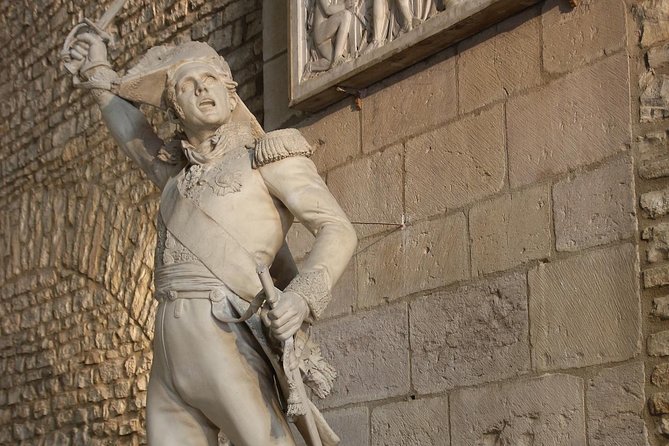
The Church of Our Lady of Dijon is one of the route’s visual highlights. It is a major French Gothic work and part of Dijon’s UNESCO-listed heritage.
Its flat façade is unusual enough to deserve a careful look. The front also includes the statue of Our Lady of Good Hope and the Jacquemart clock, whose clock figures have become one of Dijon’s best-known details.
Then there is the owl carving. It is small compared with the church itself, which is exactly why many people miss it without help. A guide can direct you to the spot and explain its place in local tradition. You will probably see people touching or looking for it, so take a moment rather than rushing past the façade.
This is where the tour’s close-up approach pays off. The church is not just a grand Gothic shell. Its appeal comes from the mix of scale and small detail: the flat front, the clock, the statue, and the owl all reward different kinds of attention.
The stop is also a good reminder to wear comfortable shoes. You are not crossing a vast site, but the route is a sustained city walk over historic streets. Supportive footwear matters more than dressing for a formal palace visit.
The Palais des Ducs and Burgundy’s former rulers
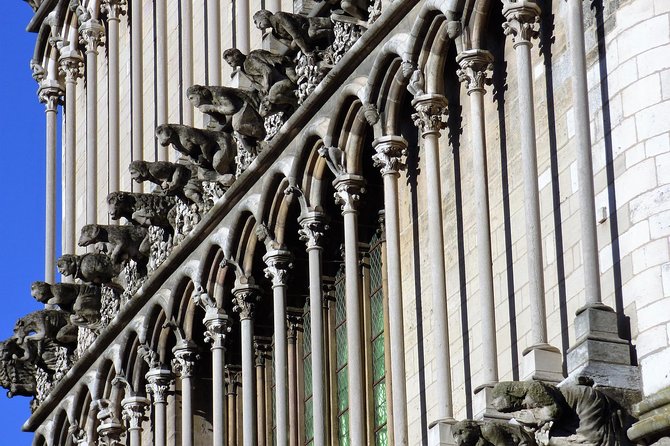
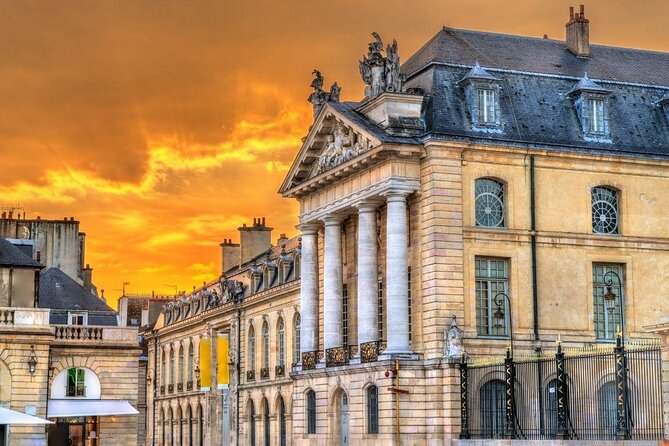
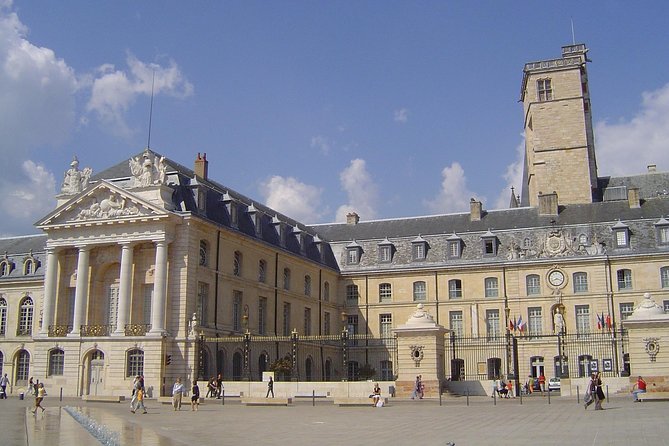
The Palais des Ducs de Bourgogne is the route’s major historical anchor. The complex served as the residence of the Dukes of Burgundy and hosted the Estates of Burgundy, the regional assembly that represented the province.
The palace is made up of several building periods. The oldest sections belong to the Gothic palace built in the 14th and 15th centuries. The classical façade you see today dates from the 17th century, giving the complex a layered appearance rather than one single architectural style.
That mixture is one of the palace’s strengths. You can see how Dijon changed as political power shifted and building fashions changed. The Gothic ducal palace points back to the medieval court, while the classical front reflects a later period under stronger French royal influence.
Today, the complex contains Dijon’s Town Hall and the Musée des Beaux-Arts de Dijon. The museum is one of France’s oldest and richest fine arts museums. The walking tour does not promise an extended museum visit, so plan separate time if you want to explore the collections.
I like the palace stop because it connects architecture to actual government. This was not simply a beautiful residence. It was a working center of regional rule, ceremony, and administration. Once your guide explains that role, the square and surrounding streets make more sense.
Because the palace is central and impressive, you may be tempted to spend much longer here. That is a good reason to view this tour as an introduction rather than a full study of Dijon. It gives you the framework, then lets you return later to the buildings that catch your interest.
Saint-Michel Church and the route’s final note
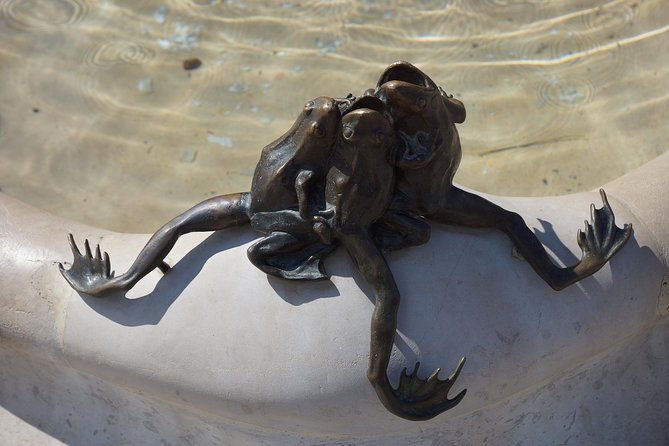
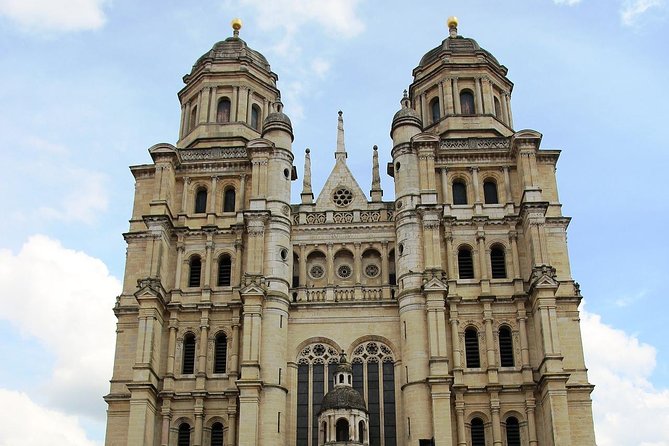
The walk ends at Église Saint-Michel, a 16th-century church known for its Renaissance façade mixed with Gothic elements and Italian artistic influence.
It is a fitting final stop because it adds another style to the architectural sequence. You begin with an 18th-century triumphal arch, pass through medieval streets, see Gothic Notre-Dame and the ducal palace, and finish with a church that reflects Renaissance ideas alongside older Gothic forms.
That progression makes the walk feel like a short lesson in Dijon’s changing tastes. You are not only collecting landmarks. You are seeing how different centuries left their mark on one compact center.
There is an important practical point here. The supplied end-point information names Église Saint-Michel de La Garde-Adhémar, with a La Garde-Adhémar address, even though the route is in Dijon and the final stop is described as Dijon’s Saint-Michel Church. Because those places do not appear to match, confirm the exact ending point and map pin before booking. This is especially important if you have a timed train, restaurant booking, or another activity afterward.
What the private format adds
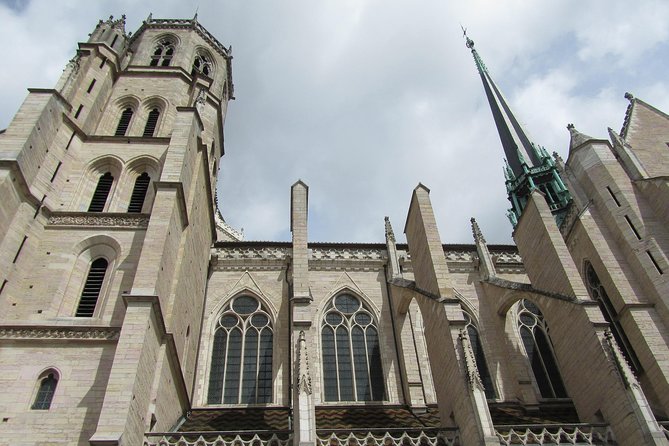
This is a private tour for your group alone, with an English-speaking guide and mobile ticketing. The group limit is 15 people, which makes it suitable for a family, a group of friends, or a small study program.
The strongest benefit is flexibility. If your children need a short pause, or if one building sparks questions, a private guide can respond to your group instead of following a fixed crowd schedule. One group particularly appreciated a guide named Fred for his regional context and his ability to include children, even working in a sorbet stop.
That detail tells you something useful about the style of experience available here. It is not limited to dates and façades. A good guide can connect the city to your group’s interests and adjust the tone for families.
There is one tradeoff. Flexibility can also mean the tour runs longer than planned. One group found that the guide went overtime and students were tired near the end. If you need the walk to finish exactly at the two-hour mark, say so at the beginning and keep an eye on the time.
Price, timing, and who gets the best value
The price is $444.32 per group of up to 15 people. That is a high total for one or two people, but the value changes quickly with group size.
For a full group of 15, the cost works out to about $29.62 per person. For 10 people, it is about $44.43 each. For two people, it is $222.16 each, before gratuities or refreshments. I would consider it sensible for a family or organized group, but expensive for a couple unless private guiding is a high priority.
The walk lasts about two hours, with about 90 to 120 minutes of walking. It is booked, on average, 56 days ahead, so planning early may matter if your dates are fixed. Confirmation is provided at booking, and the experience is non-refundable and cannot be changed after purchase, so check your date, group size, meeting point, and ending point carefully.
The tour is near public transportation, and service animals are allowed. Most people can participate, but the route still calls for comfortable shoes. The 316-step tower climb is a separate consideration, not something to assume is included in the ordinary walk.
Who should book this Dijon walk?
I would choose this experience if you want a clear first look at Dijon’s old center and prefer a private guide to a large group. It suits people interested in architecture, French history, Burgundy’s ducal past, and the way a city’s monuments fit together.
Families may also do well here, especially if the guide is Fred and can keep younger members engaged with a small treat or a change of pace. The private setup gives you more room to ask basic questions without feeling out of place.
I would be more cautious if you have limited mobility, dislike sustained walking, or need a strict finish time. The route is not presented as a specialist accessibility tour, and the possibility of running overtime could matter. Anyone hoping to tour the Musée des Beaux-Arts in detail should also schedule extra time rather than expecting the walk to cover the museum.
Should you book it?
Book this tour if you are new to Dijon, have a group large enough to share the cost, and want the main historic sights explained in one focused walk. The route covers the city’s strongest introduction: Porte Guillaume, Rue de la Liberté, Place de la Libération, Tour Philippe le Bon, Notre-Dame, the Ducal Palace, and Saint-Michel.
Skip it if you prefer exploring alone, plan to spend most of your time inside the museum, or would find $444.32 too steep for a small party. Before paying, verify the Saint-Michel ending address, then wear good shoes and allow a little flexibility beyond the advertised two hours.
FAQ
How long does the Dijon Signature Walk last?
The tour lasts approximately two hours, with about 90 to 120 minutes of walking.
Where does the tour begin?
It begins at 2 Place Darcy, 21000 Dijon, France, near Porte Guillaume.
Where does the tour end?
The route is described as ending at Église Saint-Michel in Dijon. The supplied address also shows Église Saint-Michel de La Garde-Adhémar, so confirm the exact end point before booking.
Is this a private tour?
Yes. Only your group participates, with a maximum group size of 15 people.
Is the Tour Philippe le Bon climb included?
The tower has 316 steps and panoramic city views, but the supplied tour details do not state that the climb is included in the walking tour.
What is included in the price?
The price includes a private guided tour. Gratuities and refreshments are not included.
Just added around France
- Architectural Strasbourg: Private Tour with a Local Expert★ 5.0 · 2 reviews
- Neoclassical Paris Architecture 2-Hour Private Walking Tour★ 5.0 · 7 reviews
- Gothic Paris – Castles & Cathedrals (Marais History Walk-Small Group Tour)★ 5.0 · 3 reviews
- Architectural Bourgeois Paris 19th Century★ 4.0 · 4 reviews
- Architectural Paris: Private Tour with a Local Expert★ 5.0 · 2 reviews
- Paris Art Nouveau Private Tour★ 5.0 · 7 reviews
- Art Nouveau visit to Nancy★ 5.0 · 13 reviews
- Strasbourg : Neustadt Architecture Walking Tour★ 5.0 · 14 reviews
Gothic Quarter Tours, compared.
Barcelona all included: Sagrada, Park Güell, Montjuic & Gothic
Read our review →
Barcelona Gothic Quarter Tapas & Taverns Food & Wine Tour
Read our review →
Barcelona: Gothic Quarter Ghosts and Legends Walking Tour
Read our review →
Barcelona: Old Town and Gothic Quarter Walking Tour
Read our review →
Barcelona Old Town & Gothic Quarter Small Group Tour
Read our review →
Ramblas, Old Town, Gothic and Gaudi Architecture Walking Tour
Read our review →
Barcelona: El Born and Gothic Quarter Wine & Tapas Bar Tour
Read our review →
Kids and Family Gothic Quarter Walking Tour in Barcelona
Read our review →Browse the lists this tour appears in