
Review · PRAGUE
Private Prague Art Nouveau and Cubism Walking Tour
Prague’s medieval center gets most of the attention, but this private walk shifts your eyes toward the city’s daring early-20th-century architecture. You’ll see how curling plant shapes, bold geometry, decorative signs, and new interiors reflected Czech confidence during a fast-changing era.
I like the private format, which lets your guide adjust the pace and explain details that are easy to miss alone. I also like the sharp contrast between Art Nouveau’s flowing lines and Cubism’s hard angles, especially at the House of the Black Madonna and the Czechoslovak Legion Bank.
The main drawback is simple: this is a three-hour walk with several stops, so it is not a good fit if you have limited mobility or want a seated architectural lecture. The price is also high for one or two people, though it becomes more reasonable when shared by a larger group.
Key points to know before booking
- Art Nouveau and Cubism share the spotlight, giving you two very different ideas of modern design.
- The route covers nine stops, including Obecni Dum, Café Imperial, Prague Main Train Station, and Lucerna Arcade.
- A private historian leads the walk, with guides such as Robert Wesley and Bonita bringing history, art, and personal stories together.
- The price is $396.46 per group of up to 10, not per person, which changes the value calculation for families and friend groups.
- You can choose a morning or afternoon departure, with the usual meeting point at Grand Cafe Orient unless hotel pickup is arranged.
- The walk is best for architecture fans, curious first-time visitors, and anyone ready to look beyond Prague’s Gothic and Baroque center.
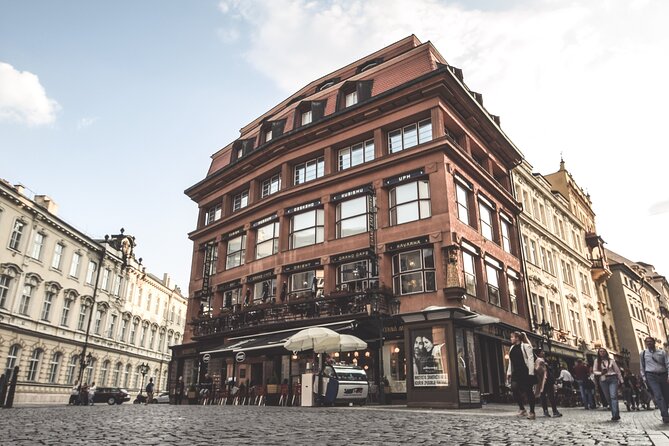
Prague’s modern turn begins at the House of the Black Madonna
The tour opens at the House of the Black Madonna, one of Prague’s best-known Cubist buildings. Its name refers to a statue of the Black Madonna, and the building gives you an immediate lesson in how Cubist design uses sharp, repeated angles rather than the soft curves common in Art Nouveau.
You’ll spend about 10 minutes here. That may sound brief, but the point is not to tour every room. Your guide uses the façade and form to explain why Czech architects adapted Cubism for buildings, furniture, and everyday objects.
This is a useful first stop because it resets your expectations. Prague is often presented as a city of old stone churches and royal streets. Here, you see an early-20th-century effort to create something modern and distinctly Czech.
More Art Nouveau tours in Prague:
- Prague Art Nouveau and Cubism Walking Tour
★ 5.0 · 77 reviews - Prague Art Nouveau and Cubism Walking Tour
★ 5.0 · 29 reviews - Prague: Private Cubism & Art Nouveau Walking Tour
★ 5.0 · 15 reviews
Obecni Dum shows Art Nouveau at full volume
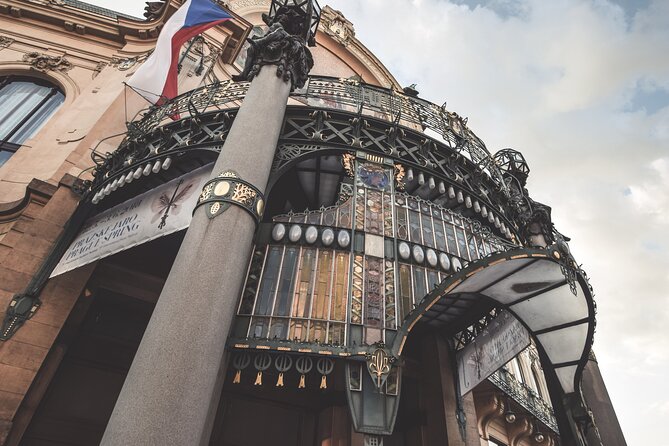
From there, the route reaches Obecni Dum, or the Municipal House, one of Prague’s major Art Nouveau buildings. You can expect about 15 minutes of discussion outside and around the building, with attention to its decorative façade and the way architecture, painting, sculpture, lighting, and interior design work together.
Art Nouveau can be easy to reduce to flowers and curving lines. Your guide should help you see the larger idea: the style aimed to make the whole setting feel designed, from the building front to the lamps, signs, furniture, and wall decoration.
Look for the plant forms that appear throughout the period. Ginkgo biloba leaves are especially useful clues because they point to the style’s interest in Japanese and other Asian artistic influences. These details help explain why the period felt fresh at the time, rather than merely decorative to modern eyes.
K+K Hotel Central and Café Imperial reveal the era’s optimism
The K+K Hotel Central Prague is presented as Prague’s first Art Nouveau building. You’ll have about 10 minutes here, enough to examine the exterior and hear how this new style fit a city eager to join wider European artistic movements.
The building is more than a design exercise. It reflects a period when Prague was looking outward and embracing new tastes in architecture, print, interiors, and public life. Curving typography, elaborate fittings, and ornamental façades all formed part of that shift.
The next stop, Café Imperial, lasts about five minutes. The focus is its Art Nouveau interior, where decorative surfaces create a very different mood from the angular House of the Black Madonna. Since the stop is short, think of it as a quick visual lesson rather than a long café break.
Food and drinks are not included, so you should not assume this part of the walk includes a meal. The value is in seeing how the café setting carried the same design language into daily life.
The Legion Bank brings Cubism into public architecture
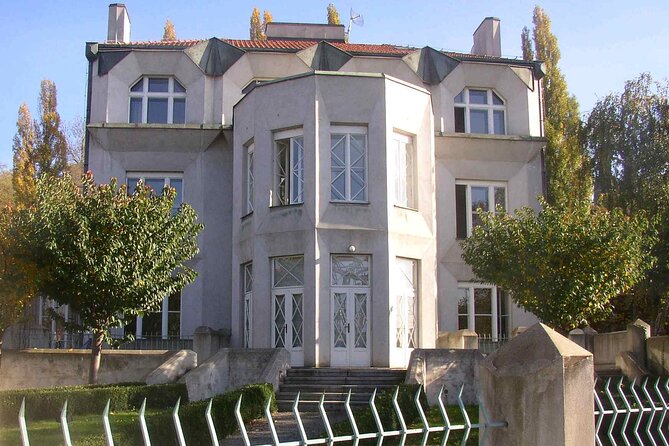
The Czechoslovak Legion Bank offers one of the more unusual stops on the route. Its architecture is Cubist, and its interior is dedicated to the Czechoslovak Legion of the First World War.
You’ll spend about 10 minutes here. The building lets your guide connect design with national identity, politics, and memory. Cubist architecture can seem purely abstract at first, but this stop gives it a human and civic setting.
I find this kind of connection especially useful. You are not just learning to identify a zigzag façade. You are considering why a country might choose a bold new style for a bank, and how architecture can express ideas about national strength and independence.
More architecture walks in Prague:
- Prague Renaissance & Baroque Gardens Walking Tour
★ 5.0 · 23 reviews - Private Prague Art Nouveau and Cubism Walking Tour
★ 5.0 · 8 reviews - Private Prague Renaissance & Baroque Gardens Walking Tour
★ 5.0 · 8 reviews - Prague Renaissance and Baroque Gardens Walking Tour
★ 5.0 · 5 reviews
Prague Main Train Station adds a grand Art Nouveau interior
Prague’s main train station is another strong point on the walk. The station includes a magnificent Art Nouveau dome, and you’ll spend roughly 15 minutes discussing the interior.
Train stations often tell you how a city wanted to present itself to people arriving from elsewhere. The dome and decoration gave a practical public building a sense of ceremony. It also shows how Art Nouveau was not limited to private homes or fashionable cafés.
This stop is valuable because it puts the style in a working urban setting. You see the period’s decorative ambition applied to transportation, commerce, and public movement. The station also gives the route a change of scale after the smaller details of cafés and façades.
Wenceslas Square mixes Art Nouveau with Art Deco
At Wenceslas Square, expect about 15 minutes focused on the square’s Art Nouveau and Art Deco buildings. This is a good place to compare styles across a broader city setting.
Art Nouveau favors organic shapes, flowing lines, and ornament inspired by plants. Art Deco, which came later, tends to use stronger symmetry, clean geometry, and a more streamlined look. Seeing the two around the same square helps you notice that architectural styles do not always arrive in neat, separate blocks.
Your guide also places the buildings in the story of Prague’s changing identity. The square is not just a pretty urban space. It is part of the city’s public life, and its buildings show how tastes shifted as the 20th century progressed.
Lucerna Arcade reveals Art Nouveau in an intimate setting
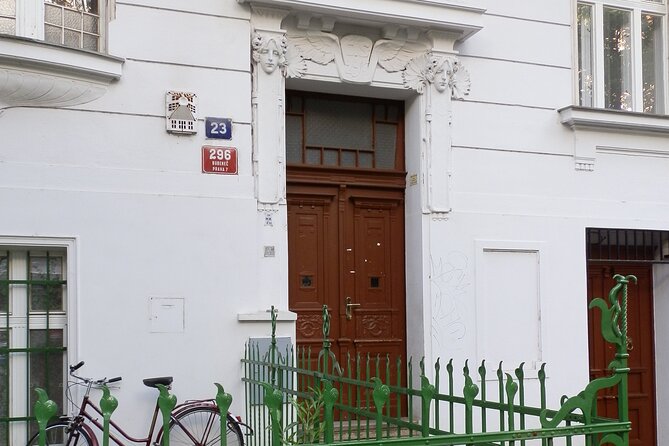
Lucerna Arcade is one of the most appealing stops for people who like interiors. You’ll spend about 10 minutes viewing the Art Nouveau design of this Prague passageway.
Arcades reward close looking. Instead of one monumental façade, you get a sequence of ceilings, lamps, signs, balconies, and decorative surfaces that create a whole atmosphere. Your guide can point out how the style shaped the experience of moving through a commercial space.
This is also where the tour reaches beyond famous exterior views. You get a sense of how Art Nouveau worked at street level, in places people used for shopping, meeting, and passing through the city.
A dead horse and King Wenceslas change the mood
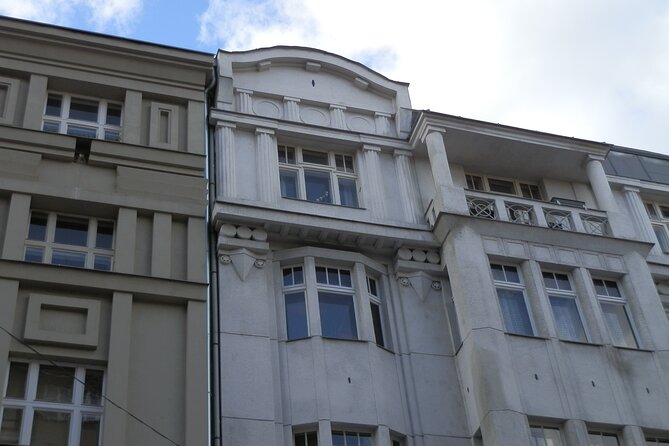
The final stop is the contemporary sculpture of King Wenceslas riding an upside-down dead horse. It is an unexpected ending after a tour filled with historic buildings and ornamental detail.
You’ll spend about 10 minutes discussing the sculpture’s symbolism in relation to Czech history and the Czech National Revival. The work asks you to consider how modern artists reinterpret national symbols, rather than simply preserving them.
This stop gives the tour a useful final twist. You finish by thinking about how Prague continues to argue with its past through art. The route is not only about identifying old styles. It also asks how a city remembers, questions, and reshapes its own symbols.
What the private guide adds to the walk
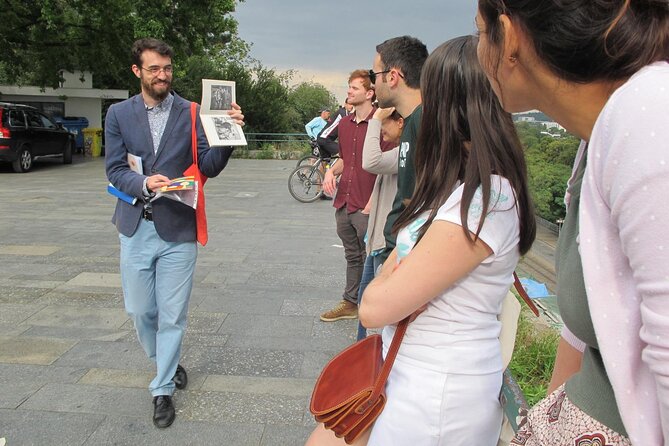
The guide is the main reason to choose this experience instead of following an architecture book on your own. A good guide can point out a ginkgo leaf, a lamp, or a letterform, then explain why it matters.
Robert Wesley has led this experience with an energetic approach that combines Prague’s buildings with personal stories. His background includes a Czech-born mother and a Nigerian father, and his own connection to Prague can add a human layer to the architectural discussion.
Bonita has also guided the walk, bringing together art, architecture, culture, and history. That range matters because these buildings make more sense when you understand the society around them. You are not simply memorizing dates and style names.
Because the tour is private, your group can ask questions without worrying about slowing down a large crowd. You can focus on interiors, national identity, design details, or the period’s connection to wider Europe, depending on your interests.
How much walking and time should you expect?
The advertised duration is about three hours. The nine stops have planned discussion times ranging from five to 15 minutes, but the experience is still a continuous city walk rather than a series of isolated visits.
You should be comfortable walking between central Prague locations and remaining on your feet for much of the time. One participant specifically described the walk as unsuitable for people with mobility limitations, so consider this carefully before booking.
Wear comfortable shoes and avoid scheduling a demanding activity immediately afterward. The route is not described as difficult hiking, but three hours on city streets can feel tiring, especially if you are trying to keep up while taking photographs.
Morning and afternoon departures are available. If you want softer light for exterior photographs, you can ask about timing, though the supplied details do not promise a particular lighting condition or access to every interior.
The meeting point, pickup, and group size
Unless hotel pickup has been arranged, meet your guide 15 minutes before the start at Grand Cafe Orient, Ovocný trh 19 in Prague 1. The tour ends in Prague, and the activity is offered in English with a mobile ticket.
Hotel pickup may be arranged, but hotel pickup and drop-off are not included as standard. Confirm this before assuming the guide will come to your accommodation.
The activity is private for your group only, with up to 10 people. That makes a major difference to the price. At $396.46 per group, one or two people pay a premium for privacy. A group of six to 10 people gets much better value per person while keeping the flexibility of a private guide.
The booking pattern suggests that this experience is often reserved about eight days ahead. That is not a rule, but it is sensible to plan ahead if you have a fixed Prague schedule or want a particular departure time.
Is $396.46 good value for a private architecture walk?
For a solo visitor or couple, the cost is substantial. You are paying for a private historian, not admissions, food, or a long list of included extras. The tour’s value depends on how much you care about architecture and how useful a personal guide would be.
For a family or group of friends, the calculation improves quickly. Ten people sharing the price would pay about $40 each, before any booking details or taxes that may apply. A smaller group of four would pay about $99 each.
The free admission at the listed stops keeps the focus on guiding rather than ticket access. You are paying for interpretation, route planning, and the ability to ask questions. If you prefer a self-guided walk and already enjoy reading architectural details, the price may feel high.
I would choose it for a group that wants a focused, well-organized look at Prague’s early modern architecture. I would skip it if your main goal is entering major museums, eating at cafés, or seeing the city’s medieval sights.
Who will get the most from this experience?
This walk suits you if you enjoy buildings but want help seeing more than the postcard view. It is especially useful for:
- First-time Prague visitors who have already seen, or plan to see, the major Gothic and Renaissance sights
- Art, architecture, design, and urban history enthusiasts
- Families and friend groups that can share the private-group cost
- Visitors who prefer asking questions to listening to a fixed speech
- People interested in Czech identity and the country’s turn toward modern European culture
It is less suitable if you have limited mobility, dislike long walks, or want plenty of time inside each location. The stop at Café Imperial, for example, is only about five minutes, so this is not designed as a leisurely café tour.
The tour also works best when you are willing to look closely. If you only want a list of famous places, the route may feel slow. If you enjoy noticing signs, lighting, plant shapes, geometry, and interiors, it gives you a new way to read Prague.
Should you book the Prague Art Nouveau and Cubism walk?
Book it if you want a private, three-hour architecture lesson on the streets of Prague, especially with a group large enough to share the cost. The route covers a fine mix of façades, public buildings, cafés, arcades, a train station, and one provocative modern sculpture.
I would book it early if the timing matters, and I would arrive 15 minutes early at Grand Cafe Orient unless a different pickup has been arranged. Wear good walking shoes and treat the walk as an active outing, not a seated tour.
Skip it if your Prague plans already center on medieval sights and you have little interest in 19th and 20th-century design. But if you want to understand why Prague feels more than Gothic, this is a smart way to see the city’s modern side.
FAQ
How long does the private Prague Art Nouveau and Cubism tour last?
The tour lasts approximately three hours.
How much does the tour cost?
The price is $396.46 per group of up to 10 people.
What language is the tour offered in?
The tour is offered in English.
Where does the tour begin?
Unless hotel pickup has been arranged, meet the guide 15 minutes before the start at Grand Cafe Orient, Ovocný trh 19, Prague 1.
Is hotel pickup included?
Hotel pickup may be arranged, but hotel pickup and drop-off are not included as standard.
What places are included on the walking route?
Stops include the House of the Black Madonna, Obecni Dum, K+K Hotel Central Prague, Café Imperial, the Czechoslovak Legion Bank, Prague Main Train Station, Wenceslas Square, Lucerna Arcade, and the upside-down statue of King Wenceslas riding a dead horse.
Can I cancel the tour for a full refund?
Yes. You can cancel at least 24 hours before the experience begins for a full refund. Cancellations or changes made less than 24 hours before the start time are not accepted for a refund.
Just added around Prague
- Private Prague Art Nouveau and Cubism Walking Tour★ 5.0 · 8 reviews
- Best of Prague Architecture – private tour with PERSONAL PRAGUE GUIDE★ 5.0 · 21 reviews
- Private Prague Renaissance & Baroque Gardens Walking Tour★ 5.0 · 8 reviews
- Prague Renaissance & Baroque Gardens Walking Tour★ 5.0 · 23 reviews
- Prague: Private Prague Art Nouveau and Cubism Tour★ 4.8 · 6 reviews
- Prague Renaissance and Baroque Gardens Walking Tour★ 5.0 · 5 reviews
- Prague: Private Cubism & Art Nouveau Walking Tour★ 5.0 · 15 reviews
- Prague: Modern Architecture and Design Guided Tour★ 3.9 · 20 reviews
Art Nouveau Tours, compared.
Riga: Old Town Walking Tour with Art Nouveau Highlights
Read our review →
Riga: 2-Hour History of Art Nouveau Walking Tour
Read our review →
Brussels: Art Nouveau Pass – Entry to Three Locations
Read our review →
Small Group Tour in Ålesund: Art Nouveau, Sea Views & Insider Tips
Read our review →
Browse the lists this tour appears in