
Review · PRAGUE
Private Prague Art Nouveau and Cubism Walking Tour
Prague’s Art Nouveau and Cubist buildings are easy to miss if you stick to the castle, Charles Bridge, and Old Town lanes. This private tour changes that. You move from the grand halls of Central Station to Prague’s sharp-edged Cubist houses, learning how a city known for Gothic towers also became a testing ground for daring modern design. I especially like the contrast between the flowing lines of Art Nouveau and the crystal-like angles of Czech Cubism. I also like the way the route reaches ordinary streets and apartment buildings, not just famous monuments.
Guide Max Hutar brings a clear passion for the subject and adjusts to the group’s interests. The main caution is pace: there is plenty of walking, a public transport leg, and the tour can run beyond its advertised two and a half hours. It is a strong choice for architecture fans, but less suited to anyone wanting a relaxed, seated sightseeing outing.
Key points to know before booking
- You see two very different styles: Art Nouveau curves and decoration give way to Prague’s angular, experimental Cubism.
- The route includes major interiors and everyday buildings: Central Station, Municipal House, banks, hotels, apartment houses, and street furniture all play a part.
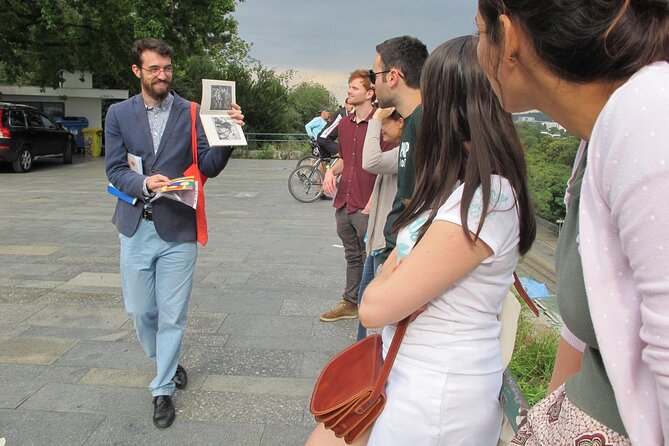
- Max Hutar leads the private experience: Your group has the guide’s full attention, with space for questions and discussion.
- The tour travels beyond the central core: The final stops near Vyšehrad and the Vltava River show a quieter side of Prague’s modernist architecture.
- Public transport is part of the plan: Short walks connect the stops, and a transport ticket is used for the later section.
- The price works best for a group: At $94.93 for up to 15 people, the cost per person drops sharply when shared by several guests.
Why Prague is the right city for this tour
Prague is often sold through its medieval center, and rightly so. Yet the city’s early twentieth-century architecture tells another story. Around 1900, Prague was changing fast. New streets, hotels, banks, department stores, cultural buildings, and apartment houses gave architects room to experiment.
Art Nouveau was the first major style on this route. Look for plant-like ornament, curved lines, decorative metalwork, mosaics, stained glass, and façades that seem to move upward. Prague’s version often feels more solid and urban than the delicate Parisian examples many people know.
Cubism arrived with a sharper edge. Czech architects took the broken planes and geometric forms of Cubist painting and turned them into buildings. In Prague, the style did not remain limited to galleries. It appeared in houses, cafés, shops, interiors, and even a lamppost. That is what makes this outing so useful: you learn to recognize the details, then begin spotting them on your own.
More Art Nouveau tours in Prague:
- Prague Art Nouveau and Cubism Walking Tour
★ 5.0 · 77 reviews - Private Prague Art Nouveau and Cubism Walking Tour
★ 5.0 · 30 reviews - Prague Art Nouveau and Cubism Walking Tour
★ 5.0 · 29 reviews
Central Station and the Moorish Jerusalem Synagogue
Begin at Prague Main Station, where the historical building opened in 1909. The station’s reconstructed halls and corridors offer a fine first lesson in Prague Art Nouveau. You do not need to know architectural terms to appreciate the effect. Look for the decorative treatment of a building designed for a practical purpose, and notice how a railway station was given the dignity of a civic monument.
The station visit lasts about 15 minutes and has no admission charge. It is a sensible starting point because it puts you inside the architecture rather than leaving you to study a façade from the pavement.
A short stop follows at Jerusalem Synagogue, built in 1906. Its Moorish design is immediately different from the station, yet Art Nouveau details are worked into the building. The five-minute visit is brief, and admission is not included, so do not expect a full interior tour as part of the standard timing. Still, the stop helps show that Prague’s architects were mixing influences rather than following one strict formula.
New Town’s apartment houses and Hotel Central
At Senovážné Square, you see three luxurious apartment buildings from the Art Nouveau period. This is one of the route’s practical strengths. Monumental buildings can make a style seem remote, but apartment houses show how design shaped daily urban life.
The stop takes about five minutes, with no admission charge. You will want to look upward at the façades, where decoration, balconies, windows, and sculptural details work together. Max’s explanation matters here because many of the most interesting features are high above street level.
The next stop is Hotel Central at Hybernská 10. Dating from 1899, it is among Prague’s early Art Nouveau buildings. Again, the visit is short and admission is not included. Think of it as a focused exterior stop, useful for seeing how the style developed before reaching its grandest expression at the Municipal House.
Municipal House, Prague’s Art Nouveau showpiece
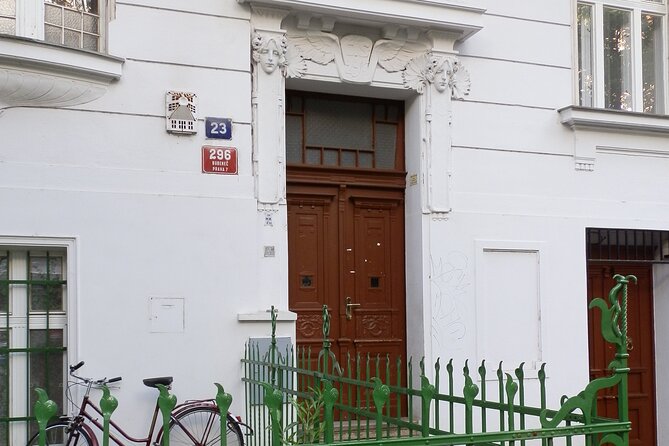
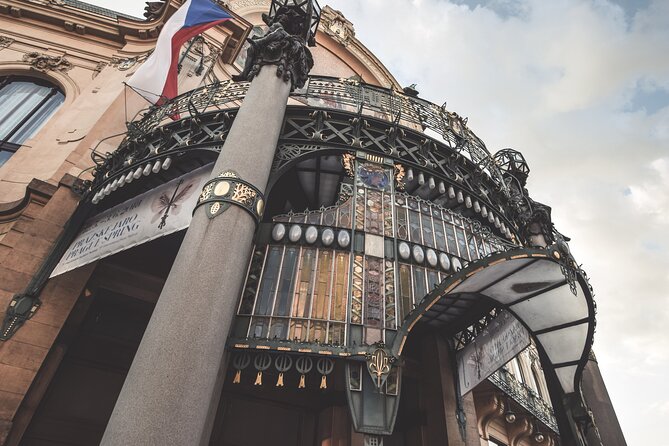
The Municipal House is the major Art Nouveau stop in the first half of the tour. Projected in 1905, it remains a cultural and representative center for Prague. Its scale and decorative detail give you a clearer sense of how the style could shape an entire public building.
The standard stop lasts about 10 minutes, and admission is not included. That matters. If you want a longer interior visit or access beyond the areas used during the tour, you should confirm arrangements before booking. The listed experience focuses on architectural explanation, not a separate extended admission visit.
Even with limited time, Municipal House gives the tour a strong visual anchor. By this point, you have seen a station, synagogue, apartment houses, and hotel. Here, those ideas come together in a building designed to make civic life feel grand.
More architecture walks in Prague:
- Prague Renaissance & Baroque Gardens Walking Tour
★ 5.0 · 23 reviews - Prague: Private Cubism & Art Nouveau Walking Tour
★ 5.0 · 15 reviews - Private Prague Renaissance & Baroque Gardens Walking Tour
★ 5.0 · 8 reviews - Prague Renaissance and Baroque Gardens Walking Tour
★ 5.0 · 5 reviews
The House at the Black Madonna introduces Cubism
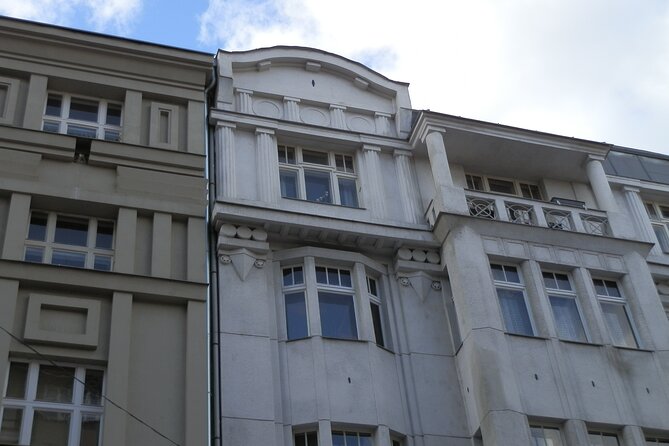
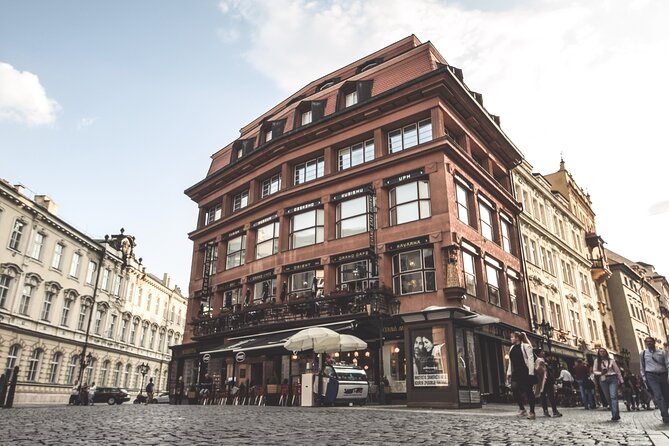
The House at the Black Madonna, completed in 1912, is the route’s key Cubist building. Its central location makes it easy to compare with the older architecture around it, while its disciplined geometric design makes the change in style obvious.
Prague Cubism is not simply a building with a few angular decorations. The goal was to give the whole structure a sense of facets and planes. The House at the Black Madonna is the clearest early example on the route, and it works well as a transition from Art Nouveau’s flowing decoration to Cubism’s hard geometry.
The stop lasts about 10 minutes, and admission is not included. That may be a drawback if you hoped to spend time inside. The building is still valuable from the street, but the experience depends on Max explaining what you are seeing and why it matters.
Na Příkopě and the radical Cubist lamppost
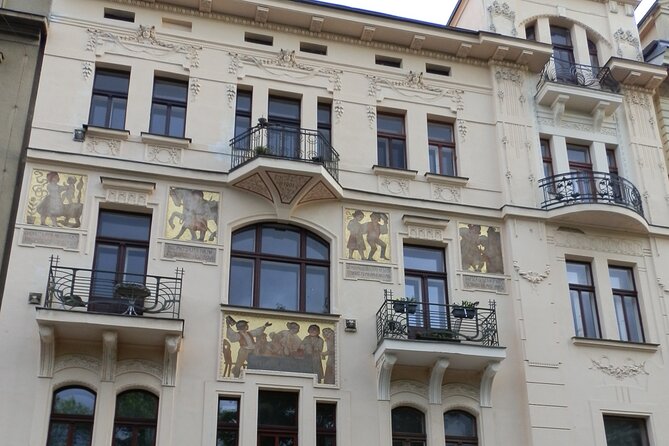
Na Příkopě marks the border between Prague’s Old Town and New Town. Several banks and other buildings here show the city’s polished Art Nouveau side. The five-minute stop is quick, but the street gives you a useful comparison between commercial architecture and the public buildings already seen.
Then comes one of the tour’s most unusual details: Emil Králíček’s Cubist lamppost. It is easy to walk past street furniture without giving it a second glance. Here, a lamppost becomes a small but serious piece of architectural design.
That detail tells you something important about Prague Cubism. The style was not only applied to large buildings. It could reach into the objects that shaped the street itself. The stop is free and lasts about five minutes, but it may be one of the moments you remember most clearly because it is so unexpected.
Wenceslas Square and Vodičkova’s mixed modernism
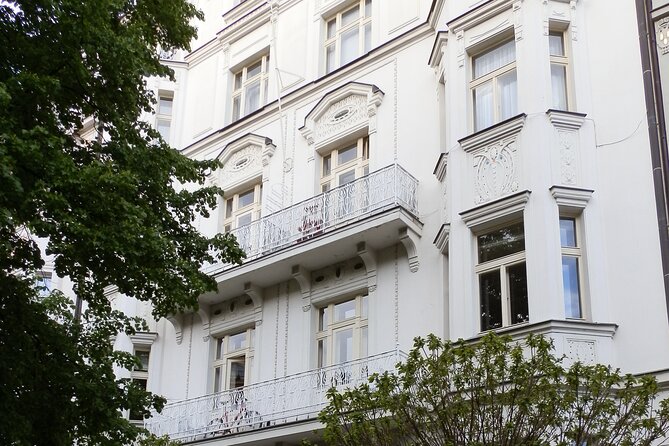
Wenceslas Square provides a broader look at central Prague’s Art Nouveau commercial life. The square includes hotels and department stores with decorated façades, and the tour allows about 20 minutes here. That extra time is welcome. The square is large, and you need a moment to compare its buildings rather than rush past them.
The route then continues along Vodičkova, where Art Nouveau and Cubist buildings appear together. This is where the earlier explanations begin to pay off. Instead of simply being told that a building belongs to a certain style, you can start testing your own eye. Is the façade soft and plant-like, or does it break into strong planes and angles?
The stop at Vodičkova lasts about 10 minutes and is free. It is not a museum visit, so the pleasure comes from reading the street. You may find the shifting mix of styles more interesting than a single isolated monument.
Three Cubist Houses beneath Vyšehrad
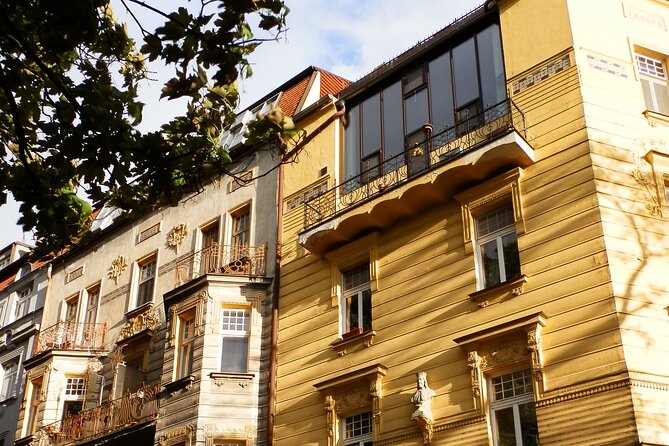
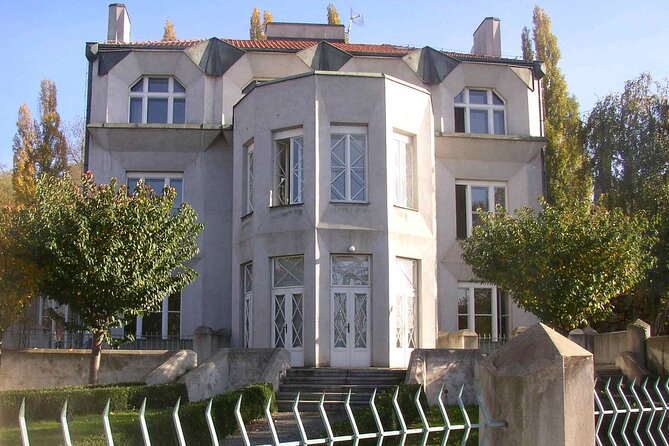
The tour later moves toward the area beneath Vyšehrad fortress to see the Three Cubist Houses. This group is among Prague’s best-known Cubist constructions. The setting gives the buildings a different feeling from those in the commercial center. They are less about a grand civic statement and more about how a bold style could shape residential architecture.
The listed stop lasts about five minutes, and admission is not included. That is enough for a close look and an explanation, but not a long architectural study. If you are passionate about design, you may wish the schedule allowed more time at several of the later locations.
Still, the houses are important because they show Cubism working as a complete building language. Their forms are not a decorative layer added to a conventional block. The structure itself carries the style.
Villa Kovařovic and the final street view
Villa Kovařovic sits by the Vltava River and dates from 1912. Its design draws on Gothic and Baroque sources while using Cubist ideas. That blend is one of the tour’s most useful lessons: Prague’s architects were not rejecting the past. They were reshaping older references into a new visual language.
The visit lasts about 10 minutes, with admission not included. Its riverside location also gives the route a change of mood after the busy central streets. You see how Cubism could work on a villa, not only on urban apartment blocks.
The final stop is on Neklanova, where an apartment building from 1913 brings the tour to a close. It is a fitting ending because the route finishes with another building integrated into an ordinary street. The point is not just to admire famous landmarks. It is to learn how to notice Prague’s architectural character in places you might otherwise pass without a glance.
How the timing and transport work
The experience lasts about two and a half hours, but the stop times do not add up to the full duration. That is because the route includes walks between locations and public transportation during part of the tour.
This is not a nonstop march from one façade to the next. The movement between districts is part of the design, but you should still wear comfortable shoes. One direct comment about the experience is worth taking seriously: the tour can last longer than the advertised time.
The starting point is Prague Main Station at Wilsonova 300/8. The tour ends near Albertov tram stop, at Na Slupi 2102/2b. The same public transport ticket used for the final part remains valid long enough for you to return toward central Prague. That is a helpful touch, especially if you do not want to work out a separate route back.
The tour is offered in English and uses a mobile ticket. It is private, so only your group participates, with a maximum group size of 15. A small group should make it easier to ask questions and keep the discussion tailored to your interests. A larger group can still be good value, but it may feel less intimate.
Is $94.93 good value?
At $94.93 per group, the price is not a per-person charge. Two people would pay about $47.47 each, while a group of four would pay about $23.73 each. With 10 people, the cost drops below $10 per person.
That makes the tour particularly appealing to families, friends, conference groups, and other small parties. You are paying for a private guide, not a large shared walk. The value is strongest if your group already has an interest in architecture or wants a custom discussion rather than a broad introduction to every Prague sight.
Admission fees are not included at several stops, including Jerusalem Synagogue, Hotel Central, Municipal House, the House at the Black Madonna, the Three Cubist Houses, and Villa Kovařovic. The standard schedule gives short visits, so check what you want to enter before assuming the fee covers an extended interior tour.
Who will enjoy this most?
I would choose this experience if you want a fresh way to understand Prague. It suits architecture and design fans, photographers, art students, history-minded visitors, and anyone who has already seen the main medieval sights.
It also works well early in a stay. Several people who took the tour found that they could identify Art Nouveau and Cubist details on their own afterward. That is the real payoff. You do not just collect a list of buildings. You gain a visual habit that can improve the rest of your time in the city.
I would be more cautious if you have limited mobility, dislike walking, or want a calm tour with long stops inside buildings. The route includes pavement walking, changes of location, and public transport. Service animals are allowed, and most people can participate, but the pace and length are worth keeping in mind.
Should you book the Prague Art Nouveau and Cubism tour?
Book it if you want Prague beyond the postcard sights and like the idea of learning how to read buildings. Max Hutar’s enthusiasm and clear command of the subject are central to the experience, and the private format gives your group room to ask questions.
Skip it if your main goal is medieval Prague, castle interiors, or a slow museum visit. For the right audience, though, this is a distinctive and fairly priced way to see the city. Bring comfortable shoes, allow more than two and a half hours if your schedule permits, and arrive ready to look above shop signs and street traffic. Prague’s boldest architecture is often hiding in plain sight.
FAQ
How long does the tour last?
The advertised duration is approximately two hours and 30 minutes. The experience can sometimes run longer, and the total time includes walking between stops and public transportation.
Where does the tour begin?
It begins at Prague Main Station, Wilsonova 300/8, Vinohrady, Prague 2.
Where does the tour end?
The tour concludes near the Albertov tram stop at Na Slupi 2102/2b, Nové Město, Prague 2.
Is the tour private?
Yes. Only your group participates, and the maximum group size is 15 people.
What language is offered?
The tour is offered in English.
Who leads the tour?
The guide is Max Hutar, associated with Prague Articulate.
Is transportation used during the tour?
Yes. The route includes public transportation for part of the experience. The ticket used for the final section remains valid long enough to return toward central Prague.
Are admission fees included?
Admission is listed as not included for Jerusalem Synagogue, Hotel Central, Municipal House, the House at the Black Madonna, the Three Cubist Houses, and Villa Kovařovic. Several exterior stops have no admission charge.
Is the tour suitable for most people?
Most people can participate, and service animals are allowed. You should still expect walking, changes of location, and some time on public transportation.
Can I cancel for a full refund?
Yes, if you cancel at least 24 hours before the local start time. Cancellations or changes made less than 24 hours in advance are not accepted for a refund.
Just added around Prague
- Best of Prague Architecture – private tour with PERSONAL PRAGUE GUIDE★ 5.0 · 21 reviews
- Private Prague Renaissance & Baroque Gardens Walking Tour★ 5.0 · 8 reviews
- Prague Renaissance & Baroque Gardens Walking Tour★ 5.0 · 23 reviews
- Prague: Private Prague Art Nouveau and Cubism Tour★ 4.8 · 6 reviews
- Prague Renaissance and Baroque Gardens Walking Tour★ 5.0 · 5 reviews
- Prague: Private Cubism & Art Nouveau Walking Tour★ 5.0 · 15 reviews
- Prague Art Nouveau Tour★ 4.9 · 12 reviews
- Prague: Modern Architecture and Design Guided Tour★ 3.9 · 20 reviews
Art Nouveau Tours, compared.
Riga: Old Town Walking Tour with Art Nouveau Highlights
Read our review →
Riga: 2-Hour History of Art Nouveau Walking Tour
Read our review →
Brussels: Art Nouveau Pass – Entry to Three Locations
Read our review →
Small Group Tour in Ålesund: Art Nouveau, Sea Views & Insider Tips
Read our review →
Browse the lists this tour appears in