
Review · INDIA
British Architecture Walk, an immersive walking tour in Chennai
Chennai’s British Architecture Walk turns a busy part of the city into an open-air lesson in design, empire, railways, and public life. You move from the grand Egmore and Central railway stations to the Indo-Saracenic buildings near the Marina, with a local guide explaining why each structure looks the way it does. I like the small group limit of 15, which gives you a better chance to ask questions than on a large city tour.
I also like the practical route: it starts at Egmore and finishes near the University of Madras, so you see several important buildings without spending the whole day on a bus. Coffee, tea, and snacks are provided, and guides such as Hareesh and Satish have brought warmth and useful local detail to the walk. The main drawback is that some admission tickets are not included, and the 2.5-hour schedule leaves limited time at each stop.
Key points to know before booking

- Egmore and Central stations open the tour with two very different railway styles, Indo-Saracenic at Egmore and Gothic Revival at Central.
- The route covers eight major sites, including Ripon Building, Southern Railway Headquarters, Napier Bridge, Senate House, and the Victory War Memorial.
- A maximum of 15 people keeps the walk personal, with room for questions and conversation.
- Coffee, tea, and snacks are included, while hotel pickup and drop-off cost extra if you choose that option.
- Some admission tickets are included and some are not, so the experience is partly an architectural walk and partly an exterior-focused city tour.
- The walk begins at Chennai Egmore and ends at the University of Madras, making the route useful for seeing central Chennai on foot.
Why Chennai’s railway stations make a strong beginning
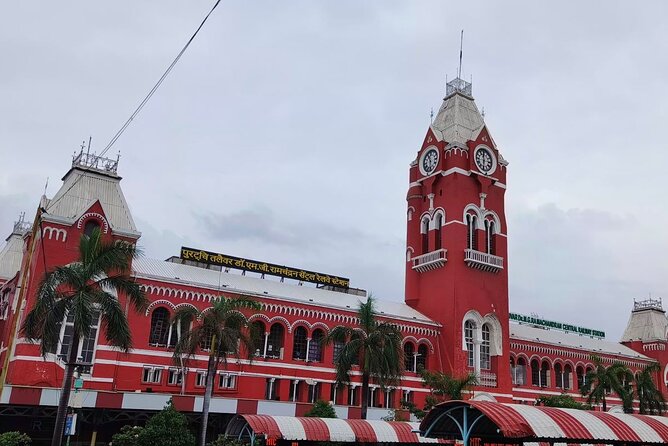
The tour starts at Chennai Egmore, where the first lesson is about a building more than a century old. Egmore Railway Station is one of the early examples of Indo-Saracenic design in Chennai, a style that mixed European planning with Indian decorative forms.
The building was designed by Henry Irwin and was intended to be larger than London’s Charing Cross station. That comparison gives you a useful sense of the ambition behind British-era public buildings. This was not simply a place to catch a train. It was also a statement about the importance of rail travel and the power of the administration that built it.
You have about 20 minutes here. That is enough for a guide to point out the broad design character and explain why Egmore matters, but it is not a long architectural study. Admission is included, which makes this one of the easier stops for getting close to the building rather than viewing it only from the street.
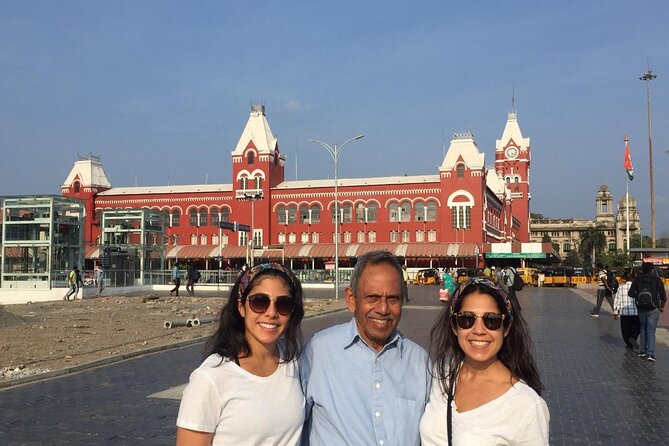
Next comes Chennai Central Railway Station, built in 1873 in the Gothic Revival style by British architect George Harding. The station was later modified by Robert Chisholm, who added the central clock tower and Travancore caps on the main towers.
This stop lasts about 30 minutes, the longest scheduled visit on the route. That extra time makes sense. Central is one of the walk’s key contrasts with Egmore. Instead of focusing mainly on Indo-Saracenic forms, your guide can draw attention to the pointed Gothic character and later changes that shaped the building.
Admission is included here too. The station remains an active transport hub, so you should expect a public setting rather than a quiet museum. That is part of the appeal, but it also means the experience can feel more urban and less controlled than a formal heritage site.
More architecture walks in India:
- Mumbai heritage walk- Story of Gothic and Art Deco buildings
★ 5.0 · 33 reviews - Victorian Gothic Heritage Quarter and Art Deco Walking Tour
★ 4.9 · 14 reviews - Victorian Gothic Heritage Quarter and Art Deco Walking Tour
★ 4.5 · 13 reviews
Victoria Public Hall and the civic face of British Chennai
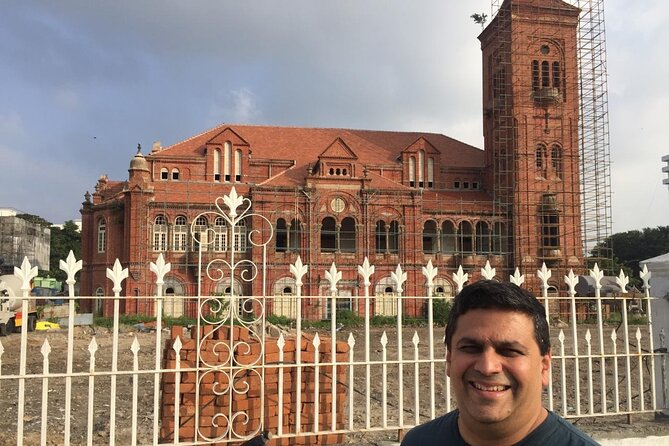
Victoria Public Hall opened in 1887 to mark the Golden Jubilee of Queen Victoria. The building was named for the queen and served as a venue for public meetings and entertainment.
You get around 20 minutes here. The important point is not only the building’s age. It also shows how architecture helped create spaces for civic life during the colonial period. A public hall could host gatherings and performances, making it different in purpose from a railway station or government office.
The ticket is not included at this stop. That matters if you expect to go inside every building on the route. The tour still gives you a useful look at the structure and its place in Chennai’s civic story, but you should not assume that every stop includes interior access.
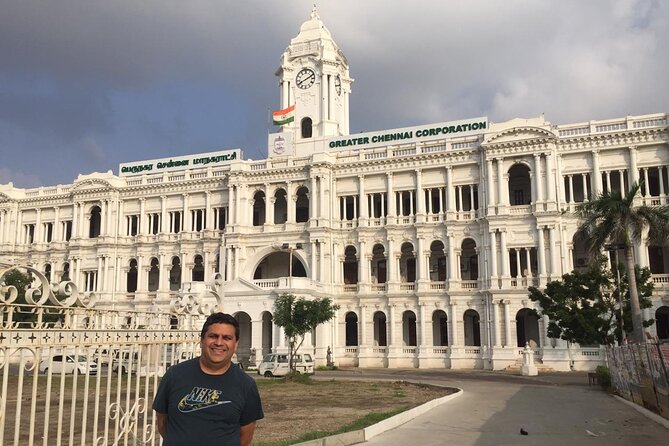
From here, the walk continues to the Greater Chennai Corporation Office, better known as Ripon Building. It was commissioned in 1913, designed by G.S.T. Harris, and built by Loganatha Mudaliar. The building was named after Lord Ripon, a Governor-General of India.
You have about 15 minutes here. Ripon Building represents the administrative side of British Chennai, with a formal civic identity that differs from the railway stations and public hall. The short visit works best if you listen closely to the guide’s explanation of the building’s name, date, and function.
Admission is not included. Treat this as a planned architecture stop rather than a guaranteed interior visit.
Southern Railway Headquarters and the Indo-Saracenic blend
The Southern Railway Headquarters is another important example of Indo-Saracenic architecture. It was designed by N. Grayson and built by Samynada Pillai, with construction completed in 1921.
This building helps you see that the architectural story did not end with the first decades of British rule. Indo-Saracenic design continued into the early twentieth century, combining European building methods with forms associated with Indian architecture.
The scheduled time is 15 minutes, and admission is not included. That is enough for an exterior explanation and a quick look, but not for an extended visit. If you are passionate about architectural details, bring your own questions. A small group gives you a fair chance to ask the guide to compare the Southern Railway Headquarters with Egmore station.
I find this part of the route particularly useful because it connects architecture with infrastructure. Railways were not only represented by platforms and trains. They also required offices, administrative buildings, and a large system of people and power behind the scenes.
Napier Bridge links the city to the Marina
Napier Bridge was built in 1869 across the Cooum River and named after Francis Napier, the British governor of Fort St George. It connects the Marina area with Fort St George.
The bridge receives about 15 minutes and admission is included. Unlike the grand railway buildings, it is a piece of functional infrastructure. Its value on the walk comes from its location and purpose: it shows how roads, bridges, and public works shaped the physical connection between different parts of colonial Chennai.
This is also a welcome change of scale. After several large buildings, you get a structure that serves movement rather than administration or ceremony. The guide can place it in the wider route between the Marina and Fort St George, helping you understand why this crossing mattered.
The listing describes the bridge as having been broadened from its earlier narrow form. That detail gives the stop a sense of change over time. Chennai’s historic buildings were not frozen objects. They were used, adapted, and altered as the city grew.
A few more architecture tours around India worth a look
- The Hipster Chandigarh Architecture History Tour
★ 5.0 · 54 reviews - Jaipur City Heritage and Architecture Tour
★ 5.0 · 32 reviews - Le Corbusier’s Chandigarh : A Complete Architecture Tour
★ 4.7 · 25 reviews - Day trip from Bangalore to Lepakshi for Temple architecture & paintings
★ 5.0 · 15 reviews
Senate House brings the walk to the University of Madras
The route continues to the University of Madras, where the Senate House serves as the university’s administrative center. It sits along Marina Beach and was constructed by Robert Chisholm.
The building is considered a major example of Indo-Saracenic architecture. After seeing Chisholm’s work at Central Railway Station, this stop lets you consider how the same broad design language could appear in a university setting rather than a railway station.
You have about 15 minutes here, and admission is not included. The stop is best for hearing the architectural explanation and taking in the building’s relationship with the Marina area. Since the tour ends at the University of Madras, this is also an important point for planning the rest of your day.
The finish is practical. You are not returned to Egmore, so you should arrange your next move from the University of Madras rather than assuming the tour circles back to the starting point.
The Victory War Memorial closes the historical route
The final stop is the Victory War Memorial, formerly known as Cupid’s Bow. It commemorates the victory of the Allied armies in World War I from 1914 to 1918 and later became known as the Victory War Memorial.
You spend about 15 minutes here, with admission included. This stop broadens the tour beyond buildings and architecture. Memorials use shape, location, and public ceremony to express political ideas, and this one adds a military and imperial layer to the story of Chennai.
Placed near the Marina and Fort St George area, the memorial works as a closing point because it links public space with the events that shaped the twentieth century. It is not as elaborate a building study as Egmore station or Senate House, but it helps explain the range of structures included on the route.
What the guide adds to a short walking tour
The quality of this experience depends heavily on the guide. The tour is built around explanation, not simply moving from one landmark to another. Hareesh has been described as bringing fascinating historical detail to the walk and even buying an Indian coffee during the outing. Satish has also led the experience with an informative and enthusiastic approach.
Those details matter because two and a half hours can pass quickly when you are looking at eight stops. A good guide gives the buildings a reason to matter, explains the people behind them, and points out the difference between Gothic Revival and Indo-Saracenic design without turning the walk into a lecture.
The group cap of 15 is another plus. It is small enough for personal attention but not necessarily a private tour. If you want to ask about architects such as Henry Irwin, Robert Chisholm, or G.S.T. Harris, you should have a better opportunity than you would in a large group.
Coffee or tea is included, and snacks are provided at no extra cost. The coffee detail is especially welcome during a walking route, though the information does not specify exactly when the refreshments are served.
Is the $55 price fair?
At $55 per person, this is not the cheapest way to look at Chennai’s historic buildings. You are paying for a local guide, a planned route across eight sites, taxes and handling charges, refreshments, and a small-group format. The value is strongest if you want the buildings explained rather than simply photographed.
The included admissions are Egmore Railway Station, Chennai Central Railway Station, Napier Bridge, and the Victory War Memorial. Tickets are not included at Victoria Public Hall, Ripon Building, Southern Railway Headquarters, or the University of Madras. That split is worth checking before you book, especially if interior access is important to you.
Hotel pickup and drop-off are not included unless you select the optional transfer choice. Since the meeting point is Chennai Egmore and the endpoint is the University of Madras, you may prefer to make your own way to the start and arrange your next stop afterward.
The price makes the most sense for visitors with a real interest in history, architecture, or Chennai’s colonial-era urban development. If you only want quick photographs of famous buildings, a self-guided route may cost less. You would, however, lose the context that connects the stations, offices, bridge, university, and memorial.
Timing, group size, and the walking effort
The scheduled duration is about 2 hours and 30 minutes. The stop times add up to roughly two hours, leaving the rest for walking between sites and explanations along the way. That is a compact schedule, so expect a brisk overview rather than long visits inside each building.
The route is near public transportation, and most people can participate. The starting point at Chennai Egmore is specific: Gandhi Irwin Road, Egmore, Chennai, Tamil Nadu 600008. The tour ends at the University of Madras in Navalar Nagar, Chepauk, Triplicane, Chennai, Tamil Nadu 600005.
You should plan for an ordinary city walk, with time spent outdoors and near active roads and public buildings. The provided details do not specify the exact distance or surface conditions, so check with the operator if you have particular mobility concerns.
Bookings are often made well ahead of time, with an average of 29 days in advance. That does not mean you must book exactly a month early, but it is a useful sign that leaving this until the last minute may not be wise, especially if your Chennai dates are fixed.
Who should book the British Architecture Walk?
I would recommend this tour to you if you enjoy architecture but want more than a list of dates and styles. It suits first-time visitors who want a guided introduction to central Chennai, as well as repeat visitors looking for a different angle on the city.
It is also a good choice if you like seeing how public buildings connect to politics and daily life. Railways, administration, education, bridges, and war memorials all appear on this route, giving you a wider picture than a tour focused only on grand facades.
You may want to skip it if you dislike walking, prefer a slow pace at each site, or need guaranteed interior entry at every stop. The schedule is tight, and four listed stops do not include admission. A private architecture tour may suit you better if you want to spend much longer at one or two buildings.
The experience has a 4.9 rating from 60 reviews, with 98 percent recommending it. I would read those figures as a strong sign that the guide-led format is working well, particularly for people who value clear history and a friendly host. The best reason to book, though, is the route itself: it puts Chennai’s railway, civic, educational, and memorial architecture into one manageable morning or afternoon.
FAQ
Where does the British Architecture Walk begin?
The tour begins at Chennai Egmore, at Gandhi Irwin Road, Egmore, Chennai, Tamil Nadu 600008, India.
Where does the tour end?
The walk ends at the University of Madras, Navalar Nagar, Chepauk, Triplicane, Chennai, Tamil Nadu 600005, India.
How long does the tour last?
The experience lasts approximately 2 hours and 30 minutes.
How many people can join the tour?
The group has a maximum of 15 travelers.
What is included in the price?
The price includes all taxes, fees, and handling charges, a local guide, and coffee or tea. Snacks are also provided at no extra cost.
Is hotel pickup included?
Hotel pickup and drop-off are not included unless you select the optional hotel transfer choice.
Which admissions are included?
Admission is included at Chennai Egmore Railway Station, Chennai Central Railway Station, Napier Bridge, and the Victory War Memorial.
Which stops do not include admission?
Admission is not included at Victoria Public Hall, the Greater Chennai Corporation Office, Southern Railway Headquarters, or the University of Madras.
Can I cancel for a full refund?
Yes. You can cancel at least 24 hours before the experience start time for a full refund. Cancellations or changes made less than 24 hours before the start time are not refunded or accepted.
Just added around India
- Victorian Gothic Heritage Quarter and Art Deco Walking Tour★ 4.9 · 14 reviews
- New Delhi: Mughal’s architecture tour with transfers★ 4.0 · 7 reviews
- Victorian Gothic Heritage Quarter and Art Deco Walking Tour★ 4.5 · 13 reviews
- 2 day tour from Mumbai to architectural wonder of Mandu★ 5.0 · 2 reviews
- Goa Walking tour: History, Culture, Art and architecture★ 4.5 · 2 reviews
- British Architecture Walk in Chennai by Wonder tours★ 5.0 · 10 reviews
- South India Tour- Temple Architecture and Backwaters★ 5.0 · 7 reviews
- Day trip from Bangalore to Lepakshi for Temple architecture & paintings★ 5.0 · 15 reviews
Walking Tours, compared.

The Official Art Deco Walking Tour by The Miami Design Preservation League
Read our review →
Barcelona: Gothic Quarter Ghosts and Legends Walking Tour
Read our review →
Barcelona: Old Town and Gothic Quarter Walking Tour
Read our review →
Lecce: Baroque Architecture and Underground Walking Tour
Read our review →
Chicago in a Day: Food, History & Architecture Walking Tour
Read our review →

Ramblas, Old Town, Gothic and Gaudi Architecture Walking Tour
Read our review →
Chicago’s Secret Interiors Architectural Walking Tour
Read our review →Browse the lists this tour appears in