
Review · INDIA
Goa Walking tour: History, Culture, Art and architecture
Goa’s story comes into focus away from the sand. This four-hour private tour takes you through Panjim’s markets, old Portuguese-era buildings, and the Latin quarter of Fontainhas, with a tuk-tuk ride and a glass of beer or cashew feni along the way. It is a useful way to see the state as a lived-in place, not just a beach resort.
I like the market route, where fish, spices, vegetables, flowers, and local traffic give you a clear look at daily life. I also like the mix of transport and stops: you walk through central Panjim, ride a tuk-tuk, pause at one of Goa’s best-known churches, and continue on foot through Fontainhas.
The main consideration is the price, $94 per person. That is easier to justify for a private group using hotel pickup, private transport, a guide, a tuk-tuk ride, water, and one included drink. If you mainly want a quick church visit, it may feel expensive.
Key points to know before booking
- Panjim’s markets come first: You spend about two hours walking past the fish, vegetable, spice, and flower markets.
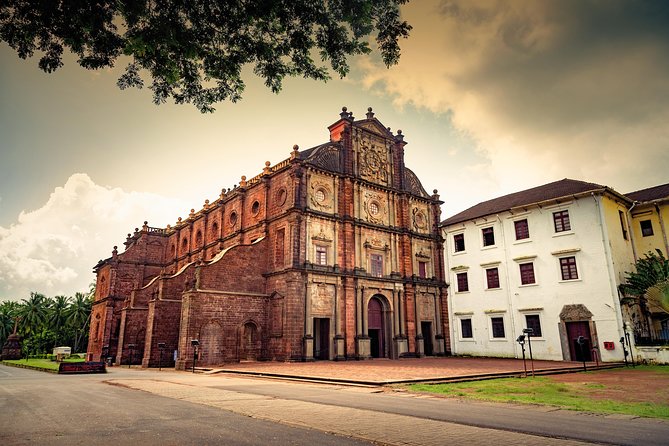
- The historic route is varied: The walk includes the Old Secretariat area, a Portuguese-built account department, the summer palace of Yusuf Adil Shah, and the Abbe Faria statue.
- Fontainhas gives the tour its character: A tuk-tuk carries you to Goa’s Latin quarter for a drink, photographs, and a stroll among Portuguese-influenced homes.
- Your drink is included: You receive either beer or cashew feni at a local restaurant, plus a bottle of mineral water.
- It is a private experience: Only your own group takes part, with hotel pickup and drop-off included.
- The pace suits many visitors: The tour lasts about four hours, though much of it is spent walking and the market streets can be busy.
Why this tour is more than a beach break
Goa is often reduced to beaches, nightlife, and resort towns. Panjim, also called Panaji, gives you a different view. Its markets, administrative buildings, churches, and old residential quarters show how Indian and Portuguese influences have shaped everyday life.
I like this tour because it does not confine you to one monument. You move through working streets, inspect old buildings from the outside, stop for photographs, and sit down for a local drink. The route feels social and practical rather than formal. You are not simply looking at Goa’s past behind museum glass. You are seeing how the older parts of the city fit into the present.
The tour is private, which matters here. A guide can adjust explanations and walking speed for your group. You can ask about an unusual building, spend longer at the market, or keep the photography stop brief. The supplied details do not name the individual guide, so you should not book expecting a particular guide by name.
Pickup and drop-off at your hotel are included, along with transport by private vehicle. That saves you the trouble of arranging a taxi to the starting point, though you should confirm the exact pickup details when booking.
More architecture walks in India:
- British Architecture Walk, an immersive walking tour in Chennai
★ 5.0 · 60 reviews - Mumbai heritage walk- Story of Gothic and Art Deco buildings
★ 5.0 · 33 reviews - Victorian Gothic Heritage Quarter and Art Deco Walking Tour
★ 4.9 · 14 reviews
Starting at the Head Post Office in Panjim
The tour begins around 8:30 in the morning at the India Post Panjim Head Post Office. After pickup from your hotel, the private vehicle brings you here to begin the walking portion.
This is a sensible starting point because it places you in central Panjim before the tour turns toward the markets. A morning start also gives you a better chance to see the city in active working mode rather than arriving after the day has slowed down.
I would wear comfortable shoes and light clothing. The tour includes roughly two hours of walking in the first major section, and the route moves through market streets rather than polished pedestrian lanes. Bring a small bag for personal items, since each person is allowed one suitcase and one carry-on, but oversized or excessive luggage may be restricted.
A bottle of mineral water is included. Still, keep sun protection and comfortable walking gear close at hand because the experience is built around being outside.
Walking past Panjim’s old government buildings
From the Head Post Office, you walk toward the local fish market. The route passes several pieces of Panjim’s built heritage, including the Old Secretariat area and an account department building constructed during the Portuguese period.
These stops are useful because they add context between the markets. You are not simply going from one food stall to another. The guide can point out how government and commerce occupied these central streets, and how older buildings remain part of the city rather than being separated from modern life.
The summer palace of Yusuf Adil Shah is another notable point on this section. It is described as one of Goa’s oldest surviving buildings, dating to the 1500s, with distinctive Indo-Portuguese architecture. The building gives you a reminder that Goa’s past was shaped by more than one political and cultural influence.
You will also pass a statue of Abbe Faria. The stop is brief in the supplied route, but it adds another recognizable landmark to the walk. If you enjoy seeing how a city remembers its historical figures, this is the sort of small detail that makes a guided walk more useful than a self-directed stroll.
Fish, spice, vegetable, and flower markets
The markets are the heart of the first half. At the fish market, you can expect an active scene of fishnets, fresh fish, sellers, and local shoppers. It is a working market, not a display arranged for sightseeing, so conditions may be crowded, wet, or strongly scented.
That is also its value. You get a direct look at the food economy of Panjim and the role of the sea in Goan life. If you are sensitive to fish-market smells or prefer quiet attractions, this portion may not be your favorite. You can ask the guide how long the group will spend there, but the route allows time for the market experience rather than treating it as a quick photo stop.
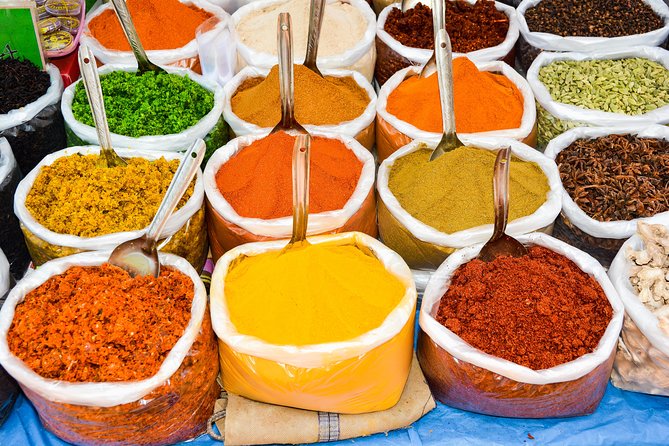
The vegetable and spice market follows. Here, the smells change quickly, with herbs, spices, and produce replacing the sharp scent of the fish stalls. This is a good place to pay attention to color, texture, and the small differences between a market built for local shopping and a shop aimed at tourists.
The flower market completes this part of the route. Together, the three markets provide a clear contrast: seafood, daily cooking ingredients, and flowers. I like this sequence because it turns an ordinary shopping district into a readable picture of local life.
You should ask before photographing people or individual stalls. A guide can help you judge when a picture is welcome and when it would interrupt someone’s work.
More history tours in India:
- The Hipster Chandigarh Architecture History Tour
★ 5.0 · 54 reviews - Jaipur City Heritage and Architecture Tour
★ 5.0 · 32 reviews - Victorian Gothic Heritage Quarter and Art Deco Walking Tour
★ 4.5 · 13 reviews - Chicago in a Day: Food, History & Architecture Walking Tour
★ 5.0 · 1,153 reviews
A tuk-tuk ride to Fontainhas
After the market walk, you board a tuk-tuk for the trip to Fontainhas. The ride is included in the tour price and gives your legs a break after the first two hours on foot.
The tuk-tuk is not just a practical transfer. It lets you experience a familiar local form of transport and changes the rhythm of the tour. You leave the market streets behind and reach one of Panjim’s best-known historic residential areas without needing to arrange another ride.
Fontainhas is known for its Portuguese-influenced character and Latin-quarter streets. The tour describes it as a place for a relaxed stroll, so expect to walk at an easier pace after the markets. You will see old residential architecture and streets that feel different from the commercial market area.
The supplied details do not promise entry into specific homes or a set of interior visits. Think of this section as an outdoor walk through the quarter, supported by the guide’s explanations and opportunities to stop for pictures.
The Immaculate Conception Church photo stop
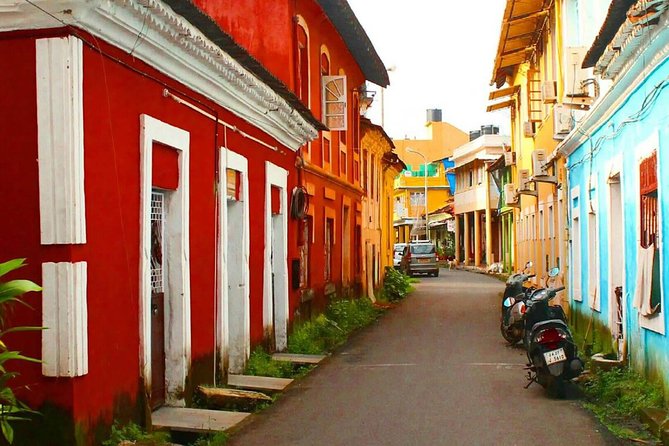
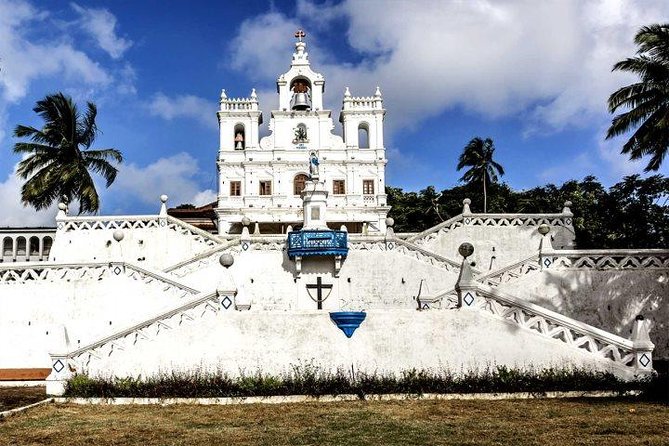
The Church of Our Lady of the Immaculate Conception is one of the tour’s main visual highlights. You stop for photographs and to see its Portuguese-inspired design.
The church was built in the 1560s and is said to draw inspiration from the Church of Bom Jesus de Braga in Portugal. Its large, carefully arranged exterior makes it easy to recognize and gives the Fontainhas section a strong landmark.
One useful detail from the available information is that the church is also described as especially beautiful inside. However, the route specifically promises a photography break, not a guaranteed guided interior visit. If seeing the interior matters to you, ask the operator whether the church will be open and whether entry fits the morning schedule.
Dress respectfully for a church stop. The tour data does not state a formal dress code, but modest clothing is a sensible choice when visiting religious buildings in India.
Beer or cashew feni in Fontainhas

The tour includes one beer or a serving of cashew feni at a local restaurant in Fontainhas. Feni is a Goan spirit made by distilling cashew fruit, and it is one of the most distinctive local drinks you can try in the state.
This pause gives the tour a welcome human touch. You can sit, talk with your guide, and ask questions about Goa rather than moving from one landmark to the next. The included drink also adds some value to the price, though food and any additional drinks are not included unless specifically stated.
If you do not drink alcohol, confirm your options before booking. The supplied details identify beer or feni, but they do not specify a nonalcoholic substitute. You should also remember that this is a walking tour. Drink lightly, especially if the weather is warm and you still have walking ahead.
The stop is described as a local Goan or Portuguese food setting, but a meal is not part of the package. If you want lunch, plan to pay separately or arrange it after the tour.
Art, architecture, and the final walk
The route includes a visit to a local art gallery after the drink and Fontainhas walk. The supplied information does not name the gallery or identify the specific artists on display, so you should think of this as a flexible cultural stop rather than a guaranteed exhibition of a particular collection.
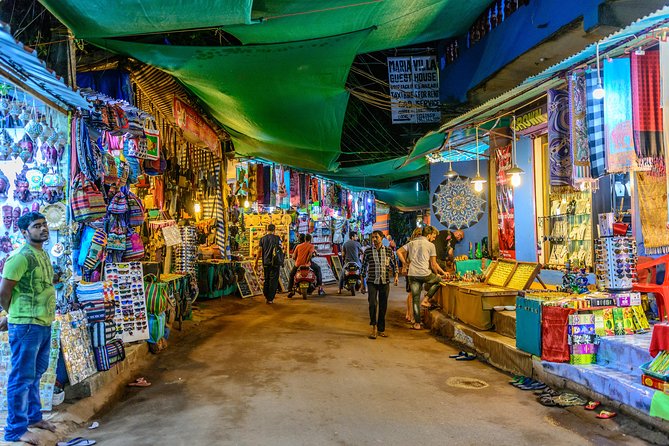
That uncertainty is not necessarily a problem. A local gallery can show a side of Goa that markets and churches do not. The tour also points out shops where you might find clothing and wearable art, along with restaurants in the city. If you are interested in buying something, ask about prices, materials, and whether an item is locally made before purchasing.
The art stop works best for people who enjoy a mixed itinerary. You get architecture, food culture, working markets, local transport, and contemporary art in one morning. If you prefer a single subject, such as churches or colonial buildings, the variety may feel scattered.
The final Fontainhas walk is also where the tour’s pace becomes more relaxed. After the market activity, you can pay closer attention to painted facades, balconies, narrow lanes, and the relationship between older homes and modern shops.
What the $94 price really covers
At $94 per person, this is not a budget walking tour. The price is easier to assess when you count what is included: hotel pickup and drop-off, private vehicle transport, a professional guide, the tuk-tuk ride, one beer or feni, mineral water, GST, and a private group experience.
For a couple or small group, the private format can make the cost reasonable. You are paying for convenience and personal attention as much as for sightseeing. You do not need to find the Head Post Office, negotiate a tuk-tuk, or organize a route between Panjim and Fontainhas.
The value is weaker if you are already staying in Panjim, are comfortable using local transport, and only want to see the church and Fontainhas. In that case, you could explore at your own pace and spend less. The tour earns its price through the market access, guide, transport, and planning.
Group discounts are available, though the exact reduction is not provided. Ask about the discount if you are booking for several people. The experience is booked, on average, about 32 days ahead, which suggests planning early is sensible if your dates are fixed.
Who will get the most from this four-hour route
I would recommend this tour to a first-time Goa visitor who wants more than a resort day. It suits you if you like walking, local markets, architecture, short cultural stops, and a relaxed drink with a guide.
It is also useful for visitors with limited time. Four hours is long enough to cover several parts of Panjim without consuming the whole day. You can still schedule a separate beach visit, meal, or afternoon activity.
The private format may work well for families and mixed-age groups because your party is not tied to strangers. Most people can participate, but the tour does require walking through markets and streets. Anyone with mobility concerns should ask the operator for more detail before booking, since the supplied information does not specify wheelchair access or the amount of uneven ground.
I would not choose this as your only Goa experience if you want a full day of major churches, museums, or formal historical sites. It is a city walk with market life and local flavor, not a complete survey of the state.
Booking details and practical limits
Confirmation is provided when you book. The tour begins at 8:30 in the morning, and pickup is offered from your hotel.
Free cancellation is available up to 24 hours before the start time for a full refund. Cancellations or changes made less than 24 hours in advance are not accepted for a refund, and the cut-off uses local time.
Luggage limits allow one suitcase and one carry-on per person. Surfboards, golf clubs, bicycles, and other oversized items may face restrictions, so contact the operator before travel if you have bulky equipment.
The tour operates near public transportation, but that matters less because private pickup and drop-off are included. You should still provide an accurate hotel location and confirm the meeting details after booking.
Should you book the Goa walking tour?
Book it if you want a compact, private introduction to Panjim that combines working markets and old architecture with Fontainhas, a tuk-tuk ride, a local drink, and art. The church, the summer palace area, and the market sequence give the morning enough variety to keep it interesting.
Think twice if $94 feels high for four hours, if you dislike fish markets, or if you would rather explore independently. The strongest value comes when you use the guide, transport, and private format fully.
For a first visit to Goa, I think the route makes a good counterpoint to beach time. It shows you the food, streets, buildings, and customs that a resort stay can easily miss.
FAQ
How long does the Goa walking tour last?
The tour lasts approximately four hours.
What time does the tour start?
The stated start time is 8:30 am.
Is hotel pickup included?
Yes. Hotel pickup and drop-off are included in the tour.
Is this a private tour?
Yes. Only your group participates in the activity.
Is the tuk-tuk ride included?
Yes. Transport by tuk-tuk is included in the tour price.
Is a drink included?
Yes. The tour includes either beer or cashew feni at a local restaurant. Additional food and drinks are not included unless specified.
Which places are visited?
The route includes the Panjim Head Post Office, the Old Secretariat area, a Portuguese-built account department, the summer palace of Yusuf Adil Shah, the Abbe Faria statue, local fish, vegetable, spice, and flower markets, the Church of Our Lady of the Immaculate Conception, Fontainhas, and a local art gallery.
Can I cancel for a full refund?
Yes. You can cancel at least 24 hours before the experience start time for a full refund. Changes or cancellations made less than 24 hours before the start time are not accepted for a refund.
Just added around India
- Victorian Gothic Heritage Quarter and Art Deco Walking Tour★ 4.9 · 14 reviews
- New Delhi: Mughal’s architecture tour with transfers★ 4.0 · 7 reviews
- Victorian Gothic Heritage Quarter and Art Deco Walking Tour★ 4.5 · 13 reviews
- 2 day tour from Mumbai to architectural wonder of Mandu★ 5.0 · 2 reviews
- South India Tour- Temple Architecture and Backwaters★ 5.0 · 7 reviews
- British Architecture Walk in Chennai by Wonder tours★ 5.0 · 10 reviews
- Day trip from Bangalore to Lepakshi for Temple architecture & paintings★ 5.0 · 15 reviews
- Old & New Delhi Culture & Architecture City Private Tour★ 4.9 · 9 reviews
Walking Tours, compared.

The Official Art Deco Walking Tour by The Miami Design Preservation League
Read our review →
Barcelona: Gothic Quarter Ghosts and Legends Walking Tour
Read our review →
Barcelona: Old Town and Gothic Quarter Walking Tour
Read our review →
Lecce: Baroque Architecture and Underground Walking Tour
Read our review →
Chicago in a Day: Food, History & Architecture Walking Tour
Read our review →

Ramblas, Old Town, Gothic and Gaudi Architecture Walking Tour
Read our review →
Chicago’s Secret Interiors Architectural Walking Tour
Read our review →Browse the lists this tour appears in