
Review · INDIA
2 day tour from Mumbai to architectural wonder of Mandu
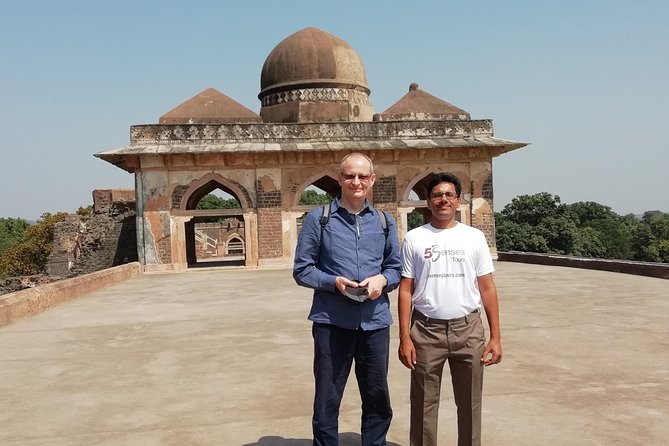
Mandu is the real prize here: a weathered former capital spread across hilltop ruins, grand gateways, mosques, palaces, and water tanks. This private trip pairs it with Indore and Dhar, giving you three very different windows into central India. The ornate Jahaz Mahal and the quiet courtyards of Jami Masjid are the major draws.
I like two things right away: the round-trip flights from Mumbai remove a long overland journey, and a private guide can shape the pace around your interests. The main catch is the schedule. The tour is described as two days in some places but runs for about three days, with long sightseeing periods and a 97-kilometer road journey to Mandu.
Key points to know before booking
- Mandu is the heart of the trip: Explore Jami Masjid, Jahaz Mahal, Hoshang Shah’s tomb, and the Royal Enclosure with a guide.
- Flights save serious time: Air travel between Mumbai and Indore replaces a much longer road transfer.
- Two nights and three breakfasts are included: Lunch and dinner are not, so plan for additional daily spending.
- The private format gives you flexibility: Your group travels alone, rather than joining a large shared coach.
- The itinerary covers three historic centers: Indore, Mandu, and Dhar each offer a different type of architecture and history.
- Expect a full day on foot: A moderate fitness level is recommended, and the Mandu day lasts about eight hours.
Why Mandu makes this unusual Mumbai side trip worthwhile
Many short trips from Mumbai concentrate on nearby caves, temples, or busy city sights. This one sends you to Madhya Pradesh, where Mandu offers something different: a former royal capital with Islamic architecture set among old fortifications and open countryside.
Mandu dates back to the sixth century and later became the capital of the Malwa Kingdom. Its buildings are not packed into one formal museum complex. You move between monuments, courtyards, gates, and palace remains, so the guide matters. A good explanation helps you understand how these structures worked as royal residences, religious buildings, and defensive sites.
The trip also gives you more than Mandu alone. Indore supplies the grand royal interiors of Lalbagh Palace and the layered construction of Rajwada. Dhar adds another chapter as an earlier capital of Malwa, with the fort and Bhoj-Shala connected to Raja Bhoj’s period of rule from 1010 to 1055.
That variety is the tour’s strongest feature. You are not spending three days looking at similar buildings. Instead, you get mosques, palaces, a fort, a mausoleum, and an old center of learning.
A few more architecture tours around India worth a look
- 2-Day Tour: Gaudi & Sagrada Familia + Montserrat & Winery
★ 5.0 · 11 reviews
Day 1: An evening flight and Indore’s Rajwada
The first day begins with a flight from Mumbai to Indore scheduled for 7:25 p.m. The written meeting information gives Indore Airport as the starting point and lists 6 p.m. as the start time, so you should confirm the exact airport pickup arrangement before departure. The schedule appears to allow for the flight and the beginning of the Indore program, but the timing needs clarification.
The listed first stop is Rajwada, the seven-story palace built in 1747 by Malhar Rao Holkar, founder of the Holkar dynasty. Its importance is not just its height or age. Rajwada represents the Maratha-era power that shaped Indore, and it introduces you to the Holkar family before you see their former home at Lalbagh Palace.
Because Rajwada is placed on the arrival day, your visit may be brief or dependent on the flight schedule. That is worth keeping in mind. The itinerary gives you four hours for the broader Indore sightseeing block on Day 3, but the first evening stop is not described with a separate duration.
You spend the night in Indore. Accommodation for two nights is included, along with breakfast. The hotel is identified in the schedule as Hotel Shivani Resort, though you should confirm the final property at booking because the tour information presents the hotel as part of the itinerary rather than as a detailed hotel description.
Day 2: The long road to Mandu
After breakfast, you check out and travel about 97 kilometers from Indore to Mandu. This transfer takes time, but it is the price of reaching a place that sits away from the usual city circuit. The day is planned for about eight hours, including the monuments.
The practical lesson is simple: wear comfortable shoes, carry water, and expect a steady amount of walking. The stated fitness level is moderate. You do not need an athlete’s training, but this is not a ride-up-to-every-building sightseeing day either.
Your first major stop is Jami Masjid, one of India’s largest mosques. Its design was inspired by the Umayyad Mosque, also called the Great Mosque of Damascus. The building is known for domes, arches, painted enamel decoration, and jali work, the carved stone screens that filter light and air.
Jami Masjid rewards slow looking. The scale gives you an immediate sense of royal ambition, while the smaller carved details keep the building from feeling plain. Ask your guide to point out the jali patterns and explain how the mosque’s design relates to its Syrian inspiration. This is one of the stops where a guide adds real value, since the architectural references may not be obvious at first glance.
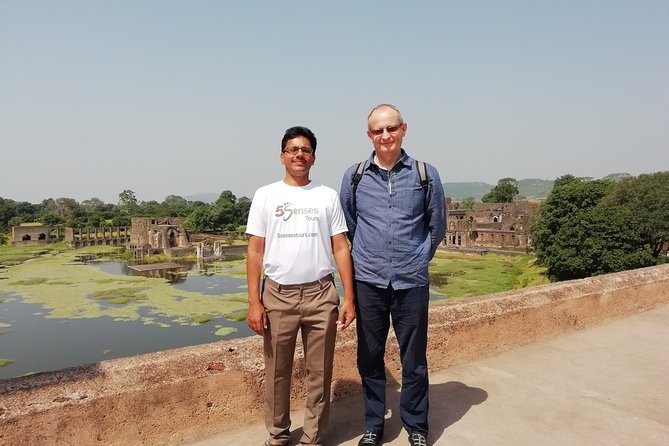
Next comes the Royal Enclosure, the main concentration of Mandu’s palace buildings. The best-known structure here is Jahaz Mahal, or Ship Palace. Its long shape resembles a ship, and the palace was built by Ghiyasuddin to house the women of his harem, said to number 15,000.
That figure gives you a sense of the scale claimed for the court, though the building itself is more memorable for its form and setting. In its prime, Jahaz Mahal included large halls, upper-floor cenotaphs, and Turkish baths. Its long profile is easy to appreciate from a distance, while the upper levels help you picture the palace as a place of movement, water, and ceremony rather than a simple stone shell.
Do not rush through the Royal Enclosure. Look for the relationship between the structures, open spaces, and water features. The pleasure of Mandu comes partly from how the buildings sit together. You are seeing an entire royal center, not a single isolated palace.
The route also includes Hoshang Shah’s tomb, described as India’s first marble mausoleum. It is a more restrained stop than Jahaz Mahal, but that contrast helps. After the palace’s long horizontal shape and royal associations, the mausoleum brings your attention to symmetry, stonework, and funerary architecture.
The supplied information does not provide a full list of every Mandu monument included in the eight-hour visit, so the exact order may vary. The named stops give you a solid core: Jami Masjid, the Royal Enclosure, Jahaz Mahal, and Hoshang Shah’s tomb. Since this is a private tour, ask the guide how much time is available at each place rather than assuming every stop will receive equal attention.
You return to your Indore accommodation for the second night. Breakfast is included, but meals beyond breakfast are not. Since the Mandu day is long, arrange your lunch and dinner budget in advance. The tour price covers the major transport and lodging costs, but not the full cost of eating on the road.
Day 3: Dhar Fort and the royal interiors of Indore
The final day begins with Dhar, the ancient capital of Malwa before Mandu rose to prominence. Dhar Fort gives the trip a defensive and political counterpoint to Mandu’s palace complex. The schedule allocates about four hours to Dhar, including the fort and Bhoj-Shala.
Bhoj-Shala is linked to Raja Bhoj, the scholar king who ruled from 1010 to 1055. It was built for Sanskrit education and was associated with a temple dedicated to Saraswati, the goddess of learning. This is an important stop for understanding that the region’s past was not only about royal residence and warfare. Education, religion, and language also shaped these centers of power.
The site has a complicated cultural history, so listen carefully to the guide’s explanation and separate established architectural details from later interpretation. A private format helps here because you can ask questions without holding up a large group.
After Dhar, you drive back to Indore for Lalbagh Palace, the former residence of the Holkar royal family. This is the tour’s most lavish interior stop. The palace is described with Italian marble columns, chandeliers, Persian carpets, Belgium stained-glass windows, Greek reliefs, Italian paintings, and stuffed tigers hunted by the Holkars.
Lalbagh works as a sharp contrast to Mandu. In Mandu, you spend much of your time reading the shape of old Islamic palaces and religious buildings. At Lalbagh, the emphasis is on royal taste and imported decoration. The building shows how a later ruling family used European materials and styles to express wealth and status.
The palace may appeal most to you if you enjoy interiors, furniture, decorative arts, and royal collecting. If you prefer bare ruins, it could feel less atmospheric than Mandu. I would still keep it in the plan because it gives useful context: the Holkars were not simply connected to an old fort or one palace. They maintained a court with international artistic influences.
The final stop is another visit to Rajwada, the seven-story Holkar palace in Indore. Seeing it after Lalbagh creates a useful link between the city’s public historical center and the royal family’s private residence. Built in 1747 by Malhar Rao Holkar, Rajwada anchors the Maratha story that began on the first evening.
The schedule allows about four hours for the Dhar and Indore program before your return flight. That sounds generous, but the actual timing depends on traffic, how long you spend at each site, and the flight departure. Keep your final sightseeing flexible and confirm the return flight details before the day begins.
Same city, a completely different century:
- Delhi Hidden Gems: Mehrauli, Lodhi Art & Sunder Nursery
★ 5.0 · 108 reviews - British Architecture Walk, an immersive walking tour in Chennai
★ 5.0 · 60 reviews - The Hipster Chandigarh Architecture History Tour
★ 5.0 · 54 reviews - Mumbai heritage walk- Story of Gothic and Art Deco buildings
★ 5.0 · 33 reviews
What the $418.67 price really covers
At $418.67 per person, this is not a cheap side trip. The value depends on how much you would otherwise spend arranging the same pieces yourself.
The price includes round-trip flights between Mumbai and Indore, two nights of accommodation, three breakfasts, a local guide, GST, and the private tour format. The named sightseeing stops also show admission tickets included. Those inclusions remove several major planning tasks, especially the flights and the long transfer from Indore to Mandu.
The private arrangement matters most for a route like this. Mandu is not a single compact monument where you can simply arrive, follow signs, and leave. You need transport between sites, and the history becomes easier to follow when one guide connects Mandu, Dhar, and Indore.
The cost is harder to justify if you are already based in Indore, can arrange your own vehicle, or are comfortable booking trains, hotels, and guides separately. It becomes more attractive if you are starting in Mumbai and have limited time. The flights turn a demanding overland journey into a short regional trip, although the flight times and airport arrangements need careful confirmation.
You also need to add lunch, dinner, and any personal spending. Breakfast is included, but the tour is not a full meal package. Group discounts are available, so the per-person value may improve if you are traveling with several people.
How the private format changes the experience
Only your group participates, which gives you more control than a large coach tour. You can ask for extra explanation at Jami Masjid, spend more time on Jahaz Mahal’s upper levels, or move on sooner from a palace interior that does not hold your interest.
The guide is especially useful at sites with layered political and religious associations, such as Bhoj-Shala. The description does not provide the guide’s name, so you cannot assess an individual guide in advance. Still, the private structure gives you a better chance to have a real conversation rather than receiving a fixed speech.
The tradeoff is that private tours can feel expensive for solo travelers. The group discount may help, but the stated price is per person. If you are traveling alone, compare that cost with a self-arranged Indore hotel, local vehicle, and separate guide before booking.
Practical limits you should consider
The schedule is ambitious. Day 2 combines a 97-kilometer transfer with roughly eight hours of sightseeing, and Day 3 combines Dhar, the drive back to Indore, two major palace stops, and a flight. You will see a lot, but you should not expect a slow, unhurried stay at every monument.
The tour requires a moderate level of physical fitness. Expect walking through historic compounds and spending time on your feet. The information does not specify step-free access, vehicle type, or exact walking distances, so ask the provider if those details affect your planning.
There is also a timing inconsistency worth resolving. The tour is described as a two-day trip in the title but as approximately three days in the summary and itinerary. The schedule clearly uses Day 1, Day 2, and Day 3, with two hotel nights. Confirm the actual dates, flight times, airport pickup, and return arrangements before payment.
The cancellation terms are strict close to departure. You can receive a full refund if you cancel at least six full days before the start time. A cancellation two to six days ahead receives 50 percent, while cancellation less than two full days before departure receives no refund. Poor weather may lead to a new date or a full refund.
Who should book this Mandu tour
I would recommend it to you if you are staying in Mumbai, want to see a less familiar part of India, and prefer a planned private trip over arranging several separate bookings. It suits history and architecture fans who like moving between mosques, palaces, forts, and royal residences.
It is also a good fit for couples, families, or small groups who value their own vehicle and guide. The private format can make a busy schedule easier to manage, especially when different people want different amounts of time at each site.
I would hesitate if you want a relaxed holiday with late mornings and long meals. I would also think twice if your budget is tight, if you dislike domestic flights, or if you already have an easy way to organize Mandu from Indore.
Final verdict: a strong route with a demanding schedule
This tour’s greatest strength is its range. You get Mandu’s monumental Islamic architecture, Dhar’s older Malwa connections, and Indore’s Holkar palaces in one carefully linked trip. The flights and private guide save time and reduce the strain of organizing a remote historical circuit.
The main weaknesses are the high price, excluded lunches and dinners, demanding timetable, and unclear wording around the two-day versus three-day duration. Confirm those details before booking.
If Mandu is high on your list and you have only a few days from Mumbai, I think the convenience is worth serious consideration. If you have more time, compare the cost of staying in Indore and arranging a local Mandu excursion. Either way, make Mandu the priority. Rajwada and Lalbagh add useful context, but Jahaz Mahal, Jami Masjid, and Hoshang Shah’s tomb are the reasons to make this trip.
FAQ
How long does this tour last?
The itinerary runs across three days and includes two nights of accommodation. The tour title describes it as a two-day tour, so confirm the exact duration and dates before booking.
Are flights from Mumbai to Indore included?
Yes. The package includes a flight from Mumbai to Indore and a return flight.
What meals are included?
Three breakfasts are included. Lunch and dinner are not included.
Is this a private tour?
Yes. Only your group participates, and a local guide accompanies the sightseeing.
What level of fitness is required?
A moderate physical fitness level is recommended. The Mandu sightseeing day lasts about eight hours and includes walking through historic monuments.
What is the cancellation policy?
You receive a full refund when canceling at least six full days before the start time. Canceling two to six full days ahead provides a 50 percent refund. Cancellations less than two full days before the start time are not refunded.
Just added around India
- Victorian Gothic Heritage Quarter and Art Deco Walking Tour★ 4.9 · 14 reviews
- New Delhi: Mughal’s architecture tour with transfers★ 4.0 · 7 reviews
- Victorian Gothic Heritage Quarter and Art Deco Walking Tour★ 4.5 · 13 reviews
- Goa Walking tour: History, Culture, Art and architecture★ 4.5 · 2 reviews
- South India Tour- Temple Architecture and Backwaters★ 5.0 · 7 reviews
- British Architecture Walk in Chennai by Wonder tours★ 5.0 · 10 reviews
- Day trip from Bangalore to Lepakshi for Temple architecture & paintings★ 5.0 · 15 reviews
- Old & New Delhi Culture & Architecture City Private Tour★ 4.9 · 9 reviews
India Architecture Tours, compared.

Delhi Hidden Gems: Mehrauli, Lodhi Art & Sunder Nursery
Read our review →
British Architecture Walk, an immersive walking tour in Chennai
Read our review →
The Hipster Chandigarh Architecture History Tour
Read our review →
Mumbai heritage walk- Story of Gothic and Art Deco buildings
Read our review →
Le Corbusier’s Chandigarh : A Complete Architecture Tour
Read our review →
Day trip from Bangalore to Lepakshi for Temple architecture & paintings
Read our review →
Victorian Gothic Heritage Quarter and Art Deco Walking Tour
Read our review →Browse the lists this tour appears in