
Review · INDIA
The Hipster Chandigarh Architecture History Tour
Chandigarh makes the most sense when you see it through the eyes of someone who grew up inside its design. Rusty spent 24 years in Le Corbusier’s public housing, studied in Pierre Jeanneret’s schools, and worked in buildings designed by Maxwell Fry. That personal link gives this architecture tour a human scale, not just a parade of concrete buildings.
I like the way the two days connect architecture with city planning, politics, daily life, and food stops. I also like the rare access to places such as Jeanneret’s former home and Chandigarh’s socialist housing. The main consideration is the pace: there are many stops, and anyone hoping for a relaxed sightseeing day may find two full days of buildings, museums, and walking a lot to absorb.
Key points to know before booking
- Rusty’s local connection: He is a third-generation Chandigarh resident, journalist, and architecture guide who lived in Corbusier-designed housing.
- A serious two-day route: The tour covers the Capitol Complex, university buildings, museums, markets, housing, Sukhna Lake, and lesser-known Corbusier sites.
- Rare access matters: The program includes guided entry to Pierre Jeanneret’s former home and, subject to local conditions, public housing that still serves its original purpose.
- Transport is built in: Pickup, drop-off, an air-conditioned vehicle, parking, waiting, and driving charges are included.
- The price includes most extras: Entry tickets and photography fees are covered, while snacks and optional gratuities cost extra.
- Best for curious minds: You do not need an architecture degree, but you should enjoy long conversations about design, planning, and Chandigarh’s social purpose.
Why Chandigarh needs a guide like Rusty
Chandigarh is often introduced as India’s planned modern city, created after Partition under the direction of Le Corbusier and a team that included Pierre Jeanneret, Maxwell Fry, and Jane Drew. That description is accurate, but it can leave you with a city full of impressive buildings and little sense of how people actually use them.
Rusty’s background helps bridge that gap. He is not presenting Chandigarh as a museum frozen in the 1950s. He grew up in its housing, went to schools shaped by the city’s modernist planning, and worked in offices designed by members of the original team. That gives him useful ground-level material about how the buildings function, not just how they look in photographs.
The guide’s style also seems well suited to a mixed group. He uses humor, keeps political jokes neutral for diplomats and foreign officials, and adjusts his explanations for families, children, students, couples, and architecture specialists. Several parts of the program can be tailored to your interests, and the food stops are kept inexpensive.
The tour has a maximum group size of 41, so it is not automatically an intimate private walk. Still, the personal guiding and included vehicle help make a large or mixed group easier to manage. If you are an architect or urban planner, Rusty knows when to slow down for photographs. If you are new to modernist architecture, he aims to keep the facts clear and entertaining.
More history tours in India:
- Mumbai heritage walk- Story of Gothic and Art Deco buildings
★ 5.0 · 33 reviews - Jaipur City Heritage and Architecture Tour
★ 5.0 · 32 reviews - Victorian Gothic Heritage Quarter and Art Deco Walking Tour
★ 4.9 · 14 reviews
Day one: the civic heart of Chandigarh
The Capitol Complex and Open Hand Monument
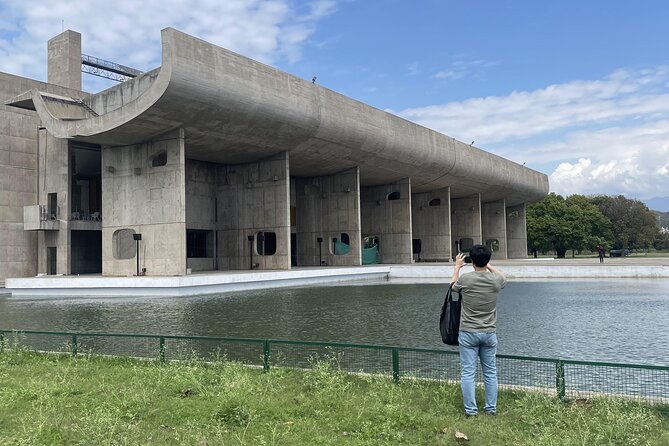
The first day begins with the Capitol Complex, the most important concentration of Corbusier’s work in Chandigarh. You see the Secretariat, Assembly Hall, and Open Hand Monument, with admission included.
This is where the city’s ideals become physical. The massive concrete forms were designed for government, but they also communicate a new civic identity. The scale can be startling, especially when you consider that Chandigarh was planned as a new capital after Partition.
You have about an hour here, including insider-guided access. That time is enough for an introduction to the major buildings and their purpose, though photography and architectural questions could easily stretch longer. The Open Hand Monument receives a separate visit later, allowing Rusty to explain it in more detail rather than rushing through it in one stop.
Le Corbusier Centre
The Le Corbusier Centre occupies the old architects’ building and provides a useful change of scale. After the broad civic spaces of the Capitol Complex, you move into the place where plans, drawings, and working ideas shaped the city.
The visit lasts about 50 minutes and includes admission. One distinctive subject is the building’s early approach to natural cooling and sustainable design. The guide uses visual demonstrations to explain how the building worked before modern air-conditioning became the default answer to heat.
I especially like this stop for visitors who need help reading architecture. Instead of simply pointing out concrete, shade, windows, and airflow, Rusty can explain why those elements mattered in Chandigarh’s climate. You leave with a better eye for details that might otherwise pass unnoticed.
A few more architecture tours around India worth a look
- British Architecture Walk, an immersive walking tour in Chennai
★ 5.0 · 60 reviews - Le Corbusier’s Chandigarh : A Complete Architecture Tour
★ 4.7 · 25 reviews - Day trip from Bangalore to Lepakshi for Temple architecture & paintings
★ 5.0 · 15 reviews - British Architecture Walk in Chennai by Wonder tours
★ 5.0 · 10 reviews
Gandhi Bhawan at Panjab University
Gandhi Bhawan is one of Chandigarh’s most recognizable buildings. Designed by Pierre Jeanneret, it has a lotus-like roof that appears to spin above the structure. The tour includes an insider-guided visit lasting about 30 minutes.
This is a good example of why Chandigarh should not be reduced to Le Corbusier alone. Jeanneret shaped much of the city’s everyday character, from housing and schools to public buildings. Gandhi Bhawan’s form is memorable, but Rusty also places it within the University setting and the wider group of buildings created for learning and public life.
You then spend about 40 minutes at Panjab University. The university gives the tour another useful angle: Chandigarh was planned not only as an administrative capital, but also as a place for education, research, and social life.
Chandigarh Architecture Museum
The Chandigarh Architecture Museum is housed in a raw concrete building inspired by Le Corbusier’s 1965 Zurich Pavilion. Its tubular stairway and three levels of exhibits help tell the story of Chandigarh’s creation.
Allow about an hour here. The museum is particularly helpful if you want plans, models, drawings, and documents to support what you have already seen outdoors. I would place this stop among the most useful parts of the tour for first-time visitors, since the material can tie together the city’s sectors, buildings, and design goals.
The drawback is simple: after several major sites, another hour of architecture may feel dense. Rusty’s humor and storytelling help, but you should still arrive ready to pay attention.
Open Hand Monument, Geometric Hill, and Tower of Shadows
The Open Hand Monument is Chandigarh’s best-known symbol. It represents peace and unity, and it is part of the UNESCO-listed Capitol Complex. The separate 25-minute visit gives you close access and time to hear the story behind the symbol. On a windy day, the hand may move, adding a small bit of drama to an otherwise monumental setting.
Nearby, Geometric Hill presents Corbusier’s interest in sculptural earth forms and concrete. The tour allows about 20 minutes for a guided walk through this planned arrangement of mounds and structures. It is not a conventional hill or park. Think of it as a piece of city design that asks you to notice how movement, shape, and scale work together.
The Tower of Shadows takes about 15 minutes. Corbusier designed this open-air concrete structure as a demonstration building for studying the movement of the sun. The visit is brief, but the idea is important: Chandigarh’s architecture was not only about dramatic shapes. It also tested how buildings could control heat and light.
Museum Maison Jeanneret
The first day ends with Museum Maison Jeanneret, the former home of Pierre Jeanneret. He lived there for 11 years, and the house is now a museum showing his design ideas.
This is one of the tour’s rarest experiences. The house offers a more intimate look at the architect than the monumental government buildings do. You can consider how a designer’s ideas appear in a domestic setting, where rooms, furniture, shade, and daily routines matter.
The visit lasts about 30 minutes. That may sound short, but it works well after a packed day. You have already seen Jeanneret’s public work at Gandhi Bhawan and Panjab University, so the house adds a personal and domestic layer to the story.
Day two: daily life, memory, and the city in use
Sukhna Lake in the morning
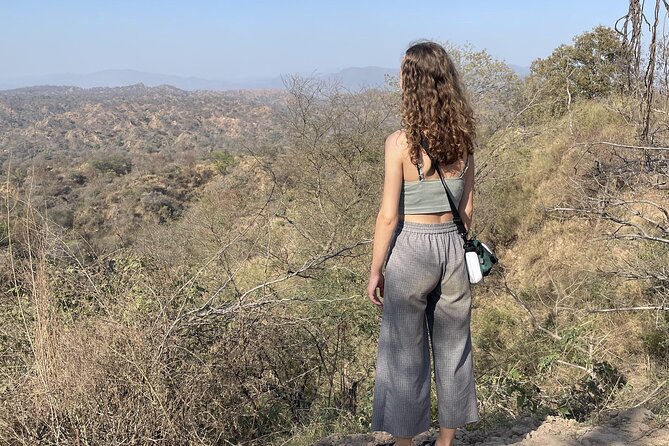
The second day opens at Sukhna Lake with a gentle 30-minute walk. The lake was created as part of Corbusier’s wider plan for Chandigarh, with a role in groundwater renewal and cooling the northern sectors.
This is a welcome change after the concrete and formal civic spaces of day one. You get open air, water, and a quieter setting while still discussing planning. The lake also shows how Chandigarh’s designers thought beyond individual buildings. Water, shade, recreation, and climate were part of the plan too.
The walk is gentle, but the program remains full. If you prefer a slow morning with plenty of time for sitting by the water, this stop may feel too brief.
Sector 17 Market
Sector 17 is the city’s central commercial area. The tour spends about an hour walking its shaded, tree-lined paths and discussing Corbusier’s less celebrated commercial designs.
This is one of the most useful stops for understanding how modernist planning meets ordinary life. Government buildings and monuments get the attention, but markets reveal how people shop, meet, walk, and spend time. Rusty also includes people watching and inexpensive snack stops, so the experience is not limited to architecture talk.
Sector 17 may be especially helpful if you are unsure whether an architecture tour will feel too abstract. You can see the plan working at street level, with commerce and community occupying the spaces between the larger buildings.
Chandigarh War Memorial
The Chandigarh War Memorial is set within Bougainvillea Garden in Sector 3. The visit takes about 30 minutes and offers a quieter, more reflective part of the route.
The memorial was conceived by Lieutenant General J.F.R. Jacob and combines a modest architectural setting with serious historical meaning. It is not presented as a grand monument competing with the Capitol Complex. Instead, the garden setting gives the visit a more subdued tone.
This stop broadens the tour beyond Corbusier and Jeanneret. You are not only studying a planned city’s famous designers. You are also looking at how Chandigarh remembers military service and public sacrifice.
Pierre Jeanneret’s public housing
The walking tour through Pierre Jeanneret’s public socialist housing is one of the program’s most unusual features. Access is subject to local conditions, so it should be treated as a possibility rather than a guaranteed highlight.
If available, this stop is valuable because the housing is still functional in its original role. You are not looking at an empty showpiece or a preserved model. You can see how Jeanneret’s ideas were intended to support everyday residents.
Rusty’s own experience gives this part unusual weight. He lived for 24 years in Corbusier’s public housing, so he can discuss the buildings as lived spaces rather than only as design objects. The walk takes about an hour and may be the best choice for anyone interested in how large planning ideas affect ordinary life.
Government Museum and Art Gallery
The Government Museum and Art Gallery is housed in a 1960s heritage building designed by Le Corbusier. The guided visit lasts about an hour and includes artifacts from the pre-Partition era in Pakistan.
The museum is also known for one of the world’s largest collections of Greco-Buddhist art. That makes it an important cultural stop, not just another example of modernist architecture. Inside, the building provides the setting, while the collections connect Chandigarh with a much wider South Asian story.
I like the balance here. After studying the city’s new post-Partition identity, you see objects linked to older traditions and places that were separated by Partition. The museum helps prevent the tour from becoming too narrowly focused on concrete and city plans.
Lake Club
The final stop is Lake Club, a private yacht club designed by Corbusier about a year before his death. The guided visit lasts roughly 30 minutes.
It is easy to overlook recreational architecture when focusing on government halls and university campuses. Lake Club shows another side of the plan, one concerned with leisure, boating, and social life. Its position near Sukhna Lake also ties back to the second day’s opening walk.
Access is private, so the included insider tour is a useful part of the program. The stop is short, but it gives the route a fitting finish: Chandigarh was planned as a city for living, not only for administration.
What the $71.02 price includes
At $71.02 per person, the tour offers good value if you use the full two-day program. You are not paying only for a guide. The price includes pickup and drop-off, an air-conditioned vehicle, parking, driving, waiting time, entry tickets, and photography fees.
Those costs can add up quickly across nine stops on the first day and six on the second. The included vehicle also matters in Chandigarh, where the sites are spread across sectors and a long walking-only plan would be tiring.
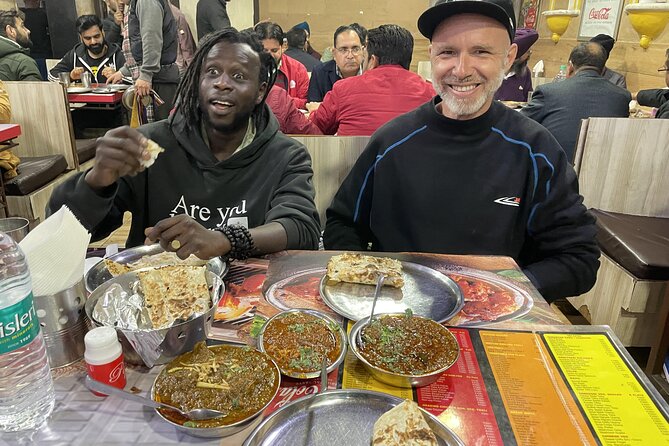
Snacks are not included. Rusty makes frequent inexpensive food and drink stops, so you should carry some cash or another way to pay for them. Lunch choices can be adjusted around your preferences, and the stops are intended to suit students and backpackers as well as couples and families.
Optional gratuities are accepted. The tour starts at 9:00 a.m., and the amount of content means you should protect both days rather than trying to squeeze the experience into a spare afternoon.
Who should book this Chandigarh tour?
I would choose this tour if you want to understand why Chandigarh looks the way it does, not simply take photos of unusual buildings. It is a strong match for architecture students, urban planners, journalists, photographers, and anyone interested in how a new city was designed after Partition.
It also suits families and general sightseers because Rusty keeps the tone light and explains technical ideas in a friendly way. You do not need prior knowledge, though some interest in buildings, planning, or local stories will make the long days more rewarding.
I would think twice if you want a short, flexible sightseeing outing. The route is full, and some stops involve detailed explanations. The maximum group size is 41, so you should not expect the same quiet pace as a private tour. On the other hand, Rusty can adjust parts of the program, and unexpected closures have been handled by replacing closed sites with other worthwhile visits.
The tour requires good weather. If poor weather forces cancellation, you are offered another date or a full refund. For cancellations, a full refund requires at least six full days’ notice. Canceling two to six days ahead allows a 50 percent refund, while cancellation less than two days before the start is not refunded.
Should you book it?
Book it if you want Chandigarh explained by someone whose own life is tied to its buildings. Rusty’s experience in the housing, schools, and offices of the city gives the tour a personal edge that a standard sightseeing route cannot easily provide.
The strongest reasons to go are the rare housing and Maison Jeanneret access, the UNESCO Capitol Complex, the included transport and entry fees, and the way the tour connects design with daily life. The main tradeoff is time. Two days is a serious commitment, and the schedule favors curiosity over leisure.
If Chandigarh is central to your trip, this is a strong choice at $71.02. If you have only a few hours, select one or two major sites instead. But if you can spare two days and want the city to make sense, Rusty’s route gives you the best chance of seeing both the grand plan and the people living inside it.
FAQ
How long does the experience last?
The experience lasts approximately two days. It begins at 9:00 a.m. and includes a full schedule of architecture, museums, public spaces, housing, and cultural sites.
What is included in the price?
Pickup and drop-off, an air-conditioned vehicle, parking, driving and waiting charges, entrance fees, and photography fees are included.
Are food and snacks included?
No. The tour makes frequent snack stops, but you pay for your own food and drinks. The stops are intended to remain inexpensive.
Is the tour suitable for people without architecture experience?
Yes. The guide presents the buildings and planning ideas in an entertaining, accessible way. Most travelers can participate, and the tour is designed for a range of ages and interests.
Is access to Pierre Jeanneret’s public housing guaranteed?
No. The walking tour through the housing is subject to local conditions. The housing is still used in its original role when access is possible.
What happens if bad weather cancels the tour?
You will be offered a different date or a full refund. The experience requires good weather.
Just added around India
- Victorian Gothic Heritage Quarter and Art Deco Walking Tour★ 4.9 · 14 reviews
- New Delhi: Mughal’s architecture tour with transfers★ 4.0 · 7 reviews
- Victorian Gothic Heritage Quarter and Art Deco Walking Tour★ 4.5 · 13 reviews
- 2 day tour from Mumbai to architectural wonder of Mandu★ 5.0 · 2 reviews
- Goa Walking tour: History, Culture, Art and architecture★ 4.5 · 2 reviews
- British Architecture Walk in Chennai by Wonder tours★ 5.0 · 10 reviews
- South India Tour- Temple Architecture and Backwaters★ 5.0 · 7 reviews
- Day trip from Bangalore to Lepakshi for Temple architecture & paintings★ 5.0 · 15 reviews
Historical Tours, compared.
Chicago in a Day: Food, History & Architecture Walking Tour
Read our review →
Kuala Lumpur: Batu Caves & Historic Buildings Tour
Read our review →
Charleston’s Best Highlights: History, Culture & Architecture
Read our review →
Palm Springs Modernism Architecture & History Bike Tour
Read our review →
Charleston: History and Architecture Guided Walking Tour
Read our review →
Historic Georgetown: History, Gossip, & Architecture Walking Tour
Read our review →
Charleston History, Homes, and Architecture Guided Walking Tour
Read our review →
Browse the lists this tour appears in