
Review · BERLIN
Karl-Marx-Allee Tour: Life and Architecture in East Berlin
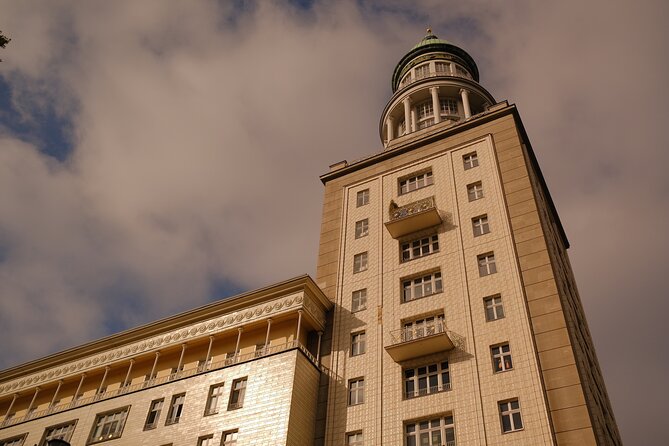
Karl-Marx-Allee tells the story of East Berlin in enormous scale. Its broad avenue, ceremonial towers, workers’ housing, cafés, and monuments reveal how architecture served daily life and political power. This walking tour follows that story from Frankfurter Tor to Strausberger Platz, with stops that connect buildings to the people who designed, built, and lived in them.
I like the way the tour sets grand socialist architecture beside the more experimental buildings that came before it. I also like its small maximum of 15 people, which gives a guide such as Martina room to explain complicated subjects, answer questions, and use the kind of visual material that makes the past easier to picture. The main drawback is that the experience depends on good weather, and two hours allows only a focused look at one part of East Berlin.
Key points to know before you book
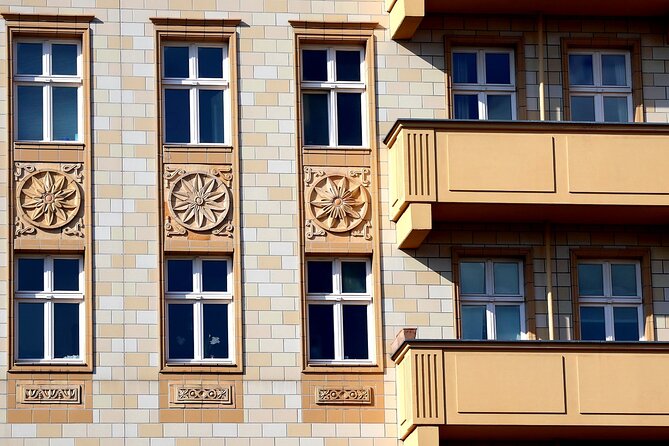
- Frankfurter Tor begins with grand scale: Hermann Henselmann’s matching towers introduce the political image of East Germany’s first socialist boulevard.
- The route covers competing ideas: You see Hans Scharoun’s postwar modernism, early socialist planning, and the later Karl-Marx-Allee style in one walk.
- The 1953 workers’ uprising gets real attention: A monument and street corner show that East German history was not only about official slogans.
- Café Sibylle adds everyday life: The café links social life, consumer culture, and the former statue of Joseph Stalin nearby.
- The walk ends near Alexanderplatz: Strausberger Platz is about a 10-minute walk from Alexanderplatz, making the tour easy to add to a Berlin day.
- Small groups help with a complex subject: The maximum is 15 people, and the tour is offered in English.
Why Karl-Marx-Allee is the right place to study East Berlin
Many Berlin history walks focus on the Wall, Nazi sites, or the former government quarter. This one takes a different road. Karl-Marx-Allee, formerly known in part as Stalinallee, lets you read East German history through buildings that were meant to shape behavior, pride, and public life.
The avenue was not simply a collection of large apartment blocks. It was planned as a showcase for a new society. Its scale suggested order and strength. Its housing promised a better life for workers. Its public spaces offered a stage for ceremonies and political displays.
At the same time, the buildings reveal doubt and change. Earlier modernist ideas were rejected. Later socialist architecture borrowed from historical styles. A workers’ protest exposed the gap between official promises and everyday reality. The tour works best because it keeps these tensions together rather than treating the avenue as one neat architectural style.
You spend about two hours walking between seven stops. The route is long enough to show how the district changes, but short enough for a weekend schedule. You will not see every corner of East Berlin, but you will leave with a useful way to read the area on your own.
A few more architecture tours around Germany worth a look
- Munich 3-Hour Segway Tour: Nazi Munich & Royal Architecture
★ 4.9 · 194 reviews - Düsseldorf: Guided City Architecture Walking Tour
★ 4.6 · 61 reviews - Hidden Architectural Gems of Munich (Max. 16 guests)
★ 4.9 · 52 reviews
Frankfurter Tor and the making of a socialist boulevard
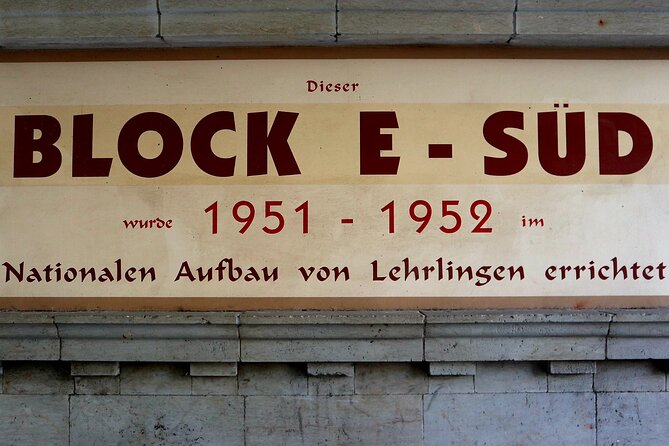
The meeting point is at U Frankfurter Tor, a practical starting place with public transport nearby. The matching towers here form one of the most recognizable views on Karl-Marx-Allee. Designed by Hermann Henselmann, they frame the avenue with a deliberate sense of symmetry.
Your guide explains how plans for Germany’s first socialist street took shape in the early 1950s. This was a period of rapid rebuilding after the destruction of Berlin. The national program called on thousands of volunteers, turning construction into both a practical project and a public display of collective effort.
The key point is that the avenue was built to communicate success. The towers were not meant to feel modest or improvised. Their scale and formal design told residents and visitors that East Germany could produce a grand capital of its own.
This first stop lasts about 20 minutes. It gives you the visual vocabulary needed for the rest of the route: symmetry, ceremony, mass housing, and political messaging. Bring your camera, but pay as much attention to the broad layout as to the towers themselves. The distance between buildings is part of the message.
Laubenganghäuser and the road not taken
The Laubenganghäuser introduce a very different architectural mood. These buildings represent modernist ideas from the years immediately after the Second World War and are associated with Hans Scharoun.
Scharoun imagined a more open and humane city rising from the ruins of Berlin. His ideas were utopian in the best sense: they tried to rethink how people might live after the old city had been destroyed. The design approach was soon rejected by the new East German government, which moved toward a more formal and monumental style.
I find this stop especially useful because it prevents the tour from becoming a simple lesson in socialist architecture. You see that East Berlin had several possible futures. The final Karl-Marx-Allee was the result of political decisions, not an unavoidable response to the war.
The stop takes about 15 minutes. It is brief, so listen closely as the guide links the buildings to wider debates about urban planning. This is also the point where you begin to see architecture as a record of ideas that succeeded, failed, or were pushed aside.
Hochhaus an der Weberwiese, a prototype with a political job
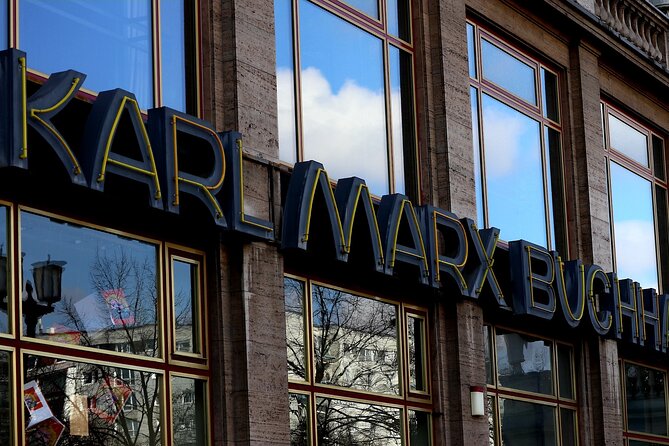
At Hochhaus an der Weberwiese, you see the prototype for the later socialist Karl-Marx-Allee. The building offered its first residents a level of comfort that was described as unprecedented for the project.
That promise mattered. Housing was not just shelter in postwar East Berlin. It was part of the government’s claim that socialism could improve working people’s lives. A new apartment could therefore become a political symbol, especially when it appeared in a carefully planned district.
The building also became a propaganda tool and drew architects from the West. That detail adds useful complexity. The project was presented as proof of East German achievement, yet it also attracted professional interest beyond the country’s political borders.
Your guide can help you notice the difference between the building’s actual residential function and its public role. It was a place for people to live, but it also had to represent a new social order. This stop takes about 20 minutes and is one of the strongest points for understanding how housing and ideology were tied together.
Same city, a completely different century:
- Dresden: Tour of the Baroque Quarter with a Night Watchman
★ 4.7 · 681 reviews - Potsdam: Guided Walking Tour of UNESCO Site and Architecture
★ 4.7 · 49 reviews - Private Taxi Tour City East & West History and Architecture 3-4h
★ 5.0 · 42 reviews - Stuttgart city library – an architectural tour
★ 4.4 · 27 reviews
The June 17, 1953 memorial and the limits of official power
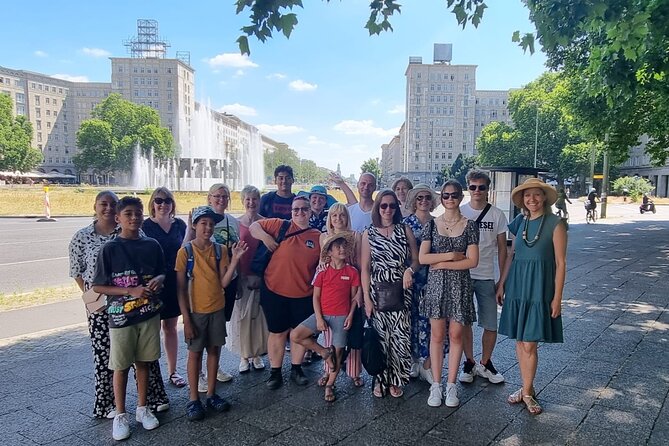
The Gedenkstätte Arbeiteraufstand 17 Juni 1953 marks the site where dissatisfied workers began a mass uprising. The protest grew into a challenge that nearly toppled East Germany’s socialist government.
This is a crucial pause in the walk. Karl-Marx-Allee was designed to display unity between the state and working people, yet workers here became the force opposing the government. The contrast gives the architecture a sharper edge.
You also see the controversial monument dedicated to the uprising. The guide explains the dispute around the memorial and places the event within the wider story of early East Germany. I appreciate this stop because it shifts attention from the people who designed the avenue to those expected to accept the system it represented.
Plan for about 20 minutes here. The subject is serious, but the walk does not treat history as a list of dates. The monument, the street, and the planned housing all sit together, allowing you to connect political promises with actual conflict.
Café Sibylle and the social life of Stalinallee
Café Sibylle brings the tour down to a more personal scale. In the days of East Berlin, it was one of the avenue’s most exclusive cafés. Its story also connects to Joseph Stalin, whose statue once stood nearby until 1961.
That link is useful because it shows how public symbols can change. A statue can dominate a square, then disappear, while the buildings and cafés around it remain part of daily life. The café gives you a sense of how residents used the avenue beyond parades, state events, and official ceremonies.
This is also a good place to think about class and access within a supposedly equal society. An exclusive café sits along a boulevard built in the name of workers. The contradiction is worth discussing, and a strong guide can make it feel concrete rather than abstract.
The stop lasts roughly 15 minutes. It is not a café visit as part of the scheduled experience, so do not expect a meal or a break built into the route. Its value is historical: it helps you imagine the avenue as a place where people met, socialized, and watched public life unfold.
The Karl Marx bust and ideology in everyday life
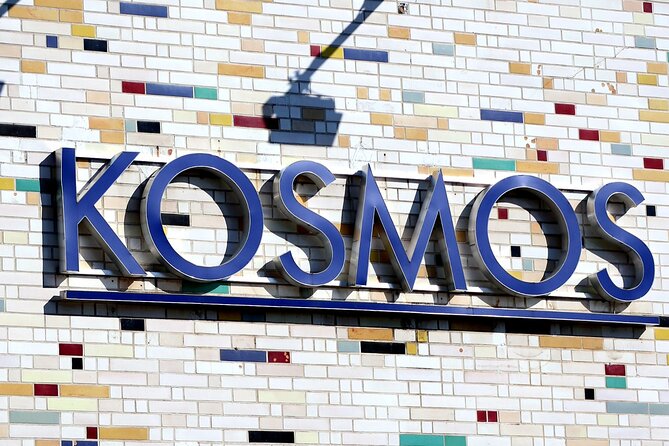
The Karl Marx bust connects the street’s name to the ideas behind the state. Here you consider how socialist ideology affected ordinary life in East Berlin.
This stop is less about one building and more about interpretation. The avenue was not only named for Marx. It was designed to make a political vision visible in stone, housing, public art, and city planning. The guide helps you connect those large ideas to the routines of people living in the district.
I like having this stop late in the route. By then, you have already seen the grand towers, the housing prototype, the workers’ uprising site, and the café. The bust becomes a chance to pull those subjects together without reducing them to a simple good-versus-bad story.
Expect about 15 minutes here. If you enjoy political history, this may be one of the most useful parts of the tour. If your main interest is architecture, it still explains why design choices carried such weight in East Berlin.
Strausberger Platz and the avenue after 1989
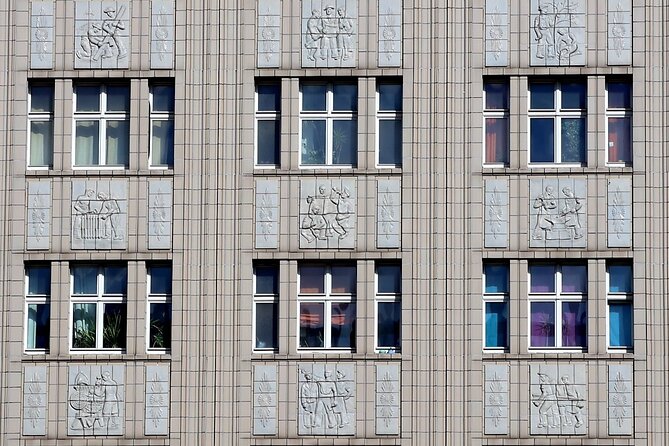
The final stop is Strausberger Platz, another major example of Hermann Henselmann’s style. The roundabout gives you a strong closing view of the avenue and a chance to think about what happened after the Berlin Wall fell.
The guide discusses life on Karl-Marx-Allee after reunification and its place in Berlin today. That matters because the avenue is not frozen in the East German period. Buildings have new owners, residents, uses, and meanings. Some people see monumental architecture; others see home, memory, or a difficult political past.
The tour ends here, on the eastern side of the roundabout. Alexanderplatz is about a 10-minute walk away, so you can continue into central Berlin without arranging extra transport.
This final stop lasts about 15 minutes. It is a good ending because it moves the story beyond 1989. You are left considering how cities handle buildings that carry both architectural value and political baggage.
What the guide adds to the walk
The subject is too layered for a quick self-guided stroll. You can see the towers alone, but you may miss why the style changed, why the Weberwiese building mattered, or how the 1953 uprising challenged the avenue’s public message.
The guide makes the route work through storytelling. Martina is praised for combining careful research, humor, passion, and personal insight into the former communist period. She has also used demonstration material and original historical items to support her explanations. Guide availability can change, so you should not assume Martina will lead every departure, but the experience is clearly built around an informed local voice.
A good guide is especially important here because several names and ideas overlap: Scharoun’s modernism, Henselmann’s socialist monumental style, Marxist ideology, Stalinist symbolism, and the later life of the avenue. The best parts are not isolated facts. They are the connections between them.
The small group limit of 15 helps. You can hear explanations more easily than in a large city walk, and there is more room for questions. It also keeps the route from feeling like a moving crowd around the buildings.
Price, timing, and who gets good value
At $30.01 per person, the tour costs more than simply walking Karl-Marx-Allee with a map. You are paying for about two hours of interpretation, route planning, and an English-speaking local guide rather than admission to paid sights. All seven stops are viewed from public areas, with no entrance fees included or required in the route.
I think the price is fair if you care about Berlin’s architecture, political history, or the former East Germany. The value comes from understanding what you are seeing. If you only want a quick photo of Frankfurter Tor, you can do that independently. If you want to know why the avenue looks the way it does, the guided format earns its cost.
The tour is especially useful for a first visit to Berlin when your time is tight. Two hours gives you a clear introduction without taking an entire morning or afternoon. It also suits repeat visitors who have already seen the central memorials and want a more focused subject.
Wear shoes suitable for city walking and check the forecast. The experience requires good weather, and poor conditions can lead to a different date or a full refund. You receive confirmation at booking, and free cancellation is available up to 24 hours before the start time.
Who should book the Karl-Marx-Allee walk
I would choose this tour if you enjoy buildings as evidence of political and social change. It is also a strong match for anyone curious about East Germany beyond the Berlin Wall and Cold War checkpoints.
Older children and teenagers with an interest in history can follow the route, especially when the guide uses stories and visual material. One account describes a 17-year-old finding the subject absorbing, which fits the tour’s mix of architecture, personal life, and political conflict.
You may want a different experience if you prefer indoor museums, a relaxed café stop, or a route with little walking. The itinerary is focused and information-heavy. You should also know that the emphasis is on explanation rather than entering major buildings.
The meeting point at U Frankfurter Tor is easy to reach by public transport. The end at Strausberger Platz keeps you within the same broad district and near Alexanderplatz, so it fits neatly before or after other Berlin plans.
Should you book it?
Book this walk if you want to understand how East Berlin tried to build a new society in brick, stone, public squares, and apartment blocks. The route gives you grand towers, modernist experiments, workers’ conflict, café culture, political symbols, and the avenue’s later life in one compact outing.
I would skip it only if your Berlin plans already contain several architecture tours and you are mainly seeking famous landmarks. For most visitors with two free hours, the small group, clear route, and strong guide-led storytelling make this a useful way to see a part of the city that many people pass without understanding.
FAQ
Where does the tour begin?
The tour begins at U Frankfurter Tor in Berlin, Germany.
Where does the tour end?
It ends at Strausberger Platz, on the eastern side of the roundabout.
How far is the end point from Alexanderplatz?
Strausberger Platz is about a 10-minute walk from Alexanderplatz.
How long does the tour last?
The tour lasts approximately two hours.
What language is the tour offered in?
The tour is offered in English.
How many people can join the tour?
The maximum group size is 15 people.
Is admission included?
The route visits public areas, and admission tickets are listed as free for each stop. An expert local guide is included.
Is the tour suitable for most people?
Yes. Most people can participate, and service animals are allowed. The tour takes place near public transportation.
What happens if the weather is poor?
The experience requires good weather. If it is canceled because of poor weather, you will be offered a different date or a full refund.
Can I cancel for a full refund?
Yes. You can cancel at least 24 hours before the experience start time for a full refund. Cancellations or changes made less than 24 hours before the start time are not refunded or accepted.
Just added around Germany
- Beautiful Baroque Potsdam: A Self-Guided Audio Tour★ 4.5 · 4 reviews
- Munich Your Way: Private Tour with Architect & Guide★ 5.0 · 2 reviews
- Private Munich Tour for History Buffs with Architectural Gems and WWII sites★ 5.0 · 3 reviews
- Art Nouveau Meets Street Art in Munich (Max. 12 guests)★ 5.0 · 3 reviews
- Hidden Architectural Gems of Munich (Max. 16 guests)★ 5.0 · 2 reviews
- Architectural Frankfurt: Private Tour with a Local Expert★ 5.0 · 2 reviews
- Private Taxi Tour of City East History and Architecture 2-3h★ 5.0 · 2 reviews
- Architectural Berlin: Private Tour with a Local Expert★ 4.0 · 3 reviews
Berlin Architecture Tours, compared.
Private Taxi Tour City East & West History and Architecture 3-4h
Read our review →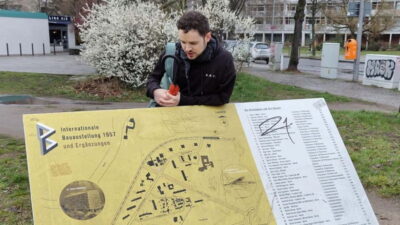
Berlin: Hansaviertel Modernist Architecture Tour
Read our review →
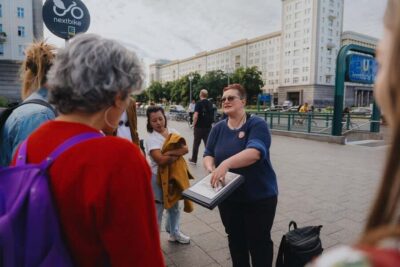
Berlin: Karl-Marx-Allee Tour of Life and Architecture in GDR
Read our review →
Berlin: Guided Architectural Walking Tour of Hansaviertel
Read our review →
Berlin Architecture/River Spree Full Day Photography Tour
Read our review →
Private Taxi Tour of City East History and Architecture 2-3h
Read our review →Browse the lists this tour appears in