
Review · BERLIN
Private Taxi Tour City East & West History and Architecture 3-4h
Berlin makes more sense when you see its grand avenues, war scars, Cold War borders, and rebuilt squares in one sweep. This private taxi tour with Gunter Bauer covers a remarkable amount of ground in three to four hours, from Charlottenburg and the Ku’damm to the East Berlin boulevards and Checkpoint Charlie.
I like the door-to-door pickup and the warm, air-conditioned taxi, especially in bad weather or for older people. I also like Gunter’s personal approach: he asks what interests you, explains the city in fluent English, and can take photos for you after the tour. The tradeoff is simple: this is a broad overview, not a slow museum visit, and some stops are quick photo breaks.
Key points at a glance
- See both sides of Berlin: Travel from Kaiser Wilhelm Memorial Church and the Ku’damm to Alexanderplatz, Unter den Linden, and the former East-West border.
- Private taxi comfort: Only your group rides, with hotel or apartment pickup within Berlin’s S-Bahn ring.
- History with local detail: Gunter connects buildings, streets, politics, war, and everyday Berlin life rather than giving isolated facts.
- Strong rainy-day choice: Most of the tour takes place inside a heated taxi, with short stops outside.
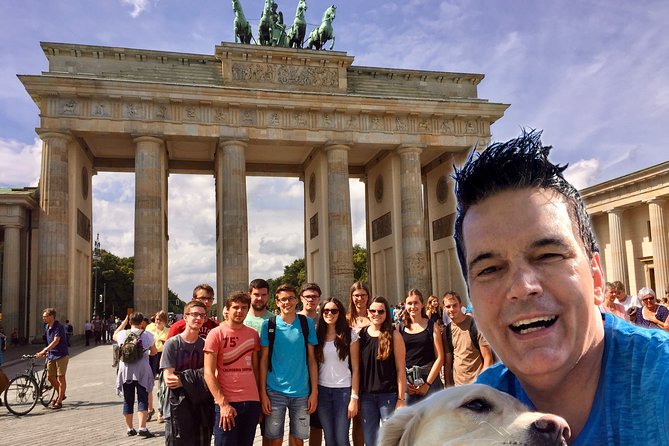
- Wide list of landmarks: Expect the Brandenburg Gate, Reichstag, Gendarmenmarkt, Humboldt Forum, Checkpoint Charlie, and many more.
- Good for mixed-age groups: Child seats are available, and the pace can suit older visitors or families better than a long walking tour.
Why a private taxi is a smart way to see Berlin
Berlin is too spread out for a short walking tour to cover its main districts. The city’s major sights run from Charlottenburg in the west to Alexanderplatz and Nikolaiviertel in the east, with the Tiergarten, government quarter, Potsdamer Platz, and former Wall sites in between.
A taxi gives you a useful overview before you commit time to individual museums. You can look at the city’s shape, see how East and West developed differently, and mark places to revisit on foot. The ride also saves your energy for the stops that matter most to you.
The tour is private, so you are not sharing the vehicle with strangers. That matters if your group includes children, older relatives, or people with different interests. Gunter can adjust the emphasis, spend more time on Berlin’s 20th-century history, or focus more on architecture and famous streets.
The price is listed at $150.18 per person. That is not a cheap taxi ride, but it includes private transportation, the driver-guide, parking fees, Wi-Fi, air conditioning, and pickup within the S-Bahn ring. For a full vehicle, the value improves because you are paying for a private service rather than buying several individual sightseeing tickets. Admission is not the main feature here, since most stops are viewed from outside, though the Humboldt Forum visit is included.
More history tours in Germany:
- Lübeck: Private Historical and Architectural Walking Tour
★ 4.5 · 6 reviews - Private Munich Tour for History Buffs with Architectural Gems and WWII sites
★ 5.0 · 3 reviews - Private Taxi Tour of City East History and Architecture 2-3h
★ 5.0 · 2 reviews
Charlottenburg, the Ku’damm, and West Berlin style
The western part of the tour begins around Breitscheidplatz and the Kaiser Wilhelm Memorial Church. The church’s damaged tower remains as a warning from the Second World War, while the modern blue-glass church beside it shows how postwar Berlin chose to preserve and reinterpret its past.
The original memorial was built for Kaiser Wilhelm I, not as a direct war memorial. Its surviving entrance portal includes figures whose faces resemble Prussian rulers and imperial family members. After the war, many wanted the ruins cleared, but public pressure saved the tower and west portal. Egon Eiermann’s modern church buildings were then added around them. Berliners gave the unusual pair their familiar nicknames, lipstick and powder compact.
You will also pass the Berlin Zoo, one of Germany’s oldest zoological gardens. From the taxi, the most noticeable features are the Elephant Gate and the Lion Gate near Zoo Station. This is not a zoo visit, so plan separate time if you want to see the animals.
The Theater des Westens brings another period into view. Its elaborate exterior reflects the time when wealthy Berliners moved west from the crowded center toward villas and gardens. The building now serves as a musical theater and still contains an imperial box.
From Kantstrasse, the route turns toward Kurfürstendamm, usually shortened by Berliners to Ku’damm. The boulevard was modeled partly on the Champs-Élysées. Its long run toward Halensee once featured villas, cinemas, cafés, and entertainment. Today it is mainly a shopping street, with luxury brands and large modern stores.
At Tauentzienstrasse, you reach the KaDeWe, or Kaufhaus des Westens. The department store covers about 60,000 square meters and is especially famous for its upper gourmet floor. You receive about 15 minutes here, enough for a quick look, a snack, or a glimpse at the food displays. It is a useful stop, but not enough time for serious shopping.
Tiergarten and the symbols of West Berlin
The route continues past Wittenbergplatz and the striking underground station, then toward Urania and Lützowplatz. The area shows how West Berlin mixed older civic institutions with postwar planning and wide roads.
The Tiergarten gives you a different view of the city. It began as a royal hunting ground. Frederick the Great opened parts of it to the public, and Peter Joseph Lenné later shaped it into an English-style park with canals, lakes, views, and paths. The Landwehr Canal helped drain wet ground and still provides a useful line through central Berlin.
The park suffered badly in the Second World War. Trees were cut down, and potatoes were planted near the Reichstag. Allied help later supported replanting, which explains why today’s broad green center feels so established despite its violent interruption.
Near the Spree, the House of World Cultures is easy to identify by its curved roof. The former congress hall was an American gift to West Berlin and became known as the Pregnant Oyster. Its roof collapsed in 1980, killing a journalist, but the building was reconstructed. It now presents non-European art and culture.
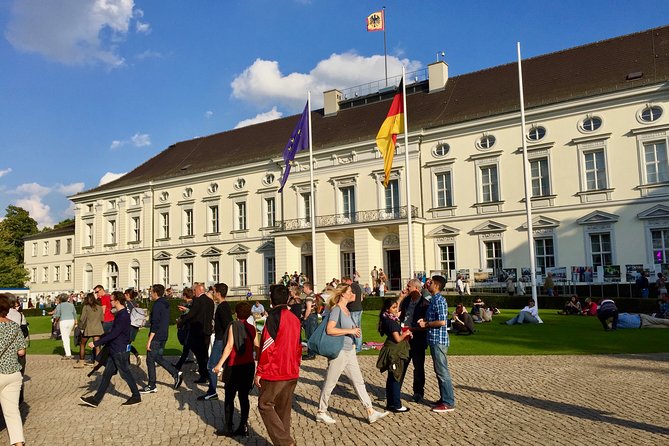
You will also see Bellevue Palace, the official Berlin residence of the Federal President. The small palace was built for August Ferdinand, a younger brother of Frederick the Great, and once had a view toward Charlottenburg Palace. That view has disappeared behind the modern city.
The Victory Column adds a harder-edged imperial symbol. It originally had three sections celebrating Prussian victories over Denmark, Austria, and France. Hitler moved it to its present location and added another section for a victory that never came. The column is usually a drive-by sight on this tour rather than a climb.
The government quarter and the long shadow of German politics
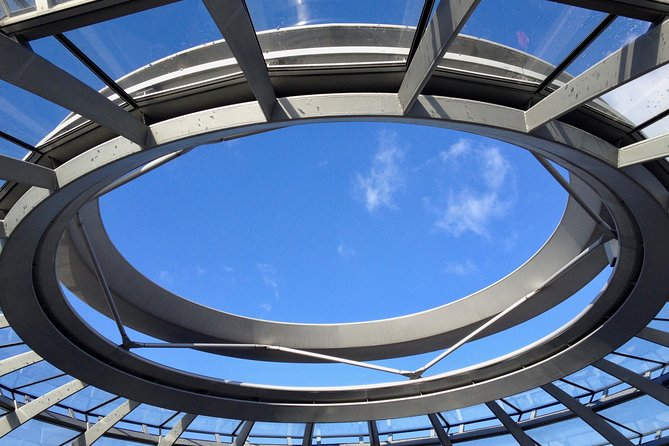
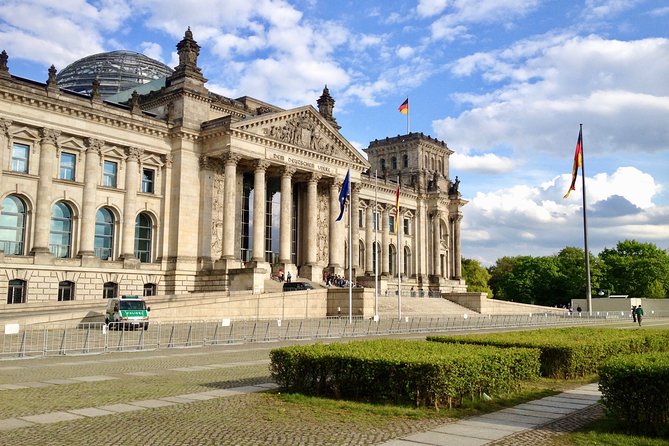
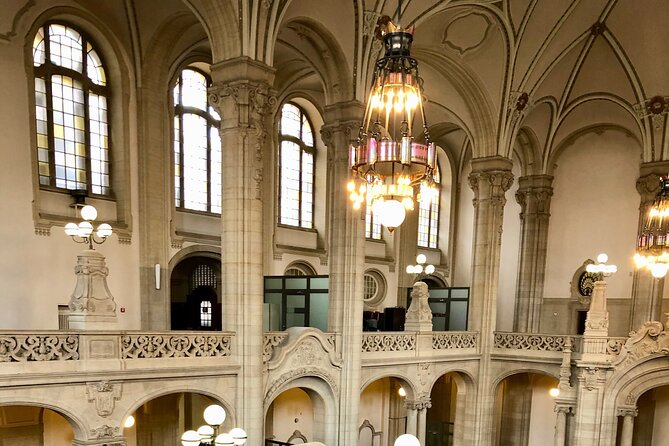
The Reichstag is one of Berlin’s most loaded buildings. Its Wilhelminian exterior recalls the German Empire, while its rebuilt interior serves the reunified parliament. The famous glass dome is not part of this taxi tour as a full visit, but you can see and discuss the building from outside.
A useful detail here is that the Reichstag is mainly used for formal parliamentary sessions. Much of the practical work takes place in the nearby Paul-Löbe Building, a long glass-and-concrete structure with meeting rooms and committee spaces. The Marie-Elisabeth-Lüders Building continues the government quarter across the Spree.
The Federal Chancellery is intentionally huge, with ten floors, hundreds of offices, and a large central rotunda. Nearby, the press area has a large window where government statements are delivered to accredited journalists. This part of Berlin is modern, open, and carefully planned, a sharp contrast to the old royal core.
More private architecture tours in Germany:
- Private walking Tour: Berlin Architecture Tour
★ 5.0 · 14 reviews - Lübeck: Architecture and Local Craft Private Guided Tour
★ 4.0 · 6 reviews - Architectural Berlin: Private Tour with a Local Expert
★ 4.0 · 3 reviews - Munich Your Way: Private Tour with Architect & Guide
★ 5.0 · 2 reviews
Hackesche Höfe and Berlin’s Jewish quarter
Crossing back toward the eastern center, the tour reaches Hackesche Höfe. These courtyards were built in 1908 to combine workshops, small businesses, and housing. Their restoration after German reunification helped set the tone for the surrounding district.
You can walk into the courtyards for about ten minutes. The Art Nouveau decoration is the main attraction, but the setting also explains how Berlin’s older apartment blocks mixed work and home life. Today, the workshops have largely become shops, galleries, and cafés. You may also see Königliche Porzellan-Manufaktur pieces and products featuring the East German Ampelmännchen traffic-light figure.
The New Synagogue on Oranienburger Strasse is another important stop. Its Moorish-style facade and gold dome recall the large synagogue opened in 1866, when Prussian Jews had gained civil rights and wanted a building that expressed their identity. The main synagogue was destroyed in the war, but the front section now houses an exhibition about Jewish life in Berlin.
Security is strict. Do not expect to walk in casually with a full bag, and allow extra time if you plan to enter beyond the exterior view.
Alexanderplatz, Nikolaiviertel, and the old city core
Berlin Central Station gives you a quick look at the city’s modern transport system. It has underground and elevated tracks, several levels, and a large shopping area. It replaced the old role of Bahnhof Zoo for long-distance trains, a change that pleased some parts of Berlin and annoyed others.
At Alexanderplatz, the scale changes again. The square was redesigned during East German rule as a broad socialist parade space, surrounded by buildings meant to express modernity. The television tower remains the most visible symbol. Before the square became a major urban center, its earlier name referred to cattle trading.
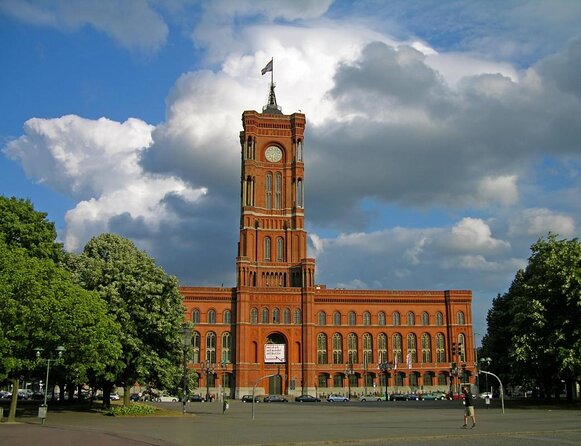
The Red City Hall gets its name from its red brick, not from the political party of the mayor. It was built in the 19th century and served East Berlin’s city government during the division. Some interior rooms can be visited free of charge, though the taxi tour does not promise a full interior visit.
Nikolaiviertel offers a smaller, more old-fashioned setting. Much of what you see is a deliberate reconstruction from the 1980s, since very little of the old quarter survived the war. The Nikolaikirche, Berlin’s oldest church, now serves as a city museum. Nearby Knoblauchhaus presents Biedermeier interiors and family life.
This is one place where I would ask Gunter to slow down if possible. The area helps you picture Berlin before the monumental avenues and modern towers. It also has restaurants by the Spree, so it can be a useful place to return for a meal after the tour.
Unter den Linden, Gendarmenmarkt, and the Humboldt Forum
Unter den Linden began as a route from the Berlin Palace toward the royal hunting grounds. Its name refers to the lime trees planted along the avenue. Today it is lined with the State Library, Humboldt University, the State Opera, museums, and former royal buildings.
At Bebelplatz, you can see the Forum Fridericianum, including the former royal library, St. Hedwig’s Cathedral, the State Opera, and Humboldt University. A glass panel in the pavement marks the empty underground library associated with the Nazi book burning of May 10, 1933. It is a small, quiet memorial in a grand square.
The Neue Wache memorial nearby has changed meaning over time. Once a guardhouse, it now honors victims of war and tyranny. Inside is Käthe Kollwitz’s enlarged Pietà, a mother mourning her dead son.
Gendarmenmarkt is one of Berlin’s most elegant squares. The French and German cathedrals frame the concert hall, though neither cathedral is a bishop’s seat. The French church recalls the Huguenot refugees welcomed to Prussia. The German cathedral now houses an exhibition on German parliamentary history.
The Humboldt Forum occupies the former site of the Berlin Palace. The palace was badly damaged in the war and later demolished by East German authorities. The current building recreates its exterior and the Schlüter courtyard while placing modern exhibition spaces inside. The visit is scheduled for about 30 minutes, and admission is included.
Because the project and exhibitions have changed over time, check current opening arrangements before relying on a particular gallery. The value here is the building itself and the chance to discuss how Berlin decides what to rebuild, preserve, or replace.
Checkpoint Charlie and the divided city
Checkpoint Charlie is a necessary stop, but you should know what you are seeing. The guard booth and sign are replicas, not the original Cold War structures. The site remains useful because it marks the former crossing point and the tense tank confrontation between American and Soviet forces in October 1961.
The nearby private museum adds context, but museum admission is not included in the tour. The taxi stop is mainly for photographs and a short explanation. If the Wall era is your main interest, tell Gunter before departure so he can give that period more attention.
The route may also pass the former border near the harbor, where Günter Litfin became one of the first people killed while trying to escape East Berlin after the Wall went up. Details like this give the divided city a human scale, beyond the famous photographs.
What the tour does best, and where it falls short
The strongest part is the amount of Berlin you can see without changing trains or wearing out your feet. You move between districts that would take much longer by public transport, and Gunter can explain why a street, building, or empty space matters.
His other major strength is personal service. He has helped people adjust plans after travel delays, assisted with train-ticket questions, and sent photographs taken during the tour. That makes the experience feel more like a private introduction than a standard ride.
The limitation is pace. Three to four hours can show you the outline of Berlin, but it cannot provide full visits to the Reichstag, museums, the zoo, the synagogue, and every memorial. Some stops last only five to fifteen minutes. You should treat this as an orientation tour, then return independently to the places that catch your interest.
The tour works particularly well in winter or wet weather. Most of your time is in the heated taxi, and outdoor stops break up the ride. Bring water, since the vehicle may be warm and the commentary is continuous.
Pickup within the S-Bahn ring is included. Airport pickup from BER and addresses outside the ring cost extra. A toddler seat for ages six months to three years, a booster seat, and a baby seat on request are available. Service animals are allowed, and most people can take part, though the tour still includes getting in and out of a vehicle at several stops.
Should you book the Berlin taxi tour?
Book it if you want a private, efficient first look at Berlin, especially if your group includes older relatives, children, or anyone who prefers not to walk long distances. It is also a good choice when weather is poor or when you want a guide to connect the city’s royal, Nazi, East German, and reunited eras in one sitting.
Skip it if your priority is slow museum time or a long walk through one neighborhood. You will get more from the tour if you arrive with two or three subjects you care about and tell Gunter in advance.
The flexible pickup, strong English, personal photos, and wide route make this a useful introduction. Just keep your expectations clear: you are buying context, comfort, and coverage, not a day of extended interior visits.
FAQ
How long does the private taxi tour take?
The tour lasts approximately three to four hours.
What is included in the price?
Private transportation, Wi-Fi, air conditioning, parking fees, pickup within the S-Bahn ring, the taxi fare, and the city tour are included.
Where can pickup take place?
Pickup is included from your chosen hotel, apartment, or other address within Berlin’s S-Bahn ring. Pickup from BER Airport or locations outside the ring costs extra.
Is the tour offered in English?
Yes. The tour is offered in English, and Gunter Bauer provides the commentary.
Is this a private group experience?
Yes. Only your own group participates in the tour.
Are child seats available?
A toddler seat for children from six months to three years and a booster seat for older children are available. A baby seat can be brought on request.
Just added around Germany
- Beautiful Baroque Potsdam: A Self-Guided Audio Tour★ 4.5 · 4 reviews
- Munich Your Way: Private Tour with Architect & Guide★ 5.0 · 2 reviews
- Private Munich Tour for History Buffs with Architectural Gems and WWII sites★ 5.0 · 3 reviews
- Art Nouveau Meets Street Art in Munich (Max. 12 guests)★ 5.0 · 3 reviews
- Hidden Architectural Gems of Munich (Max. 16 guests)★ 5.0 · 2 reviews
- Architectural Frankfurt: Private Tour with a Local Expert★ 5.0 · 2 reviews
- Private Taxi Tour of City East History and Architecture 2-3h★ 5.0 · 2 reviews
- Architectural Berlin: Private Tour with a Local Expert★ 4.0 · 3 reviews
Historical Tours, compared.
Chicago in a Day: Food, History & Architecture Walking Tour
Read our review →
Kuala Lumpur: Batu Caves & Historic Buildings Tour
Read our review →
Charleston’s Best Highlights: History, Culture & Architecture
Read our review →
Palm Springs Modernism Architecture & History Bike Tour
Read our review →
Charleston: History and Architecture Guided Walking Tour
Read our review →
Historic Georgetown: History, Gossip, & Architecture Walking Tour
Read our review →
Charleston History, Homes, and Architecture Guided Walking Tour
Read our review →
Browse the lists this tour appears in