
Review · MUNICH
Hidden Architectural Gems of Munich (Max. 16 guests)
Munich has plenty of grand squares and famous palaces. This tour takes a different route, through southern neighborhoods where a boat sits on a railway bridge, an old air-raid shelter has become housing, and painted shipping containers form an art district. It is an unusual way to see how Munich keeps changing.
I like the mix of architecture and local history, and I like that Philipp brings an architect’s eye to places most city tours skip. Bahnwärter Thiel, Little Venice, and Gans Woanders give the route plenty of character. The main trade-off is simple: you spend much of the 2.5 hours moving between outdoor stops, so this suits you better if you enjoy walking and neighborhood detail than if you want Munich’s major sights.
The group is limited to 16 people, which should make it easier to hear explanations and ask questions. At $31.44 per person, the price is fair for a small-group tour led in English, though you are paying for interpretation and local insight rather than admission to ticketed attractions.
Key points to know before booking
- An architect leads the route: Philipp is an architect and certified city guide who focuses on design, urban change, and the stories behind overlooked places.
- The route is packed with unusual stops: You see a theatre, street-art district, boat café, former air-raid shelter, workers’ cottages, canal houses, and an alternative beer garden.
- Bahnwärter Thiel is a major highlight: More than 40 spray-painted shipping containers and the Beginner’s Wall bring a former cattle-yard area to life.
- Alte Utting is exactly as strange as it sounds: An old boat has been placed on a railway bridge and now operates as a bar, café, and restaurant.
- The tour finishes at Gans Woanders: You can stay for food or a drink, and the nearby Humboldtstraße bus stop gives you a practical route back toward central Munich.
- Expect a neighborhood walk, not a museum visit: Every stop has free admission, but the experience depends on outdoor sightseeing, storytelling, and the route between locations.
Why this Munich tour takes a different road
The appeal here is not a single famous monument. It is the way Philipp links small, unexpected places into one story about Munich’s southern districts.
You begin at Piazza Zenetti, then work south through areas shaped by industry, flooding, war, transport, art, and housing. The route shows how old structures can be reused rather than erased. A theatre becomes a lesson in modern design. A former cattle-yard district turns into a place for street art. A wartime shelter becomes an exclusive residential complex.
I find that approach more revealing than simply collecting postcard views. You get a sense of the city as a living place, with odd corners and unresolved debates. At the same time, you should know what this tour is not. It does not focus on Marienplatz, the Residenz, or Munich’s best-known church interiors. If this is your first hour in the city and you want the headline sights, choose a central orientation tour instead.
For a return visit, an architecture fan, or anyone who wants a less polished side of Munich, this route has a lot to offer.
A few more architecture tours around Germany worth a look
- Munich 3-Hour Segway Tour: Nazi Munich & Royal Architecture
★ 4.9 · 194 reviews - Düsseldorf: Guided City Architecture Walking Tour
★ 4.6 · 61 reviews - Hidden Architectural Gems of Munich (Max. 16 guests)
★ 4.9 · 52 reviews
Starting at Münchner Volkstheater
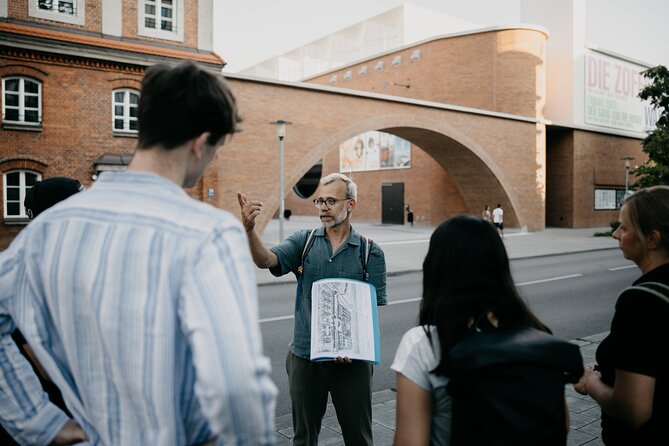
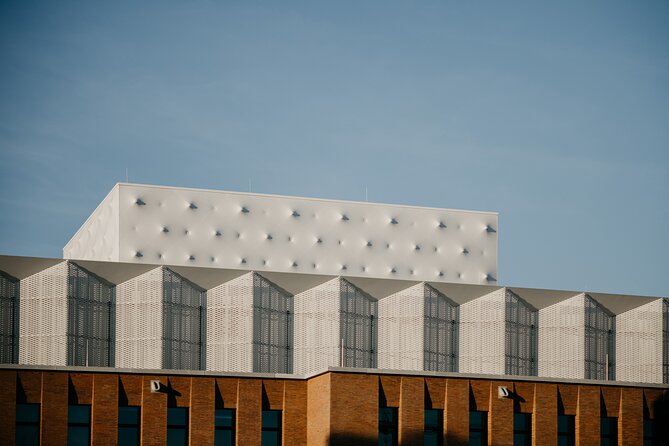
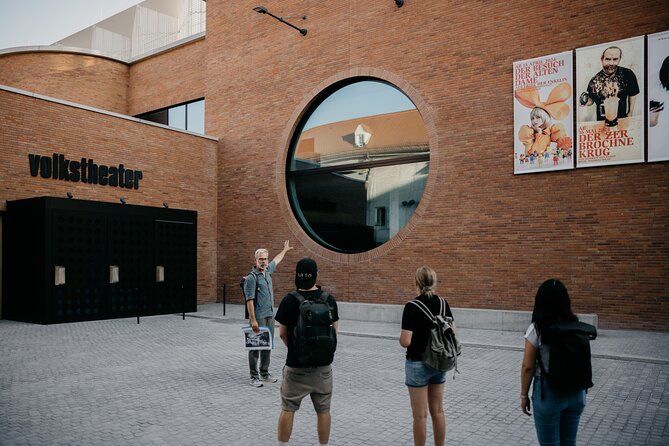
The first stop is Münchner Volkstheater, where Philipp explains the building’s design journey. The theatre is especially personal for him because it was created by his former architecture professor.
That detail gives the opening a useful human angle. You are not just looking at a façade and hearing dates. You are hearing how an architect thinks about a building, how design decisions develop, and how a contemporary cultural building fits into its neighborhood.
The stop lasts about 10 minutes, so expect a focused introduction rather than a full architectural lecture. Admission is free. If you enjoy modern buildings, pay close attention here, since the tour’s design focus begins immediately.
Shipping containers and street art at Bahnwärter Thiel
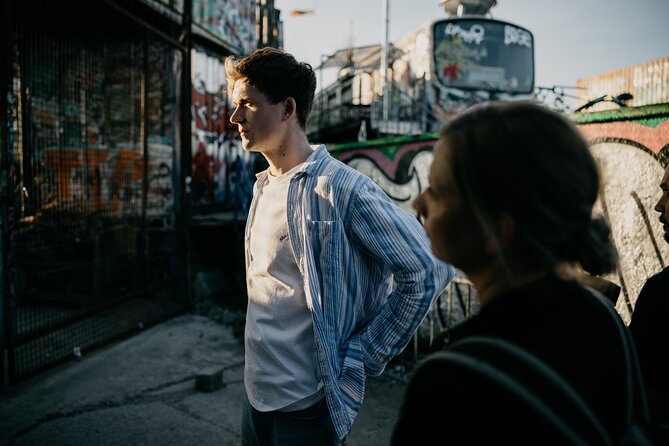
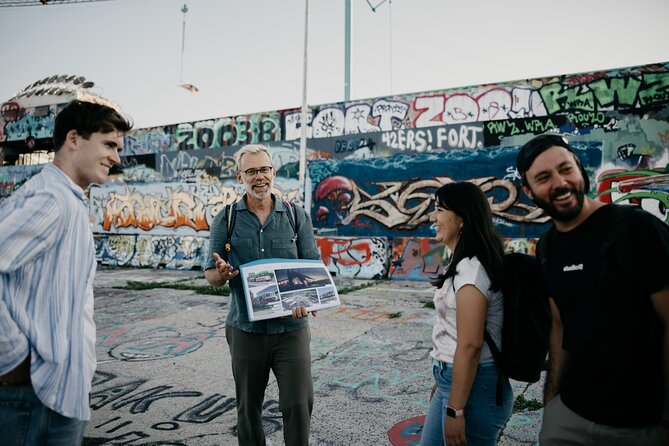
Bahnwärter Thiel brings a sharp change of mood. This former cattle-yard district now functions as an art area, with the Beginner’s Wall and more than 40 shipping containers covered in spray paint.
I like this stop because it makes urban reuse easy to understand. The art is not set apart in a formal gallery. It occupies working materials and leftover urban space. The painted containers give the place a rough, changeable quality, and Philipp can explain how this kind of area fits into Munich’s cultural life.
You spend around 15 minutes here. That is enough to get the idea and take in the setting, but not enough for a long, leisurely art walk. If street art is your main interest, you may wish you had extra time to look around on your own after the tour.
Still, it is one of the clearest examples of the tour’s purpose: finding creativity in places that were not built as attractions.
The unlikely boat at Alte Utting
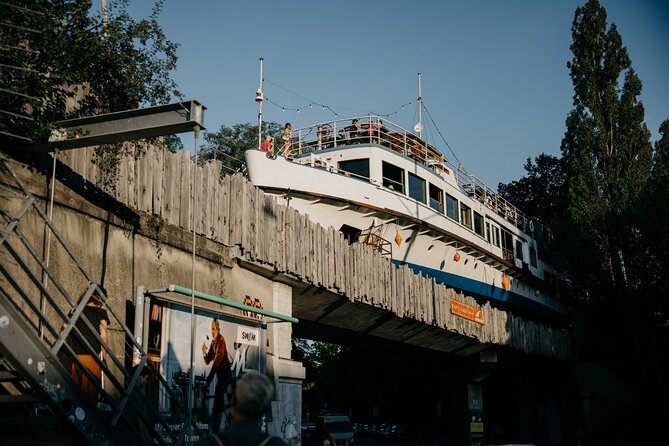
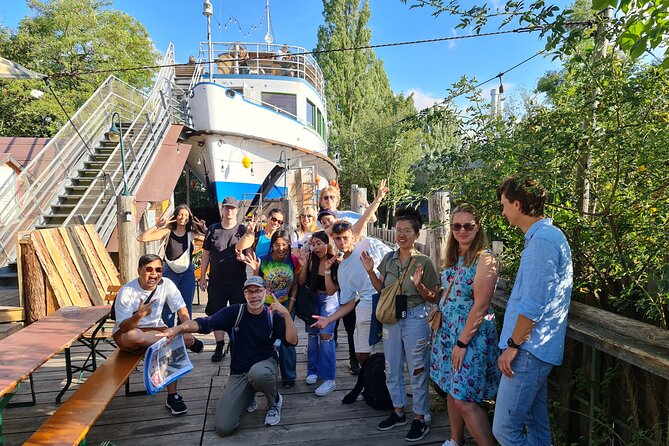
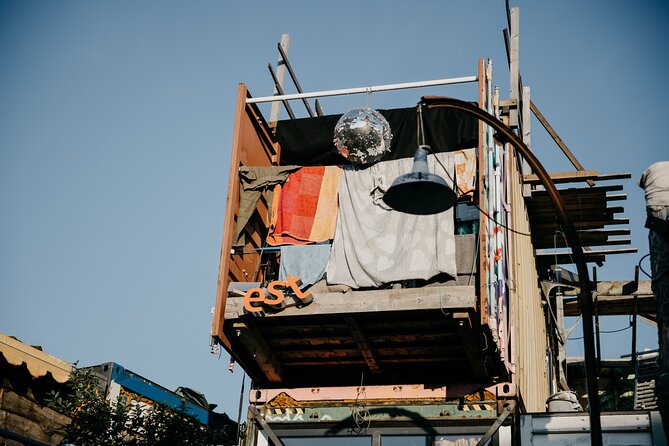
Alte Utting is the route’s most instantly memorable oddity. An old boat has been placed on a railway bridge, where it now operates as a bar, café, and restaurant.
The story is strong because the setting is so unexpected. You are used to seeing boats on water and trains on tracks. Here, the two ideas meet in one improbable place. The venue has received international attention, including coverage in The New York Times, but its appeal is not only publicity. It is the kind of reuse project that gives a neighborhood its own personality.
The scheduled stop is about 10 minutes. That is enough to hear the backstory and understand the design idea, but it is not a meal break. If you want to eat or linger, plan to return separately. The tour keeps moving.
This is also a good example of why the experience works best for curious people. You are not being shown a grand civic monument. You are being shown what happens when an old object finds a new purpose.
Same city, a completely different century:
- Dresden: Tour of the Baroque Quarter with a Night Watchman
★ 4.7 · 681 reviews - Potsdam: Guided Walking Tour of UNESCO Site and Architecture
★ 4.7 · 49 reviews - Private Taxi Tour City East & West History and Architecture 3-4h
★ 5.0 · 42 reviews - Stuttgart city library – an architectural tour
★ 4.4 · 27 reviews
Dreimühlenviertel and the old water-mill setting
At Dreimühlenstraße, the focus shifts from individual buildings to the shape of the neighborhood. Philipp traces the area back to a time when there were fields, a canal, and a water mill.
Today, Dreimühlenviertel is one of Munich’s more appealing small districts. The value of this stop lies in seeing how a place can retain traces of its earlier form even after the city grows around it. The area gives the tour a calmer pause after the street art and Alte Utting.
The stop lasts about 10 minutes. You will not get every detail of the neighborhood’s development, but you will gain a useful frame for seeing it. I appreciate stops like this because they train you to look for the old city beneath the newer one.
The Isar, rafting, and river repair at Wittelsbacherbrücke
At Wittelsbacherbrücke, the route reaches the Isar. You stroll through the park beside the river and hear about more than 700 years of rafting history.
The river also gives Philipp a chance to discuss the renaturation project completed in 2009. That subject matters because it connects Munich’s past use of the Isar with its more recent effort to improve the river environment and public spaces. The stop is not just scenic. It shows how a city can reconsider the way it manages an urban river.
This is the longest stop, at about 20 minutes. That extra time helps the explanation breathe. You get a chance to take in the water, the park, and the broader setting instead of rushing from one object to the next.
Do not expect a long nature walk. The emphasis remains on history, urban planning, and the river’s changing role. Still, this section offers a welcome outdoor break and some of the route’s most pleasant surroundings.
A former air-raid shelter on Claude-Lorrain-Straße
The stop on Claude-Lorrain-Straße carries more weight. A former high-rise air-raid shelter from World War II has been transformed into an exclusive residential complex.
Philipp uses the building to explain both its wartime purpose and its later transformation. The change from a massive protective structure to a modern living space, with more light and transparency, raises difficult questions about memory and reuse. How should a city live with buildings created for frightening purposes? What does it mean to transform them without pretending their past never happened?
The visit lasts about 10 minutes. You will not enter for a full architectural inspection, but the exterior and the story offer a strong contrast with the playful venues earlier in the route.
This is one of the tour’s most serious moments. It keeps the experience from becoming a parade of quirky photo stops. Munich’s architecture also carries the marks of conflict, and this building makes that clear.
Workers’ cottages in the Scherbenviertel
At Untere Weidenstraße, you reach the Scherbenviertel, a name that translates as the district of shards. It was once a poor neighborhood frequently affected by flooding from the Isar.
Two small workers’ cottages remain from that period. They are preserved as part of a historical ensemble, and Philipp uses them to explain how ordinary housing can carry as much meaning as a major public building.
The stop also connects to a local dispute involving similar cottages and the struggle to protect Munich’s older architectural fabric. That gives you a glimpse of preservation politics, not just preservation itself. Saving old buildings is often complicated when land is valuable and a neighborhood is changing.
You spend around 10 minutes here. The cottages are modest, so the explanation matters more than the scale of what you see. If you appreciate everyday history, this may be more rewarding than another grand façade.
Little Venice beside the Auermühlbach canal
Little Venice is a quiet change of pace. Small houses line the Auermühlbach canal, creating a village-like setting inside Munich.
The name tells you what to expect, but the appeal is in the contrast. A major German city suddenly feels intimate, with water, houses, and a slower rhythm. It is a pleasant place to pause before the final stop at Gans Woanders.
The scheduled visit is about 10 minutes, with a nearby café for anyone who wants to relax. The short timing means you will get a taste of the area rather than a long break. If this is the part that catches your imagination, you can return later and spend more time there.
Little Venice also reinforces one of the tour’s best ideas: Munich is not only a city of monumental buildings. Its character also comes from canals, small houses, former industrial edges, and neighborhoods that retain a local scale.
Finishing at Gans Woanders
The tour ends at Gans Woanders on Pilgersheimer Straße, an alternative beer garden with a strong artistic character. It is designed as a place to linger, so the ending feels practical as well as entertaining.
You can use the restrooms here, and the café and restaurant provide an easy place to rest after the route. Since the tour includes several stops but no admission tickets, this final venue gives you the option to continue the experience with food or a drink at your own expense.
The nearby Humboldtstraße bus stop is about a two-minute walk away. Bus 52 takes you toward central Munich, reaching Marienplatz at Rindermarkt in about 12 minutes. That makes the ending much easier than being left in an unfamiliar outer district with no clear way back.
The final stop also captures the spirit of the whole experience. Gans Woanders is not a standard beer hall or a formal museum. It is informal, creative, and a little eccentric.
What $31.44 buys you
At $31.44, you are paying for about two and a half hours with Philipp, an architect and certified city guide, in a group capped at 16 people. That is a reasonable price if you value interpretation and access to a carefully connected route.
There are no entrance fees included because each stop is viewed from the public area. This matters when comparing prices. You are not buying admission to nine attractions. You are buying a guided walk through places that would be hard to connect on your own, with architectural and historical context along the way.
The small maximum group is a plus. A group of 16 is still large enough to have energy, but much easier to manage than a coach group. You should also receive more useful answers when the subject turns technical or local.
The tour is offered in English and uses a mobile ticket. It requires a moderate level of physical fitness, so wear sensible shoes and be ready for a route with multiple stops. The details do not specify seating at every location, so do not treat this as a stationary lecture.
Who will enjoy this route most
I would choose this tour for you if you:
- Like architecture, urban design, and adaptive reuse
- Have already seen Munich’s central sights
- Prefer local neighborhoods to a standard monument checklist
- Enjoy street art, unusual cafés, and independent cultural spaces
- Want a small group rather than a large sightseeing operation
- Are comfortable spending about 2.5 hours moving through outdoor areas
I would think twice if you have limited mobility, dislike walking between stops, or want a tour focused on Munich’s royal buildings and historic center. The stated fitness requirement is moderate, and the route has many separate locations.
Service animals are allowed, and the route is near public transportation. Still, the information provided does not give a detailed accessibility breakdown, so you should confirm any specific mobility needs before booking.
Should you book Hidden Architectural Gems of Munich?
Book it if you want to see Munich through buildings, neighborhoods, and creative reuse rather than famous landmarks alone. Bahnwärter Thiel, Alte Utting, and the former air-raid shelter give the route real variety, while the Isar and Little Venice keep it from feeling like a succession of façades.
The strongest reason to go is Philipp’s point of view. An architect and certified city guide can connect design choices with the city’s past and present in a way a general sightseeing tour may not. The main limitation is that the tour stays at each location for a short time, so you need to enjoy the overall route rather than expect long visits at individual sites.
For $31.44, a maximum of 16 people, and a clear public-transit connection at the end, I consider it a good value for an architecture-minded afternoon. It is especially well suited to repeat visitors and curious first-time visitors who are willing to trade Munich’s headline sights for a more personal look at its southern neighborhoods.
FAQ
How long does the tour last?
The experience lasts approximately 2 hours and 30 minutes.
How much does the tour cost?
The listed price is $31.44 per person.
What language is the tour offered in?
The tour is offered in English.
How many people can join the tour?
The maximum group size is 16 travelers.
Where does the tour start and finish?
It starts at Piazza Zenetti, Zenettiplatz, 80337 München. It finishes at Gans Woanders, Pilgersheimer Str. 13, 81543 München.
Can I cancel for a full refund?
Yes. You can cancel up to 24 hours before the experience starts for a full refund. Changes or cancellations made less than 24 hours before the start time are not accepted for a refund.
Just added around Germany
- Beautiful Baroque Potsdam: A Self-Guided Audio Tour★ 4.5 · 4 reviews
- Munich Your Way: Private Tour with Architect & Guide★ 5.0 · 2 reviews
- Private Munich Tour for History Buffs with Architectural Gems and WWII sites★ 5.0 · 3 reviews
- Art Nouveau Meets Street Art in Munich (Max. 12 guests)★ 5.0 · 3 reviews
- Architectural Frankfurt: Private Tour with a Local Expert★ 5.0 · 2 reviews
- Private Taxi Tour of City East History and Architecture 2-3h★ 5.0 · 2 reviews
- Architectural Berlin: Private Tour with a Local Expert★ 4.0 · 3 reviews
- Berlin Architecture/River Spree Full Day Photography Tour★ 5.0 · 2 reviews
Munich Architecture Tours, compared.
Munich 3-Hour Segway Tour: Nazi Munich & Royal Architecture
Read our review →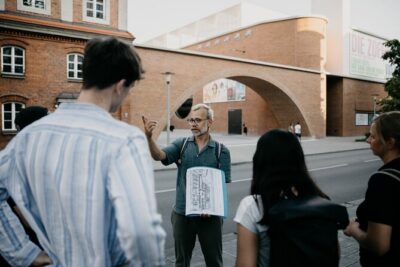
Hidden Architectural Gems of Munich (Max. 16 guests)
Read our review →
500 Years of Munich Architecture (Max. 16 Guests)
Read our review →
Art Nouveau Meets Street Art in Munich (Max. 12 guests)
Read our review →Art Nouveau Meets Street Art in Munich (Max. 12 guests)
Read our review →
Private Munich Tour for History Buffs with Architectural Gems and WWII sites
Read our review →
Browse the lists this tour appears in