
Review · LATVIA
Riga: 2-Hour History of Art Nouveau Walking Tour
Riga’s Art Nouveau district is one of Europe’s great city walks, and this two-hour tour gives you a useful way to read it. You begin at the House of the Black Heads in the Old Town, then walk toward Alberta Street, where elaborate facades, national romantic designs, and the work of Mikhail Eisenstein fill the streets. The buildings are the main event, but the stories explain why they look the way they do.
I like two things here. First, the route connects Riga’s medieval center with its early 20th-century architectural district, so you see a clear change in the city as you walk. Second, the guides focus on details you could easily miss on your own, from facade ornament to the different ideas behind decorative and more restrained Art Nouveau. The main drawback is the group minimum of three people. If too few people book, the tour may be cancelled or changed to a private option.
Key things to know before you book
- Mikhail Eisenstein’s Riga: See the work of the city’s most controversial Art Nouveau architect and hear about his life in Riga, then a major port of the Russian Empire.
- A walk from Old Town to Alberta Street: The route begins at the House of the Black Heads and moves into Riga’s best-known Art Nouveau area.
- Architecture with a human story: Learn about Latvian, German, Russian, and Jewish architects who shaped the city’s distinctive facades.
- A small-group feel when numbers are low: One review described a group of fewer than 10 people, which made questions and conversation easier.
- English or German guiding: Other languages, including French, Spanish, Italian, Japanese, Swedish, Norwegian, Polish, Portuguese, and more, can be requested.
- Two hours on foot: Wear comfortable shoes. The tour is wheelchair accessible, though route changes can occur.
Why Riga is the right city for an Art Nouveau walk
Riga has a particularly strong concentration of Art Nouveau buildings. That makes it a good city for learning the style on foot rather than seeing isolated examples from a taxi window or a museum interior.
Art Nouveau was not just a search for pretty decoration. The style aimed to bring beauty into ordinary urban life while keeping buildings useful. That tension gives the tour a good question to explore: do these dramatic facades make practical buildings, or are they mainly elaborate street scenery?
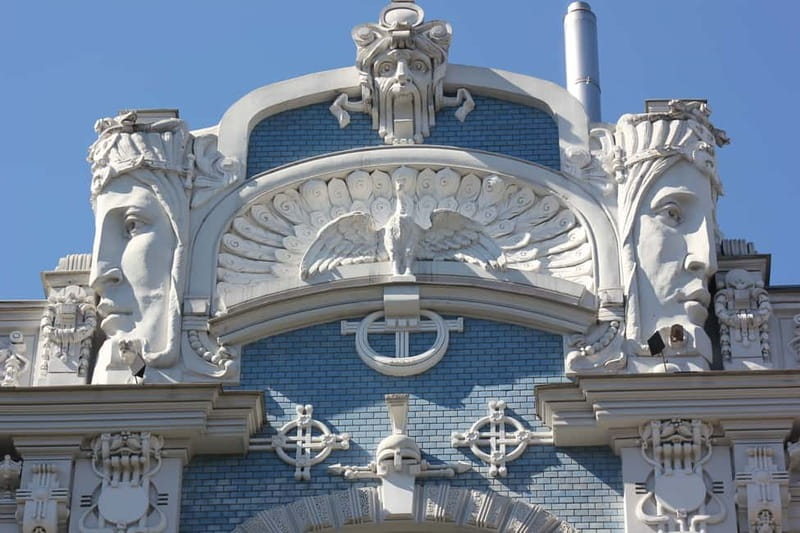
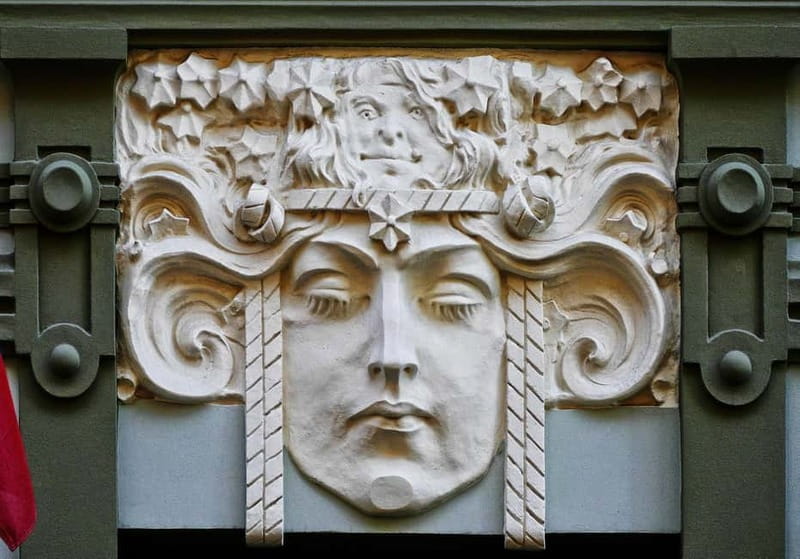
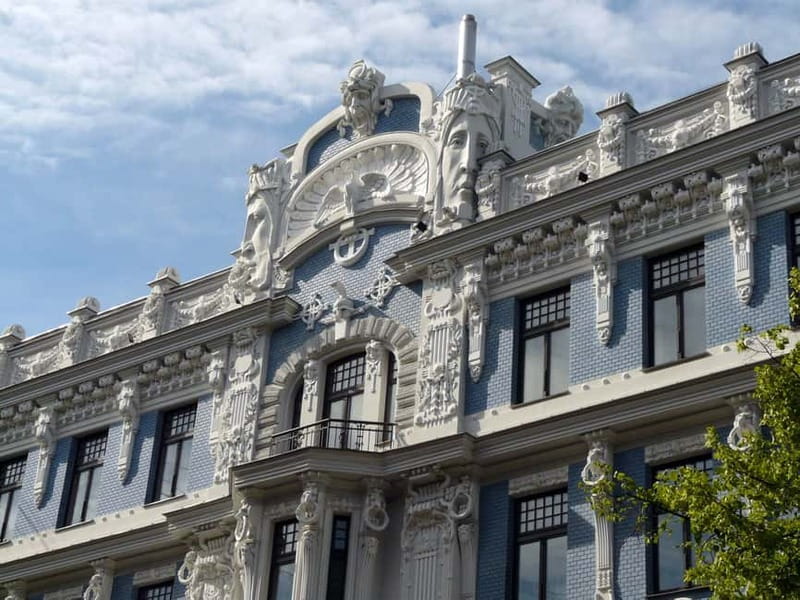
You will see both sides. Some buildings use heavy ornament, sculpted faces, floral forms, and theatrical details. Others take a more intellectual approach, with simpler shapes and designs tied to national romantic ideas. The contrast helps you understand that Art Nouveau is not one fixed look.
The tour also places the buildings in Riga’s social setting. At the time, the city was an important port in the Russian Empire, with Latvian, German, Russian, and Jewish communities contributing to its cultural life. The architecture reflects that mix. A good guide can turn a row of handsome facades into a story about a city changing quickly.
More Art Nouveau tours in Riga:
- Riga: Old Town Walking Tour with Art Nouveau Highlights
★ 4.7 · 332 reviews - Riga Art Nouveau walking tour
★ 4.0 · 27 reviews - Walking Tour of Riga’s Beautiful Art Nouveau Architecture
★ 4.8 · 20 reviews
From the House of the Black Heads into central Riga
The meeting point is the Smile Line office in the House of the Black Heads at Townhall Square, 7. This is a practical starting place because the square is in the heart of the Old Town, close to many other central sights.
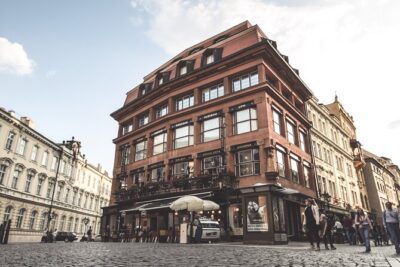
The House of the Black Heads gives you an immediate architectural contrast. You begin among Riga’s older historic buildings before leaving the medieval center for the later Art Nouveau district. That change is important. You are not simply being driven to a set of facades. You are walking through the city’s growth.
Your guide leads the group through central Riga and explains how the city developed before the Art Nouveau boom. The exact stops can change, so you should expect a guided route rather than a fixed checklist of every building.
This opening section is also useful for orientation. If Riga is new to you, the walk gives you a sense of how the Old Town relates to the newer streets beyond it. One solo visitor found the organized setting reassuring, especially because a local guide pointed out details that would have been easy to miss while exploring alone.
Mikhail Eisenstein and the most dramatic facades
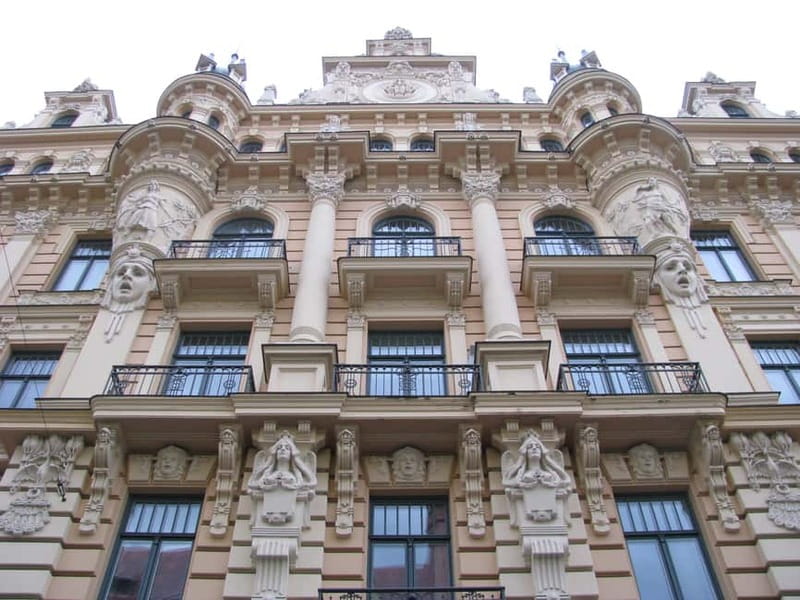
The route continues to the Art Nouveau district, including famous Alberta Street. This is where the tour’s strongest visual moments are likely to come. Mikhail Eisenstein is a central figure, both for his architectural work and for the debate around his style.
Eisenstein’s buildings are not shy. Their decoration can feel theatrical, with strong forms and carefully arranged details competing for your attention. A guide helps you look past the first impression and notice how the parts work together.
You also hear about Eisenstein’s life in Riga and the city he knew as a major imperial port. That background matters because architecture does not appear in isolation. Wealth, trade, cultural ambition, and urban growth all helped create the conditions for these large, decorative buildings.
The tour does not treat Eisenstein as the only architect worth seeing. That is a strength. His work provides a clear thread, but the walk also introduces other designers and the different communities that shaped Riga’s built environment.
Because the facades are so detailed, this is a tour where the guide’s voice matters. A visitor praised the audio system because it allowed the group to hear the explanation while looking up and moving through the streets. That is a small but useful feature, especially when the group is spread along a pavement.
Alberta Street and Riga’s architectural range
Alberta Street is the headline stop for many people, and it deserves the attention. The street is known for its Art Nouveau buildings, but the important point is the range of designs gathered in one area.
Some facades are highly decorative. Look for the way ornament frames windows, emphasizes entrances, and gives upper floors their own visual character. The decoration is not random. A guide can show you repeated motifs and explain how they contribute to the building’s overall design.
Other buildings express national romanticism. Instead of relying only on elegant curves and lavish surface detail, these designs connect architecture with ideas about local identity and tradition. You may find the forms more restrained or more solid, but they still belong to the same broad period of experimentation.
The route also helps you compare architects. Latvian, German, Russian, and Jewish designers each left their mark on Riga. You are not expected to remember every name. The real benefit is learning to see that the district is not the work of one person or one community.
I like this kind of explanation because it changes the way you walk afterward. Instead of seeing an entire street as one grand wall of decoration, you begin to compare entrances, windows, materials, proportions, and symbols. One visitor said the tour changed the way they looked at buildings. That is exactly what a good architecture walk should do.
More architecture walks in Riga:
- Old Town And Art Nouveau Walking Tour Of Riga
★ 4.0 · 15 reviews - Riga Art Nouveau Secrets: Self-Guided Puzzle Walk
★ 5.0 · 6 reviews - Riga Old Town, C Market & Art Nouveau Guided Walking Tour
★ 5.0 · 2 reviews - Riga: Art Nouveau Walking Tour with Welcome Drink
★ 5.0 · 2 reviews
What the guide adds to the experience
The guide is the difference between a pleasant stroll and a useful tour. This experience is designed around a live guide, with English and German listed as the regular languages.
Several guides have received strong praise for their approach. Tatiana, also written as Tatianna in one review, is described as warm, engaging, and exceptionally well prepared. Gunta was praised for answering questions carefully in a small group. Caspars was noted for being organized and for focusing on architectural detail. Liga and Nelli were also singled out for clear, thoughtful explanations.
Guide assignments can change, so you should not book expecting a specific person unless the operator confirms it. Still, the repeated pattern is encouraging: the guides are expected to explain, answer questions, and keep the walk moving at an easy pace.
That pace matters. You need time to look up, take photographs, and listen. A rushed tour would reduce the buildings to a blur of grand entrances and sculpted faces. The available feedback points to a comfortable walking rhythm, with space for questions.
The guides also offer practical local suggestions. One visitor appreciated recommendations for shops and cafes. That can be useful because the tour ends in an area where you may want to continue exploring, stop for a drink, or return for another look at a favorite facade.
Group size, timing, and walking comfort
The tour lasts two hours and is offered as a group experience with a minimum of three participants. The group size may vary, but one recent group had fewer than 10 people. A group that size usually gives you a better chance to hear the guide and ask questions without turning the outing into a private tour price.
The minimum booking requirement is worth noting. If too few people book, the excursion may be cancelled with a full refund, or you may be offered an upgrade to a private tour. This is not a major problem, but it does introduce some uncertainty if your Riga schedule is tight.
The walk is best for anyone who can comfortably remain on foot for two hours. Comfortable shoes are specifically recommended. You will be outdoors, looking at upper floors and moving between the Old Town and the Art Nouveau district, so dress for the day’s weather.
The tour is listed as wheelchair accessible. Some routes may change, so anyone with detailed mobility needs should confirm the current route before booking. The city setting and walking format make that a sensible question to ask in advance.
Children under six can join free. Older children pay the regular price, and one parent felt that some slightly older children became bored toward the end. That is fair advice. Unless your child is genuinely interested in buildings, two hours of facade details and architectural history may be a long stretch.
Is $39 good value for two hours?
At $39 per person, this is not the cheapest way to look at Riga’s buildings. You can walk to Alberta Street on your own and admire the facades without paying an admission fee.
The value comes from interpretation. You are paying for a local guide who connects the streets, architects, design movements, and political setting. Entry tickets are not included, but the activity is primarily an outdoor walking tour, so there is no expectation of paid interior visits.
I consider the price reasonable if Art Nouveau is one of your reasons for visiting Riga, or if you want a strong introduction early in your stay. The tour can save you from wandering past important details without understanding them. It also gives you a framework for a second, self-guided walk later.
The value is weaker if you have little interest in architecture or already know Riga’s Art Nouveau district well. In that case, the tour may feel too focused on facades and design vocabulary. It is also less useful if you want museum interiors, long stops inside buildings, or a broad survey of every part of Riga.
One advantage is the two-hour length. It is long enough to provide real context but short enough to fit around other sightseeing. You could schedule it in the morning, then continue through the Old Town, or take it later and use the guide’s cafe and shop suggestions afterward.
Who should book this Riga walking tour?
I would recommend it most strongly to first-time visitors who want to understand Riga’s architecture rather than simply photograph it. It also suits people who enjoy city history, design, and stories about how different communities shaped an urban center.
Solo visitors may appreciate the structure and the company of a small group. One solo participant felt comfortable joining the walk rather than exploring an unfamiliar city alone. The live guide also gives you someone to ask about places you see along the way.
It works well for couples and friends who like a focused cultural activity. The route is also useful for architecture students, photographers, and anyone curious about Art Nouveau beyond the usual decorative label.
Families should think about the child’s interests before booking. Young children under six are free, but older children pay the full price, and the subject may not hold every child’s attention for the full two hours.
If you need a tour in a language other than English or German, ask in advance. Swedish, Norwegian, Polish, Spanish, Portuguese, French, Italian, and Japanese may be available upon request, but they are not the standard languages listed for every departure.
My practical verdict
I would book this tour if you want Riga’s Art Nouveau district to make sense, not just look impressive. The combination of Old Town streets, Alberta Street, Eisenstein’s work, and the city’s mix of architectural voices gives you a strong introduction in a manageable two hours.
The best reason to go is the guide’s interpretation. The facades are easy to admire, but the stories about design, function, identity, and Riga’s imperial-era growth give the walk its purpose. The strongest praise has gone to guides who explain details clearly, welcome questions, and keep the pace comfortable.
Skip it if your schedule is extremely short and you only want a quick photo stop, or if architecture is not part of your interests. For most visitors who want to understand one of Riga’s defining features, $39 is a fair price for a well-paced, focused walk. Book with comfortable shoes, leave room in your schedule afterward, and keep your eyes above street level.
FAQ
Where does the Riga Art Nouveau tour begin?
Meet the guide at the Smile Line office in the House of the Black Heads, Townhall Square, 7, in central Riga.
How long does the tour last?
The walking tour lasts two hours.
What languages are available?
The regular tour languages are English and German. Swedish, Norwegian, Polish, Spanish, Portuguese, French, Italian, and Japanese may be available upon request.
What buildings and areas does the tour cover?
The route begins in Riga’s Old Town and continues to the Art Nouveau district, including the famous Alberta Street area. It focuses on notable facades and the work of Mikhail Eisenstein, along with other architects.
Is the tour suitable for wheelchair users?
The activity is listed as wheelchair accessible. Some routes may change, so confirm the current route if you need specific accessibility arrangements.
How many people are needed for the group tour?
A minimum of three participants is required. If there are not enough bookings, the tour may be cancelled with a full refund, or you may be offered a private-tour upgrade.
Are entry tickets included?
No. Entry tickets are not included in the tour price.
Can children join the tour?
Children under six can join free. Older children are charged the regular price, and the two-hour architecture focus may not suit every child.
What should I bring?
Bring comfortable shoes for the two-hour city walk.
More 2-Hour Experiences in Riga
- Barcelona 2-Hour Gothic Walking Tour
★ 4.7 · 317 reviews - Guided Gaudí Trencadís Mosaic Workshop in Barcelona 2 Hours
★ 5.0 · 176 reviews - Miami: 2-Hour Art Deco Bike Tour
★ 4.6 · 155 reviews - Gaudi’s Barcelona 2-Hour Segway Tour with a Live Guide
★ 4.9 · 67 reviews
More History Tours in Riga
- Riga’s Architecture: A self-guided audio tour of the city’s art nouveau history
★ 5.0 · 3 reviews - Chicago in a Day: Food, History & Architecture Walking Tour
★ 5.0 · 1,153 reviews - Kuala Lumpur: Batu Caves & Historic Buildings Tour
★ 4.7 · 539 reviews - Charleston’s Best Highlights: History, Culture & Architecture
★ 5.0 · 422 reviews
Just added around Riga
- Riga Old Town, C Market & Art Nouveau Guided Walking Tour★ 5.0 · 2 reviews
- Ultimate Art Nouveau Experience in Riga – Private Tour★ 5.0 · 4 reviews
- Explore Riga’s Art Nouveau district with a Local★ 3.0 · 2 reviews
- Private Riga Art Nouveau Tour★ 5.0 · 5 reviews
- Riga’s Architecture: A self-guided audio tour of the city’s art nouveau history★ 5.0 · 3 reviews
- Riga Art Nouveau Secrets: Self-Guided Puzzle Walk★ 5.0 · 6 reviews
- Old Town And Art Nouveau Walking Tour Of Riga★ 4.0 · 15 reviews
- Riga’s Old Center and Art Nouveau Tour★ 4.9 · 11 reviews
Art Nouveau Tours, compared.
Riga: Old Town Walking Tour with Art Nouveau Highlights
Read our review →
Brussels: Art Nouveau Pass – Entry to Three Locations
Read our review →
Small Group Tour in Ålesund: Art Nouveau, Sea Views & Insider Tips
Read our review →
Browse the lists this tour appears in