
Review · WASHINGTON DC
Iconic Capitol Hill Architectural Walking Tour
Washington’s most revealing architecture tour begins in a train station and ends beneath the U.S. Capitol. In about two hours, you’ll walk from Union Station past the Supreme Court, the Capitol, and the Library of Congress, while stories about designers, politics, and public arguments bring the buildings to life.
I like the route’s strong sense of place and the chance to enter the Library of Congress Thomas Jefferson Building. I also like the personal scale, with a maximum of 20 people and guides such as Sam, who mixes solid historical detail with humor.
The main caution is that Capitol Hill is a working political district, not a quiet museum quarter. Marches, police barriers, and sudden crowds can make it hard to hear or get close to the buildings, and bad weather or low enrollment can lead to a cancellation.
Key points to know before you book
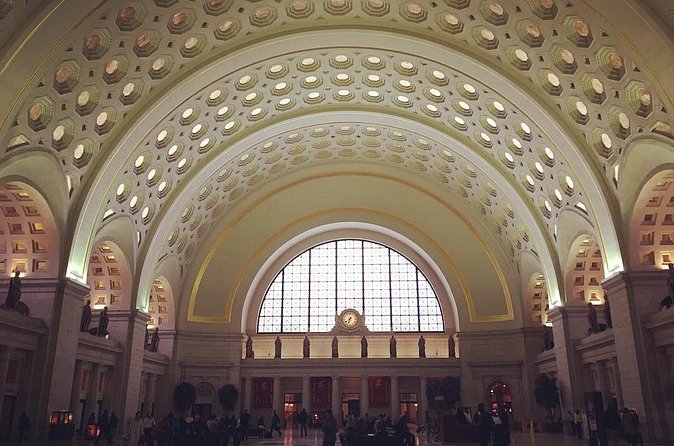
- Union Station is part of the experience: Begin beneath the big clock in the restored Great Hall, surrounded by Classical design and artwork.
- The route covers about one mile: You’ll walk from Union Station to Capitol Hill, with several stops and time inside the Library of Congress.
- Architecture comes with political drama: Hear how Thomas Jefferson, Robert Mills, Frederick Law Olmsted, and Daniel Burnham shaped, argued over, and improved Washington.
- The Library of Congress is the indoor highlight: The Thomas Jefferson Building is known for elaborate decoration, symbols, and a tunnel connection to the Capitol.
- Sam has earned strong praise: His style combines serious information, humor, and memorable details, including an explanation of the Grant Memorial.
- The finish is useful for the rest of your day: The tour ends inside the Capitol Visitor Center, near National Mall sights and public transportation.
Starting beneath Union Station’s great clock
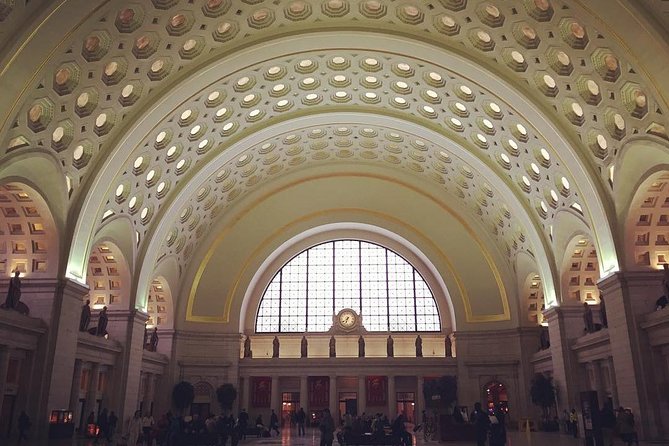
Your meeting point is inside Union Station at 50 Massachusetts Avenue NE. Enter through the main entrance, turn right, and look up for the large clock in the Great Hall. This matters because Union Station is not just a place to gather before the tour. It gives you an architectural opening scene.
The station was once the largest train station in the world. Its vaulted interiors, Classical facade, and artwork have been restored after years of decline. The building has also witnessed presidential inaugurations, wartime movement, diplomatic arrivals, political meetings, and even a runaway train.
That range of stories sets the tone for the morning. You are not simply checking off famous government buildings. You are following the way Washington was designed, repaired, argued over, and used.
Give yourself enough time to find the clock before the start. Union Station is large, and the instructions are simple but specific: use the main entrance, turn right, and look overhead. Your mobile ticket makes arrival easy, but you still need to be in the correct part of the building.
More architecture walks in the USA:
- The Official Art Deco Walking Tour by The Miami Design Preservation League
★ 5.0 · 1,580 reviews - Chicago in a Day: Food, History & Architecture Walking Tour
★ 5.0 · 1,153 reviews - Miami South Beach Art Deco Walking Tour
★ 5.0 · 1,039 reviews
Meeting the designers behind Washington
The tour’s central idea is that Washington did not appear fully formed. Its major buildings and public spaces came from people with competing plans, strong opinions, and plenty of official red tape.
You’ll hear about Thomas Jefferson, Robert Mills, Frederick Law Olmsted, and Daniel Burnham. Each name connects to a different part of the city’s design story, from grand public buildings to open grounds and later efforts to organize Washington’s monumental core.
I like this approach because architecture can feel dry when it is reduced to dates and styles. Here, the buildings become the result of choices and disputes. A guide can point out why a facade looks the way it does, then connect that design to the politics and ideals of the United States.
The tour also gives you a reason to look up. Washington’s public buildings are packed with domes, statues, columns, symbols, and carved details that are easy to miss when you are rushing from one attraction to the next.
Columbus Memorial Fountain and the walk toward the court
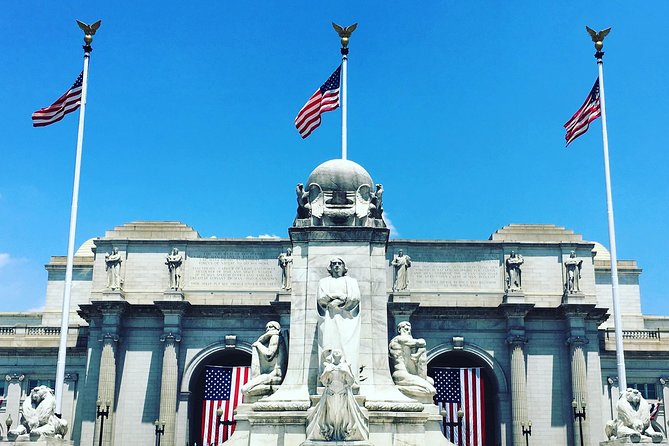
After Union Station, the route passes the Freedom Bell and the Columbus Memorial Fountain before reaching the steps of the Supreme Court. This section is brief, with about five minutes listed for the fountain stop, so expect a quick introduction rather than a long visit.
The fountain and the nearby bell help mark the transition from the railway station to the federal district. You leave a transportation hub behind and move toward the institutions that shape American law and government.
This is also where the walking pace begins to matter. The entire route covers roughly one mile, which is manageable for most people, but the tour includes stops, standing, photographs, and time outdoors. Comfortable shoes will make the morning easier, especially if you plan to continue exploring Capitol Hill afterward.
The Supreme Court facade in five useful minutes
The Supreme Court is an imposing stop, even with only about five minutes devoted to it. You’ll look at the facade and hear about the building’s architecture, design, and role as the home of the judicial branch.
That short timing has both an advantage and a limit. You get a clear explanation of why the building matters without spending half the tour on one institution. At the same time, this is not an interior visit to the courtroom, so you should book the tour for its exterior architecture and context.
I find this kind of short stop useful early in a walking tour. The guide can explain what you are looking at, point out the formal features, and then let you take a few photographs before moving on. If you want a long architectural study of the Supreme Court, this tour will feel too quick. If you want it placed within a wider Capitol Hill route, the timing works well.
A few more architecture tours around the USA worth a look
- Chicago Architecture River Cruise
★ 5.0 · 15,756 reviews - Chicago River 90-Minute Architecture Tour
★ 4.5 · 9,629 reviews - Chicago River: 1.5-Hour Guided Architecture Cruise
★ 4.8 · 8,046 reviews - Chicago Architecture Center River Cruise aboard First Lady
★ 5.0 · 5,536 reviews
The Capitol’s East Front and the Statue of Freedom
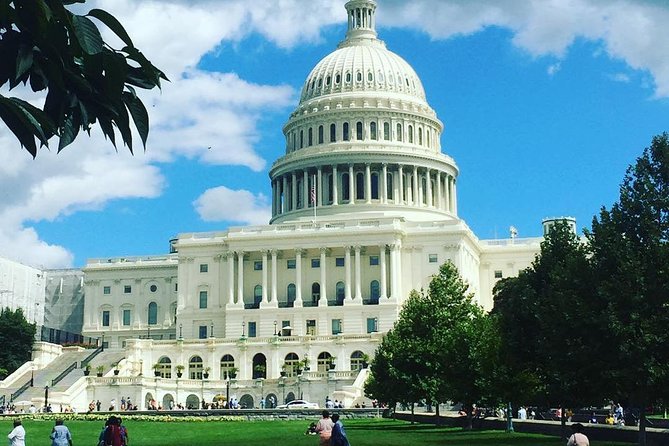
The U.S. Capitol is the visual centerpiece of the walk. The tour takes you to the East side for photographs and discussion of the building’s difficult history. You’ll also look up to the Statue of Freedom at the top of the dome.
That statue is more than a finishing touch on the Capitol. Its unveiling caused controversy, giving the guide an opening to explain how even a national symbol can become part of a political argument.
The East Front offers an excellent setting for a broader conversation about the Capitol. The building represents stability and authority, but its construction and development were shaped by conflict, changing plans, and national upheaval. You’ll spend about 10 minutes here, so the guide’s explanation will be focused rather than exhaustive.
This is one of the best places for photographs, but conditions can change quickly. Political demonstrations near the Capitol can bring police barriers, marchers, noise, and restricted access. One recent tour was badly affected by a march, with people being jostled and unable to get close to the buildings. That problem is difficult to predict in Washington, especially around the Capitol.
Inside the Library of Congress Thomas Jefferson Building
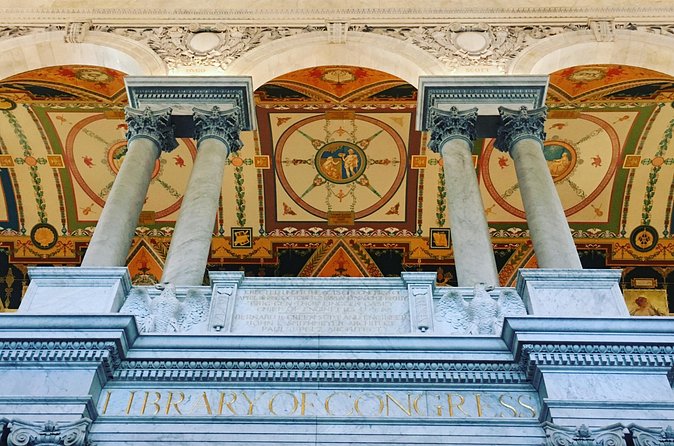
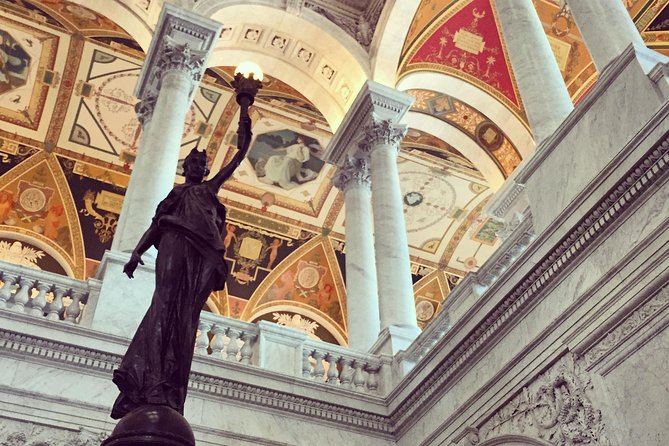
The Library of Congress is the most substantial stop on the tour. About 30 minutes are set aside inside the Thomas Jefferson Building, and admission is included.
The building is known for elaborate decoration and hidden symbols, so this is where an architecture-focused guide can add real value. Rather than simply entering, you’ll be shown how design choices communicate ideas about learning, government, and national identity.
I especially like that the route gives you time indoors. Washington weather can be uncomfortable, and the Library of Congress provides a change from the exposed Capitol grounds. It also gives the tour a second architectural style and mood after the formal government facades outside.
The plan includes taking an underground tunnel from the Library of Congress to the Capitol. That detail makes the route feel connected to the working government district rather than like a string of isolated photo stops. It also reduces some outdoor walking between these two major buildings.
Keep your expectations clear: the included Library visit is part of a guided walking experience, not a full day of independent exploration. The listed timing is 30 minutes, so the guide will focus on the main spaces, decoration, symbols, and institutional story.
Finishing inside the Capitol Visitor Center
The tour ends inside the U.S. Capitol Visitor Center after about 15 minutes of final orientation. This is a practical finish because you are near the National Mall, Capitol Hill sights, and public transportation.
Depending on timing and availability, the guides can help you join a free interior tour of the Capitol. That possibility is useful, but it is not guaranteed. You should treat it as an opportunity at the end, not as the main reason to book this walking tour.
The location also makes it easy to continue your day. You can remain in the Capitol area, head toward National Mall sights, or use public transportation from nearby stops. Unlike a tour that returns you to its starting point, this one leaves you where you are likely to want to explore next.
What the guide adds to the experience
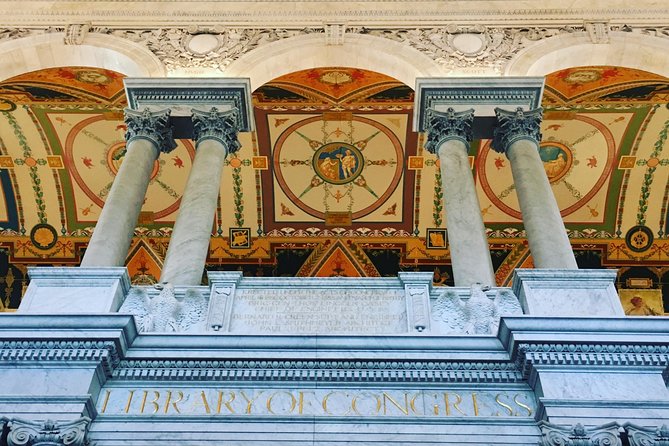
The guide matters here because the buildings are familiar but their details are easy to miss. A good explanation can turn the Statue of Freedom, a columned facade, or a painted ceiling into a story about public ideals and political compromise.
Sam has received especially strong praise for being personable, informative, and fun. His style is described as serious information delivered with humor, with historical details that make the architecture easier to remember. His explanation of the Grant Memorial was singled out as a highlight.
You should not assume Sam will lead every departure, since the provider may assign different local guides. Still, the available feedback gives you a useful sense of the preferred tone: clear history, architectural detail, and a light touch rather than a lecture.
The maximum group size is 20. That is not a private tour, but it is small enough for a guide to manage a moving group and answer occasional questions. A larger crowd would make the Supreme Court steps, Capitol grounds, and Library interiors harder to navigate.
Is the $48 price fair?
At $48 per person, this is not the cheapest way to walk around Capitol Hill. You can see the exterior of the Supreme Court and Capitol on your own, and the public areas around them do not require a paid walking tour.
The price becomes easier to justify because the experience combines several elements in one route. You receive a local guide, a structured one-mile walk, architectural interpretation, access to the Library of Congress, and an ending point inside the Capitol Visitor Center. You are paying mainly for context and efficient routing.
I would find the price reasonable if architecture and design are central interests, or if this is your first visit to Washington and you want a clear introduction to the federal district. It is less convincing if you prefer to move at your own pace, spend a long time inside one building, or already know Capitol Hill well.
The free Capitol interior tour possibility adds value, but only if space and timing allow it. Do not count on it when comparing prices. The dependable core of the experience is the guided walk and Library of Congress visit.
Timing, weather, and the realities of Capitol Hill
The tour lasts about two hours and is offered in English. It requires good weather, and the provider may cancel if too few people book. In either case, you are offered another date or experience, or a full refund.
Washington’s political calendar can also affect the route. Demonstrations are common around the Capitol, and the effect can range from a minor detour to a noisy, crowded walk with limited views. The provider cannot always predict the size of a march or the level of security in place.
For the best experience, arrive ready to walk outdoors and stand for short periods. Wear comfortable shoes and keep your schedule flexible after the tour if you hope to join the Capitol interior visit.
Most people can participate, and service animals are allowed. The activity is near public transportation, and the endpoint is especially useful for reaching more of central Washington.
Who should book this Capitol Hill walk?
I would recommend this tour to first-time visitors who want the big federal buildings explained in a sensible order. It also suits anyone who likes architecture but wants political stories and human decisions included with the design details.
The route works well for people who prefer a focused morning rather than a full-day commitment. The one-mile distance is modest, and the indoor Library stop breaks up the time outside.
Families and mixed-interest groups may also find the format useful. The guide can shift between statues, public arguments, famous buildings, and unusual events such as the runaway train connected to Union Station. That variety gives people different ways to connect with the route.
I would be more cautious if you need a quiet, predictable visit around the Capitol, or if you want guaranteed access to the Capitol interior. Marches can disrupt the experience, and the free Capitol tour at the end depends on availability.
Should you book the Iconic Capitol Hill Architectural Walking Tour?
Book it if you want a compact introduction to Washington’s federal architecture with a real guide, a stop inside the Library of Congress, and a useful finish near the National Mall. The strongest reasons are the well-planned route, the restored Union Station opening, and the chance to hear engaging explanations from guides such as Sam.
Skip it if you only want exterior photographs or prefer to explore at your own pace. The $48 cost pays for interpretation and organization, not exclusive access, and Capitol Hill’s protests and security activity can sometimes interfere.
For most first visits, I think the balance is good. You get the essential Capitol Hill buildings, a memorable indoor stop, and enough historical background to make the rest of your Washington sightseeing more rewarding.
FAQ
Where does the tour begin?
It begins inside the Great Hall of Union Station at 50 Massachusetts Avenue NE. From the main entrance, turn right and look up for the large clock.
Where does the tour end?
The tour ends inside the U.S. Capitol Visitor Center in the Capitol Hill area of Washington, DC.
How long does the tour last?
The tour lasts approximately two hours.
How much walking is involved?
The route covers roughly one mile on foot, with several sightseeing stops and time standing outside and inside buildings.
Is the Library of Congress included?
Yes. The tour includes entry to the Library of Congress Thomas Jefferson Building, with about 30 minutes devoted to the visit.
Is the U.S. Capitol interior tour included?
The walking tour ends at the Capitol Visitor Center, where guides may help you join a free Capitol interior tour depending on timing and availability.
What language is the tour offered in?
The tour is offered in English.
How many people can join the tour?
The maximum group size is 20 people.
Is the tour suitable for most people?
Most people can participate, and service animals are allowed. The tour is near public transportation.
Can I cancel for a full refund?
Yes. You can cancel at least 24 hours before the start time for a full refund. Changes or cancellations made less than 24 hours before the start time are not accepted for a refund.
Just added around the USA
- Wilmington History and Architecture Tour★ 4.8 · 18 reviews
- Washington, DC: Georgetown Architecture Walking Tour★ 5.0 · 8 reviews
- New Orleans : Garden District Architecture Walking tour★ 4.8 · 5 reviews
- Washington DC: Dupont Circle & Embassy Row Architecture Tour★ 5.0 · 6 reviews
- Tulsa: Art Deco Walking Tour of Tulsa★ 5.0 · 8 reviews
- Castle to Capitol: Museums of the National Mall Architecture Tour★ 4.5 · 9 reviews
- Private Colonial Williamsburg Architectural Tour★ 5.0 · 5 reviews
- Monuments and Memorials Architectural Walking Tour★ 5.0 · 17 reviews
Walking Tours, compared.
The Official Art Deco Walking Tour by The Miami Design Preservation League
Read our review →
Barcelona: Gothic Quarter Ghosts and Legends Walking Tour
Read our review →
Barcelona: Old Town and Gothic Quarter Walking Tour
Read our review →
Lecce: Baroque Architecture and Underground Walking Tour
Read our review →
Chicago in a Day: Food, History & Architecture Walking Tour
Read our review →
Ramblas, Old Town, Gothic and Gaudi Architecture Walking Tour
Read our review →
Chicago’s Secret Interiors Architectural Walking Tour
Read our review →Browse the lists this tour appears in