

Review · NEW YORK CITY
The Story Behind NY’s Evolving Skyline An Architectural Journey Through History
New York’s skyline is a history book written in stone, steel, glass, and brick. Kitt Garrett’s on-demand tour traces that story from the Dutch settlement and Henry Hudson’s arrival to today’s towers, waterfront parks, and ever-changing neighborhoods. You follow along by video, then use the downloadable material to explore the city in person.
I like the clear architectural timeline, which moves through Georgian, Federal, Greek Revival, Romanesque Revival, Italianate, Renaissance Revival, Gothic Revival, Queen Anne, Neo-Classical, and modern design. I also like the flexible format: one $25 purchase covers a group of up to 15 people, and you can watch it without physically being in New York.
The main drawback is simple: this is not a live walking tour. You will not have a guide beside you to answer questions or adjust the route to your interests. The nearly two-hour presentation also asks for focused listening, so it works best when you set aside time for it rather than treating it like background entertainment.
Key points to know before you book
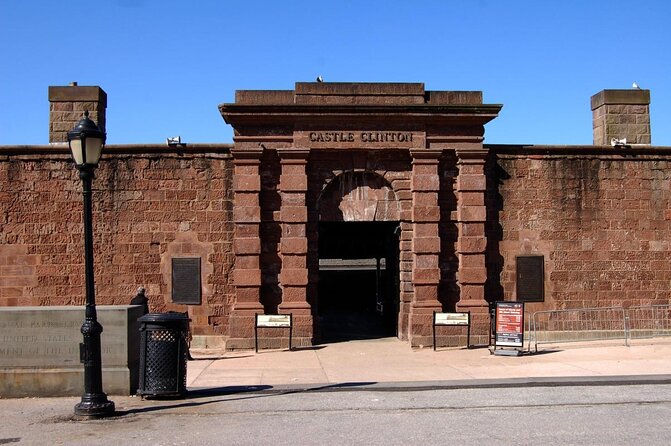
- Start at Castle Clinton and finish near Hudson Yards: The journey links New York Harbor and Lower Manhattan with 20 Hudson Yards, where you can stop for food, shopping, and restrooms.
- Kitt Garrett leads the presentation: Her methodical approach connects building details with the people, events, and decisions behind them.
- The tour explains styles, materials, and planning: You learn how to look at a building, not just where to find one.
- The $25 price covers up to 15 people: That makes it a strong value for a family, classroom, friend group, or private gathering.
- A downloadable PDF extends the experience: Keep it on your device as a reference while walking through New York’s neighborhoods.
- The format suits locals as well as first-time visitors: The material reaches beyond famous sights into zoning, air rights, transportation, and waterfront change.
A city tour told through buildings

The clever idea here is to use architecture as the organizing thread for New York’s past. Instead of presenting a disconnected list of famous structures, Kitt Garrett shows how styles appeared during different periods and how the city’s needs shaped what was built.
That approach gives you a useful habit: look up, identify the materials and decorative details, then ask what was happening in New York when the building went up. A façade becomes more than a pretty backdrop. It can reveal changing wealth, technology, population, taste, and city government.
The presentation covers roughly 400 years of development. It begins with New York as a small Dutch settlement and follows its growth into a major center of trade and commerce. From there, the focus broadens to the city’s famous vertical growth and the practical rules that determine where and how buildings rise.
I especially like that the tour does not treat architecture as an isolated art subject. It connects buildings to parks, public transportation, waterfront use, and neighborhoods. That helps you understand why New York feels so different from one block to the next.
More skyscraper tours in New York City:
- Midtown Manhattan: Times Square & Skyscrapers Walking Tour
★ 5.0 · 18 reviews - NYC Midtown Manhattan Times Square & Skyscraper Walking Tour
★ 5.0 · 11 reviews - Chicago Premium Driving Tour with River Boat Cruise and Sky Deck
★ 4.5 · 165 reviews
Castle Clinton and the city’s harbor beginnings
Castle Clinton National Monument is the starting point, and it is a fitting one. Located at the southern tip of Manhattan, it places the story beside the harbor that helped make New York a center of trade and commerce.
The opening section sets the city in motion from the moment Henry Hudson sailed into New York Harbor. From there, you get the broad historical frame needed to understand why the city grew where it did and why its waterfront mattered so much.
This beginning is not presented as a narrow monument visit. Castle Clinton serves as the doorway into a larger discussion of New York’s physical growth. The emphasis is on how a settlement became a metropolis and how buildings recorded each stage of that change.
The listed stop takes about 10 minutes, but the full experience lasts approximately 1 hour and 58 minutes. Think of Castle Clinton as the first anchor in a much longer visual and historical route, not as the only place you will study.
Learning to recognize New York’s architectural styles
The most useful part of the experience is its architectural vocabulary. Many people walk through New York admiring façades without knowing what they are seeing. This tour gives you a way to sort the details.
You move through styles including Georgian, Federal, Greek Revival, Romanesque Revival, Italianate, Renaissance Revival, Gothic Revival, Queen Anne, Neo-Classical, and modern design. That is a large span of material for one presentation, but the structure gives it a clear direction: early city, expanding city, industrial and commercial growth, and the modern period.
The tour also discusses building materials. That matters because material often tells you as much as decoration. Brick, stone, metal, and glass reflect different construction methods and different ideas about what a city should look like.
Kitt Garrett’s approach is organized and detailed. You are given locations and explanations of why particular structures were designed as they were. The goal is not simply to memorize labels. You learn to connect a style with its period and purpose.
If you already know New York well, this can change your daily walks. A familiar street may begin to show layers you had missed: an older façade beside a newer tower, a decorative detail that hints at a building’s era, or a street pattern shaped by an earlier phase of development.
From low-rise neighborhoods to skyscrapers
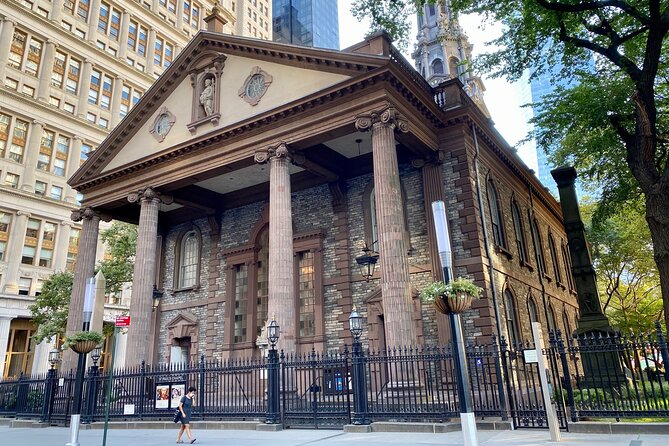
New York’s skyline did not appear all at once. It grew through changing technology, business needs, land values, and planning rules. The tour explains that process while also looking at the people and architects who influenced the city’s form.
The presentation’s scope reaches beyond famous landmarks. It considers the relationship between towering skyscrapers and landmarked neighborhoods, showing how the city places new construction beside older buildings. That tension is one of the central facts of New York life.
A particularly useful subject is air rights, an idea that can seem technical until you see how it affects the skyline. The tour brings planning concepts into the story so you can understand why some buildings rise higher, why other areas stay lower, and how development can shift from one block to another.
This is where the tour becomes valuable for repeat visitors. You may already recognize the Empire State Building or Grand Central Terminal, but the larger question is how the city around them was allowed to grow. The presentation gives you a framework for reading that process.
More history tours in New York City:
- Tribeca Architecture And History Walking Tour
★ 5.0 · 141 reviews - New York City: Flatiron Food, History, and Architecture Tour
★ 4.8 · 43 reviews - TriBeCa Architecture & History Walking Tour
★ 5.0 · 37 reviews - Chelsea Galleries and High Line; Art, Architecture and History
★ 5.0 · 14 reviews
The waterfront’s change from industry to recreation
New York’s waterfront is another important thread. For much of the city’s history, the shoreline served practical commercial and industrial needs. Today, neighborhood by neighborhood, sections of the waterfront are being reshaped for recreation and new destinations.
The tour looks at that change and at the public and private partnerships behind it. You are encouraged to consider how new parks, buildings, and public spaces affect the people who live and work nearby.
This section adds a needed present-day angle. Architecture here is not only about old façades. It is also about what happens when former industrial areas receive new uses and new investment.
The topic is especially useful if you plan to visit several parts of New York during the same trip. The downloadable PDF can help you connect those areas instead of seeing each waterfront project as a separate attraction.
Finishing at Hudson Yards
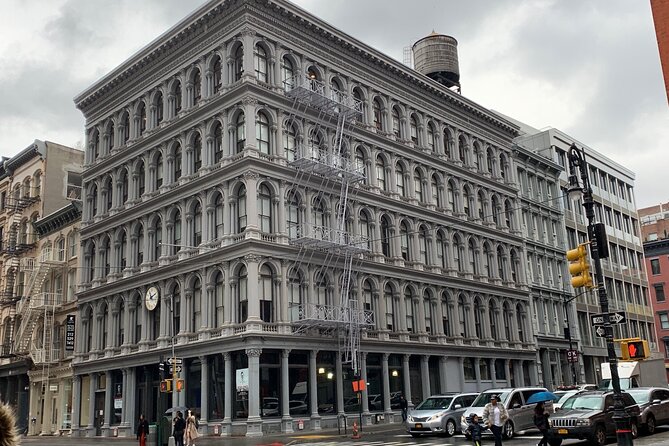
The route ends at 20 Hudson Yards, a modern destination with shopping, restaurants, and restrooms. That endpoint gives the story a clear final chapter: New York’s newest large-scale development and the city’s continuing effort to create new commercial and public spaces.
Hudson Yards also provides a practical stopping point. After nearly two hours of architecture and urban planning, you have somewhere convenient to pause. You can eat, shop, or simply use the restrooms before continuing your day.
The contrast between Castle Clinton and Hudson Yards is the point. You begin beside the harbor and a monument tied to the city’s earlier development, then finish among contemporary towers and planned urban space. The two locations help show how far New York has moved while also reminding you that the city is still changing.
You should not expect the final stop to feel like a traditional guided arrival with a scheduled group activity. It is better understood as the end of your self-guided route and a useful place to stop.
What the on-demand format means for you
The mobile format gives you plenty of freedom. You can watch the tour at home before a trip, use it as preparation while staying elsewhere, or share it privately with your group. Since the purchase is for up to 15 people, it can work well for a family or small private gathering.
The experience is also accessible in a broad practical sense. Service animals are allowed, the route is near public transportation, and most people can participate. Still, remember that the main product is a video presentation, not a live guide walking beside you.
The downloadable document is an important part of the value. Keep it on your phone or tablet and use it as a reminder of locations, styles, and stories while exploring New York on your own. It helps turn the presentation into a travel tool rather than a one-time viewing.
I would watch the video before visiting the city if possible. Then, when you are on the street, you can focus on spotting the features Kitt Garrett explains instead of trying to absorb all the material for the first time.
Who will get the most from this tour

This is a strong choice for a first-time visitor who wants historical context before walking around Manhattan. It is also well suited to someone who has visited New York many times but feels the city still has more stories to reveal.
Architecture students and history-minded travelers should find plenty to work with. The presentation covers a wide range of styles and connects them with world events, New York’s growth, and the decisions that shaped its neighborhoods.
Locals can use it as a fresh way to revisit familiar streets. The experience has been designed to give New Yorkers new ways to identify when buildings were built, who influenced them, and what was happening in the city at the time.
It is less suitable if you want a short, casual activity with minimal information. Nearly two hours is a serious sitting, and the presentation favors people who enjoy detail, careful organization, and historical explanation.
Is the $25 group price good value?
At $25 per group, the price is reasonable, especially if you share it with several people. A full group of 15 brings the cost to less than $2 per person, though a solo buyer will need to decide how much value they place on an extended architecture lesson.
The value increases if you plan to use the PDF during a New York visit. You are not paying only for a video. You are also getting a reference that can guide later walks through neighborhoods, waterfront areas, and streets filled with different architectural periods.
The main value is educational rather than admission-based. There is no claim that the purchase includes entry to attractions, and Castle Clinton is listed as free admission. You are paying for Kitt Garrett’s research, organization, narration, and the convenience of having the material on your device.
The booking is non-refundable and cannot be changed for any reason, so make sure the format suits you before purchasing. If you are uncertain about watching a nearly two-hour presentation, that policy is worth considering.
My advice on booking
Book this tour if you like understanding a city by looking closely at its buildings. It is particularly useful before a New York trip, for a local who wants fresh eyes, or for a group that can share the $25 cost.
Skip it if you want a live guide, a fast highlights walk, or a tour built around entering specific attractions. The format is quiet and self-directed, with the reward coming from the connections between architecture, history, zoning, transportation, and waterfront change.
For the right audience, this is a smart travel companion. Watch it with a notebook or your phone nearby, download the PDF, and then walk through New York looking up. You will begin to see the skyline not as one giant spectacle, but as a record of decisions made across four centuries.
FAQ
How long does the experience last?
The video and self-guided experience lasts approximately 1 hour and 58 minutes.
Where does the tour start?
It starts at Castle Clinton National Monument in New York, New York 10004.
Where does the tour end?
It ends at 20 Hudson Yards, New York, New York 10001.
Is this a live guided walking tour?
No. It is an on-demand video and self-guided walking tour that you can follow at your own pace.
Who leads the presentation?
The experience is presented by Kitt Garrett of Kitt Garrett New York Sites & Insights.
How much does the tour cost?
The price is $25 per group, with up to 15 people included.
Is a mobile ticket available?
Yes. The experience includes a mobile ticket, and a document of the virtual tour can be downloaded to your device.
Can I cancel or change my booking?
No. The experience is non-refundable and cannot be changed for any reason.
Just added around New York City
- Race to the Sky: NYC Architecture Tour With SUMMIT One Ticket★ 5.0 · 3 reviews
- Private Flatiron Food, History and Architecture Tour★ 5.0 · 8 reviews
- New York Upper West Side Art and Architecture Tour★ 5.0 · 4 reviews
- New York Upper East Side Art and Architecture Tour★ 5.0 · 3 reviews
- Custom Private New York Architecture, Art and City Tour★ 5.0 · 3 reviews
- Chelsea and the High Line NYC Architecture Walking Tour★ 5.0 · 6 reviews
- Midtown North NYC Architecture Walking Tour★ 5.0 · 28 reviews
- New York Midtown South Art and Architecture Tour★ 5.0 · 2 reviews
Skyscraper Tours, compared.

Chicago Premium Driving Tour with River Boat Cruise and Sky Deck
Read our review →
Chicago Walking Tour: Art Deco Skyscrapers Loop
Read our review →
Florence Skyline from the Top of Brunelleschi’s Dome
Read our review →
Chicago Walking Tour: Art Deco Skyscrapers Riverfront
Read our review →
Walking Tour: Chicago’s Loop – Home of the Modern Skyscraper
Read our review →

3-Hour Shanghai Bund Swift Tour with River Cruise or Skyscraper
Read our review →Browse the lists this tour appears in