Review · ARCHITECTURE TOURS
Private 4 Hours Space Architecture Tour in Belgrade
Belgrade’s most striking buildings are scattered across the city and beyond it. This private tour links them in one smart route, from the mountaintop view at Avala Tower to the concrete drama of New Belgrade and its famous Genex Tower. Along the way, the architecture becomes a way to understand Yugoslavia, its ambitions, and its politics.
I like two things right away: you get a private vehicle and guide, so you are not wasting half the day figuring out distant sites by yourself; and the guides, including Stefan, Novica, Mihailo, and Nemanja, bring history, culture, and personal enthusiasm into the buildings. The main consideration is that much of the four hours is spent in the vehicle, moving between stops. This is a sightseeing drive with short visits, not a slow architectural walk.
Why this tour earns a place on your Belgrade schedule
- Avala Tower gives you a city view before the concrete tour begins.
- The Eastern City Gate and Genex Tower show two different sides of Yugoslav brutalism.
- A private car makes far-flung sites practical in one half-day.
- The guides connect buildings to Serbia, Yugoslavia, socialism, and modern politics.
- Pickup and drop-off at your accommodation keep the day simple.
- The route suits architecture fans, but history-minded visitors will get just as much from it.
A four-hour introduction to Belgrade’s boldest architecture
This is not a standard old-town sightseeing tour. You will not spend the morning moving between churches, cafés, and fortress walls. Instead, you will follow Belgrade’s modern architectural story, much of it built after the Second World War when the new Yugoslavia wanted buildings large enough to express a new political order.
That makes the tour useful even if you do not usually study architecture. Brutalism can look like a mass of raw concrete, but the best guides explain why the forms were so large, angular, and confident. The buildings here were designed for communication, government, conferences, transport, and housing. They were meant to show that a socialist country could build on a grand scale.
The private format matters. Only your group of up to three people takes part, and pickup is offered from your accommodation. You can ask questions as you go, and the guide can adjust the conversation to your interests. The route also reaches places that are awkward to connect by public transport in a short visit.
The price is $175.14 per group of up to three, not per person. For three people, that works out to about $58 per person before any personal spending. For two, it is roughly $88 each. That is not the cheapest way to see Belgrade, but the private air-conditioned vehicle, entrance fee for Avala Tower, guide, pickup, and return transfer make the price easier to justify, especially if you have only a few days in the city.
The schedule is available daily from 9:00 AM to 5:00 PM. Transportation time is included in the four-hour duration, so do not expect four full hours of standing beside buildings. You will see a lot of the city, but each stop is brief and focused.
More private architecture tours in the world:
- Best of Chicago: Architecture & Highlights City Private Tour
★ 5.0 · 94 reviews - Private Harajuku Omotesando Architecture Walking Tour
★ 5.0 · 67 reviews - Private Santa Barbara History and Architecture Walking Tour
★ 5.0 · 56 reviews
Avala Tower: a mountaintop start with a dramatic past
The drive from central Belgrade to Avala Tower takes about 30 to 45 minutes. That trip is part of the experience, since the city gradually gives way to the wooded slopes of Avala, Belgrade’s tallest mountain.
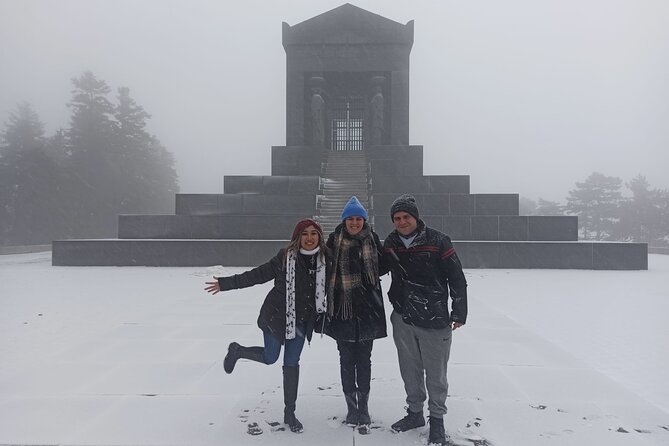
The tower was destroyed during the NATO bombing in 1999 and rebuilt in 2010. That detail gives the first stop more weight than a simple viewing platform visit. You are looking at a symbol that disappeared and then returned, while also seeing how Serbia has chosen to preserve and restore important national landmarks.
The observation deck provides a broad view over Belgrade. The tour allows about 45 minutes here, with admission included. That is enough time to go up, take photographs, and listen to the guide explain the tower’s place in the city’s story.
Weather can shape this stop. A clear day should give you the best view, while snow or poor conditions may make the mountain trip slower. The route has been completed in snowy conditions, but you should still dress for a more exposed, colder setting than central Belgrade.
Avala Tower is also a good opening because it gives you physical perspective. After seeing the city from above, you spend the rest of the tour looking at the structures that shape it from ground level.
Eastern City Gate: three towers and a socialist skyline
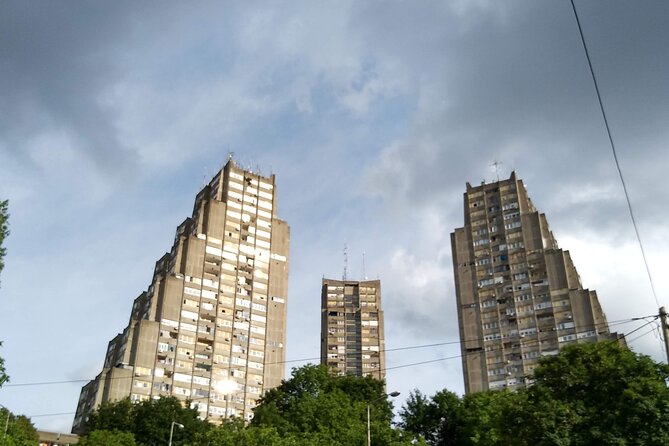
The drive from Avala Tower to the Eastern City Gate takes another 30 to 45 minutes. Officially called Rudo, the complex consists of three residential buildings, each about 85 meters high.
This is one of the clearest examples of the scale of socialist housing in Belgrade. The three towers are built in the brutalist style and have become one of the city’s symbols. Their height and repeated form were not designed to blend quietly into the background. They announce a planned, collective vision of urban life.
You have about 20 minutes here. That is enough for an exterior look and an explanation of the design, but not a detailed architectural survey. The guide can help you notice the relationship between the towers, their mass, and the surrounding city.
One practical advantage of a private tour is that you are not limited to the easiest central sights. Residential complexes such as this are important to Belgrade’s architectural identity, yet they are rarely part of a first-time walking route. The private vehicle gets you there without forcing you to spend the day changing buses or navigating distant neighborhoods.
The drawback is that this is primarily an exterior stop. If you want long access to apartment interiors, lobbies, or stairwells, the scheduled 20 minutes may feel short. Still, the Eastern City Gate is one of the stops that makes the tour feel distinct from a regular city visit.
Ada Bridge: modern engineering over the Sava
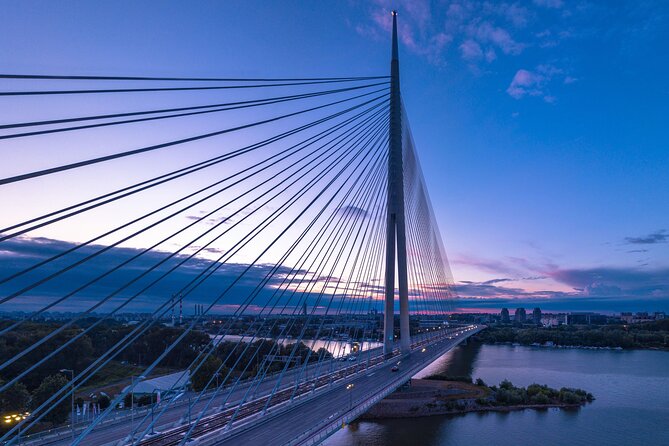
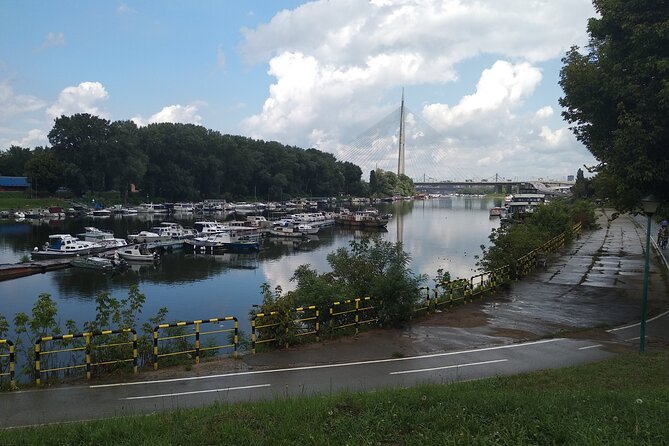
From the Eastern City Gate, it takes about 10 to 15 minutes to reach Ada Bridge. The visit lasts around 20 minutes and includes crossing the bridge above the Sava River.
Ada Bridge is a modern counterpart to the older socialist buildings on the route. Its construction was featured on the Discovery Channel, and it is described as the highest single-pylon bridge in Europe. The single pylon gives the bridge a strong visual identity, while the river setting lets you see how infrastructure can become part of a city’s image.
You will not be taking a long walk along the bridge. Think of this as a moving architectural viewpoint, with time to pause and understand the structure rather than a separate river excursion.
The stop also breaks up the concrete-heavy building visits. After residential towers and before the large conference and government complexes, the bridge shows Belgrade working as a modern capital. It connects areas of the city while making an unmistakable visual statement.
A few more architecture tours around the world worth a look
- Chicago Architecture River Cruise
★ 5.0 · 15,756 reviews - Chicago River 90-Minute Architecture Tour
★ 4.5 · 9,629 reviews - Chicago River: 1.5-Hour Guided Architecture Cruise
★ 4.8 · 8,046 reviews - Chicago Architecture Center River Cruise aboard First Lady
★ 5.0 · 5,536 reviews
Sava Center: polyhedral design and Yugoslav ambition
The short drive from Ada Bridge to Sava Center takes about 10 minutes. You will spend about 15 minutes examining the exterior and structural design of this large complex.
Sava Center was built for the Conference on European Security and Cooperation held in Belgrade in 1977. It was the first and largest conference center in former Yugoslavia, so its scale had a clear purpose. Belgrade was presenting itself as a place where major international meetings could happen, and the building had to support that role.
The complex is known for its polyhedral forms. From the outside, the shapes can seem severe or even puzzling until someone points out how the different volumes work together. This is a useful stop for understanding that brutalist and late-modernist buildings were not simply blocks of concrete. Their unusual shapes often reflected structure, function, and political ambition at the same time.
Fifteen minutes is enough for a guided look, but it is not enough to inspect every angle. If Sava Center is your main architectural interest, you may wish you had more time to photograph and study it. As part of a route covering six major sites, though, the short visit keeps the day moving.
Palace of Serbia: architecture serving the state
The Palace of Serbia is only about five minutes from Sava Center. The visit lasts around 15 minutes and focuses on the exterior of this vast late-modernist government building.
Originally known as the Federal Executive Council, the building was the first major project in New Belgrade after the Second World War. Its size and formal appearance were carefully suited to a federal government that wanted to project order, confidence, and permanence.
This is where the tour’s historical side becomes especially clear. Architecture is not only about materials and shapes. Government buildings tell you how a state wanted to be seen. The Palace of Serbia uses enormous scale but also aims for elegance, creating a formal image rather than the rougher industrial appearance often associated with brutalism.
You will stand in front of the structure rather than take a long interior tour. That limitation is important, since security and official use naturally restrict access. The guide’s explanation is what turns a quick exterior stop into something more meaningful.
Genex Tower: Belgrade’s western exclamation point
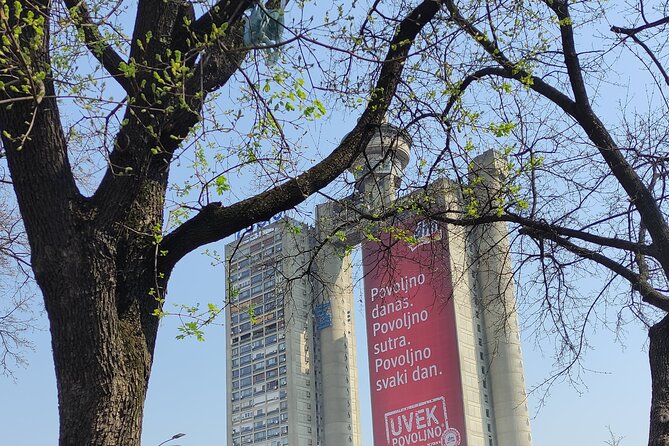
The final architectural stop is the Western City Gate, better known as Genex Tower. The drive from the Palace of Serbia takes about 10 minutes, and the visit lasts around 15 minutes.
Designed by Mihajlo Mitrović in 1977, the 36-story complex is made from two towers joined by a two-story bridge. Its brutalist form is immediately memorable. The structure was designed as a western gateway to Belgrade, so its unusual shape had an urban job as well as an architectural one.
Genex Tower is a fitting finish because it brings together many themes from the day: scale, movement, socialist planning, and the belief that a city entrance should make a statement. The tower is not a delicate monument. It is forceful, vertical, and difficult to ignore.
Again, the stop is mainly an exterior visit. You should not book this expecting a full interior tour or access to every part of the building. The value is in seeing the tower in its urban setting and hearing how it fits into Belgrade’s postwar development.
What the guides add to the concrete
The strongest part of this experience is not simply the number of buildings. It is the explanation connecting them.
Stefan has been described as having degrees in history and brings Serbian history, culture, and society into the architectural discussion. Novica is known for explaining Serbia and Yugoslavia with energy and a strong sense of narrative. Mihailo has been praised for sharing information throughout the drive, while Nemanja has guided architecture-focused visitors through the sites with particular attention to Yugoslav socialist heritage and monuments.
The guide assigned to your booking may differ, but the important point is the style of commentary you should expect: architecture is treated as a doorway into the country’s recent past. You may hear about socialist ideals, the former Yugoslav federation, postwar construction, NATO bombing, and the way Belgrade developed beyond its historic core.
The driver also matters because the route covers a lot of ground. A calm, safe driver lets the guide keep talking and gives you a chance to watch the city between stops. Online resources may also be shared after the tour, giving you more to read or see during the rest of your time in Belgrade.
Timing, comfort, and the private format
The tour lasts approximately four hours, including every transfer. The six stops have a combined scheduled visiting time of about two hours and 10 minutes, while the rest is spent driving. That balance is not a flaw, but you should understand it before booking.
The vehicle is air-conditioned, and pickup and drop-off are included at your accommodation. This is especially useful for Avala Tower and the distant New Belgrade sites. You avoid arranging separate taxis, and you can keep your attention on the city rather than on directions.
The group limit is three people. That makes the experience a good fit for a couple, a small family, or a few friends who want to ask questions without competing with a larger group. Most people can participate, and service animals are allowed.
The tour is offered in English. Confirmation is sent at booking, and free cancellation is available up to 24 hours before the start time. Changes or cancellations inside that window are not accepted for a refund, so keep the local cutoff in mind when your schedule is uncertain.
Who should book this architecture tour?
I would choose this tour if you have a serious interest in brutalism, modern city planning, or the history of socialist Yugoslavia. It is also a good choice if you want to see more of Belgrade than the central sights allow and prefer an informed guide to independent research.
You do not need an architecture degree. The buildings are large, unusual, and easy to discuss at a basic level, while the historical context gives you plenty to think about even if concrete structures are not normally your priority.
I would be more cautious if you want a walking-heavy experience, long interior visits, or plenty of free time at each location. The route is broad rather than slow. You will see six important sites, but most visits last between 15 and 20 minutes.
Should you book it?
Book this private tour if you want Belgrade’s modern architecture explained as part of the country’s political and social story. The route is well planned, the private vehicle solves a real transport problem, and the guides add far more than labels and dates.
Skip it if your main goal is old Belgrade, food, or a relaxed walking day. For the right audience, though, this is an efficient and unusual half-day that shows why Belgrade cannot be understood through its historic center alone.
FAQ
How long does the private architecture tour last?
The tour lasts approximately four hours, and transportation time between stops is included in that duration.
How many people can join the private tour?
The price covers one private group of up to three people. Only your group participates.
Is pickup included?
Yes. Pickup and drop-off at your accommodation are included, and travelers are picked up from their stated address.
What language is the tour offered in?
The tour is offered in English.
Which places are visited?
The route includes Avala Tower, the Eastern City Gate, Ada Bridge, Sava Center, Palace of Serbia, and the Western City Gate, also called Genex Tower.
Is admission to Avala Tower included?
Yes. The entrance fee for Avala Tower is included. The other listed stops have no admission charge.
Just added around the world
- Wilmington History and Architecture Tour★ 4.8 · 18 reviews
- Washington, DC: Georgetown Architecture Walking Tour★ 5.0 · 8 reviews
- New Orleans : Garden District Architecture Walking tour★ 4.8 · 5 reviews
- Washington DC: Dupont Circle & Embassy Row Architecture Tour★ 5.0 · 6 reviews
- Walk & Discover KL’s Architectural and Heritage Gems★ 5.0 · 7 reviews
- Vicenza: discovering the city of Palladio by e-bike★ 5.0 · 4 reviews
- Vicenza: Palladian Architecture Private Walking Tour★ 3.3 · 3 reviews
- Unveiling Brno: History, Culture & Architectural Delights★ 5.0 · 2 reviews
Private, compared.

Sagrada Familia & Gaudi Tour Private or Small Group with Tickets
Read our review →
Barcelona: Sagrada Familia, Park Guell & Tapas Private Tour
Read our review →
Park Guell and Sagrada Familia Private Tour with Hotel pick-up
Read our review →
Barcelona 1.5h Private Old Town, Gothic & Ramblas Walking Tour
Read our review →
Sagrada Familia Evening Private Tour with Expert Guide
Read our review →
Sagrada Familia & Montserrat Private Tour with Hotel pick-up
Read our review →