

Review · THE UK
Oxford: 90 minute Architectural & Historical Highlights Tour
Oxford’s story is packed into a surprisingly small area, and this 90-minute walking tour gives you a brisk introduction to its medieval gates, ancient colleges, libraries, churches, and grand university buildings. You’ll walk from the Weston Library to the Golden Cross, passing some of the city’s most famous sights along the way.
I like the small maximum group of 15, which makes it easier to hear the guide and ask questions. I also like the mix of major landmarks and small details, from the pelican carved at Corpus Christi to the history of Oxford’s first coffee house. The main drawback is the pace: with roughly 17 stops, several colleges receive only a few minutes.
Key points at a glance
- Oxford’s oldest surviving city building: See the Anglo-Saxon tower of St Michael at the North Gate.
- A medieval college is included: Get more than an outside look at Oxford’s university world.
- A strong literary and academic thread: Hear about J.R.R. Tolkien, Philip Pullman, C.S. Lewis, Edmund Halley, and others.
- Major university landmarks: Walk past the Bodleian Library, Radcliffe Camera, Sheldonian Theatre, and Divinity School.
- A useful local touch: You receive a map and guidebook, plus suggestions for places to eat and drink.
- Best for first-time visitors: The tour gives you a clear layout before you explore Oxford on your own.
Why this short Oxford walk works
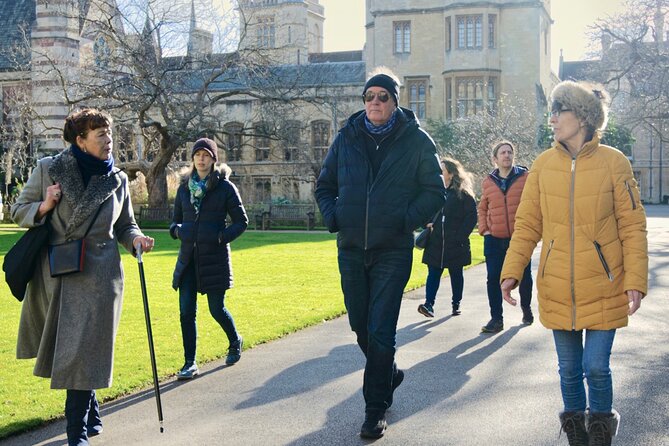
Oxford can feel confusing at first. Its colleges are scattered along busy streets, tucked behind gates, or hidden behind walls. University buildings and city buildings overlap, and the same street may hold a medieval church, a Victorian examination hall, and a modern library.
This walk gives you a useful framework. You are not simply ticking off famous buildings. You learn how Oxford developed, how the university shaped the city, and how religion, science, literature, and politics all left their mark.
The route begins at the Weston Library on Broad Street and ends at the Golden Cross. That finish is handy for further exploring, eating, or finding a drink in central Oxford. The walk is listed at about 90 minutes, though the many stops mean you will spend much of the time listening while standing outdoors.
Guide Sophie is named in the available tour information and has led families, couples, and small groups in English and French. Her approach combines facts with humor and personal recommendations. One useful feature is the attention given to different ages and interests. Children can follow the stories, while adults get more detail on university customs, architecture, and Oxford’s famous scholars.
More history tours in the world:
- Chicago in a Day: Food, History & Architecture Walking Tour
★ 5.0 · 1,153 reviews - Kuala Lumpur: Batu Caves & Historic Buildings Tour
★ 4.7 · 539 reviews - Charleston’s Best Highlights: History, Culture & Architecture
★ 5.0 · 422 reviews
Start with martyrs, gates, and Exeter College
The first stop is the Martyrs’ Memorial, a Victorian monument recalling the Protestant martyrs of the 16th century. It is a quick introduction to Oxford’s religious conflicts, and it helps explain why faith once mattered so strongly in university life.
From here, you reach St Michael at the North Gate. Its Anglo-Saxon tower formed part of the old medieval city gate and is probably Oxford’s oldest surviving building. The stop is brief, but the location gives you a sense of how the university grew inside an existing town.
Exeter College follows. Its chapel was influenced by the Oxford Movement and modeled on Paris’s Sainte-Chapelle. The college is also linked with writers including J.R.R. Tolkien, Philip Pullman, and Alan Bennett. You may only have a few minutes here, but the guide connects the building to both religious reform and modern literature.
This early section is especially useful if you are new to Oxford. You quickly see that the university is not a single campus. It is a group of old colleges woven into the city streets.
Lincoln, St Mary’s, and the medieval university
At Lincoln College, the original frontage on Turn Street helps explain the old relationship between Oxford’s colleges and the surrounding city. The college is linked with Prime Minister Rishi Sunak and the Wesley brothers, who were important figures in the Methodist movement.
The University Church of St Mary the Virgin is one of the route’s key stops. It was the university’s first building and is listed in the Domesday Book. The church’s spire can be climbed separately, but this tour focuses on the stained glass and the building’s connection with C.S. Lewis.
I like this part of the route because it shows Oxford as more than a collection of pretty courtyards. The church represents the university’s medieval religious foundation, while the C.S. Lewis connection gives the site a more familiar literary link.
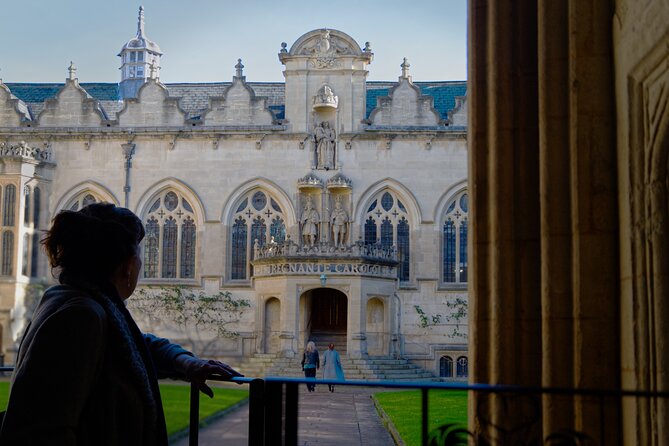
Next comes Oriel College, one of the university’s oldest colleges. Its front quad is known for its attractive Oriel windows, and the college has a strong rowing tradition. Nearby Corpus Christi College holds an annual tortoise race, a wonderfully odd detail that keeps the walk from becoming too solemn.
Corpus Christi and Merton College
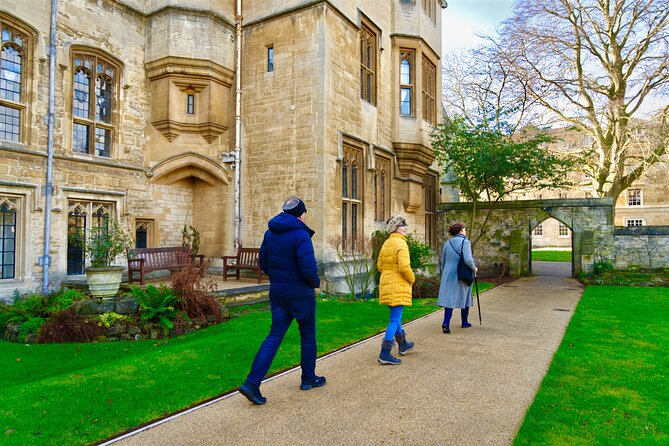
Corpus Christi has early 16th-century architecture decorated with carved animals, including a pious pelican. The college sits along a cobbled street listed as a national treasure, so even a short stop gives you a good feel for old Oxford.
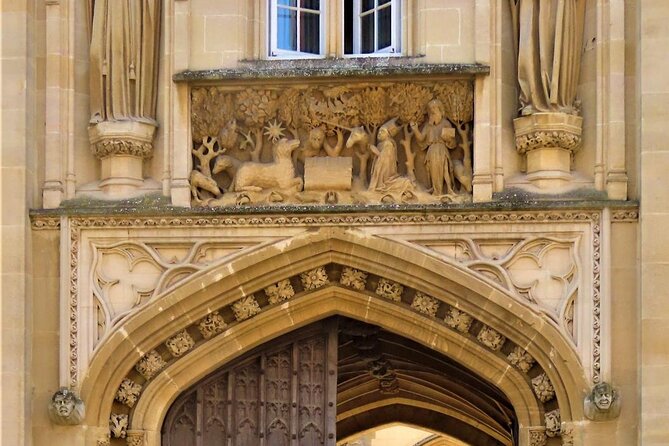
Merton College is the third-oldest college in Oxford. Its gatehouse frieze is one of the most interesting details on the route. It tells the story of how colleges were founded in Oxford’s earlier years, and the chapel’s decorated flying buttresses add a strong architectural finish.
Merton is also linked with Thomas Bodley, the founder of the Bodleian Library. Its library is described as the oldest continuously surviving library in Oxford. That connection makes the later library stops easier to understand, since you see the institution’s long development rather than treating the Bodleian as an isolated monument.
This section rewards anyone who likes architectural details. The guide points out carvings, windows, and structural features that are easy to miss if you simply walk past the college gates.
A few more architecture tours around the world worth a look
- Chicago Architecture River Cruise
★ 5.0 · 15,756 reviews - Chicago River 90-Minute Architecture Tour
★ 4.5 · 9,629 reviews - Chicago River: 1.5-Hour Guided Architecture Cruise
★ 4.8 · 8,046 reviews - Chicago Architecture Center River Cruise aboard First Lady
★ 5.0 · 5,536 reviews
Examination Schools and Queen’s College
The Examination Schools mark a change in Oxford’s academic life. The university held its first written examination in the early 19th century, and this Victorian building was designed in a Jacobean and Tudor style. In the 1870s, it represented a modern push toward making education more widely available.
Queen’s College brings in a different set of stories. It was founded for poor scholars from the north of England. One former student later became wealthy enough to help fund the college’s 18th-century rebuilding, with designs linked to Christopher Wren and Nicholas Hawksmoor.
The college is also associated with actor Rowan Atkinson. That small modern reference helps balance the older material and gives younger visitors a familiar name.
The walk along the High Street adds useful city history. This was once the road to London. Frank Cooper’s marmalade was first made here and later became known around the world. The street was also home to England’s first coffee house, established after Jewish people were welcomed back into England following their earlier expulsion.
You will not have time to explore every building on the High Street during the tour. Think of this part as a guide to what deserves a second look later.
New College and the Bridge of Sighs
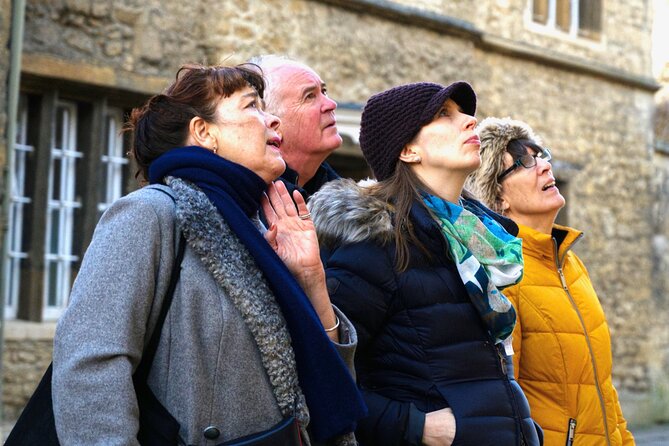
New College’s gatehouse tells the story of its foundation after the plague outbreaks of the 14th century. Its attractive setting has also appeared in several films, making it one of the more familiar-looking Oxford stops.
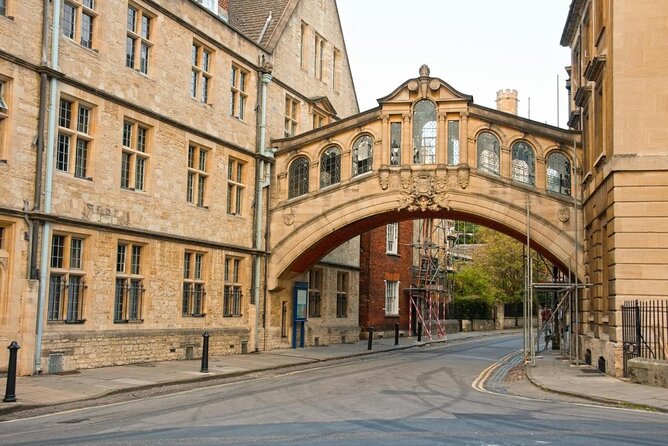
The Bridge of Sighs belongs to Hertford College. It resembles an old Venetian bridge, but it was built in the 20th century. That is a good reminder that Oxford often looks older than it is.
The bridge is near the house associated with Edmund Halley, the astronomer whose name was given to Halley’s Comet. This is a typical Oxford pairing: an attractive view, a famous name, and a short lesson in science.
The stop is brief, so you will mainly admire the bridge from outside. If you want to photograph it without rushing, return later on your own.
Wren, Harry Potter, and the Bodleian Library
The Sheldonian Theatre is one of the route’s major architectural highlights. Built in the 17th century, it hosts Oxford University ceremonies and is believed to be Christopher Wren’s first building. Wren later designed St Paul’s Cathedral in London, and he was also Oxford’s professor of astronomy.
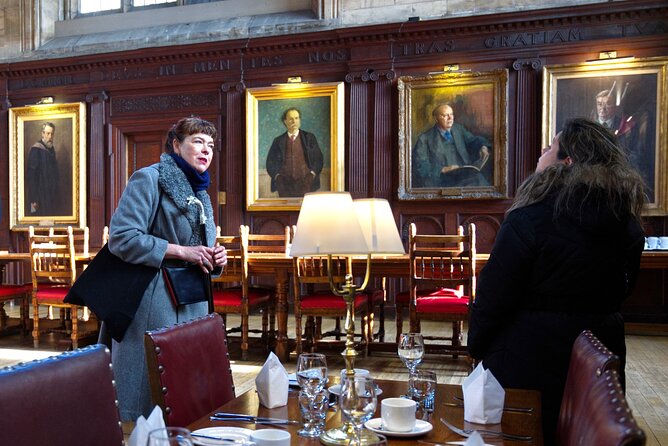
The next stop is the Oxford Central Library area, where the medieval Divinity School and Duke Humphrey’s Library are found. Duke Humphrey’s Library was built in the 15th century to hold a gift of more than 200 books from the king’s brother. Both rooms were used for Harry Potter scenes, including the Divinity School’s striking vaulted interior.
This is one of the tour’s most useful moments for film fans, but the buildings matter even without the movie connection. They show how teaching, religion, and book collecting shaped Oxford’s buildings long before modern libraries existed.
At the Bodleian Library, you learn how the library began and how it continues to function. Today it holds more than 13 million books. The tour does not turn this into a full library visit, so check the arrangements if you want interior access beyond the areas included on the walk.
Radcliffe Camera and the final college stop
The Radcliffe Camera was Oxford’s first science library. It was funded by Sir John Radcliffe, a royal physician and one of Oxford’s more eccentric and generous benefactors.
The building is one of the city’s most recognizable sights, with its circular form and pale stone. From the outside, it looks almost theatrical. The story behind its funding adds a human touch and shows how individual wealth shaped university buildings.
The final stop is Balliol College. The information provided for this stop notes the point at which undergraduates began to gain access to the university and its colleges. Admission to Balliol is not included, so confirm what you will see inside before booking if interior college access is essential to you.
The tour ends at the Golden Cross, close to the center of Oxford. From there, you can use the supplied map and guidebook to revisit a college, find the Christchurch Picture Gallery, or follow the guide’s suggestions for food and drink.
What the price means
The listed price is $0 per person, making this an unusually strong value if the booking terms remain the same when you reserve. You receive a guided orientation, entry to a medieval college, a map, a guidebook, and personal suggestions for eating and drinking without a stated tour charge.
Still, free does not mean every Oxford sight is included. Balliol College admission is specifically not included, and the tour does not promise full interior access to every college, library, or church along the route. You should also budget for any optional spire climb, museum visit, food, or later college admission.
The value is highest if you want context before exploring alone. A map and guidebook are useful here because Oxford’s sights are close together but easy to mix up.
Timing, group size, and practical comfort
The group is limited to 15 people, which is a good size for a walking tour in narrow historic streets. You should be able to hear the guide more easily than in a large coach group, and there is a better chance to ask about a specific college or building.
The route is offered in English, and Sophie has also guided families in both English and French. Most people can participate, and the starting point is near public transportation.
Plan for outdoor walking and standing. The tour requires good weather, and poor weather may lead to a different date or a full refund. The booking is otherwise non-refundable and cannot be changed for any reason, so check your plans before reserving.
Because the itinerary contains many short stops, wear comfortable shoes and keep your schedule flexible afterward. The tour is a beginning, not a full day inside Oxford’s colleges.
Who should book this Oxford tour?
I would choose this walk if you are visiting Oxford for the first time, especially on a day trip from London or during a short England visit. It gives you the city’s main academic landmarks without asking you to spend hours on one subject.
It also suits families and mixed-age groups. The stories move from martyrs and medieval libraries to tortoise races, marmalade, film locations, and famous actors. That range helps keep the walk lively.
You may prefer a longer or more specialized tour if you want detailed interior visits, extensive art collections, or time for photography at each stop. The pace is purposeful, and the 90-minute format cannot cover every college in depth.
Should you book it?
Book this tour if you want a friendly, well-organized first look at Oxford’s colleges, libraries, churches, and streets. The strongest reasons are the small group, the wide range of subjects, Sophie’s personal style when she is your guide, and the useful map and local food advice.
Skip it if your main goal is a slow interior tour of one college or library. For most first-time visitors, though, this is a practical way to get your bearings and decide where to spend the rest of your Oxford day.
FAQ
Where does the tour start?
The tour starts at the Weston Library on Broad Street, Oxford OX1 3BG.
Where does the tour end?
The tour ends at the Golden Cross, Oxford OX1 3EU.
How long does the tour last?
The tour lasts approximately 90 minutes.
Is entry to a college included?
Yes. The tour includes entry to a medieval college. Admission to Balliol College is specifically not included.
Is the tour offered in English?
Yes. The tour is offered in English. The guide information also notes that Sophie has guided families in both English and French.
What happens if the weather is poor?
The experience requires good weather. If it is canceled because of poor weather, you will be offered another date or a full refund. Otherwise, the experience is non-refundable and cannot be changed.
Just added around the world
- Wilmington History and Architecture Tour★ 4.8 · 18 reviews
- Washington, DC: Georgetown Architecture Walking Tour★ 5.0 · 8 reviews
- New Orleans : Garden District Architecture Walking tour★ 4.8 · 5 reviews
- Washington DC: Dupont Circle & Embassy Row Architecture Tour★ 5.0 · 6 reviews
- Vicenza: discovering the city of Palladio by e-bike★ 5.0 · 4 reviews
- Vicenza: Palladian Architecture Private Walking Tour★ 3.3 · 3 reviews
- Walk & Discover KL’s Architectural and Heritage Gems★ 5.0 · 7 reviews
- Unveiling Brno: History, Culture & Architectural Delights★ 5.0 · 2 reviews
Historical Tours, compared.
Chicago in a Day: Food, History & Architecture Walking Tour
Read our review →
Kuala Lumpur: Batu Caves & Historic Buildings Tour
Read our review →
Charleston’s Best Highlights: History, Culture & Architecture
Read our review →
Palm Springs Modernism Architecture & History Bike Tour
Read our review →
Charleston: History and Architecture Guided Walking Tour
Read our review →
Historic Georgetown: History, Gossip, & Architecture Walking Tour
Read our review →
Charleston History, Homes, and Architecture Guided Walking Tour
Read our review →
Browse the lists this tour appears in