
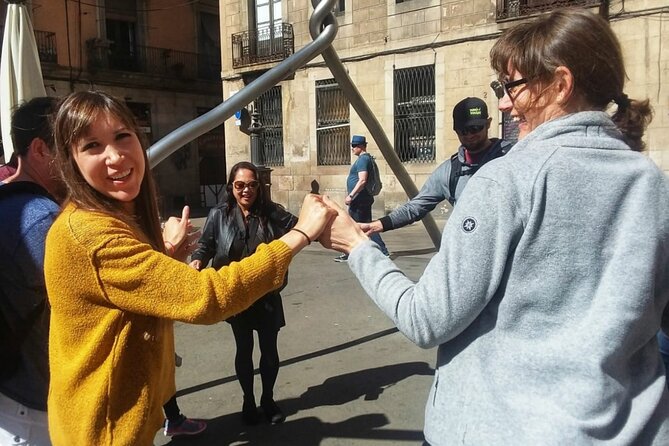
Review · BARCELONA
Barcelona Old Town & Gothic Quarter Small Group Tour
Barcelona’s old center is best understood on foot, and this tour gives you a useful thread through its tangled lanes. In about two and a half hours, you move from Roman Barcelona to medieval churches, La Rambla, La Boqueria market, and the El Born district, ending near the striking Palau de la Música Catalana.
I like the small-group format, which makes it easier to hear the guide and ask questions in crowded streets. I also like the mix of major sights and tucked-away corners, with guides such as Alba, Joris, Isabel, and Miguel bringing history, local customs, food, and Catalan culture into the walk. The main drawback is that several important interiors, including Barcelona Cathedral and Santa Maria del Mar, are viewed from outside unless you pay admission separately.
Key points at a glance
- Roman Barcelona beneath the Gothic lanes: Look for ancient remains woven into the oldest part of the city.
- A useful first-day orientation: The route links Ciutat Vella, La Rambla, La Boqueria, Plaça Reial, and El Born.
- Small enough for questions: The tour is described as having a maximum of 12, with separate information allowing up to 15 participants.
- Food stop with freedom to choose: La Boqueria gives you time to browse or buy juice and food at your own cost.
- Strong guide element: Alba, Joris, Isabel, Miguel, Steven, Tatiana, and others are praised for lively explanations and local suggestions.
- Good value at $22.15: You get a guided city orientation for less than the cost of many paid attractions, but entrance tickets are extra.
Why this is a smart first walk in Barcelona
Barcelona’s Old Town is not one single historic quarter. It is a series of districts layered together, each with its own feel and story. The Gothic Quarter has narrow lanes and medieval buildings. La Rambla is broad, busy, and theatrical. El Born mixes old churches with newer shops, cafés, and squares.
That variety is the chief strength of this route. You are not spending two hours on one monument. Instead, you get a moving introduction to how Barcelona grew from a Roman settlement into a medieval city and then into the modern Catalan capital you see today.
I would place this tour near the beginning of a Barcelona stay. It helps you get your bearings, and the final stop near Palau de la Música Catalana puts you in a useful central area for continuing on your own. Guides also offer a chance to ask about food, customs, local politics, and places to visit later. Miguel, for example, has helped with restaurant suggestions and paella reservations, while Laura has offered recommendations for gelato and paella.
The price is appealing. At $22.15 per person, the tour costs less than many individual museum or church visits, while giving you a guide for the entire route. The value depends on what you want: if you prefer a slow, private look at every church interior, this is too broad. If you want a clear introduction without spending much, it is a strong buy.
More Gothic quarter walks in Barcelona:
- Barcelona all included: Sagrada, Park Güell, Montjuic & Gothic
★ 5.0 · 2,169 reviews - Barcelona Gothic Quarter Tapas & Taverns Food & Wine Tour
★ 5.0 · 1,470 reviews - Barcelona: Old Town and Gothic Quarter Walking Tour
★ 4.8 · 1,393 reviews
Roman traces in the Gothic Quarter
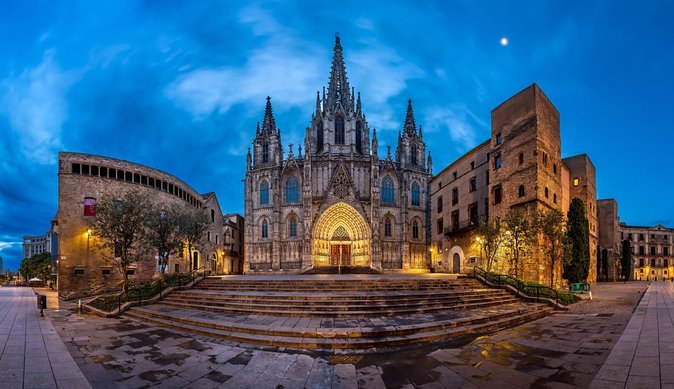
The first major section takes you into the Gothic Quarter, where the streets tighten and the city feels older with every turn. The guide points out Roman remains still visible around the quarter, helping you see that this is not simply a district of attractive medieval façades.
The walk covers roughly 45 minutes here, though the exact pace depends on the group and the guide. This is the part where a guide matters most. On your own, you may notice stone walls and narrow passages but miss how the Roman village developed, how the medieval city grew around it, and why the area became such a maze.
The Gothic Quarter is also where you should wear sensible shoes. You will be walking over hard city surfaces and through lanes where stopping can be awkward when other people are passing. The route is designed for most participants, and one family described it as suitable with a stroller, but you should still expect a walking tour through compact streets rather than a smooth, open promenade.
Guides bring different personalities to this section. Alba is described as energetic and especially good with children. Isabel has a gift for connecting Roman, Visigothic, Moorish, and later Spanish history. Joris is praised for answering questions patiently and keeping the pace comfortable. Your guide may differ, but the experience relies heavily on that person’s storytelling.
Ciutat Vella and the story of Barcelona
Ciutat Vella means Old City in Catalan, and the tour uses this area to widen the story beyond the Gothic Quarter. The guide explains how the oldest neighborhoods fit together and points out details that are easy to miss when you are simply trying to navigate.
The scheduled stop is short, about 15 minutes, so this is not a detailed architectural lecture. Think of it as a bridge between the Gothic lanes and the larger city. You get the background needed to understand why Barcelona’s oldest center feels so compressed and varied.
This brief historical framing is useful because Barcelona has several identities at once. It is Roman, medieval, Catalan, Spanish, artistic, commercial, and modern. A good guide can explain those layers without turning the walk into a classroom. The strongest feedback about this experience centers on guides who make the past understandable through stories rather than a string of dates.
Walking La Rambla without making it the whole day
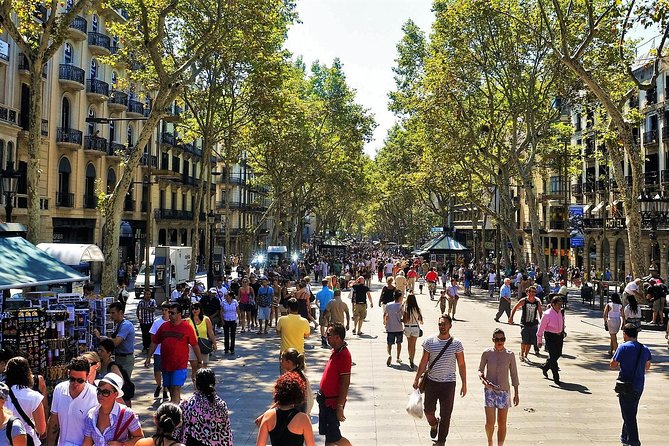
The route then reaches La Rambla, Barcelona’s famous central boulevard. You get about 15 minutes here, enough to see its role as a meeting place and busy public stage without losing the rest of the afternoon.
The guide explains that this avenue once followed a sandy watercourse beside the old city walls. Today it is lined with restaurants, bars, street performers, and constant foot traffic. It is one of Barcelona’s most recognizable spaces, but it is not necessarily the place where you will feel the city most intimately.
That is why I like the short treatment. You see La Rambla, learn how it developed, and then move into the market and nearby quarters. A tour that spent the whole morning here would miss the quieter lanes that give the Old Town its character.
Keep your attention on the group in this section. La Rambla can be crowded, and the guide may need to gather everyone before crossing or continuing. One guide, Miguel, was specifically praised for keeping the group together and helping separated participants rejoin by phone. A small group makes this easier, but you should still stay alert.
More old town architecture walks in Barcelona:
- Barcelona in 1 Day: Sagrada Familia, Park Guell,Old Town & Pickup
★ 5.0 · 13,541 reviews - Barcelona: Sagrada Familia, Modernism, and Old Town Tour
★ 4.7 · 1,621 reviews - Barcelona e-Bike Tour: Gaudí & Old Town Small Group
★ 5.0 · 769 reviews - Ramblas, Old Town, Gothic and Gaudi Architecture Walking Tour
★ 5.0 · 723 reviews
La Boqueria: a useful pause for food
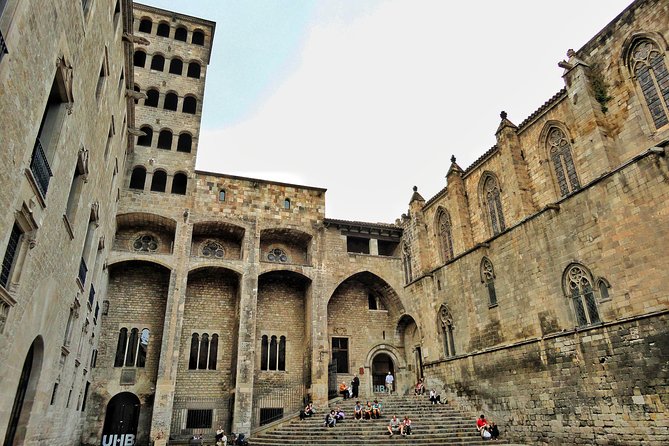
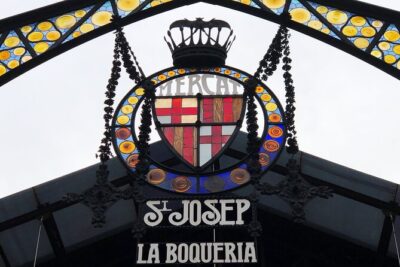
Mercat de la Boqueria is one of the most practical stops on the route. You enter a market filled with colorful produce, prepared food, and Catalan specialties. The scheduled visit is around 15 minutes, which gives you time to look around and perhaps buy fresh juice or a snack.
Food and drinks are not included, so treat this as a chance to choose your own extra rather than a formal tasting. That is a plus if you are particular about what you eat or want to save money. It is a limitation if you expect the guide to provide a full food experience.
The market is also a good place to ask questions about Catalan food traditions, including Iberian cured ham. You may find that the short stop whets your appetite rather than satisfying it. One useful strategy is to note what catches your eye, then return after the tour when you have more time. A participant specifically appreciated being able to come back later.
Because the market is popular, you should not expect a quiet browse. The value here is context and orientation. The guide tells you what you are seeing, then gives you enough freedom to look around.
Plaça Reial and the open space of the Old Town
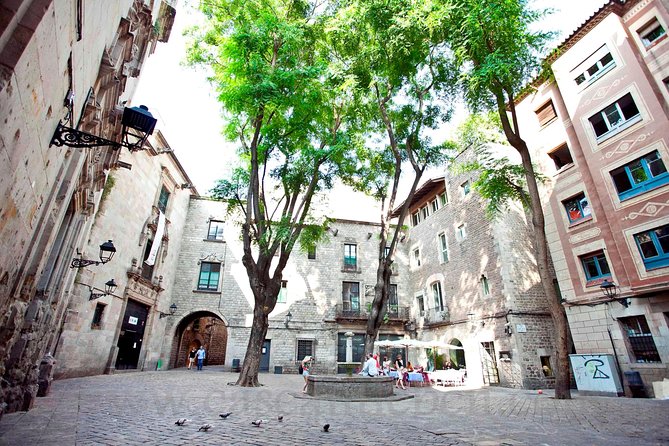
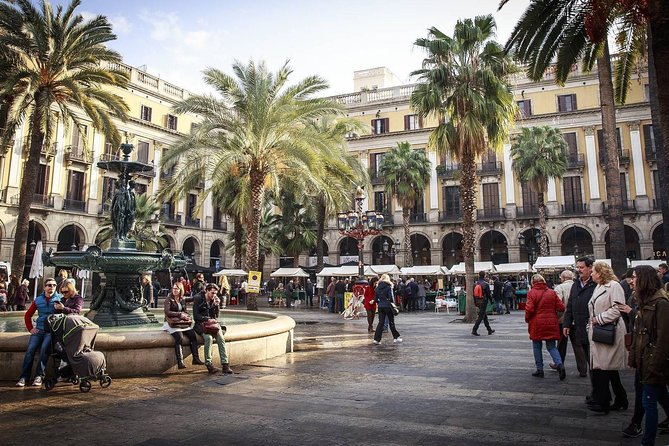
After the tight streets, Plaça Reial feels like a release. This broad square is framed by elegant buildings and terraces, with tall palms, the Tres Gràcies fountain, and distinctive lamps linked to a young Gaudí’s first public commission.
The stop lasts about 15 minutes. You will hear about the square’s Napoleonic design and its long connection with artists, bohemians, and visitors. It is a good example of how Barcelona’s old center alternates between cramped lanes and grand public rooms.
I would not plan a long meal here during the tour. The stop is too brief, and the group needs to keep moving. Instead, use it to take in the architecture and mark the square as a possible place to return. The guide’s explanation adds meaning to what might otherwise look like a pleasant but generic plaza.
Barcelona Cathedral from the outside
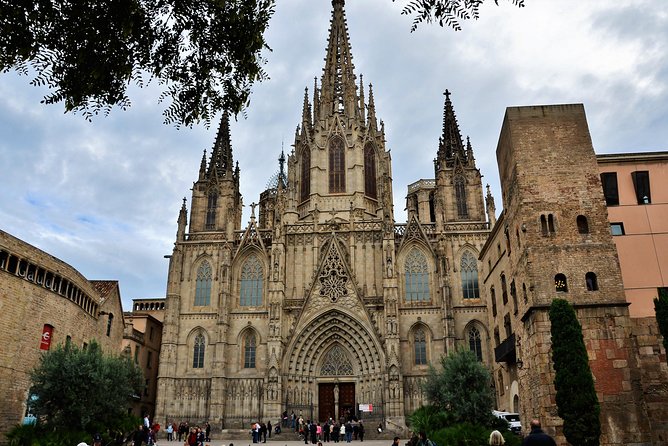
The walk continues to Barcelona Cathedral, one of the quarter’s major landmarks. Its towers and gargoyles make a strong impression from the street, and the guide explains its connection with Saint Eulalia and the city’s archbishopric.
This is an important point about the tour: the Cathedral admission is not included. The scheduled visit is about 15 minutes, so you are primarily seeing and discussing the building rather than taking a full interior tour.
That arrangement suits a first orientation. You can decide later if you want to return and pay for entry, rather than committing part of the walking tour to an indoor visit. If the Cathedral interior is a top priority, check admission arrangements separately and leave time in your schedule for a return visit.
El Born and Santa Maria del Mar
The route then moves into El Born, a district where old buildings and newer city life meet. The streets remain historic, but the mood changes. You see attractive squares, cultural sites, and a neighborhood that feels less enclosed than the Gothic Quarter.
The stop is about 15 minutes, followed by a visit to the exterior of Santa Maria del Mar. This basilica is often called the real cathedral of the Old Town because neighborhood residents helped build it in the medieval period. It is a major example of Catalan Gothic architecture and one of the most meaningful buildings on the route.
Admission is not included here either. You can admire the outside with the group, then return on your own if you want to see the interior. That is worth keeping in mind when comparing the $22.15 price with a private sightseeing package that includes entry tickets.
The Born section adds welcome variety. After the Roman and Gothic material, you get a sense of a district where history remains part of ordinary city life. This is also one of the better places to continue exploring after the tour, since the endpoint is nearby.
Ending near Palau de la Música Catalana
The tour finishes near Palau de la Música Catalana, an architectural highlight of Catalan modernism. The building was designed by Lluís Domènech i Montaner, who taught Gaudí, and combines sculpture, mosaic, stained glass, and wrought iron.
You do not receive a full concert-hall admission as part of this walking tour. The route ends nearby, allowing you to see the exterior and use the location as a springboard for the rest of your day.
This ending is well chosen. It avoids leaving you at the edge of town and puts you near central Barcelona, restaurants, shops, and more Old Town streets. If you want to visit the interior, arrange that separately rather than assuming the walking tour includes it.
Group size, guides, and pace
The tour is advertised as a small group of no more than 12, while the additional information allows a maximum of 15. That difference is worth noting. Even at 15, this is more personal than a large coach excursion, but you should not assume an intimate private walk.
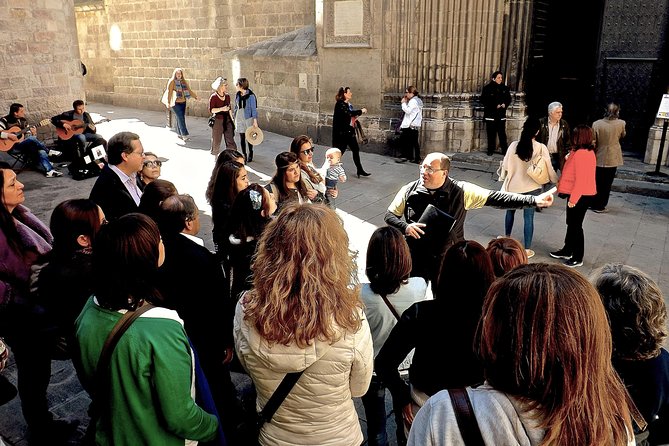
The guide is the main reason to choose this experience. Alba is frequently praised for enthusiasm, humor, and making history enjoyable for children and teenagers. Isabel is described as especially strong at linking the city’s past with present-day questions. Joris is noted for patience and clear answers. Steven brings humor and local customs into the conversation. Tatiana and Miguel are also praised for practical help and strong narration.
The tour is offered in English, with morning and afternoon departure choices. That flexibility makes it easier to fit around a museum visit, lunch, or arrival schedule. The walk lasts approximately two hours and 30 minutes, though one guide has kept a group out for nearly three hours. Plan on about three hours if you do not want to rush your next appointment.
Who should book it?
I would recommend this walk to first-time visitors, couples, families, and anyone with limited time in Barcelona. It is especially useful if you want historical context before exploring the city independently. Children under two can join free, and children from three to eight receive a 30 percent discount. Children must be accompanied by an adult.
The route suits people who enjoy walking, stories, and frequent changes of scenery. It is less suitable if you want long stops inside monuments, a dedicated food tour, or a slow photographic walk.
The tour has a 4.8 rating from 1,309 reviews, with 96 percent recommending it. Those figures suggest a reliable experience, but guide quality can vary because the personality and style of the individual guide shape the day. You should book it for the route and format, while hoping for the kind of engaging guide who makes the history feel close at hand.
Practical details before you go
The meeting point is at Carrer de Fontanella, 2, in Ciutat Vella. One participant found that the map location and meeting address were more than 100 meters apart, so check the exact point before setting out and arrive early.
The tour is near public transportation, service animals are allowed, and most people can participate. Wear walking shoes and bring water, especially for a warm afternoon. Food, drinks, hotel pickup, and hotel drop-off are not included.
You receive confirmation at booking. Cancellation is free up to 24 hours before the start time for a full refund. Within 24 hours, refunds are not available and changes are not accepted.
My verdict on this Old Town walk
Book this tour if you want a low-cost, well-organized introduction to Barcelona’s oldest quarters, with enough time for questions and a route that covers far more than the Gothic Quarter alone. The best parts are the Roman traces, the market, the shift into El Born, and the guide’s ability to explain Catalan history in a human way.
Skip it if you already know the Old Town well or if your priority is paid entry to the Cathedral, Santa Maria del Mar, or Palau de la Música Catalana. For most first visits, though, $22.15 is fair value for a guided walk that helps you understand where you are before you set off to explore on your own.
FAQ
How long does the Barcelona Old Town and Gothic Quarter tour last?
The tour lasts approximately two hours and 30 minutes. Individual tours may run a little longer depending on the guide and group pace.
What areas does the walking tour cover?
The route covers the Gothic Quarter, Ciutat Vella, La Rambla, La Boqueria market, Plaça Reial, Barcelona Cathedral, El Born, Santa Maria del Mar, and the area near Palau de la Música Catalana.
Are entrance tickets included?
No. Admission to Barcelona Cathedral and Santa Maria del Mar is not included. The tour ends near Palau de la Música Catalana, but entry to that building is not included either.
What is the group size?
The tour is described as a small group with a maximum of 12 people, while the additional information states that up to 15 travelers may participate.
Is food included at La Boqueria?
No. Food and drinks are not included. You can use the market stop to browse or buy juice and food at your own expense.
Can children join the tour?
Yes. Children must be accompanied by an adult. Children under two years old can join free, and children from three to eight receive a 30 percent discount.
Just added around Barcelona
- Love in the Gothic Quarter Barcelona: Self-Guided Romantic Walk★ 4.5 · 9 reviews
- Walking tour of the Gothic Quarter of Barcelona + Cathedral★ 5.0 · 8 reviews
- Wine tasting with a view of the Sagrada Familia★ 4.5 · 13 reviews
- Roman & Gotic & Gaudi in Barcelona: private walking tour★ 4.5 · 2 reviews
- Visit to the Modernist houses of the Americans★ 5.0 · 2 reviews
- Barcelona Jewish & Gothic Tour★ 5.0 · 18 reviews
- Self-Guided Audio Tour-The Surrealist Barcelona of Dalí and Gaudí★ 3.5 · 8 reviews
- Barcelona Gaudi Tour: Sagrada Familia, Casa Batllo & Casa Mila★ 5.0 · 4 reviews
Gothic Quarter Tours, compared.
Barcelona all included: Sagrada, Park Güell, Montjuic & Gothic
Read our review →
Barcelona Gothic Quarter Tapas & Taverns Food & Wine Tour
Read our review →
Barcelona: Gothic Quarter Ghosts and Legends Walking Tour
Read our review →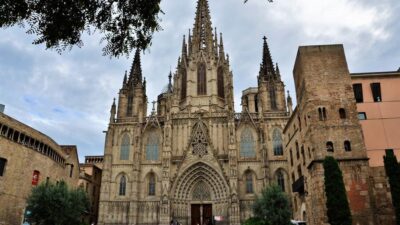
Barcelona: Old Town and Gothic Quarter Walking Tour
Read our review →
Ramblas, Old Town, Gothic and Gaudi Architecture Walking Tour
Read our review →
Barcelona: El Born and Gothic Quarter Wine & Tapas Bar Tour
Read our review →
Kids and Family Gothic Quarter Walking Tour in Barcelona
Read our review →
Browse the lists this tour appears in