
Review · ARCHITECTURE TOURS
Bishkek : USSR History , Soviet Architects , Statues & Mosaics
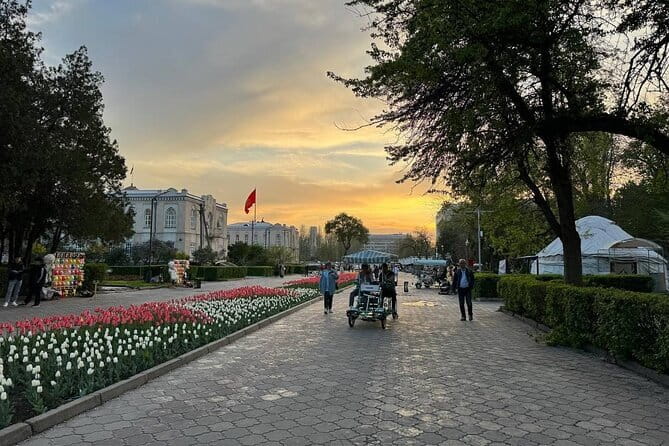
Bishkek’s Soviet past is not locked away in a museum. It is built into the city’s squares, theaters, libraries, mosaics, parks, and government offices. This 3 to 4-hour walking tour gives you a clear way to read that story, from the Russian Empire and Soviet rule to the city’s post-1991 changes.
I like the mix of large public monuments and easy-to-miss art, especially the mosaic on Ala Too Cinema and the textile-factory mural celebrating working women. I also like the human scale: guides such as Anna and Alex explain the meaning behind each stop instead of simply pointing at buildings. The main drawback is that the tour covers many places in short visits, so museum interiors and detailed art study receive little time.
Key points about the Bishkek Soviet history tour
- A walking route through central Bishkek: The tour begins and ends at the Paramount Kyrgyz Republic Flag on Chuy Avenue.
- Soviet architecture in daily view: See Stalin-era civic design, Socialist Modernism, public libraries, theaters, and government buildings.
- Statues with changing political meaning: Learn about Manas, Lenin, Karl Marx, Friedrich Engels, and the statues removed after 1991.
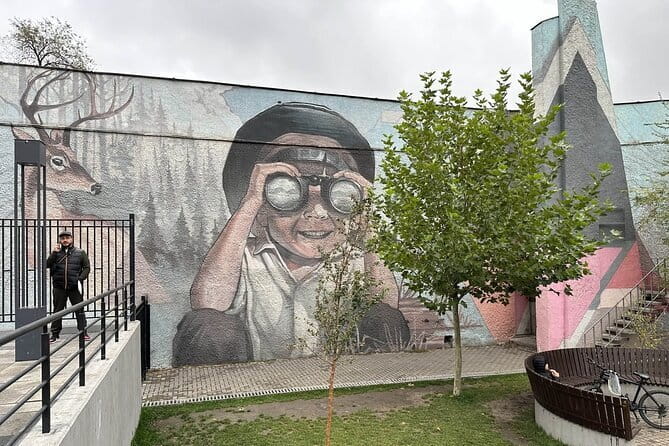
- Public art beyond monuments: Look for the Ala Too Cinema mosaic and the large textile-factory mural titled Our Work to You, Motherland.
- War memory and national identity: Victory Square and Panfilov Park connect Soviet military memory with Kyrgyz public life.
- Useful local guidance: The fee includes suggestions for local food and other places to visit in Kyrgyzstan.
Reading Bishkek through its Soviet buildings
I like this tour because it treats Bishkek as a collection of clues. A square tells you how the state wanted people to gather. A statue shows which heroes mattered at a certain time. A mosaic reveals how work, family, industry, and national identity were presented to the public.
The city was known as Frunze for more than 60 years, named after Bolshevik military leader Mikhail Frunze. The return to Bishkek after the Soviet period is part of the story, but the physical city did not change overnight. Soviet buildings, parks, memorials, and public art remain part of everyday life.
This is not a tour for grand interiors or long museum visits. It is better for seeing how political ideas became part of the streetscape. You move from one site to another, hear the background, and begin to notice the details you might otherwise walk past.
The group can reach up to 25 people. That keeps the price moderate, but it may also mean that questions are harder to ask when everyone gathers around a statue or mural. The strongest experience will likely come when the guide has room to speak clearly and you stay close enough to hear.
More history tours in the world:
- Chicago in a Day: Food, History & Architecture Walking Tour
★ 5.0 · 1,153 reviews - Kuala Lumpur: Batu Caves & Historic Buildings Tour
★ 4.7 · 539 reviews - Charleston’s Best Highlights: History, Culture & Architecture
★ 5.0 · 422 reviews
Ala Too Square and the flag of Kyrgyzstan
Ala Too Square is the natural place to begin. It is the city center and a useful introduction to the changing political face of Bishkek. Here you see major Soviet-era buildings and learn about statues that were removed after 1991.
The square is not just an open place for photographs. It shows how Soviet city planning favored broad civic spaces, formal buildings, and public ceremonies. Your guide can help you understand what changed when Kyrgyzstan became independent and which symbols remained.
The nearby flagstaff adds a different layer. You learn about the Kyrgyz flag, its colors, and the meaning of its central emblem. The tour also connects the flag to the country’s nomadic traditions, which helps balance the Soviet focus with an older Kyrgyz identity.
The stop at the flag is listed as only about five minutes. Think of it as a short explanation rather than a full lesson in national history. If you want a photograph, take it quickly and stay ready to move.
Manas and the question of national heroes
The Manas statue shifts the focus from Soviet political figures to a hero central to Kyrgyz identity. Manas is presented as a major figure in the Kyrgyz national story, and the guide explains his life and role in the nation’s cultural memory.
This is one of the useful contrasts in the tour. Lenin, Marx, and Engels represent international communist ideology. Manas represents Kyrgyz tradition and national belonging. Seeing those figures in the same city helps you understand that Bishkek is not defined by one period alone.
You spend about five minutes here, so the explanation will be concise. I would pay attention to the guide’s interpretation rather than expect a full account of the Manas epic. The value lies in seeing how a national hero occupies a public place once shaped so strongly by Soviet symbols.
Ala Too Cinema and Bishkek’s public mosaics
Ala Too Cinema opened in the early 1960s and is described as the oldest movie theater in Kyrgyzstan. The building matters here less for a film program than for its mosaic, which reflects the Soviet habit of using public art on ordinary civic and cultural buildings.
This is the kind of stop I particularly like. A grand square is easy to notice, but a cinema mosaic can pass without a second glance if you do not know to look. Your guide helps you connect the artwork with the period’s interest in education, culture, leisure, and collective life.
You have around ten minutes here, enough to see the exterior and discuss the mosaic. Since the tour does not promise admission to the cinema, plan on an architectural and art stop rather than an indoor cinema visit.
Same city, a completely different century:
- Chicago Architecture River Cruise
★ 5.0 · 15,756 reviews - Chicago River 90-Minute Architecture Tour
★ 4.5 · 9,629 reviews - Chicago River: 1.5-Hour Guided Architecture Cruise
★ 4.8 · 8,046 reviews - Chicago Architecture Center River Cruise aboard First Lady
★ 5.0 · 5,536 reviews
Art at the Gapar Aitiev Museum
The Gapar Aitiev National Museum of Fine Arts is included as a brief architectural and cultural stop. It is named for Gapar Aitiev and is presented as one of Bishkek’s notable buildings. You also hear about works brought by well-known artists from Russia.
The museum holds thousands of objects connected to Kyrgyz cultural heritage, with material ranging from antiquity to the late 20th century. That makes it potentially one of the broadest stops on the route, but the schedule allows only about five minutes.
That short timing matters. You should not expect to see the collection properly or spend time with individual paintings. Instead, use the stop to understand how Russian and Kyrgyz art histories meet in Bishkek. If the building catches your interest, note it as a place to return to later.
Opera, ballet, and Soviet cultural ambition
The Maldybaev Opera and Ballet Theater opened in 1937 as a musical drama theater. Its long performance history reflects the Soviet effort to build formal cultural institutions across the republics, including opera, ballet, and organized musical performance.
The building is another example of how culture was made public and official. A theater was not merely a place for entertainment. It also represented education, refinement, and the state’s idea of a modern capital.
Again, this is a short exterior visit of about five minutes. You will learn why the theater matters, but you will not attend a performance or receive a full architectural tour. That is fine if you want a city overview. It will feel brief if theater history is your main interest.
Victory Square and Panfilov Park
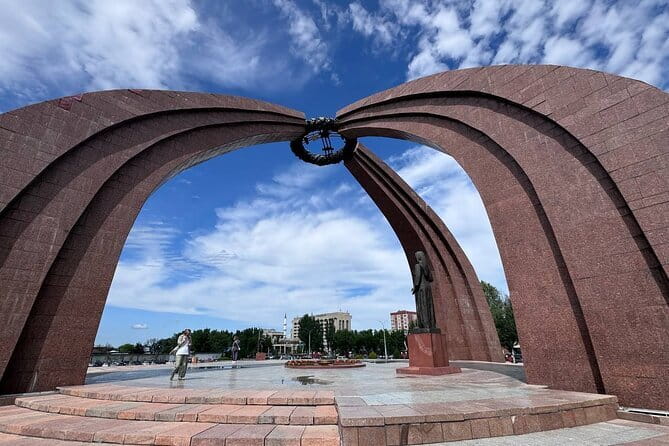
Victory Square honors the Soviet victory over Nazi Germany. It was created in 1985 for the 40th anniversary of the end of the Second World War. The memorial connects Bishkek with the wider Soviet memory of wartime sacrifice.
This is an important stop because the memorial is not only about military history. It also shows how the Soviet Union used public spaces to create a shared story across many republics. Your guide can place Kyrgyzstan inside that larger wartime narrative.
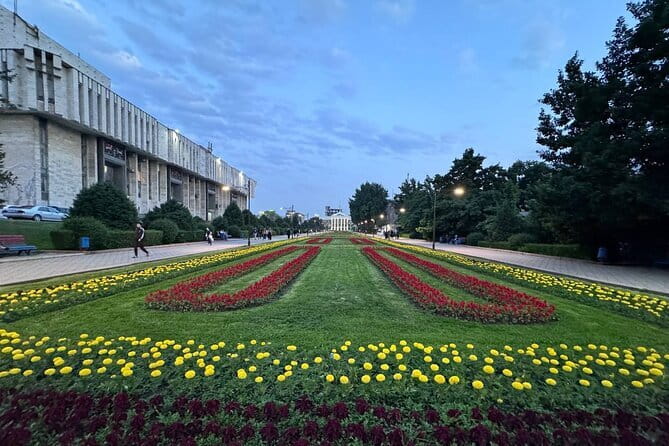
Panfilov Park brings the memorial theme into a green public setting. The park is near the Old Square and Manas Square and is named for Ivan Panfilov, a Hero of the Soviet Union and chairman of the Military Committee of the Kirghiz SSR.
You spend roughly five minutes in the park. That is enough to understand its name and place in the city, but not enough for an extended stroll. The park does provide a welcome change from formal civic buildings and gives the route some breathing room.
The National Library and Soviet civic design
The National Library of the Kyrgyz Republic was founded in 1934 and serves as the country’s legal deposit and copyright agency. Its collection contains six million documents in 89 languages.
That figure gives the building more weight than a simple photo stop. A national library is a statement about education, administration, language, and access to knowledge. In a Soviet capital, such institutions helped define the city as a center of public life.
The visit is listed at about five minutes. You should expect to see the building from outside and hear its role, not browse the collection. Still, it is a useful reminder that Soviet urban planning included institutions for reading and scholarship, not just statues and government offices.
Marx, Engels, and the Lenin statue
The monument to Karl Marx and Friedrich Engels brings communist theory into the route. Your guide can explain the Communist Manifesto, written jointly by Marx and Engels between December 1847 and January 1848 and first published on February 21, 1848.
This stop helps explain the ideas behind the political system that shaped Bishkek. It is not just another pair of bronze figures. Their presence links the local city to an international ideological movement.
The Lenin statue offers a more direct look at changing public memory. It was erected in 1984 for the 60th anniversary of the Kyrgyz Soviet Socialist Republic. After communism fell in 1991, Lenin statues were removed in many places, though the Lenin statue connected with Bishkek’s story remained in the city.
The exact political meaning of a surviving statue is worth asking about. The tour gives you a starting point, while the short five-minute stop keeps the discussion moving. If you are interested in how monuments survive political change, these two stops may be among the most thought-provoking.
The textile-factory mosaic and women’s work
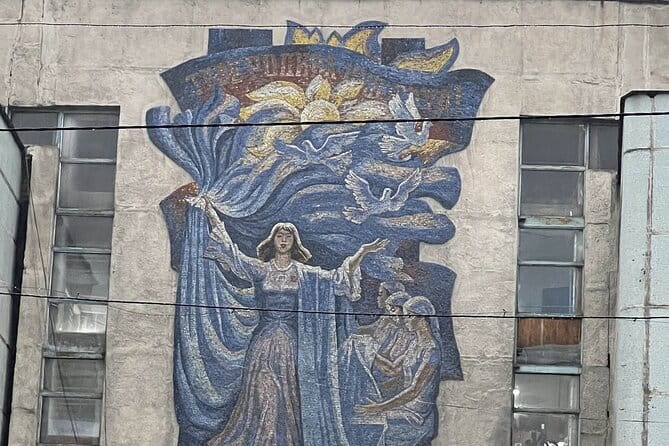
The mural titled Our Work to You, Motherland is located on a textile factory and celebrates the power of working women in the Soviet system. This is one of the route’s most specific pieces of public art.
I like that the tour includes it. Famous statues often dominate city tours, but a factory mural shows how ideology entered workplaces and daily routines. It presents labor as patriotic service and gives you a visual record of the Soviet ideal of the productive worker.
The stop lasts about five minutes. Since the information provided does not include the mural’s exact location details or interior access, expect an exterior viewing. Look closely at the figures, gestures, and subject matter, then ask the guide how the artwork fits into the city’s industrial history.
Philharmonic Hall and Stalin-era City Hall
The Toktogul Satylganov Philharmonic Hall grew from a Philharmonic Society founded on October 7, 1936. For years, concerts took place in other halls because the society had no dedicated concert venue. That background shows how formal musical life developed before receiving a permanent home.
The hall represents both Kyrgyz musical culture and Soviet institutional planning. The society was based on an orchestra of folk instruments, so the stop can help you see how local traditions were organized within a Soviet cultural framework.
The final major stop is Bishkek City Hall, the mayor’s building. It is described as a distinctive example of Stalin-era architecture. Look for the formal scale and strong civic presence typical of that period.
City Hall is a good closing point because it brings the tour back to power and administration. You have seen national symbols, cultural buildings, war memorials, ideology, and public labor. This building returns you to the machinery of government that tied many of those parts together.
What the $49 price gives you
At $49 per person, the value depends on how much context you want. You are not paying for restaurant meals, museum admission, or a private vehicle. The price covers the guide, the historical explanations, the organized route, and recommendations for local food and other places in Kyrgyzstan.
For a city with many scattered Soviet-era sights, that guidance can save time. You could find Ala Too Square, the parks, and major monuments yourself, but it would be harder to understand why the Lenin statue remained, how the mosaics fit the period, or how Kyrgyz identity sits beside Soviet symbols.
The group limit of 25 keeps the cost below a private tour. It also means the experience may feel less personal than a one-to-one walk. If you prefer to ask frequent questions or linger at every detail, a private option would likely suit you better, though the provided information does not give a private-tour price.
The tour is booked an average of 37 days ahead, so it is sensible to reserve early if your Bishkek dates are fixed. Confirmation arrives at booking, and free cancellation is available until 24 hours before the start time.
Who will get the most from this walk
I would choose this tour if you enjoy architecture, public art, political history, or the way cities reveal their past without a formal museum visit. It also suits a first day in Bishkek because the route introduces central squares, parks, cultural buildings, and several places you may want to revisit.
You will get the most from it if you stay close to the guide and listen for the links between stops. Anna received particularly warm praise for patient explanations of history and geography, while Alex was described as friendly and clear when discussing buildings, monuments, and mosaics. Guide assignments can vary, so you should not assume either person will lead your departure.
The route is not ideal if you want extensive indoor sightseeing. Several stops last only five minutes, and the museum, cinema, theater, library, and Philharmonic Hall are mainly treated as city landmarks. Bring comfortable walking shoes, and remember that food and drinks are not included.
Should you book the Bishkek Soviet history tour?
Book it if you want a focused introduction to Bishkek’s Soviet architecture, monuments, mosaics, and changing public symbols. The strongest parts are the guide’s explanations, the contrast between Manas and Soviet leaders, the surviving Lenin statue, and the public art that is easy to miss on your own.
Skip it if you want long museum visits, a meal, or a relaxed private walk with no fixed pace. At $49, it is a fair choice for a guided overview of central Bishkek, especially when you want the city’s buildings to make historical sense rather than simply serve as photo backgrounds.
FAQ
Where does the tour begin?
It begins at the Paramount Kyrgyz Republic Flag, located at VJG3+J7Q on Chuy Avenue in Bishkek.
Where does the tour end?
The activity ends back at the meeting point.
How long does the experience last?
The tour lasts approximately 3 to 4 hours.
How much does the tour cost?
The listed price is $49 per person.
How large can the group be?
The maximum group size is 25 people.
Is the tour offered with a mobile ticket?
Yes. Mobile tickets are available.
Are museum and attraction admission fees included?
The tour includes all fees and taxes, and the listed stops have no admission charge. The activity does not promise extended indoor admission to the museums or other buildings.
Is food included?
No. Food and beverages are not included, though the guide provides recommendations for local food spots.
Is transportation included?
No air-conditioned vehicle is included. The experience is presented as a city walking tour, with the route beginning and ending at the same meeting point.
Can most people participate?
Yes. The activity information says most people can participate.
What happens if I need to cancel?
You can receive a full refund if you cancel at least 24 hours before the experience start time. Cancellations or changes made less than 24 hours before the start are not accepted for a refund.
Just added around the world
- Wilmington History and Architecture Tour★ 4.8 · 18 reviews
- Washington, DC: Georgetown Architecture Walking Tour★ 5.0 · 8 reviews
- New Orleans : Garden District Architecture Walking tour★ 4.8 · 5 reviews
- Washington DC: Dupont Circle & Embassy Row Architecture Tour★ 5.0 · 6 reviews
- Vicenza: discovering the city of Palladio by e-bike★ 5.0 · 4 reviews
- Vicenza: Palladian Architecture Private Walking Tour★ 3.3 · 3 reviews
- Walk & Discover KL’s Architectural and Heritage Gems★ 5.0 · 7 reviews
- Unveiling Brno: History, Culture & Architectural Delights★ 5.0 · 2 reviews
Historical Tours, compared.
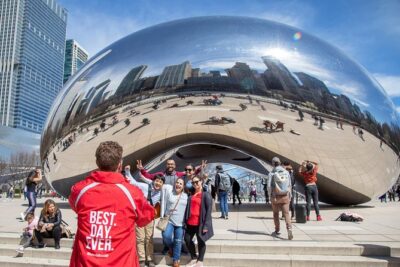
Chicago in a Day: Food, History & Architecture Walking Tour
Read our review →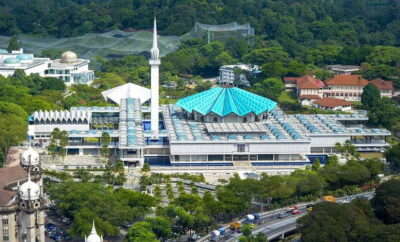
Kuala Lumpur: Batu Caves & Historic Buildings Tour
Read our review →
Charleston’s Best Highlights: History, Culture & Architecture
Read our review →
Palm Springs Modernism Architecture & History Bike Tour
Read our review →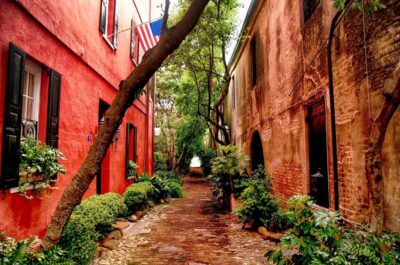
Charleston: History and Architecture Guided Walking Tour
Read our review →
Historic Georgetown: History, Gossip, & Architecture Walking Tour
Read our review →
Charleston History, Homes, and Architecture Guided Walking Tour
Read our review →
Browse the lists this tour appears in