
Review · PRAGUE
Prague Renaissance and Baroque Gardens Walking Tour
Prague’s gardens tell a quieter story than its castles and churches. This walk follows the city’s shift from useful medieval herb plots to grand Renaissance pleasure grounds and carefully staged Baroque gardens. You’ll hear how Emperor Ferdinand I brought Italian gardeners and architects north of the Alps, then see the results in person.
I like the Singing Fountain, whose falling water creates a bell-like sound, and the chance to visit Vrtba Garden, a walled Baroque retreat that many people miss. The guide-led history also gives the statues, grottoes, and terraces a clear purpose instead of leaving you to admire them without context.
The main drawback is the route itself. Expect steep and narrow stairs, including the Bull Stairs and climbs within Vrtba Garden. Admission to the gardens is not included in the $123 price, so your final cost will be higher.
Key points to know before booking
- Italian design in Prague: Learn how Ferdinand I imported Italian talent to create a Renaissance court garden in Bohemia.
- A working royal garden: See the Fig House and Orangery, linked with the early cultivation of figs, almonds, oranges, and lemons in Central Europe.
- Music made by water: The 1564 Singing Fountain resonates when water drops into its bronze bowl.
- Wallenstein’s theatrical garden: Look for albino peacocks, Mannerist statues, a grotto wall, and myth-inspired fountains.
- A climb with a reward: Vrtba Garden’s upper courtyard has a marine-themed grotto and broad views across Prague.
- A history-focused walk: The three-hour tour is led in English by a historian and can be booked privately or in a small group.
Why Prague’s gardens are worth your morning
Prague is famous for its Old Town lanes and hilltop castle, but its gardens explain how power was displayed between buildings. A palace garden was not simply a pleasant place to plant flowers. It showed that a ruler could command land, water, stone, imported plants, foreign craftsmen, and the leisure to enjoy them.
The tour begins with the older roots of gardening in Bohemia. Medieval gardens were mostly practical places for growing herbs used in cooking and medicine. Some traces survive in Gothic cloisters. Vineyards on the hills around Prague also reach back before the reign of Charles IV.
The major change came in the 1500s. Emperor Ferdinand I wanted the royal court to enjoy the formal gardens associated with the Italian Renaissance. He brought Italian gardeners and architects to Prague, introducing a more ordered style of paths, fountains, pleasure buildings, and planted courts.
That background matters because you will see the gardens as political projects, not just pretty green spaces. The route connects each feature to the ambitions of the person who commissioned it and to changing ideas about what a noble garden should do.
More Baroque architecture tours in Prague:
- Beer & Baroque: A Highbrow Brew Tour
★ 5.0 · 45 reviews - Beer & Baroque: A Private Highbrow Brew Tour
★ 5.0 · 33 reviews - Prague Renaissance & Baroque Gardens Walking Tour
★ 5.0 · 23 reviews
Belvedere and the Royal Gardens
One of the first major sights is the Belvedere Summer Palace, commissioned by Ferdinand I for his wife, Queen Anne. She died before it was finished, which gives the building a sad edge beneath its polished Renaissance design.
The palace was designed by the Italian architect Paola della Stella. It is often described as the finest Renaissance building outside Italy, and its elegant form makes clear why Italian influence mattered so much here.
Look closely at the reliefs. One shows Ferdinand presenting his wife with a flower from the Royal Gardens. It is a small courtly gesture carved into stone, but it also reflects the garden’s role as a place of ceremony and display.
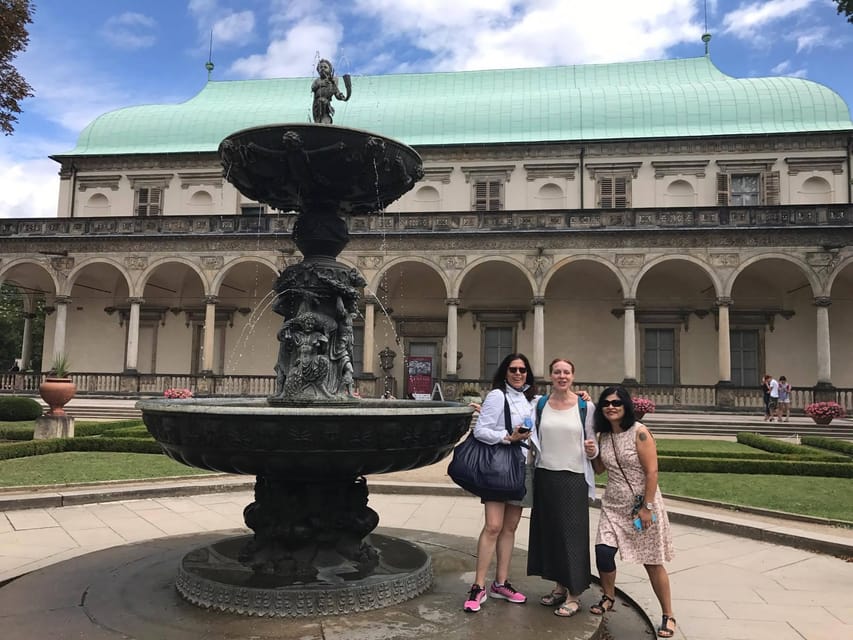
In front of the palace is a small formal garden, known as a Giardinetto. Its centerpiece is the Singing Fountain, cast in bell bronze in 1564. Water falling into the bowl causes the metal to resonate. This is one of the tour’s best details because it joins sculpture, engineering, sound, and court entertainment in one object.
You should not expect a large performance or a dramatic burst of sound. The point is subtler. The fountain was designed to reward close attention, and a guide can explain what you are hearing and why it was considered special.
The Fig House and Orangery
The walk continues to the Fig House and Orangery, buildings connected with growing plants that were unfamiliar in Central Europe. Figs, almonds, oranges, and lemons were cultivated here, showing how royal gardens could serve as testing grounds for plants from warmer climates.
These structures are valuable because they reveal the work behind the image of a perfect palace garden. Exotic plants needed protection and care. The garden was not simply a collection of imported wonders. It required buildings, gardeners, knowledge, and money.
You will also hear how tulips reached the Royal Gardens as an exotic gift from the Sultan of Constantinople. The story adds a useful reminder that gardens have always depended on trade and cultural exchange. Plants that now seem ordinary or familiar once carried the prestige of distant places.
The Fig House and Orangery may appeal most to anyone interested in horticulture, garden design, or the practical side of royal life. If you mainly want grand views, these stops are quieter than the Belvedere or the terraces below Prague Castle, but they make the rest of the tour more understandable.
From the stag moat to the South Gardens
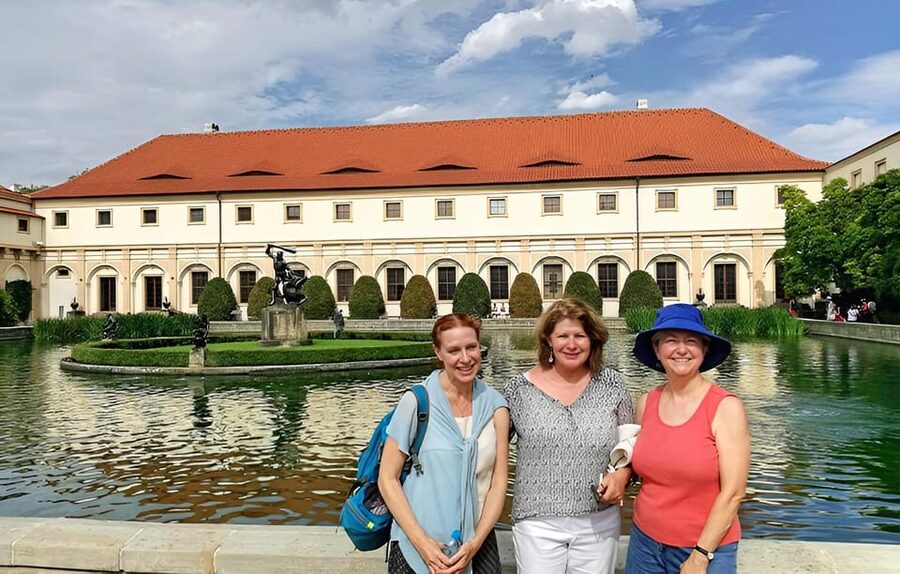
After the northern part of the castle gardens, the route takes you past the stag moat, through the castle courtyard, and down the Bull Stairs. The stairs are an important practical point. They can be narrow and steep, and the route includes repeated climbs and descents.
At the South Gardens, you explore the Garden of Paradise and the Garden on the Bulwark. Their names sound grand, but the real interest is how these spaces use the castle’s slope and defensive structures. They are not isolated flat parks. They are shaped by the hill, the walls, and the need to connect royal buildings with outdoor rooms.
From here, the route heads downhill through several terraced gardens below the castle. The descent gives you changing angles across Prague, but it also requires steady footing. Comfortable shoes are essential, and you should not book this regular route if stairs are a serious problem.
A private tour is the better choice if you need a slower pace or a modified route. The guide can leave out some locations and focus on others according to your limits. That flexibility is more useful here than on a flat city walk because the garden entrances and connections are not all at street level.
More architecture walks in Prague:
- Prague Art Nouveau and Cubism Walking Tour
★ 5.0 · 77 reviews - Private Prague Art Nouveau and Cubism Walking Tour
★ 5.0 · 30 reviews - Prague Art Nouveau and Cubism Walking Tour
★ 5.0 · 29 reviews - Prague: Private Cubism & Art Nouveau Walking Tour
★ 5.0 · 15 reviews
Wallenstein Garden and the fall of a powerful man
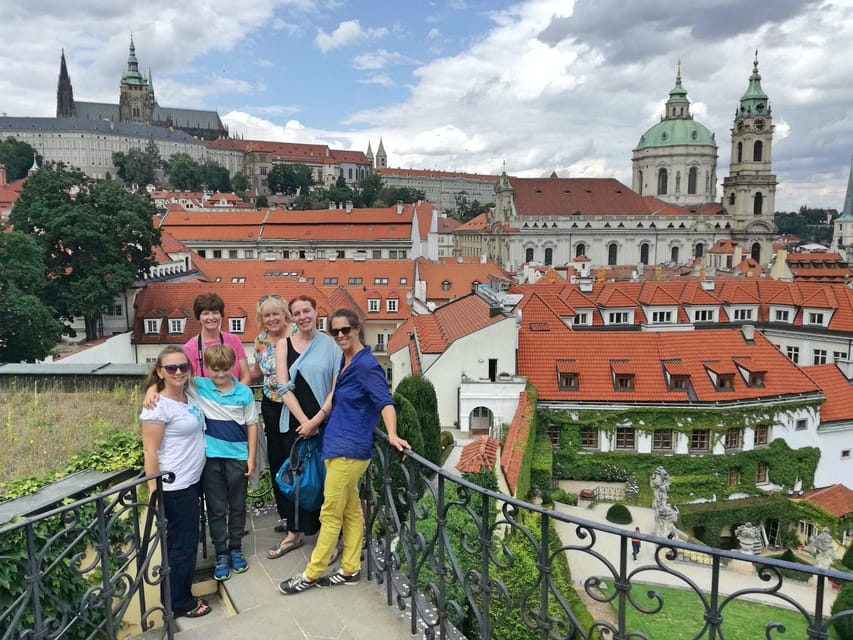
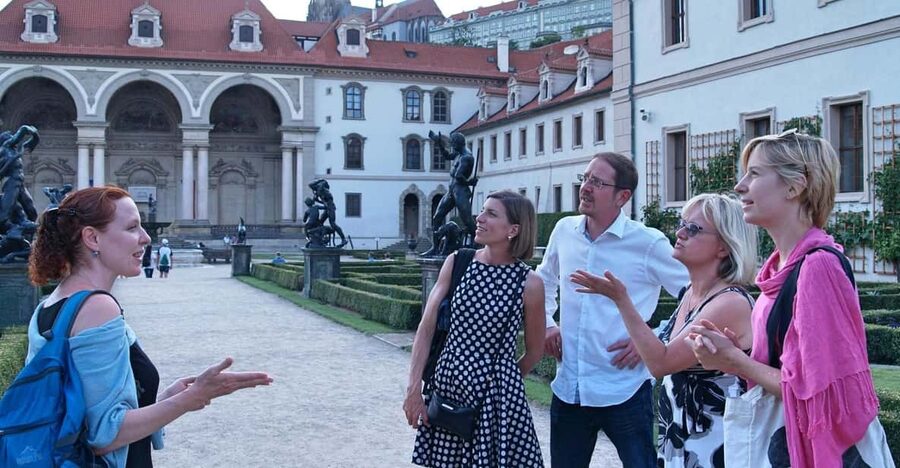
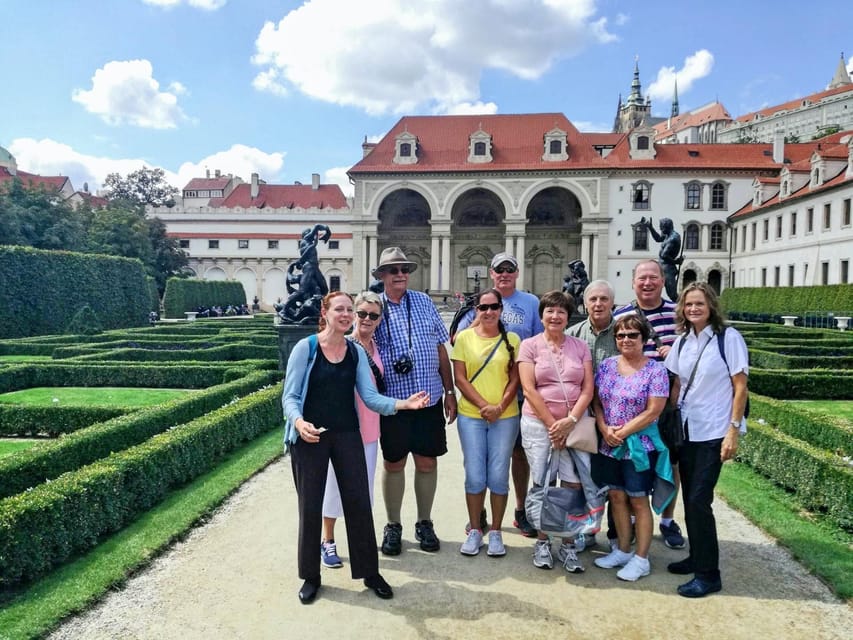
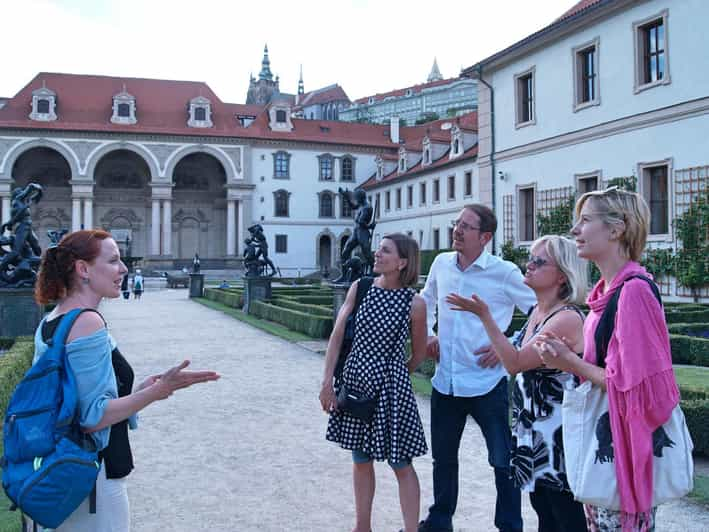
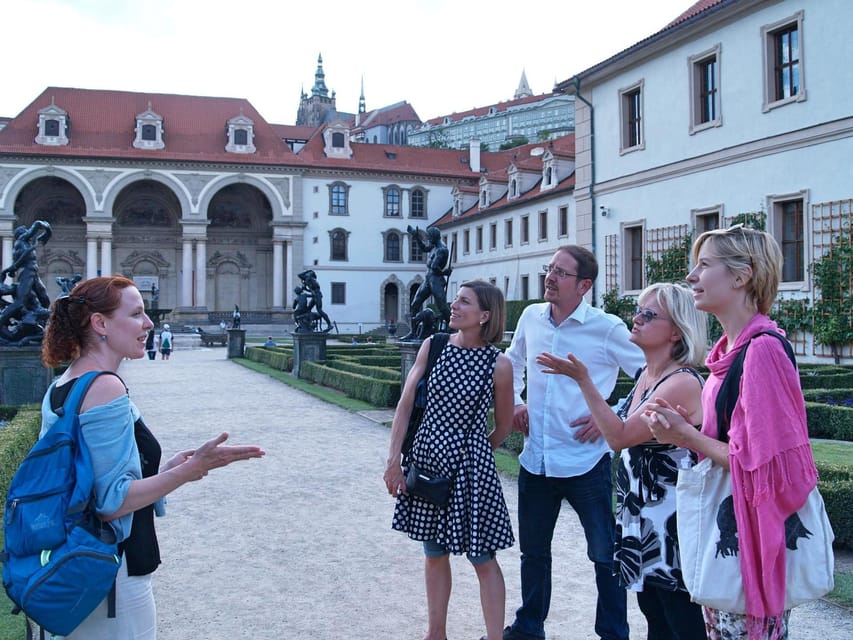
At the bottom of the hill, the mood changes at Wallenstein Garden. This is the grandest garden on the route, with a formal arrangement, Mannerist statues, a grotto wall, fountains based on myth, and unusual albino peacocks.
The garden was commissioned by Albrecht von Wallenstein, one of the most powerful and controversial figures in seventeenth-century Bohemia. His garden reflected ambition on a huge scale. It was meant to impress, and it does so through theatrical views, elaborate sculpture, and controlled symmetry.
The grotto wall is especially fun to study. Its rough, artificial rock surface contrasts with the formal geometry elsewhere in the garden. That tension is typical of the period, when designers enjoyed combining order with staged wildness.
The statues and fountains also show the move from Renaissance classicism toward Baroque ideas. Renaissance design valued proportion, balance, and reference to ancient models. Baroque gardens pushed harder toward drama, movement, surprise, and emotional effect.
Your guide’s explanation is useful here because the garden can otherwise feel like a collection of separate attractions. The story of Wallenstein gives the site a human edge. His rise and fall make the garden’s display of wealth and authority feel less decorative and more revealing.
The albino peacocks are an unusual bonus, though they should not be the reason you book the tour. Their presence adds charm, but the main value is the combination of political history and garden design.
Vrtba Garden and the final view
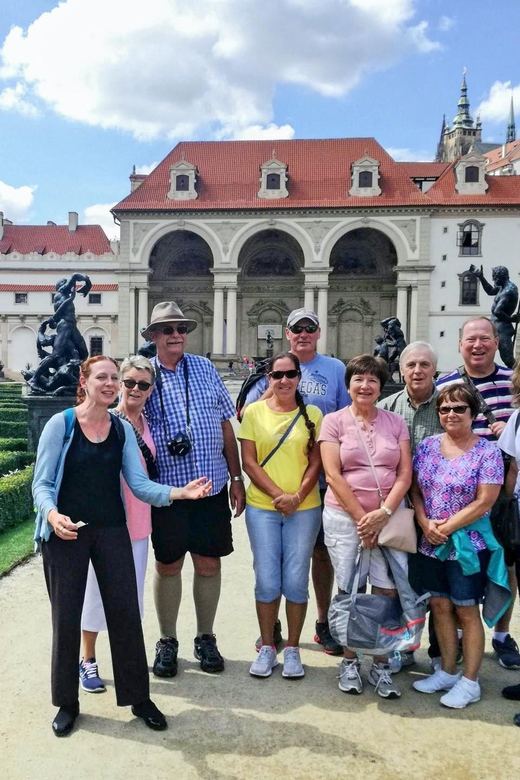
The tour ends at Vrtba Garden in Mala Strana. Dating from 1720, this walled Baroque garden offers a more intimate experience than the broad Royal Gardens or the formal scale of Wallenstein Garden.
Vrtba is built into the hillside, so you climb through a series of terraces toward the upper courtyard. The ascent is part of the design. Each level gives you a different relationship between walls, sculpture, planting, and the city beyond.
At the top, a marine-themed grotto adds another theatrical touch. The grotto connects the garden with the Baroque taste for staged scenes and imaginative decoration. It is not a natural cave, but a designed feature meant to surprise and entertain.
The reward is the view over Prague. From this height, the garden’s enclosure becomes clear. You are in a private noble retreat, separated from the streets below, yet still looking directly across the city.
Vrtba is also where the tour feels most personal. Wallenstein Garden presents power in a broad public style. Vrtba feels like a carefully arranged private world. The contrast helps you understand how garden design changed as noble families sought more controlled, decorative spaces for leisure and status.
Admission to Vrtba Garden is extra, as is admission to the gardens under Prague Castle. Keep that in mind when comparing the $123 tour price with a self-guided visit. You are paying not only for entry arrangements, but also for three hours of connected interpretation across several sites.
What the $123 price buys you
At $123 per person, this is not a cheap walk. The value depends on how much you want the historical explanation and how many people are in your group.
You receive a three-hour guided history walk with an English-speaking historian. That matters because the gardens are spread across different periods and settings. Without context, you might see a fountain, a statue, or an orangery without understanding its purpose.
The price is easier to justify for a private or small-group booking, especially if you care about questions and a flexible pace. It is less compelling if you only want to stroll through one garden and take photographs.
You must also add the admission fees that are not included. Since the exact amounts are not provided here, check the current cost before booking. The tour’s true value comes from the route, the specialist focus, and the guide’s ability to connect the sites, not from bundled entry tickets.
The feedback attached to the experience has been very strong. Miriam was singled out for an informative but relaxed approach, which suits this subject well. Garden history can become dry when presented as dates and names. A calm guide who explains why each space looks the way it does will make the three hours feel much more manageable.
Bonita Rhoads has also been identified as an excellent guide. Guide assignments can vary, so you should not assume a particular person will lead every departure. Still, the repeated emphasis on warm, capable guiding supports this tour’s main strength: interpretation rather than simple sightseeing.
Who should book this garden walk
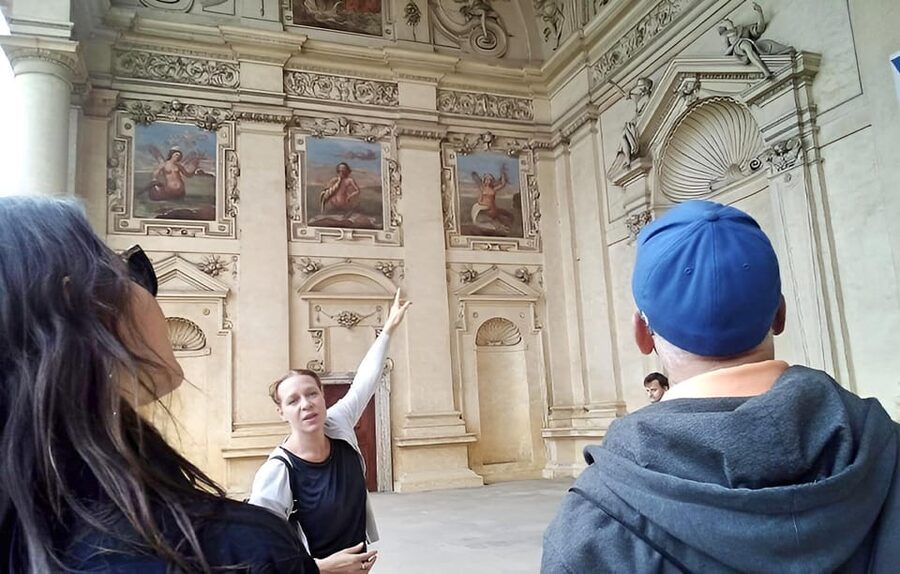
I would recommend this tour to you if you have already seen Prague’s major churches and squares and want a different angle on the city. It is also a good match for anyone interested in architecture, horticulture, royal history, Italian Renaissance design, or Baroque art.
You will get the most from it if you enjoy details such as the sound of the Singing Fountain, the arrival of tulips, or the way a grotto wall changes the mood of a formal garden.
The tour is less suitable if you dislike stairs, need a flat route, or want a relaxed garden visit without a fixed schedule. The three-hour format covers several sites, so the pace includes both sightseeing and movement between locations.
Meet at the door of Bagel Lounge Malostranska. Check the starting time when you book, since several departure times may be available. The tour is offered in English, with private and small-group options.
Free cancellation is available up to 24 hours before the start, and you can reserve now while paying later. Those policies are helpful if your Prague plans are still changing, but they do not alter the physical demands of the route.
Should you book the Prague garden tour?

Book it if you want Prague’s gardens explained as works of art, political statements, and living experiments. The Singing Fountain, the citrus-growing Orangery, Wallenstein’s theatrical garden, and Vrtba’s hilltop view give you a varied three-hour route with plenty of specific details to remember.
Skip it if your main goal is a flat stroll or if the extra admission fees push the cost beyond your budget. For most people who value a focused guide and are comfortable with steep stairs, this is a thoughtful way to see parts of Prague that are easy to miss.
FAQ
How long does the Prague Renaissance and Baroque Gardens Walking Tour last?
The tour lasts three hours.
What language is the tour offered in?
The live tour guide speaks English.
Where is the meeting point?
Meet at the door of Bagel Lounge Malostranska.
Is the tour private or shared?
Private and small-group options are available.
Are garden admission fees included?
No. Admission to the gardens under Prague Castle and Vrtba Garden is not included.
Is the historian guide included?
Yes. The experience includes a three-hour guided history walk with a historian guide.
What is the Singing Fountain?
It is a fountain cast in bell bronze in 1564. Water dropping into its bowl causes it to resonate or sing.
Which gardens are visited?
The route includes Prague Castle’s Royal Gardens, the Fig House and Orangery, the South Gardens, Wallenstein Garden, and Vrtba Garden.
Is the route suitable for people with mobility issues?
The regular route includes narrow, steep stairs and repeated walking up and down hills. A private tour may allow the guide to adjust the route and pace.
Can I cancel the booking?
Yes. You can cancel up to 24 hours in advance for a full refund. You can also reserve now and pay later.
Just added around Prague
- Private Prague Art Nouveau and Cubism Walking Tour★ 5.0 · 8 reviews
- Best of Prague Architecture – private tour with PERSONAL PRAGUE GUIDE★ 5.0 · 21 reviews
- Private Prague Renaissance & Baroque Gardens Walking Tour★ 5.0 · 8 reviews
- Prague Renaissance & Baroque Gardens Walking Tour★ 5.0 · 23 reviews
- Prague: Private Prague Art Nouveau and Cubism Tour★ 4.8 · 6 reviews
- Prague: Private Cubism & Art Nouveau Walking Tour★ 5.0 · 15 reviews
- Prague Art Nouveau Tour★ 4.9 · 12 reviews
- Prague: Modern Architecture and Design Guided Tour★ 3.9 · 20 reviews
Baroque Architecture Tours, compared.
Lecce: Baroque Architecture and Underground Walking Tour
Read our review →
Train Exp. through the Alps (Royal Baroque Route from Nice)
Read our review →
Dresden: Tour of the Baroque Quarter with a Night Watchman
Read our review →
Interpreti Veneziani Ensemble Baroque Concert in Venice Ticket
Read our review →
Borghese Gallery Max 6 People Tour: Baroque & Renaissance in Rome
Read our review →
Concert at the Palais Schönborn-Batthyány by the Vienna Baroque Orchestra
Read our review →
Guided Walking Tour of Rome: Top Sights & Baroque Treasures
Read our review →
Noto, Modica and Ragusa: The Baroque Tour from Catania
Read our review →Browse the lists this tour appears in