
Review · ROTTERDAM
Rotterdam: Wilhelminapier, High-rise & floating architecture
Rotterdam’s Wilhelminapier is where old port buildings meet bold towers and floating experiments. This private walk gives you the story behind that change, then takes you inside Pakhuismeesteren for a rooftop view across one of Europe’s most striking city skylines. You’ll also see De Rotterdam and the former Holland America Line area.
I like the mix of architecture and human stories, especially the shift from working harbor to modern city district. I also like the short, focused route: a guide, a rooftop, a Dutch treat, and floating projects all fit into one hour. The tradeoff is clear: $286 for up to six people is good value for a full group, but expensive for one or two people, and one hour leaves little time for lingering.
Key points
- Pakhuismeesteren rooftop: Enter a former harbor warehouse and take in a panoramic Rotterdam view.
- Wilhelminapier transformation: Learn how a port district became a showcase for high-rise design.
- De Rotterdam: Hear about the concept and design of the huge multi-tower complex.
- Floating projects: See a floating hotel, park, and office along Rijnhaven.
- Foodhallen stop: Visit the food hall inside Pakhuismeesteren, a useful pause for anyone interested in Dutch food culture.
- Private format: Your group of up to six has its own guide, with Dutch, English, German, Spanish, and French available.
Starting beside the red Het Nieuwe Luxor Theater
You meet your guide outside Het Nieuwe Luxor Theater, the red building on Wilhelminapier. This is a practical starting point because the theater is easy to recognize and places you right in the middle of Rotterdam’s modern waterfront district.
The tour is private, so you are not folded into a large crowd. That matters on a one-hour walk. You can ask about a tower, building detail, or harbor view without waiting for a full group to catch up. The guide can speak Dutch, English, German, Spanish, or French, so confirm your preferred language when booking.
The walk is short, but it is not simply a photo stop beside tall buildings. The point is to understand how the pier changed and why Rotterdam chose such a bold architectural direction. You will hear about the port’s earlier role, the former Holland America Line connection, and the ideas behind the new buildings.
More skyscraper tours in the Netherlands:
- Chicago Premium Driving Tour with River Boat Cruise and Sky Deck
★ 4.5 · 165 reviews - Chicago Walking Tour: Art Deco Skyscrapers Loop
★ 5.0 · 138 reviews - Florence Skyline from the Top of Brunelleschi’s Dome
★ 4.5 · 99 reviews
Wilhelminapier, from ocean liners to high-rise Rotterdam
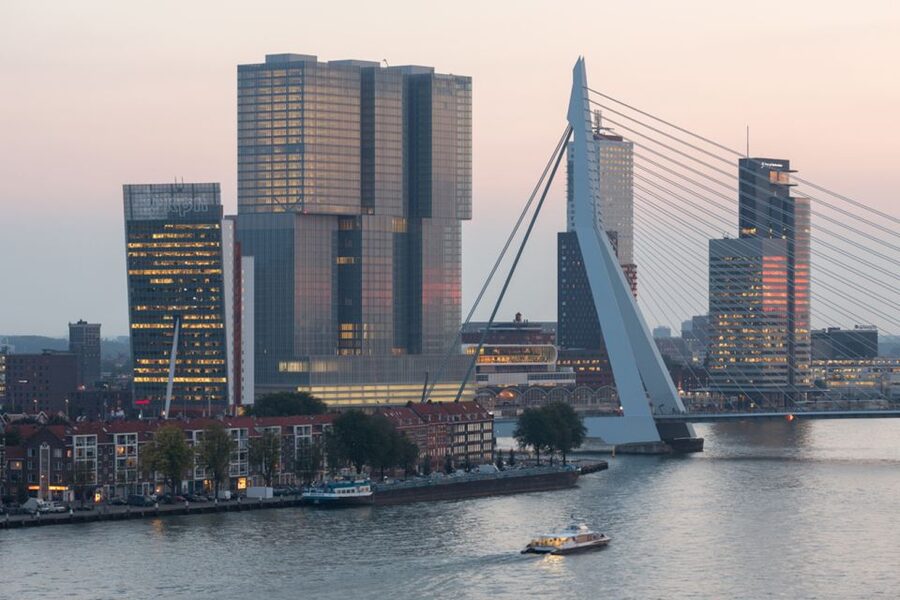
Wilhelminapier was once tied closely to the Holland America Line, which used Rotterdam as a major departure point for voyages to North America. That past helps explain why the district feels different from an ordinary office quarter. It was built around movement, trade, ships, and long-distance connections.
Today, the pier is known for its tall buildings and wide views over the water. A guide adds useful scale to what you see. Instead of simply pointing at a tower and naming its architect, the tour explains the area’s transformation and the design concepts that shaped it.
The setting is especially useful if you are new to Rotterdam. The city has a modern identity because so much of its center was rebuilt and redesigned after wartime destruction. Wilhelminapier gives you a concentrated look at that forward-looking spirit, with old port functions, hotels, apartments, offices, restaurants, and public spaces sharing a compact waterfront.
You should expect plenty of exterior viewing and explanation. The tour is not an extended museum visit, and the hour moves quickly. If you like architecture, bring questions. If your interest is mainly food or history, the guide’s comments about the Holland America Line and Pakhuismeesteren give the walk more depth than a skyline stroll alone.
De Rotterdam and the logic behind its stacked towers
A major part of the tour focuses on De Rotterdam, one of the district’s most recognizable buildings. Your guide explains its history, concept, and design rather than treating it as a simple landmark for photographs.
The complex is memorable because it reads as several large sections placed together. From the outside, its scale can be hard to grasp. A guide helps you understand how the parts relate to one another and why the building has become such an important symbol of Rotterdam’s high-rise ambitions.
This is one of the tour’s strongest features for anyone who wants context. You will not receive a full architectural course in one hour, but you should come away with a clearer sense of how Rotterdam uses height, density, and mixed functions to reshape its waterfront.
There is also a practical limitation. The information about De Rotterdam is part of a moving walking tour, so the amount of detail depends on your questions and the guide’s pace. If you want a long, technical study of the building, you will need more time elsewhere. For a first introduction, the stop fits well.
Inside Pakhuismeesteren, a warehouse with a new job
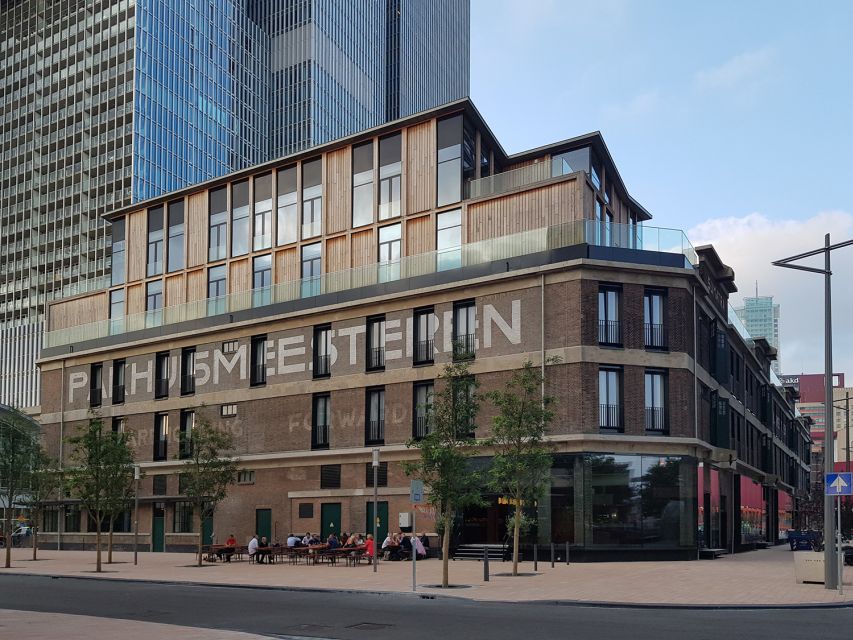
Pakhuismeesteren is one of the most appealing stops because you get to see the inside of a former harbor warehouse. The building now contains a hotel and the Foodhallen, showing how Rotterdam reuses industrial spaces instead of leaving them behind.
That change gives the tour a useful contrast. Outside, the pier is all towers and glass. Inside Pakhuismeesteren, the older warehouse character connects the modern district to its working-port past. You can better understand the area when you see both sides in the same hour.
The Foodhallen adds a food-focused element. It is described as a must-see for food lovers, but keep your expectations in proportion. This tour includes a visit, not an extended meal or a food tour. You may have time to look around and absorb the atmosphere, while the main focus remains architecture and local development.
A tasty Dutch treat is included. The precise treat is not specified, so do not book this expecting a particular pastry or specialty. Still, the small food stop is a pleasant touch. It breaks up the architectural discussion and gives you a taste of the Netherlands without taking the tour off track.
A few more architecture tours around the Netherlands worth a look
- Rotterdam: Architectural Highlights Guided Walking Tour
★ 4.8 · 215 reviews - Rotterdam: Highlights, Gems, Architecture & History Walk
★ 5.0 · 191 reviews - Rotterdam Walk: Hilights, Gems, Architecture & WWII | 2 or 3hrs
★ 5.0 · 149 reviews - Rotterdam Architecture Highlights Walking Tour
★ 5.0 · 66 reviews
The Pakhuismeesteren rooftop view
The rooftop is the visual payoff. After learning about the building’s warehouse past and present use, you go upstairs for a panoramic view of Rotterdam and its famous architecture.
This viewpoint is valuable because the city’s design makes more sense from above. You can see how the towers relate to the water, how the pier projects into the harbor, and how the new buildings form a distinct cluster rather than isolated objects. You also get a better sense of Rotterdam’s scale than you do from street level.
I would especially value this stop on a first visit. It gives you a mental map of the district early in your stay. Later, when you see De Rotterdam, Rijnhaven, or the surrounding towers from street level, you have some idea of how the pieces fit together.
The rooftop entrance is included, which helps the price feel more reasonable for a private group. The view is also dependent on conditions. The tour promises access and a scenic outlook, but it cannot promise clear skies. On a gray day, the architecture remains interesting, though the wide panorama may be less dramatic.
Along Rijnhaven, Rotterdam’s floating experiments
The route continues along Rijnhaven, where you see floating projects including a hotel, a park, and an office. These are not just unusual objects on the water. They show how Rotterdam is testing ways to use its harbor space while responding to changing needs in a low-lying country.
The floating concepts are a strong reason to choose this tour over a standard city walk. You get to discuss practical design ideas, not only admire tall buildings. A floating hotel raises questions about tourism and changing waterfront use. A floating office points to new ways of placing workspaces. A floating park suggests that public green space does not have to stay on solid ground.
The wording of the experience is important here: you stroll past these projects and take a look. You should not expect a long visit inside each one or a detailed demonstration of their engineering. The value is in seeing several working concepts close together and hearing how they fit Rotterdam’s plans.
The route ends near Fenix Migration Museum, identified as Rotterdam’s newest icon. The museum itself is not listed as an included visit, so think of it as a useful final landmark and a possible next stop, not part of the guided program.
What the private price means for your group
The cost is $286 per group of up to six, not $286 per person. For six people, that works out to about $48 per person. At that size, the price can make sense, especially because it includes a private guide, rooftop entrance, a Dutch treat, and a one-hour route centered on several major buildings.
For two people, the calculation changes. You are paying for privacy and direct access to a guide rather than a budget group walk. That can still be worthwhile if you care about architecture, want a particular language, or prefer to ask questions at your own pace. If you mainly want a quick skyline photo, the price will feel high.
The one-hour duration is both a strength and a weakness. It is easy to fit before dinner, after arriving in Rotterdam, or between other city plans. It also keeps the walk manageable for people who do not want a long architectural outing. On the other hand, you will not have much free time at Pakhuismeesteren or Foodhallen.
The experience is wheelchair accessible, which makes the route more practical for a wider range of visitors. Since the tour includes a rooftop visit and waterfront walking, it is sensible to check the conditions and exact starting time before you go, but the activity is presented as accessible.
You can cancel up to 24 hours ahead for a full refund, and you can reserve now while paying later. Those terms are useful if your Rotterdam plans are still shifting.
Who will get the most from this hour
I would choose this tour if you want a compact introduction to Rotterdam’s modern architecture with a real guide rather than a self-guided photo walk. It suits first-time visitors, architecture fans, design students, and anyone curious about how a former port district found a new purpose.
It also works well for a private family group or a small party of friends. The private format lets you set the tone. You can ask for more history, more design detail, or more attention to the skyline without competing with strangers.
Food lovers may enjoy the Foodhallen stop, but this is not primarily a tasting tour. History fans will appreciate the Holland America Line connection, but the focus is the district’s transformation rather than a full account of maritime Rotterdam.
The clearest positive pattern in the guest feedback is the combination of learning and enjoyment. One guide, Willem, was specifically praised for creating a good-natured walk with plenty of laughter and useful information. Other comments singled out the chance to see the building interior and hear its background, while another called the architecture-focused tour interesting and recommended it for a Rotterdam visit.
Those comments point to the real strength here: the tour makes a striking building and a complicated district easier to understand. It is not trying to cover all of Rotterdam. It gives you a focused hour in one of the city’s most distinctive areas.
Should you book the Wilhelminapier tour?
Book it if your group has a strong interest in architecture, waterfront redevelopment, or Rotterdam’s modern identity. The rooftop at Pakhuismeesteren, the interior of the old warehouse, De Rotterdam, and the floating projects create a varied route despite the short duration.
I would be more cautious if you are traveling alone or as a couple on a tight budget. The $286 group price is most attractive when shared by several people. I would also skip it if you want a long food experience, a museum visit, or a relaxed walk with lots of unscheduled time.
For a group of up to six, this is a practical way to see several important Wilhelminapier sights in one hour, with enough background to make the buildings mean more than skyline decoration.
FAQ
Where does the tour meet?
You meet your guide outside Het Nieuwe Luxor Theater, the red building on Wilhelminapier.
How long does the tour last?
The tour lasts one hour.
How much does the tour cost?
The price is $286 per private group of up to six people.
Is this a private tour?
Yes. The activity is offered for a private group.
Which languages are available?
The guide can provide the tour in Dutch, English, German, Spanish, or French.
Is rooftop admission included?
Yes. Entrance to the Pakhuismeesteren rooftop is included.
Is a food item included?
Yes. A tasty Dutch treat is included. The specific treat is not stated.
What is Pakhuismeesteren?
Pakhuismeesteren is a former harbor warehouse on Wilhelminapier. It now contains a hotel and the Foodhallen.
Will I see floating architecture?
Yes. The route passes floating projects including a hotel, park, and office along Rijnhaven.
Is the tour wheelchair accessible?
Yes. The activity is listed as wheelchair accessible.
Can I cancel for a refund?
Yes. You can cancel up to 24 hours in advance for a full refund.
Do I have to pay when I reserve?
No. The reserve-now, pay-later option lets you book without paying immediately.
Just added around the Netherlands
- Rotterdam Must Do Tour: Highlights, History, WW2 and Architecture★ 5.0 · 20 reviews
- Private Rotterdam Walking Tour – guided by Architects★ 5.0 · 2 reviews
- Rotterdam Architecture and Highlights Walking Tour (TOP RATED)★ 4.5 · 14 reviews
- Escape Room – l’Architecte★ 4.5 · 13 reviews
- Maastricht Highlights, Architecture & Heritage Tour★ 5.0 · 7 reviews
- Gouda Private Walking Tour: History, Architecture & Cheese★ 4.5 · 8 reviews
- Amsterdam Walking Tour. All about History, Architecture, Traditions & Anecdotes.★ 5.0 · 2 reviews
- Walking Tour about Golden Age Architecture, private local guide★ 5.0 · 15 reviews
Skyscraper Tours, compared.
Chicago Premium Driving Tour with River Boat Cruise and Sky Deck
Read our review →
Chicago Walking Tour: Art Deco Skyscrapers Loop
Read our review →
Florence Skyline from the Top of Brunelleschi’s Dome
Read our review →
Chicago Walking Tour: Art Deco Skyscrapers Riverfront
Read our review →
Walking Tour: Chicago’s Loop – Home of the Modern Skyscraper
Read our review →

3-Hour Shanghai Bund Swift Tour with River Cruise or Skyscraper
Read our review →Browse the lists this tour appears in