
Review · ROTTERDAM
Rotterdam: Architectural Highlights Guided Walking Tour
Rotterdam makes the most sense when you understand why it looks so different from other Dutch cities. This two-hour walk connects the rebuilt city center to the river, using buildings such as Rotterdam Centraal, the Markthal, and the Cube Houses to explain how war, commerce, housing, and city planning shaped the modern city.
I like the route’s clear progression from railway station to waterfront, and I like having a practicing architect explain not only what buildings look like, but why they were designed that way. The main drawback is pace: you cover about 3 to 4 kilometers in two hours, so there is limited time to linger or explore interiors.
- A city story told through buildings: Follow Rotterdam’s development from wartime destruction to ambitious modern planning.
- An architect as your guide: Guides including Tanya, Tania, Silvia, and Sylvie have led tours that connect design with daily life and urban change.
- A useful first look at Rotterdam: The route starts at Centraal Station and ends near the Maas, giving you a strong sense of the central city.
- Major sights without transport: See the Lijnbaan, City Hall, Timmerhuis, Laurenskerk, Markthal, Cube Houses, and Erasmus Bridge on foot.
- Good value at $53: The price is reasonable for a private or small-group architectural walk led by a specialist.
- A walk for curious minds: You do not need a background in architecture, but comfortable shoes and interest in cities will help.
Why Rotterdam’s buildings tell a better story than a standard city walk
Rotterdam is not a city you simply admire from a postcard. Its streets explain a difficult past and a bold decision: rebuild in a new way rather than recreate the old one.
The city center was heavily damaged during the Second World War, and much of what you see today comes from the decades that followed. That gives Rotterdam an unusual mix of styles. A traditional church can sit near a postwar shopping district, which can sit near a glass office block or an experimental housing project.
This tour uses that contrast as its main subject. You are not just stopping at attractive buildings to take pictures. You are encouraged to notice scale, purpose, materials, public space, and the choices made by architects and city planners.
The 4.8 rating from 215 bookings reflects the tour’s strongest feature: the quality of its guides. Tanya, Tania, Silvia, Sylvie, and Tina are among the names associated with past departures. The guide you receive may vary, but the experience is designed around an architect-led explanation rather than a general city commentary.
That distinction matters. A regular walking tour might tell you when a building was built. An architect can also point out how it meets the street, handles light, creates public space, or fits into a larger plan.
Meeting beneath the clock at Rotterdam Centraal
The tour begins beneath the clock at Rotterdam Centraal Station, a practical meeting place if you arrive by train or metro. Give yourself enough time to find the correct area, especially if you are arriving with luggage or stepping into Rotterdam for the first time.
Centraal is an appropriate starting point. The station is one of the city’s most visible modern projects, with a sharp, forward-facing design that directs attention toward the city center. It also introduces a recurring Rotterdam theme: transport, growth, and architecture working together.
From here, your guide sets the historical frame. You learn about Rotterdam as a major industrial and port city, then move into the story of its wartime destruction and postwar recovery. This opening is valuable because the city can otherwise feel visually confusing. Once you know why so many buildings are modern, the mixture begins to look deliberate rather than random.
The guide also explains daily life and urban development, not just famous facades. That broader view helps you see Rotterdam as a working city, not simply an outdoor architecture exhibition.
More architecture walks in the Netherlands:
- Rotterdam: Highlights, Gems, Architecture & History Walk
★ 5.0 · 191 reviews - Rotterdam Walk: Hilights, Gems, Architecture & WWII | 2 or 3hrs
★ 5.0 · 149 reviews - Rotterdam Architecture Highlights Walking Tour
★ 5.0 · 66 reviews
Lijnbaan and City Hall: early postwar choices
The route continues through the Lijnbaan area, one of Rotterdam’s important postwar urban projects. This is where the tour begins to show how the city experimented with shopping, pedestrian movement, and public space after the bombing.
The Lijnbaan is useful to study because it is less about one dramatic building than about how people move through a city. Look at the relationship between shops, walkways, open areas, and surrounding buildings. Your guide explains the thinking behind the layout and how it fit Rotterdam’s plans for a rebuilt center.
City Hall adds another layer. The building helps show how older civic architecture fits into a center that was being reshaped around it. The contrast is one of the pleasures of Rotterdam: you can compare different periods without needing to travel far across town.
This part of the walk is also where a good guide earns the fee. Past guides have been praised for pausing to answer questions and for adjusting explanations to people with little or no architectural background. Silvia, in particular, has been described as clear, personable, and careful with pacing.
Still, pace can vary. One past participant wanted more pauses for people walking slowly. If your group includes young children, older family members, or anyone who finds a brisk city walk tiring, keep the 3 to 4 kilometer distance in mind.
Timmerhuis and Rotterdam’s changing working city
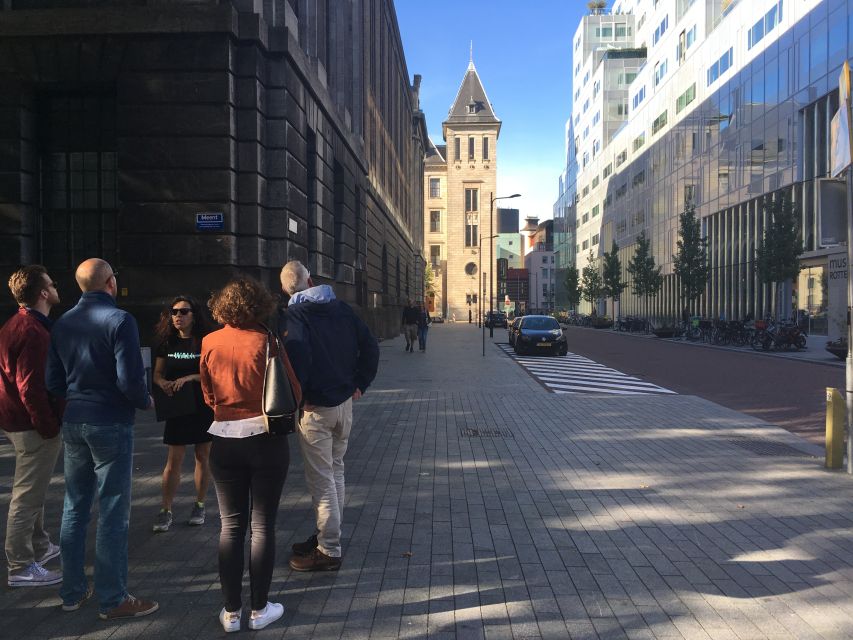
The Timmerhuis offers a sharp contrast to the older parts of the route. Its modern form reflects Rotterdam’s continuing interest in flexible buildings, mixed uses, and new ways of fitting offices, housing, and public areas into the city center.
Here, you get more than a lesson in appearance. Your guide can explain how a contemporary building responds to the space around it and how newer development changes the feel of the center.
This is also a good point to ask questions. The walk is designed as a live English-language tour, and the strongest departures appear to leave room for discussion. That makes it more useful than a memorized list of dates, especially if you want to understand why Rotterdam has kept choosing striking modern designs.
You may not spend long inside individual buildings. The tour’s focus is the city as a whole, so the value comes from seeing several examples in sequence. If you want a slow study of one building, a museum visit or a longer specialist tour would suit you better.
Laurenskerk and the memory of wartime Rotterdam
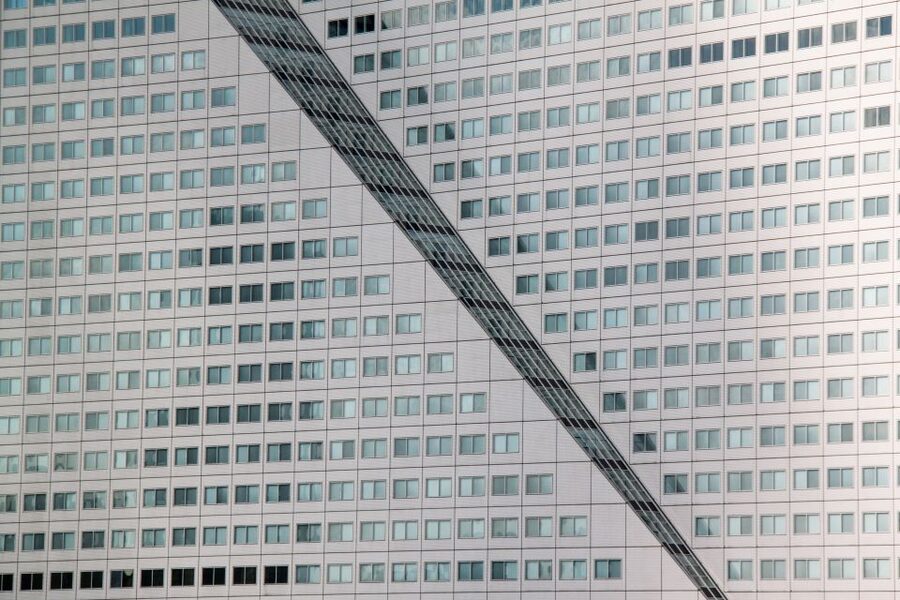
The Sint Laurens church, usually called Laurenskerk, provides one of the route’s most important historical contrasts. It is a surviving reminder of Rotterdam before the wartime destruction and a useful reference point for understanding what changed afterward.
The church helps make the city’s modern architecture easier to read. Instead of treating old and new Rotterdam as separate subjects, the guide can show you how they exist side by side. You learn how the bombing affected the center and how rebuilding decisions shaped the city that followed.
Past guides have used old photographs and historical images to make this story clearer. That kind of visual aid is especially useful here, since modern streets do not always reveal what stood in the same place before the war.
One unusual detail connected with the destroyed section of the city is a set of lights embedded in sidewalks. At night, these lights outline the area affected by the bombing when seen from above. The tour does not promise a special nighttime visit, but knowing about this detail gives you another way to read Rotterdam after dark.
More guided tours in the Netherlands:
- Walking Tour about Golden Age Architecture, private local guide
★ 5.0 · 15 reviews - Private Rotterdam Walking Tour – guided by Architects
★ 5.0 · 2 reviews - La Haye: “Art Nouveau” guided tour
★ 5.0 · 2 reviews - Barcelona: Sagrada Familia Entry Ticket with Audio Guide
★ 4.6 · 105,312 reviews
Inside the Markthal, then under the Cube Houses
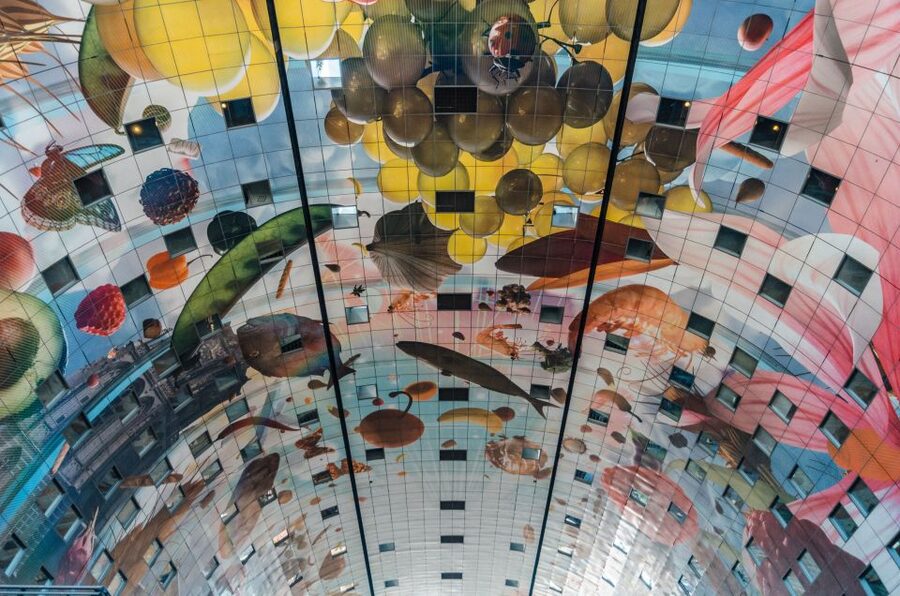
The Markthal is one of the route’s most photogenic stops. The tour takes you inside, where the scale and colorful interior make a welcome change from street-level facades and office buildings.
The Markthal is also a good place to think about the modern city as a place to live, shop, work, and gather. Your guide explains its role within Rotterdam’s redevelopment rather than treating it as a quick photo stop.
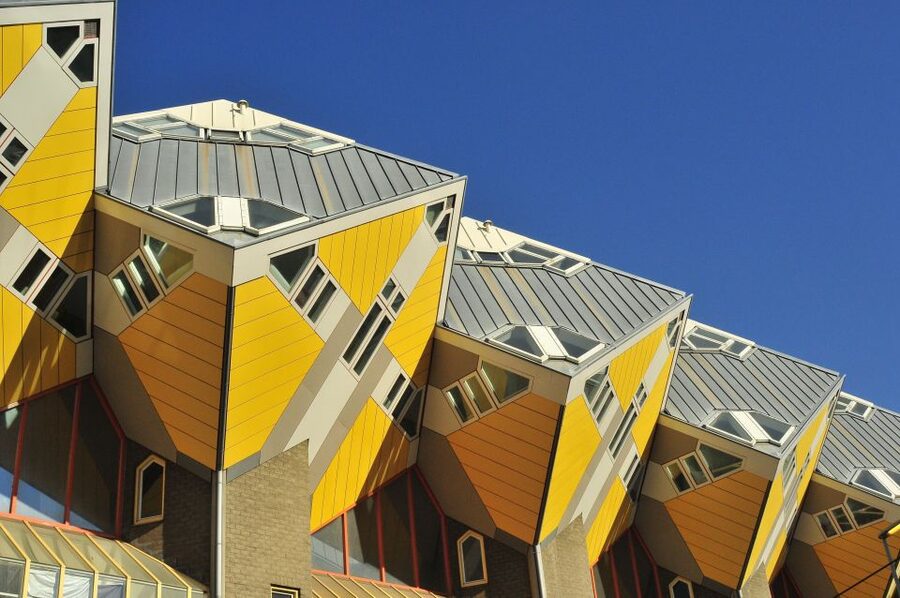
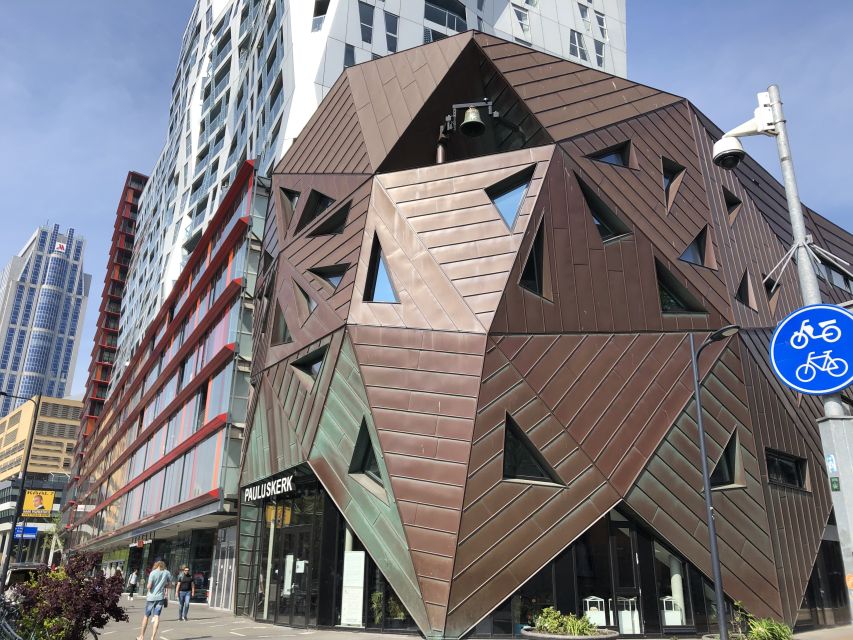
Nearby, you walk past the Cube Houses. Their tilted forms are instantly recognizable, and they remain one of Rotterdam’s signature sights. The unusual design raises practical questions about rooms, windows, furniture, and everyday use. Your guide helps put the project into its architectural and urban setting.
One useful caution: not everyone agrees that the Cube Houses are successful housing. One participant felt the design was overpraised, while the tour itself was still considered worthwhile. That is a fair reason to approach the cubes with curiosity rather than assuming you must love them.
The tour normally passes the row rather than promising a full interior visit. If you want to see a model Cube House from inside, confirm what is included when booking, since the stated experience focuses on walking past the houses.
From the city center to the Maas and Erasmus Bridge
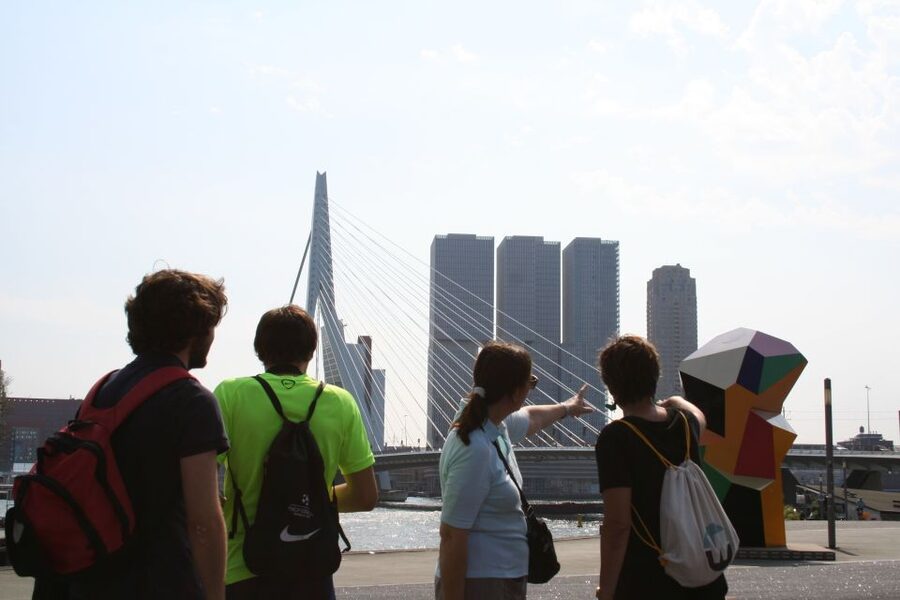
The final section leads toward the riverside and the newer development on the south bank. This change in scenery helps you understand Rotterdam’s continuing ambitions. The city is not finished rebuilding or reshaping itself; new towers, public spaces, and riverfront projects continue to alter the skyline.
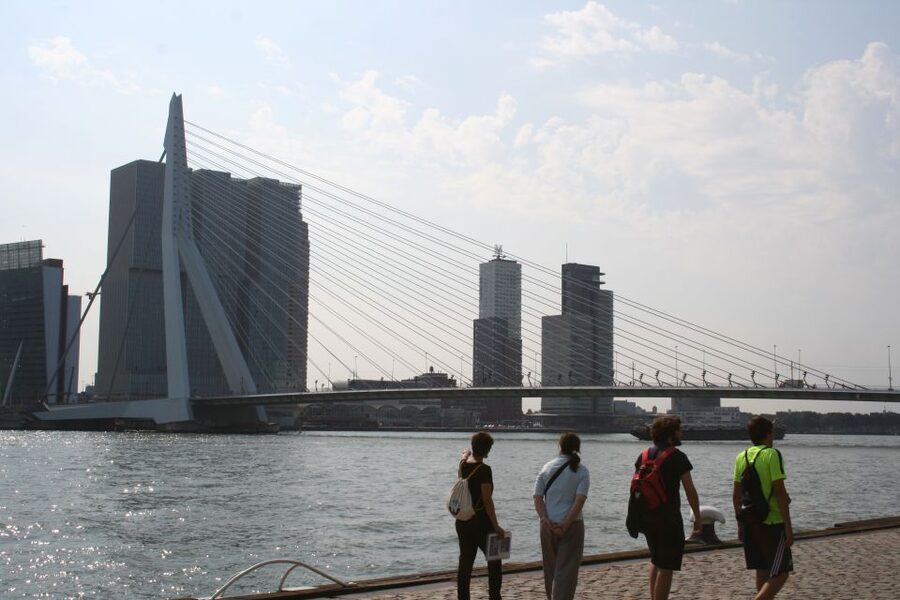
The Erasmus Bridge is the visual finish. Its long, elegant span has become one of Rotterdam’s defining symbols, and the riverfront gives you the best context for seeing how the bridge links different parts of the city.
Your guide discusses the high-rise skyline and the plans behind the south-bank development. This is where the tour broadens from individual buildings to urban scale. You see how transport, housing, business, public space, and the river fit into one larger plan.
The ending is especially useful if you are staying in Rotterdam for more than one day. You finish with a clearer sense of direction and can decide which waterfront areas deserve a closer look later.
Do not expect a long stop for food or drinks. Neither is included, and the walk is too short to function as a café break. Plan your snack before the tour or after it, depending on your starting time.
How much value do you get for $53?
At $53 per person, this is not the cheapest way to spend two hours in Rotterdam. You can walk the same streets for free. The question is what you gain from having an architect connect the pieces.
I think the price is fair for three reasons. First, the route covers many of the city center’s key architectural sights without requiring public transport. Second, the guide adds background that is difficult to pick up from a plaque or guidebook. Third, the walk gives you a framework for the rest of your stay.
The value is strongest if Rotterdam is new to you or if you care about architecture, planning, design, history, or urban life. It is less compelling if you prefer entering museums, shopping, or spending a long time at each major sight.
A private group is available, which can improve the experience if you want to ask many questions or set a more personal pace. The regular format may be enough for most people, especially since past groups have sometimes been small.
Who should book this walk?
I would choose this tour for a first day in Rotterdam. It gives you the basic story of the city and puts the main central sights in an order that makes sense.
It is also a good fit for:
- People interested in modern architecture and city planning
- Visitors who want history explained through buildings
- Couples or families who prefer a guided walk to a museum
- Rail passengers arriving at Centraal Station
- Anyone who wants to understand the postwar city beyond the usual photo stops
Children aged 0 to 12 can join free, but parents should judge the distance, subject, and two-hour duration carefully. This is not a playground-focused walk, and the guide’s explanations are aimed at adults and older children who can follow a sustained discussion.
The tour is wheelchair accessible, and it operates rain or shine. Bring comfortable shoes and clothing suited to the weather. Rotterdam can feel exposed near the river, so a light rain layer is sensible even when the forecast looks friendly.
English is the stated language. Some past participants found a guide’s strong Spanish accent occasionally difficult to follow, while others found the explanations clear and engaging. If precise spoken English is important to you, a private group may give you more freedom to ask for clarification.
Should you book the Rotterdam architecture walk?
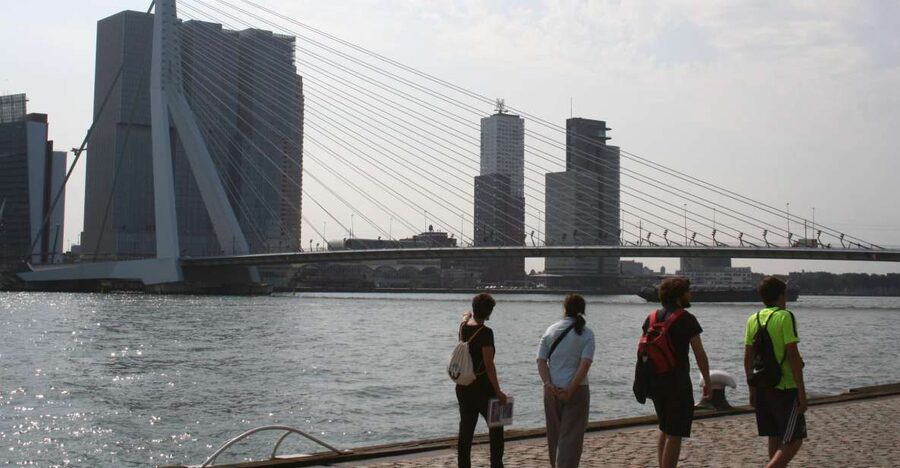
Book it if you want Rotterdam’s buildings to make sense, not just look unusual. The strongest part is the link between the 1940 bombing, postwar planning, modern housing, commercial development, and the future-facing riverfront.
You should skip it if you want a relaxed stroll with lots of free time, food stops, or extended interior visits. The route covers ground, and the two-hour schedule keeps things moving.
For most first-time visitors, I think the tour earns its $53 price. You finish near the river with a clearer understanding of why Rotterdam looks the way it does, plus a practical orientation to the central city. That is a useful foundation for exploring the Markthal, Cube Houses, Erasmus Bridge, and waterfront on your own.
FAQ
Where does the tour begin?
Meet the guide underneath the clock at Rotterdam Centraal Station.
Where does the tour finish?
The walk finishes at the riverside, near the newer south-bank development and the Erasmus Bridge area.
How long is the tour?
The tour lasts two hours.
How far do you walk?
The route covers about 3 to 4 kilometers.
What language is the tour offered in?
The live guided tour is offered in English.
Is the tour wheelchair accessible?
Yes, the activity is listed as wheelchair accessible.
Can children join the walk?
Yes. Children aged 0 to 12 can join free, though parents should consider the distance, subject matter, and two-hour duration.
What should I bring?
Bring comfortable shoes and clothing suitable for the weather. The tour operates in rain or shine.
Just added around the Netherlands
- Rotterdam Must Do Tour: Highlights, History, WW2 and Architecture★ 5.0 · 20 reviews
- Private Rotterdam Walking Tour – guided by Architects★ 5.0 · 2 reviews
- Rotterdam Architecture and Highlights Walking Tour (TOP RATED)★ 4.5 · 14 reviews
- Escape Room – l’Architecte★ 4.5 · 13 reviews
- Maastricht Highlights, Architecture & Heritage Tour★ 5.0 · 7 reviews
- Gouda Private Walking Tour: History, Architecture & Cheese★ 4.5 · 8 reviews
- Walking Tour about Golden Age Architecture, private local guide★ 5.0 · 15 reviews
- Amsterdam Walking Tour. All about History, Architecture, Traditions & Anecdotes.★ 5.0 · 2 reviews
Walking Tours, compared.
The Official Art Deco Walking Tour by The Miami Design Preservation League
Read our review →
Barcelona: Gothic Quarter Ghosts and Legends Walking Tour
Read our review →
Barcelona: Old Town and Gothic Quarter Walking Tour
Read our review →
Lecce: Baroque Architecture and Underground Walking Tour
Read our review →
Chicago in a Day: Food, History & Architecture Walking Tour
Read our review →
Ramblas, Old Town, Gothic and Gaudi Architecture Walking Tour
Read our review →
Chicago’s Secret Interiors Architectural Walking Tour
Read our review →Browse the lists this tour appears in