
Review · THE NETHERLANDS
Walking Tour about Golden Age Architecture, private local guide
Amsterdam’s Golden Age is easiest to understand when you stop looking at Amsterdam’s canal houses as a pretty backdrop and start reading them as evidence. This private walk connects trade, engineering, social class, religion, and family stories to the buildings around you. The soft ground beneath the city is every bit as interesting as the façades above it.
I like the private format, which gives you room to ask questions and pause for photographs. I also like the focus on details many city walks skip, including hoisting beams, facade stones, leaning houses, and the difficult work of building on marshy ground. The main drawback is simple: you will walk and stand for about 90 minutes, with no mobility aids available.
Key points at a glance
- A private walk with Anna: The English-speaking local guide leads only your group, making questions and changes of pace easier.
- Royal Palace engineering: Learn how a grand civic building was raised on challenging clay and marshy soil.
- Canal houses with clues: Read house names, façades, warehouses, and facade stones as records of Amsterdam life.
- A walk through several districts: The route links Dam Square, the canal belt, and Jordaan.
- A useful final stop: The tour ends at Westerkerk, beside the Anne Frank House area.
- Good value for architecture fans: At $73.59 per person, the price makes the most sense for a small group that wants a focused private explanation rather than a broad city overview.
Why Amsterdam’s Golden Age makes a good walking subject
This is not a tour built around entering major attractions. It is an outdoor lesson in how Amsterdam grew during the 17th century, when trade made the city an international power. You move through streets and canals where the buildings still show who had money, what people did for work, and how goods moved through the city.
That approach suits me because Amsterdam’s architecture can look repetitive at first. The canal houses share narrow plots and tall façades, but their details vary. A guide helps you notice why one house has a stepped gable, another has a decorative plaque, and another has a beam at the roof for lifting cargo.
Anna is the guide named in the tour details, and the experience is designed around her local perspective. She lives on the canals and brings in architecture, history, and social policy. The private setting is especially useful here because the subject invites questions. You can ask why a house leans, how a warehouse worked, or what a symbol meant without holding up a large group.
More architecture walks in the Netherlands:
- Rotterdam: Architectural Highlights Guided Walking Tour
★ 4.8 · 215 reviews - Rotterdam: Highlights, Gems, Architecture & History Walk
★ 5.0 · 191 reviews - Rotterdam Walk: Hilights, Gems, Architecture & WWII | 2 or 3hrs
★ 5.0 · 149 reviews
Dam Square and the Royal Palace
The walk begins at the Royal Palace Amsterdam on Nieuwezijds Voorburgwal, in the Dam Square area. The opening is short, but it gives you the essential setting: Amsterdam’s rise during the 17th century and the forces that shaped its buildings.
Dam Square is the right place to begin because the city’s wealth was not just private. It also produced public buildings meant to express civic confidence. The Royal Palace was first built as Amsterdam’s town hall, not as a royal home. That change in purpose tells you something about the city’s political story as well as its architecture.
The palace is discussed in terms of Dutch Neoclassical design, construction materials, and the engineering needed to support a large stone building on unstable ground. Amsterdam’s clay and marshy soil made heavy construction difficult. The solution required careful support beneath the visible structure, a reminder that the city’s grandest buildings depend on work you cannot see.
You should not expect a full palace visit as part of this walking experience. The focus is the building’s exterior, history, and construction. If you want to tour the palace’s interior, treat that as a separate plan.
Huis Bartolotti and the display of wealth
From the civic scale of the Royal Palace, the walk turns to canal houses such as Huis Bartolotti. This red-brick house is presented as an example of 17th-century Dutch Baroque design, with large windows and sandstone decoration.
The building offers a useful lesson in status. A canal house was a home, but it was also a public statement. Its façade faced the water and showed the owner’s wealth to anyone arriving by boat or passing along the street. The ornament was not random. It reflected money, taste, and international connections, including the owner’s trading ties with Italy.
This is the kind of stop where a guide adds real value. You can see brick, stone, windows, and curved or decorated details on your own. Anna’s role is to connect those features to the people who paid for them and the trading world that made such houses possible.
Torensluis and Amsterdam’s crooked houses
Torensluis is one of the most useful viewing points on the route. From this broad bridge, you can compare four façade designs associated with Amsterdam’s mercantile class during the Golden Age.
The bridge also gives you a clear look at how Dutch Baroque ideas were adapted to local conditions. Amsterdam’s version is not simply a copy of another country’s style. It had to fit narrow plots, canal-side commerce, local materials, and the tastes of wealthy merchants.
Look closely at the houses that do not sit perfectly straight. Amsterdam’s famous crooked buildings are not just comic curiosities. Soft ground, settling foundations, narrow sites, and centuries of change all help explain the city’s uneven appearance. The buildings lean in different ways, which makes this stop both visually fun and technically useful.
I would pay attention here to the contrast between controlled design and unpredictable movement. The façades may have been carefully planned, but the ground beneath them has had its own say over time.
More private architecture tours in the Netherlands:
- Gouda Private Walking Tour: History, Architecture & Cheese
★ 4.5 · 8 reviews - Private Rotterdam Walking Tour – guided by Architects
★ 5.0 · 2 reviews - Amsterdam, Eastern Docklands Architecture: Private Tour
★ 5.0 · 2 reviews - Sagrada Familia & Gaudi Tour Private or Small Group with Tickets
★ 4.5 · 1,188 reviews
De Dolphijn and a Rembrandt connection
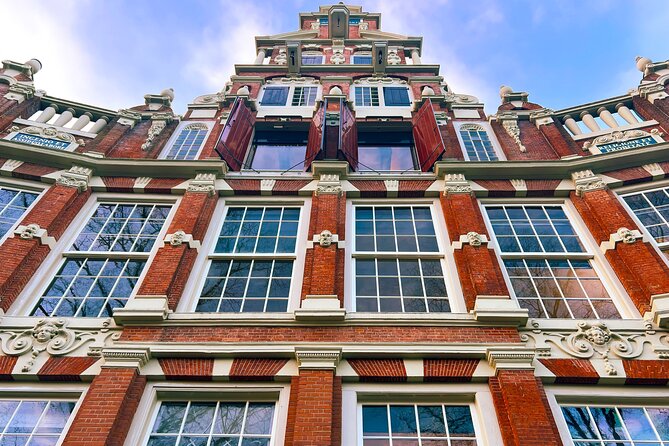
De Dolphijn adds a personal name to the route. The dolphin symbol refers to wealth and to Amsterdam’s maritime trade. The house was once owned by Frans Banning Cocq, the captain associated with Rembrandt’s The Night Watch.
This stop links architecture to a familiar piece of art without turning the whole tour into a painting lecture. You see how a house can preserve the status of a person who helped shape the city’s public life, while its name points back to the importance of shipping and commerce.
For me, this is one of the better reasons to take a focused architecture walk. You are not only looking at style. You are building connections between a building, its owner, a trade economy, and the cultural figures linked to Amsterdam.
The Ronde Lutherse Kerk and the power of a dome
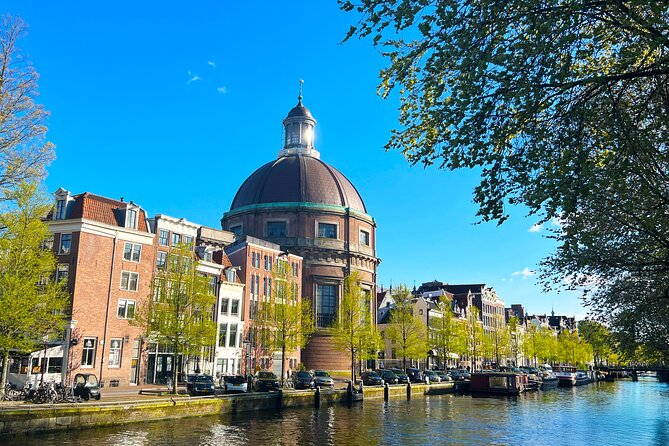
The Ronde Lutherse Kerk brings religion and architectural ambition into the story. Domes were considered a major architectural achievement during the Renaissance period, and the church gives the walk a chance to discuss how religious buildings differed from merchant houses.
You will spend only a short time here, so this is more of a pointed explanation than a full church visit. The value comes from placing the building within the wider story of Amsterdam’s religious and civic architecture. After several canal houses, a church helps show that the city’s Golden Age was expressed through more than private wealth.
Prinsengracht warehouses and practical design
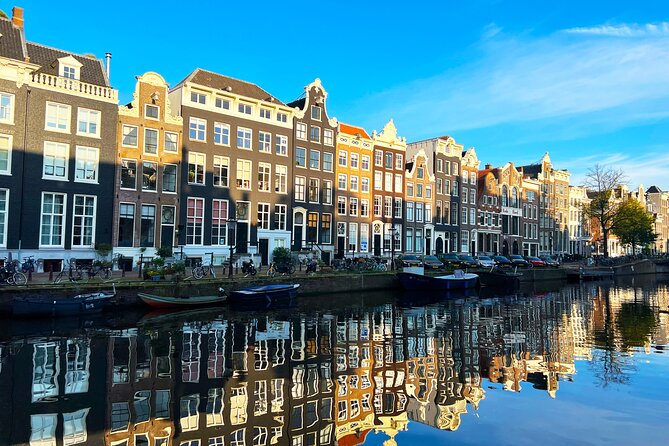
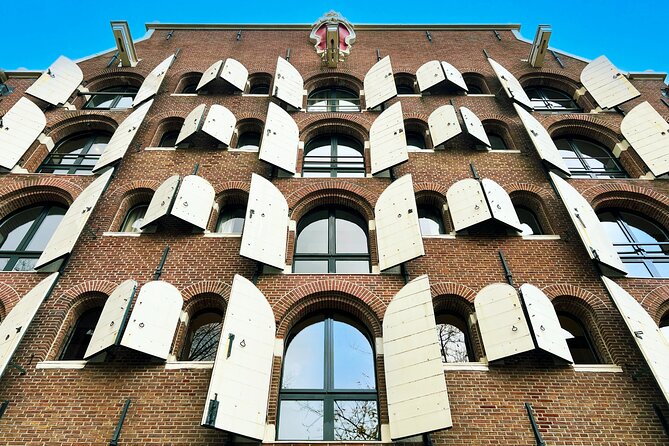
Along Prinsengracht, the focus shifts from showy façades to buildings designed for work. The warehouses have tall gables, large windows, and wooden hoisting beams near the roofs.
Those beams are among the easiest features to miss if you walk without a guide. They allowed merchants to lift heavy cargo from boats and bring it into upper storage areas. The narrow buildings were not only homes. Many combined domestic space, offices, storage, and trade.
The clean exteriors and limited decoration make sense once you understand the purpose. The scale still signals money, but the design is practical. Goods had to move in and out, and the buildings had to make good use of tight canal plots.
This is a strong part of the route for anyone interested in how cities work. You see the connection between water transport, architecture, and business rather than treating the canal belt as scenery alone.
Jordaan and the stories hidden in facade stones
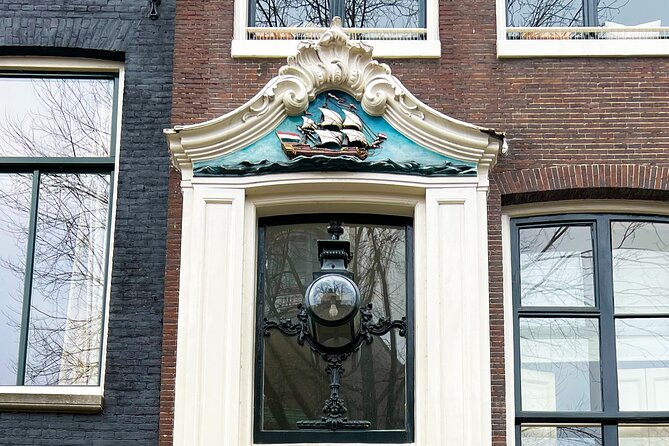
The longest stop is in Jordaan, where the tour spends about 20 minutes. That extra time matters because the neighborhood offers many small clues rather than one famous monument.
During the 17th century, Jordaan served as a lower- and middle-class district for craftsmen and laborers. Homes often had small shops or workshops on the ground floor. The canals and narrow streets formed a working neighborhood, not simply a residential postcard.
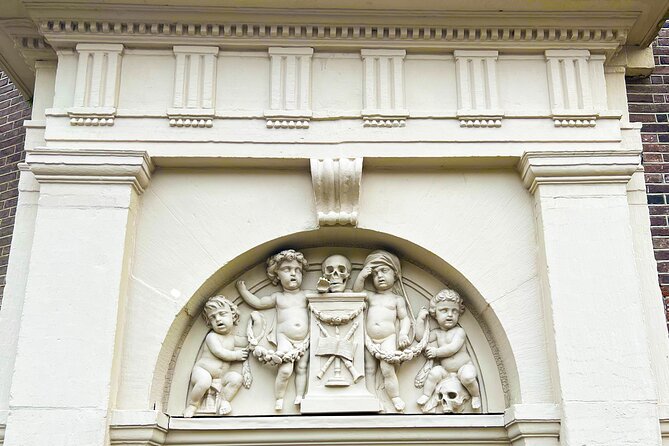
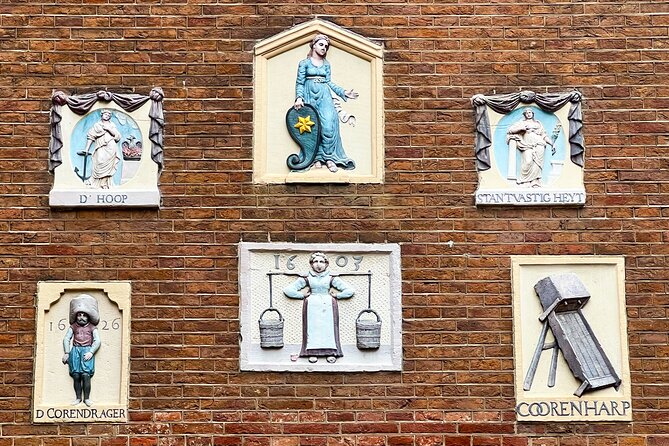
The main subject here is the gevelsteen, or facade stone. These small carved plaques were placed in building fronts and could identify a profession, describe a use, mark an owner, or point to a notable fact about the people who lived there. Before widespread street numbering, such symbols also had a practical role.
You may have walked past facade stones without noticing them. With Anna’s help, you can treat them as small public records. A carving can reveal what happened inside a building or what work supported the household. This is one of the most distinctive parts of the walk because it teaches you how to keep reading Amsterdam after the tour ends.
Westerkerk and the Anne Frank House area
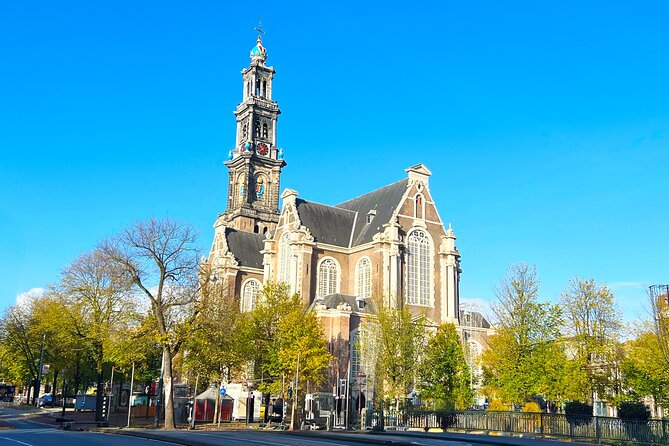
The route ends at Westerkerk on Prinsengracht, beside the Anne Frank House area. The church was built as a Calvinist place of worship for Amsterdam’s growing population, and its design reflects that setting: a large, airy interior with restrained decoration.
The tower reaches 85 meters, or about 280 feet, and was completed in 1638. Its imperial crown reflects Amsterdam’s status, while the clock chimes have marked the hours for centuries. Anne Frank also wrote about those chimes in her diary, giving the sound a place in the modern story of the city.
Rembrandt is associated with Westerkerk as well. He was buried there, though the exact location of his grave is not known today. These details make the final stop a good closing point because it brings together religion, art, city identity, and everyday sound.
The tour ends here rather than returning to Dam Square. That is convenient if you plan to visit the Anne Frank House area afterward, although you will need a separate timed ticket for that attraction if you intend to go inside.
What $73.59 per person gets you
At $73.59 per person, this is not the cheapest way to take a walk through central Amsterdam. Its value depends heavily on group size and your interest in buildings.
For one or two people, the private format costs more than a standard group stroll, but you receive direct access to the guide and can ask questions throughout. For a small group, the price becomes easier to justify, especially since group discounts are available. You are paying for interpretation, not entry tickets or refreshments.
The tour also covers a lot in 90 minutes: Dam Square, the Royal Palace, canal houses, Torensluis, Prinsengracht, Jordaan, and Westerkerk. It is a concentrated introduction rather than a slow architectural study. If you want detailed interior visits, this will feel limited. If you want to understand what you are seeing as you walk through the center, the price is more reasonable.
Bring your own water. Bottled water is not included.
Timing, walking effort, and who should book
The tour is offered in English and takes about 1 hour and 30 minutes. It is near public transportation, and confirmation is provided when you book.
You should be comfortable walking between stops and standing during explanations. The experience is not recommended for people who use a walker or have trouble walking and standing for the full 90 minutes. Mobility aids are not available. Service animals are allowed.
I would choose this tour early in an Amsterdam visit. The information about house shapes, beams, stones, and crooked façades can improve every later walk along the canals. It is also a good choice for repeat visitors who already know the main sights but want a sharper understanding of the city’s built environment.
The private setting suits couples, families with older children, and small groups with a shared interest in architecture. It may be less suitable if your main goal is museum admission, interior access, or a relaxed ride with little walking.
Should you book this Amsterdam architecture walk?
Book it if you want the city’s buildings to make more sense. Anna’s approach brings together construction, commerce, design, social class, and local stories, with especially useful attention to details you can easily miss.
Skip it if you want a broad sightseeing tour with many major interiors or if 90 minutes on foot will be uncomfortable. For everyone else, the private format, practical route, and strong focus on Golden Age architecture make this a focused way to see Amsterdam beyond its canals and postcard views. Free cancellation is available up to 24 hours before the start time, which gives you some flexibility when planning.
FAQ
Where does the tour start?
It starts at the Royal Palace Amsterdam, Nieuwezijds Voorburgwal 147, in the Dam Square area of Amsterdam.
Where does the tour end?
The tour ends at Westerkerk, Prinsengracht 279, near the Anne Frank House.
How long does the experience last?
The walking tour lasts approximately 1 hour and 30 minutes.
Is the tour private?
Yes. Only your group participates in the activity.
What language is the tour offered in?
The tour is offered in English.
Is admission to the stops included?
The listed stops have no admission ticket charge as part of the walk. The experience focuses on outdoor explanations and does not include bottled water.
Is the tour suitable for people with limited mobility?
Most people can participate, but it is not recommended for anyone who uses a walker or has difficulty walking and standing for 90 minutes. Mobility aids are not available.
Just added around the Netherlands
- Rotterdam Must Do Tour: Highlights, History, WW2 and Architecture★ 5.0 · 20 reviews
- Private Rotterdam Walking Tour – guided by Architects★ 5.0 · 2 reviews
- Rotterdam Architecture and Highlights Walking Tour (TOP RATED)★ 4.5 · 14 reviews
- Escape Room – l’Architecte★ 4.5 · 13 reviews
- Maastricht Highlights, Architecture & Heritage Tour★ 5.0 · 7 reviews
- Gouda Private Walking Tour: History, Architecture & Cheese★ 4.5 · 8 reviews
- Amsterdam Walking Tour. All about History, Architecture, Traditions & Anecdotes.★ 5.0 · 2 reviews
- Amsterdam Architecture Tour★ 5.0 · 4 reviews
Walking Tours, compared.
The Official Art Deco Walking Tour by The Miami Design Preservation League
Read our review →
Barcelona: Gothic Quarter Ghosts and Legends Walking Tour
Read our review →
Barcelona: Old Town and Gothic Quarter Walking Tour
Read our review →
Lecce: Baroque Architecture and Underground Walking Tour
Read our review →
Chicago in a Day: Food, History & Architecture Walking Tour
Read our review →

Ramblas, Old Town, Gothic and Gaudi Architecture Walking Tour
Read our review →
Chicago’s Secret Interiors Architectural Walking Tour
Read our review →Browse the lists this tour appears in