Review · ARCHITECTURE TOURS
Tbilisi Architectural Tour Explore Iconic Landmarks and Culture
Tbilisi’s architecture is at its best when old and new sit almost side by side. This private walk follows that idea from the grand buildings of Rustaveli Avenue to the colorful Gabashvili House, a former Persian-style palace, and a modern library. It is less about checking off famous sights and more about learning how to read the city’s streets.
I like the small private format, since your group can keep a comfortable pace and ask questions without competing with a crowd. I also like the route’s unusual mix of polished public buildings and easily missed details, especially the carved balconies and decorative work that give Tbilisi its human scale.
The main consideration is that only the outside experience is included at most stops. The Tbilisi State Academy of Arts requires a separate $4.50 entry ticket, and the tour is scheduled for about three hours even though the listed visits add up to roughly 80 minutes. Expect walking and transitions between places, not three hours inside landmark buildings.
Key points to know before booking
- A private route created by Marina: The guide has designed the walk herself, focusing on buildings you might pass without understanding.
- Five very different stops: The route moves from Rustaveli Avenue and historic balconies to an art academy, opera house, and modern library.
- The Art Academy costs extra: Entry is not included and is listed at $4.50 per person.
- A strong choice for architecture fans: You do not need specialist knowledge, since the explanations are intended to be clear and accessible.
- Morning start in central Tbilisi: Meet at 9:00 am at 2 Merab Kostava Street near Rustaveli Metro Station.
- Good value for a private walk: At $25 per person, the price is modest for a three-hour, English-language tour reserved for your group.
Why this Tbilisi walk feels different
Many city walks focus on the same handful of postcard views. This one takes a more thoughtful route through central Tbilisi, using architecture as the guide to the city’s changing identity.
You begin with a major avenue, then move toward a private historic house, an ornate academic building, a performance hall, and a modern library. That sequence gives you several ways to understand Tbilisi. You see the city as a former imperial capital, a center of Georgian culture, a place shaped by Persian influence, and a modern capital still making room for new ideas.
The route was created by Marina, whose approach is particularly useful if you are not an architecture specialist. Her explanations are meant to make decorative details and building styles easy to follow. You can expect the focus to be on what you are looking at, why it matters, and how it fits into Tbilisi’s wider story.
Because this is a private activity, the pace should suit your own group better than a large public walk. You can ask about a carving, balcony, or building style when it catches your eye. That flexibility is valuable in a city where the best detail may be above street level.
A few more architecture tours around the world worth a look
- Chicago Architecture River Cruise
★ 5.0 · 15,756 reviews - Chicago River 90-Minute Architecture Tour
★ 4.5 · 9,629 reviews - Chicago River: 1.5-Hour Guided Architecture Cruise
★ 4.8 · 8,046 reviews
Rustaveli Avenue and the poet who gives it its name
The first stop is the statue of Shota Rustaveli, close to Rustaveli Metro Station. Rustaveli Avenue is one of the city’s main ceremonial streets, lined with 19th- and early-20th-century buildings, theaters, cafés, and balconies.
The statue offers a useful starting point because Shota Rustaveli is one of Georgia’s most important poets. You are not simply meeting at a convenient street corner. You are beginning beside a figure tied closely to Georgian culture and the avenue that carries his name.
Allow about 15 minutes here. That is enough for an introduction, orientation, and a look at the surrounding architecture, but not enough for an extended visit to every building along the boulevard. If you enjoy street photography, this is a good place to notice how formal façades share space with everyday café life.
The location near the metro is practical. It should be easy to find, and starting in the morning gives you a cooler, quieter beginning than a midday walk. The meeting address is 2 Merab Kostava Street, with the start time set for 9:00 am.
The Gabashvili House and Tbilisi’s softer side
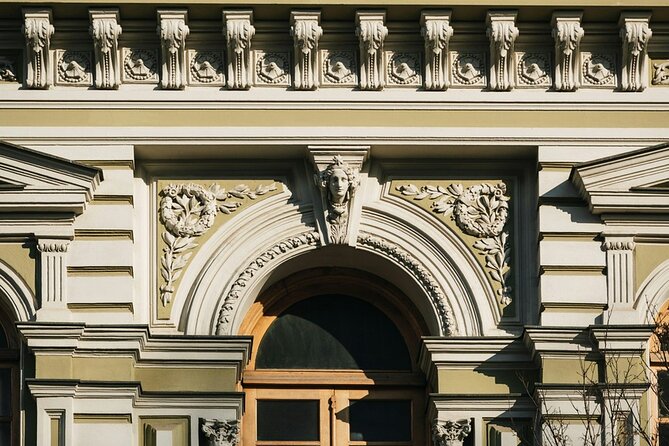
The Vasil Gabashvili House is a sharp change from the grand scale of Rustaveli Avenue. This 19th-century home is known for colorful wooden balconies, delicate carvings, and pale blue tones.
Tbilisi’s balconies are one of the city’s most memorable architectural features. They bring private life out toward the street, adding shade, decoration, and a sense of neighborhood to otherwise formal urban spaces. At the Gabashvili House, the details matter more than size.
The stop lasts about 15 minutes and is free to enter. You will likely spend that time looking at the façade and hearing how the house reflects the character of old Tbilisi. The building is a good reminder that the city’s appeal does not depend only on grand institutions. A single home can reveal just as much about local taste and daily life.
I especially like this part of the route because it gives the walk a more personal feel. After the avenue’s public monuments and theaters, the Gabashvili House brings you close to the decorative traditions of a historic home.
Inside the former palace at the Tbilisi Art Academy

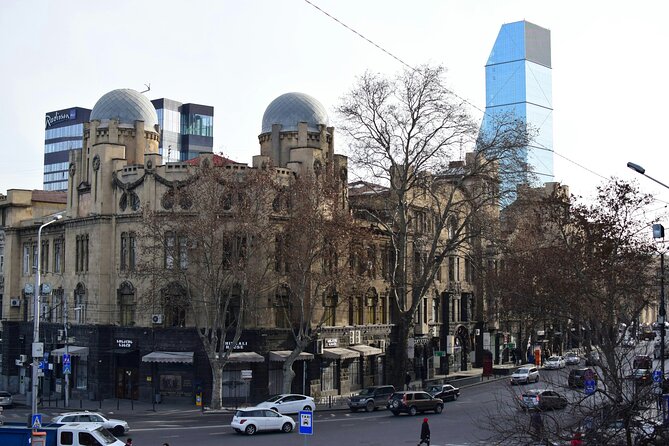
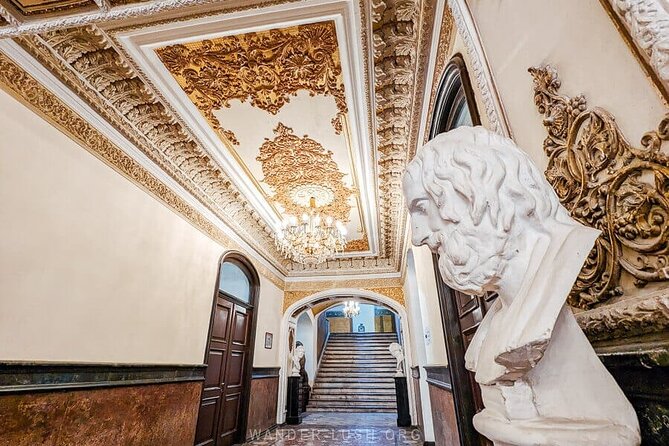
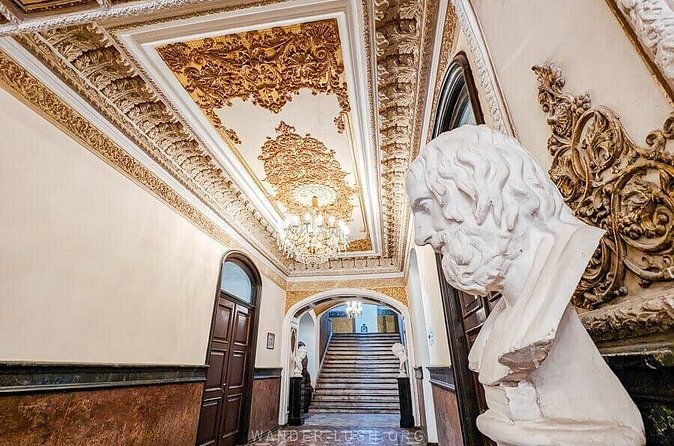
The Tbilisi State Academy of Arts is the route’s most distinctive stop. The building was once a Persian-style palace, and its interiors include intricate details, colorful mosaics, and elegant arches.
This is also the only listed stop with an extra entry cost. Admission is $4.50 per person and is not included in the tour price. That is a small addition, but you should budget for it if you want to see the building properly rather than treating it as an exterior photo stop.
The academy now belongs to the city’s artistic life, with young artists studying and working there. That gives the building a useful contrast. Its older design is not preserved as a frozen museum piece. It continues to house creative work.
You are scheduled for about 20 minutes here, the longest single visit on the route. That makes sense, since the academy has more decorative detail to take in than the other stops. Still, 20 minutes is a short visit if you want to examine every mosaic and arch. If interiors are your main reason for booking, ask Marina at the beginning how the entry works and how much time the group can spend inside.
This stop is also where the tour earns much of its $25 price. A self-guided walk might take you past the academy, but without context you could miss why the building looks different from nearby European-style architecture. The guide helps connect the palace design, the art school, and Tbilisi’s mixture of cultural influences.
Same city, a completely different century:
- Chicago Architecture Center River Cruise aboard First Lady
★ 5.0 · 5,536 reviews - Chicago: Architecture River Cruise Skip-the-Ticket Line
★ 4.8 · 4,325 reviews - Chicago River 45-Minute Architecture Tour from Magnificent Mile
★ 4.5 · 2,924 reviews - Barcelona: Sant Pau Recinte Modernista Entry Ticket
★ 4.6 · 2,567 reviews
The Opera and Ballet Theatre on Rustaveli Avenue

The Tbilisi Opera and Ballet State Theatre brings the route back to a grand public building. Its neoclassical appearance includes columns, ornate details, and the formal scale you expect from a major cultural institution.
The theatre is more than a handsome façade. It represents Georgia’s long connection with performance and European artistic traditions. The building remains part of Tbilisi’s cultural life, so the stop connects architecture with a living institution rather than treating the theatre as a relic.
You have about 15 minutes here, with no admission ticket required for the tour stop. That means you should expect an exterior explanation unless the guide confirms another arrangement. You can use the time to look at the columns and decorative elements, then consider how different the building feels from the warmer wooden balconies at the Gabashvili House.
This contrast is one of the walk’s strengths. Tbilisi does not have one single architectural style. Its streets can shift from ornate homes to formal theaters and then to buildings shaped by other cultural traditions. The tour makes those changes easier to notice.
Ending at the National Library’s modern design
The final listed sight is the National Library of Georgia, described as a modern building where design and atmosphere take center stage. It provides a quiet finish after the stronger decorative character of the earlier stops.
This part of the route looks at Tbilisi’s current direction. The city is not only preserving older buildings. It is also adding contemporary spaces that show a forward-looking side. The library helps complete the walk’s central idea: Tbilisi honors its past while continuing to change.
The stop is scheduled for about 15 minutes and is free. As with the other public buildings, you should not assume that a full interior tour is included unless the guide confirms it. The value here is in seeing how a modern civic building fits into the city’s larger architectural story.
The activity ends back at the meeting point. That return is useful if you have plans later in the day, since you do not need to work out a separate route from the final stop.
What $25 buys you in practical terms
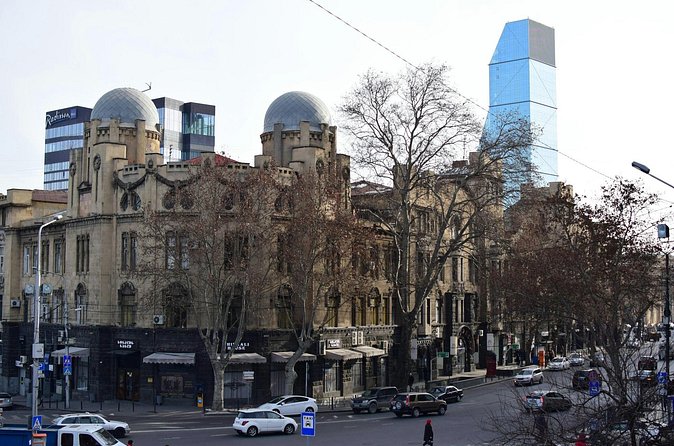
The price is $25 per person, including a professional local guide and an English-language private tour. The academy entry fee is separate, adding $4.50 per person if you visit it.
For a solo visitor, the price is still reasonable for a private three-hour experience, though it costs more per person than a large group walk might. For two or more people, the private format becomes easier to justify because your group gets the guide’s attention throughout.
The value is not based on entrance tickets. Most stops are free, and the main benefit is interpretation. You are paying for the route, the explanations, and the chance to notice buildings that might otherwise blur into the street.
The itinerary lists about 80 minutes at the five stops, while the full experience lasts roughly three hours. The difference likely covers walking, commentary, and time between buildings. You should wear comfortable shoes and leave room for a steady city walk, even though the tour is not described as strenuous.
Who will enjoy this most

This tour suits you if you like cities best when someone points out the details that guidebooks skip. It is especially useful for first-time visitors who want a clear introduction to central Tbilisi before exploring alone.
It also works well for:
- Couples or families who prefer a private activity
- Architecture and design enthusiasts
- Visitors interested in Georgian literature, art, and performance
- People who want an English-language introduction to the city
- Photographers looking for balconies, façades, arches, mosaics, and civic buildings
- Anyone who prefers a focused three-hour walk instead of a full-day tour
You may want something else if your priority is extensive interior access, long museum visits, or a broad tour of Tbilisi’s food and markets. This is an architecture-focused walk, not a general sightseeing tour with lunch included.
The information provided does not set out a specific accessibility route, but it says most people can participate and that the activity is near public transportation. Service animals are allowed. Since the route involves walking between several central buildings, ask before booking if your group needs a particular pace or step-free access.
How the guide shapes the experience
Marina is the guide connected with this route, and her strength is making architecture approachable. You do not need to know the difference between architectural periods before you arrive. The point is to learn by looking.
Her route is self-created rather than a standard march between only the most famous attractions. That matters in Tbilisi, where a colorful residential façade or unusual institutional building may be more revealing than a major monument.
I would use the private setting well. Ask why the Gabashvili House has such prominent balconies, how the Art Academy’s Persian design differs from the Opera Theatre, or what makes the National Library feel modern. Those questions can turn a short stop into a more useful lesson.
The strongest praise attached to the experience centers on Marina’s warm manner, clear explanations, and creative route. That combination is important. A guide can know a great deal and still make a walk feel flat. Here, the focus is on explaining things simply and making the route enjoyable for people who are not experts.
Booking, timing, and cancellation
The tour begins at 9:00 am at 2 Merab Kostava Street in Tbilisi. Confirmation is provided when you book, and the activity is offered in English.
It is a private experience, so only your group participates. That makes it a good fit if you want to avoid a large party or keep the morning flexible. The tour returns to the meeting point, which simplifies the rest of your day.
Free cancellation is available if you cancel at least 24 hours before the start time. Cancellations made less than 24 hours in advance are not refunded, and changes inside that period are not accepted. The cut-off follows local Tbilisi time.
Should you book this architectural walk?
Book it if you want a compact, personal introduction to Tbilisi’s buildings and cultural character. The best reasons are the private format, Marina’s clear and friendly guiding style, and the route’s mix of grand landmarks with less obvious architecture.
Before booking, remember the two practical limits: the Art Academy costs an extra $4.50, and the tour offers a guided look at several buildings rather than long interior visits. If that suits your plans, $25 is a fair price for three hours of context that can improve how you see the rest of Tbilisi.
FAQ
How long does the Tbilisi architectural tour last?
The tour lasts approximately three hours.
What time does the tour start?
The tour starts at 9:00 am.
Where does the tour meet?
Meet at 2 Merab Kostava Street in Tbilisi, near Rustaveli Metro Station.
Where does the tour end?
The activity ends back at the meeting point.
Is the tour private?
Yes. Only your group participates in the activity.
What language is the tour offered in?
The tour is offered in English.
Is the Tbilisi State Academy of Arts entry included?
No. Entry to the academy costs $4.50 per person and is not included.
Is lunch included?
No. Lunch is not included.
Are entrance tickets included at the other stops?
The listed stops at the Shota Rustaveli Statue, Gabashvili House, Opera and Ballet Theatre, and National Library are marked as free. The academy has a separate entry fee.
Can I cancel for a full refund?
Yes, if you cancel at least 24 hours before the experience start time. Cancellations or changes made less than 24 hours in advance are not accepted for a refund.
Just added around the world
- Wilmington History and Architecture Tour★ 4.8 · 18 reviews
- New Orleans : Garden District Architecture Walking tour★ 4.8 · 5 reviews
- Washington, DC: Georgetown Architecture Walking Tour★ 5.0 · 8 reviews
- Washington DC: Dupont Circle & Embassy Row Architecture Tour★ 5.0 · 6 reviews
- Vicenza: discovering the city of Palladio by e-bike★ 5.0 · 4 reviews
- Vicenza: Palladian Architecture Private Walking Tour★ 3.3 · 3 reviews
- Walk & Discover KL’s Architectural and Heritage Gems★ 5.0 · 7 reviews
- Unveiling Brno: History, Culture & Architectural Delights★ 5.0 · 2 reviews
Architecture Tours, compared.



Chicago River: 1.5-Hour Guided Architecture Cruise
Read our review →
Chicago Architecture Center River Cruise aboard First Lady
Read our review →
Chicago: Architecture River Cruise Skip-the-Ticket Line
Read our review →
Chicago River 45-Minute Architecture Tour from Magnificent Mile
Read our review →
Barcelona: Sant Pau Recinte Modernista Entry Ticket
Read our review →