
Review · ROTTERDAM
Rotterdam Walk: Hilights, Gems, Architecture & WWII | 2 or 3hrs
Rotterdam’s story comes into focus on foot: first the city’s museums and harbor views, then the wartime destruction and the daring modern buildings that followed. I like the way this tour connects WWII history with today’s architecture, rather than treating the city as a collection of unrelated sights. I also like the finish inside Markthal, where you can keep exploring, eat, or walk to the cube house show home after the guide leaves.
The main consideration is pace. You cover a lot in two to three hours, with several stops and plenty of explanation. That makes this a smart first look at Rotterdam, but it is not a slow museum visit or a relaxed café stroll. Rain may also affect the outing, since good weather is required.
Key points at a glance

- WWII context throughout: Learn about the invasion, the 1940 bombardment, destruction, and reconstruction while seeing the places connected to that story.
- A strong architecture route: The walk includes Erasmus Bridge, the White House, cube houses, and the Markthal.
- Harbor views without a boat trip: See the Maas, Hotel New York, Steam Ship Rotterdam, and the Shipping Quarter from the river side.
- Guides with a local connection: Yoreh leads many tours, and Elmore has also guided groups. Visual aids help explain how Rotterdam changed.
- Small-group format: The maximum group size is 15, which should make questions and conversation easier.
- Useful first-day choice: The route ends at Markthal, giving you an easy place to eat and continue exploring.
Why Rotterdam makes sense as a walking tour
Rotterdam can feel confusing at first. The center has old harbors, postwar open spaces, daring new buildings, surviving historic structures, and broad roads that do not fit the usual Dutch city picture. A guided walk gives those pieces an order.
This tour is especially strong at showing how the city’s past and present sit side by side. You see the old port district, a historic office tower, a memorial to wartime destruction, and highly experimental housing in one route. The guide explains not only what each building is, but why Rotterdam looks so different from Amsterdam, Delft, or Utrecht.
I would take this tour early in a Rotterdam stay. It helps you decide where to return later, and the guides give practical suggestions for museums, food, and other places around town. Several people found the visual material useful, particularly the old photographs showing how much of the city changed after the bombing.
The route is offered in English and lasts about two to three hours. The exact length can depend on the pace, questions, and group. You should expect continuous walking with short stops, rather than long periods inside buildings.
More architecture walks in the Netherlands:
- Rotterdam: Architectural Highlights Guided Walking Tour
★ 4.8 · 215 reviews - Rotterdam: Highlights, Gems, Architecture & History Walk
★ 5.0 · 191 reviews - Rotterdam Architecture Highlights Walking Tour
★ 5.0 · 66 reviews
Starting at Depot Boijmans Van Beuningen
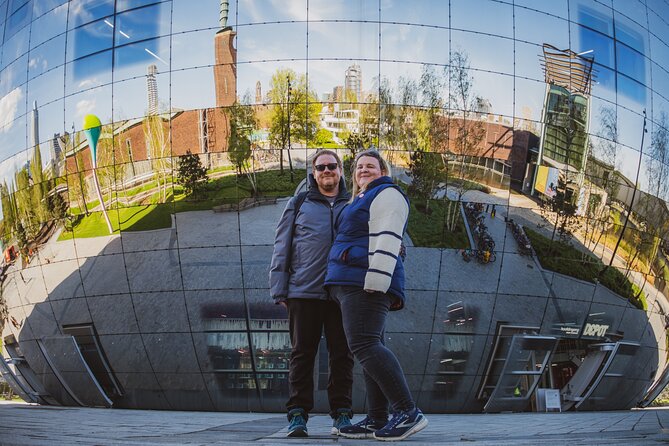
The meeting point is beside Museumpark, near the mirrored Depot Boijmans Van Beuningen. You do not go inside the art depot as part of the tour, and no admission ticket is included or needed for this stop.
Instead, the guide uses the area to explain Rotterdam’s Museum District and the former Land of Hoboken. This is a useful opening because it places the city’s art institutions in their urban setting. The mirrored exterior also gives you an immediate taste of Rotterdam’s habit of treating architecture as public spectacle.
The stop lasts about 15 minutes. Arrive with enough time to find the meeting point at Museumpark 20. The stated meeting location is a Vaimoo shared-bike station near Melkkoppad, so checking the map before you set out is sensible.
The Shipping Quarter and the open Maas view
The walk continues toward Nieuwe Werk and Het Scheepvaartkwartier, also called the Shipping Quarter. This part of the route is a welcome change from the dense modern center. It has a broad, open feel, with the river helping you understand Rotterdam as a working harbor city.
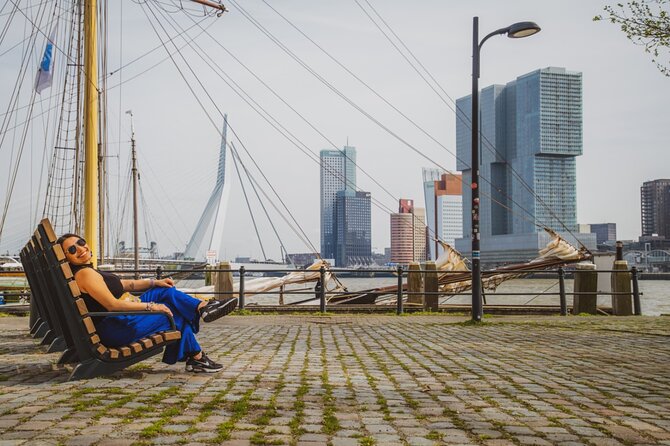
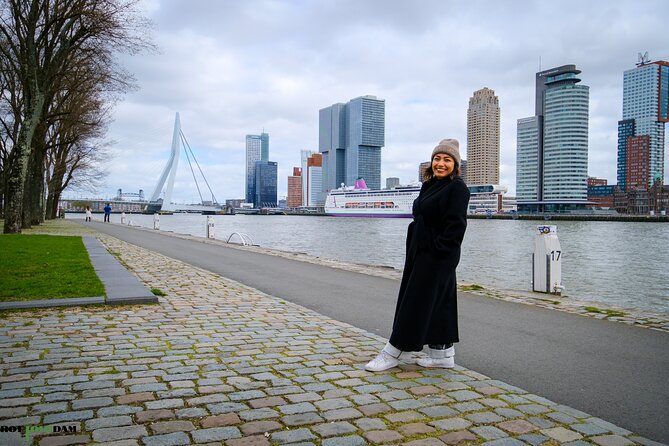
From the Maas side, you can see Hotel New York, the former headquarters of the Holland-America Line, along with the Steam Ship Rotterdam and Erasmus Bridge. The tour does not turn these into isolated photo stops. The guide uses the view to explain the city’s links with shipping, migration, trade, and the river.
This is one of the best sections for photographs, especially if the weather is clear. It is also one reason the tour requires good weather. Wind and rain can make a waterside walk less comfortable, and poor conditions may lead to cancellation, a new date, or a full refund.
Erasmus Bridge and Rotterdam’s wartime turning point
At Erasmus Bridge, the focus shifts from harbor life to the Second World War. The bridge is one of Rotterdam’s clearest modern symbols, linking the northern and southern parts of the city across the Maas. It also provides a useful place to understand the scale of the river and the city’s spread.
The guide covers the invasion of the Netherlands, the bombing of Rotterdam, and the destruction that shaped the postwar city. This is not just a date-filled history lesson. The point is to connect the events to the streets, empty spaces, rebuilt districts, and modern buildings you are seeing around you.
The stop lasts about 20 minutes. You will hear a great deal here, so it is worth asking questions if you want more detail about the war or the rebuilding that followed. Yoreh is often praised for using photographs and other visual aids to show what Rotterdam looked like before and after the destruction. That approach gives the story more weight than a simple spoken timeline.
A few more architecture tours around the Netherlands worth a look
- The rise of Haarlem: Culture, History, Art and Architecture Walking Tour
★ 5.0 · 59 reviews - Rotterdam Must Do Tour: Highlights, History, WW2 and Architecture
★ 5.0 · 20 reviews - Rotterdam: Architecture Highlights Tour including the Depot
★ 4.6 · 17 reviews - Walking Tour about Golden Age Architecture, private local guide
★ 5.0 · 15 reviews
Maritime Museum district and the old boats
The route then reaches the Maritime District near Maritiem Museum Rotterdam. The walk takes place around the outdoor collection of historic boats, including vessels that are more than 100 years old and described as among the last of their kind.
You do not enter the Maritime Museum as part of the tour. Instead, the guide points out the boats and explains how this area preserves a piece of Rotterdam’s port life in the open air. It is a short stop, around 10 minutes, but it adds texture to the larger harbor story.
I like this part because it keeps the tour from becoming only a parade of famous buildings. The boats give you something tangible and close at hand. If you are particularly interested in maritime history, you may want to return to the museum or spend more time around the boats after the walk, though the tour itself does not include museum admission.
The Destroyed City at Square 1940
At Square 1940, you see Ossip Zadkine’s sculpture The Destroyed City. The monument is one of Rotterdam’s most important memorials to the Second World War and the 1940 bombing.
The guide explains the meaning of the work and its place in the city’s memory. This is a quieter stop than Erasmus Bridge, and it gives the wartime story a human and emotional focus. Instead of looking only at the buildings that were lost, you are asked to consider what the destruction meant for the people of Rotterdam and for the city’s identity.
The stop lasts about 10 minutes. I would give this part your full attention. It is easy to rush past public art when you are trying to cover a city, but the sculpture helps explain why Rotterdam’s modern appearance is tied so closely to memory and loss.
Witte Huis and the old harbor
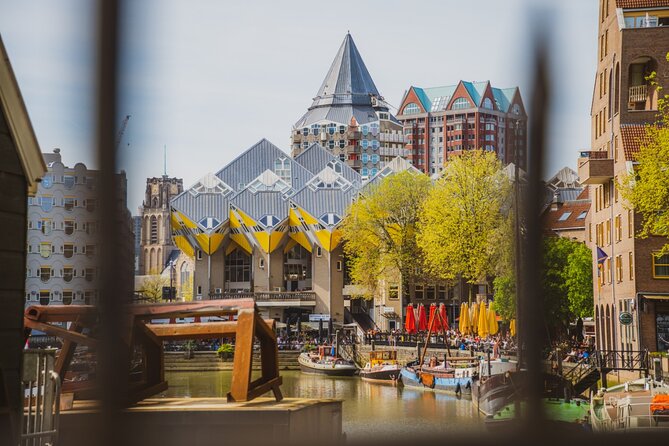
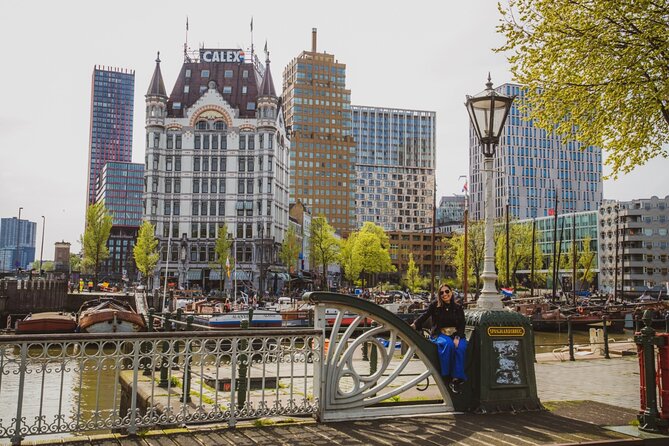
The Witte Huis, or White House, offers a different kind of historical contrast. Built as an office tower, it was once the tallest office building in Europe. Today, it looks modest beside Rotterdam’s newer high-rises, but its place in the city’s architectural story is important.
The guide spends about 15 minutes here. You learn why the building mattered and how it fits into the older port district. This is a good example of the tour’s balance: Rotterdam is not only postwar concrete and futuristic design. It also has surviving older buildings that help show what the city was like before its present form took shape.
From here, the route reaches Oude Haven, one of the oldest harbors in the Netherlands. The old harbor has a cozy, almost intimate feel compared with the wide Maas views earlier in the walk. You get a good view of the cube houses from here before walking closer to them.
The juxtaposition is classic Rotterdam: historic boats and waterfront buildings below, sharply angled yellow cube houses above. I find this one of the most useful places to pause because you can see several eras of the city at once.
Walking through the cube houses
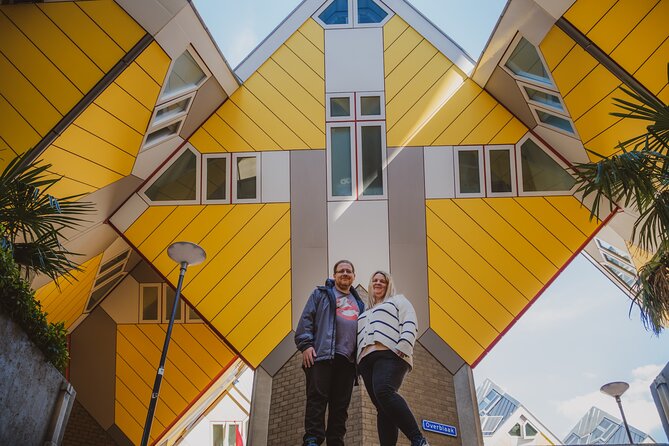
The cube houses on Overblaak are among Rotterdam’s most recognizable sights. Their tilted forms are not easy to understand from a distance, so walking through the street matters. The guide explains the design, the idea behind the unusual angles, and how the group of homes creates what is described as a concrete forest.
The stop takes around 10 minutes. That may sound brief, but the route is designed to explain the concept from outside rather than provide a full architectural tour. You walk beneath and among the structures on the way toward the market square.
The tour does not include entry to the demonstration cube house. After the walk, you can visit that model home on your own. This is worth knowing if you want to see how the interior works, since the outside view alone does not answer the obvious question: how does anyone live in a tilted house?
I like that the guide explains the why and how instead of simply pointing and saying these are the cube houses. The buildings are more interesting once you understand that their strange forms reflect a larger idea about creating an urban village above the street.
Finishing inside Rotterdam’s Markthal
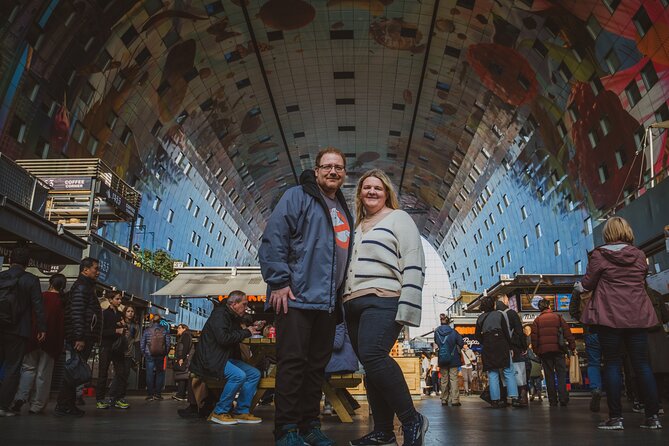
The final stop is Markthal, where the tour ends inside the building. The guide explains the structure, its market function, and the enormous colorful artwork overhead, sometimes compared to a modern Sistine Chapel.
The official stop lasts about 15 minutes, but I would plan extra time afterward. You can browse the food stalls, get a meal, or continue to the cube house show home. Since the walk ends here, Markthal is not merely a quick photo stop. It gives you a practical next step.
This ending also helps balance the heavier wartime material. You finish in a place associated with food, design, and daily city life. Rotterdam’s story moves from destruction to rebuilding, then from rebuilding to experimentation, and Markthal captures that modern confidence.
One practical tip: do not schedule an immediate train, cruise transfer, or fixed appointment right after the tour. The walk can last close to three hours, and you may want time to look around Markthal. One person specifically wished for more time in the city after the tour, which is a good sign that this experience can leave you with a longer list of places to see.
What the guide adds to the route
The guide is central to the experience. Yoreh leads many outings and is described as a Rotterdam native with a strong personal connection to the city. Elmore has also led tours. Since the exact guide may vary, you should not book based on a promise that one particular person will be present unless the booking details confirm it.
The strongest part of the guiding style is the mix of information and energy. Yoreh uses photographs to show the prewar city and the damage caused during the war, then connects those images to the buildings in front of you. That makes the history easier to follow, especially for anyone who does not usually enjoy formal history talks.
The guides also give recommendations for what to do afterward. That matters because the tour covers only the outside of many sights. You may leave wanting to visit the Maritime Museum, enter the cube house, spend longer at Markthal, or explore another museum in the Museum District.
The group maximum is 15 people. That is small enough for questions without making the outing feel like a private tour. If you prefer a silent walk or want to move at your own pace, this format may feel too guided. If you want context and conversation, it is a good fit.
Price, pace, and practical value
The price is $49.60 per person. No admission tickets are included because the main experience is an outdoor walking route, so the value comes from the guide’s interpretation, route planning, visual material, and local recommendations.
I consider that fair for a two to three hour guided walk, particularly if you take it near the start of your visit and use the advice to plan the rest of your time. You are not paying for entry to a major museum or a boat ride, so the value depends on how much you want explanation rather than independent sightseeing.
The tour offers group discounts, though the exact discount is not specified. It is available in English and uses a mobile ticket. The route is near public transportation, and service animals are allowed. Most people can participate, but you should be comfortable walking outdoors for several hours and standing during frequent stops.
Free cancellation is available up to 24 hours before the start time for a full refund. Changes or cancellations inside that window are not accepted for a refund. If poor weather or a failure to reach the minimum number of participants cancels the tour, you are offered another date, another experience, or a full refund.
Who should book this Rotterdam walk?
I would recommend it to a first-time visitor who wants a clear introduction to Rotterdam before choosing which museums and neighborhoods deserve more time. It is also a good choice before a cruise or on a first afternoon in town, when you want to see the main sights without spending the whole day inside.
History fans will appreciate the focus on the 1940 bombing and reconstruction. Architecture fans will enjoy the sharp contrast between the White House, Erasmus Bridge, cube houses, and Markthal. Even if you are not a history enthusiast, the guide’s humor, photographs, and local stories should keep the subject grounded.
You may want something else if you prefer a very slow pace, extensive interior visits, or a tour centered mainly on food. The route includes many highlights, but most stops are short and admission to museums and the show cube house is not included.
Should you book it?
Book this tour if you want Rotterdam to make sense quickly. Its best feature is the connection between wartime destruction and bold rebuilding, supported by a route that covers old harbors, memorials, bridges, boats, and modern architecture.
I would choose it early in your stay, wear comfortable shoes, leave room for weather, and keep time free after the finish at Markthal. Skip it only if you already know Rotterdam well or prefer to explore every sight independently. For a compact introduction led by a local guide, the price is reasonable and the route gives you a strong base for the rest of the city.
FAQ
How long does the Rotterdam walking tour last?
The tour lasts approximately two to three hours. The route includes several short stops, and the total time may depend on the group’s pace and questions.
Where does the tour start?
The meeting point is at the Vaimoo shared-bike station near Melkkoppad, Museumpark 20, 3015 CX Rotterdam, Netherlands.
Where does the tour end?
The tour ends inside Markthal at Verlengde Nieuwstraat, 3011 GX Rotterdam. From there, you can continue exploring Markthal or visit the demonstration cube house independently.
Is the tour offered in English?
Yes. The experience is offered in English.
How many people can join the tour?
The maximum group size is 15 participants.
Can I cancel for a full refund?
Yes. You can cancel at least 24 hours before the start time for a full refund. Cancellations or changes made less than 24 hours before the start time are not accepted for a refund.
Just added around the Netherlands
- Rotterdam Must Do Tour: Highlights, History, WW2 and Architecture★ 5.0 · 20 reviews
- Private Rotterdam Walking Tour – guided by Architects★ 5.0 · 2 reviews
- Rotterdam Architecture and Highlights Walking Tour (TOP RATED)★ 4.5 · 14 reviews
- Escape Room – l’Architecte★ 4.5 · 13 reviews
- Maastricht Highlights, Architecture & Heritage Tour★ 5.0 · 7 reviews
- Gouda Private Walking Tour: History, Architecture & Cheese★ 4.5 · 8 reviews
- Amsterdam Walking Tour. All about History, Architecture, Traditions & Anecdotes.★ 5.0 · 2 reviews
- Walking Tour about Golden Age Architecture, private local guide★ 5.0 · 15 reviews
Walking Tours, compared.
The Official Art Deco Walking Tour by The Miami Design Preservation League
Read our review →
Barcelona: Gothic Quarter Ghosts and Legends Walking Tour
Read our review →
Barcelona: Old Town and Gothic Quarter Walking Tour
Read our review →
Lecce: Baroque Architecture and Underground Walking Tour
Read our review →
Chicago in a Day: Food, History & Architecture Walking Tour
Read our review →

Ramblas, Old Town, Gothic and Gaudi Architecture Walking Tour
Read our review →
Chicago’s Secret Interiors Architectural Walking Tour
Read our review →Browse the lists this tour appears in