
Review · ROTTERDAM
Rotterdam Must Do Tour: Highlights, History, WW2 and Architecture
Rotterdam’s story is written in its buildings. This two-hour walk links the city’s wartime destruction with its daring postwar rebuild, taking you from Rotterdam Centraal to the Markthal, Oude Haven, and the famous Cube Houses. Guides such as Edwin, Susan, Michel, and Stephan bring different voices to the route.
I like the clear focus on architecture and WWII history, rather than a quick parade of sights. I also like the small maximum group of 15, which makes it easier to ask questions and keep up with the guide. The main drawback is time: two hours is enough for an introduction, but not enough for a slow look inside every landmark.
Key points to know before booking
- A compact route with a clear story: You see how Rotterdam moved from medieval roots to wartime ruin and modern design.
- The Cube Houses and Markthal anchor the walk: These are the most visually memorable stops, with time to look around the Markthal.
- WWII shapes the whole experience: The Groot Handelsgebouw and Lijnbaan help explain the city’s postwar rebuilding.
- Small groups matter: The tour accepts no more than 15 people, a useful size for city streets and questions.
- Guides vary: Edwin, Susan, Michel, John, Stephan, and others have led this experience, so the tone may differ from one departure to another.
- Good value at $29.41: You receive about two hours with a local guide, while food, drinks, and indoor admissions are not included.
Why Rotterdam makes a strong walking-tour subject
Rotterdam can confuse first-time visitors. It has a medieval church, a historic harbor, postwar shopping streets, a wooden footbridge, and some of the Netherlands’ most unusual modern buildings. The pieces do not always look as if they belong together.
That is exactly why a guided walk helps. The route gives you a timeline. Rotterdam was heavily bombed during the Second World War, and much of the central shopping district disappeared. The city then made a striking choice: instead of rebuilding every street in the old style, it created a new center with modern buildings, broad pedestrian areas, and bold experiments in design.
You begin at Rotterdam Centraal Station, a fitting place to discuss architecture. The station is the city’s main transport gateway and gives the guide a chance to explain Rotterdam’s modern character before you start walking. From there, the route moves through places that show different stages of the city’s past.
I would choose this tour early in a Rotterdam visit. The walking route helps you understand what you are seeing later, especially if you plan to return to the Markthal, Oude Haven, or Cube Houses on your own.
More history tours in the Netherlands:
- Rotterdam: Highlights, Gems, Architecture & History Walk
★ 5.0 · 191 reviews - The rise of Haarlem: Culture, History, Art and Architecture Walking Tour
★ 5.0 · 59 reviews - Gouda Private Walking Tour: History, Architecture & Cheese
★ 4.5 · 8 reviews
Starting at Centraal Station and the Groot Handelsgebouw
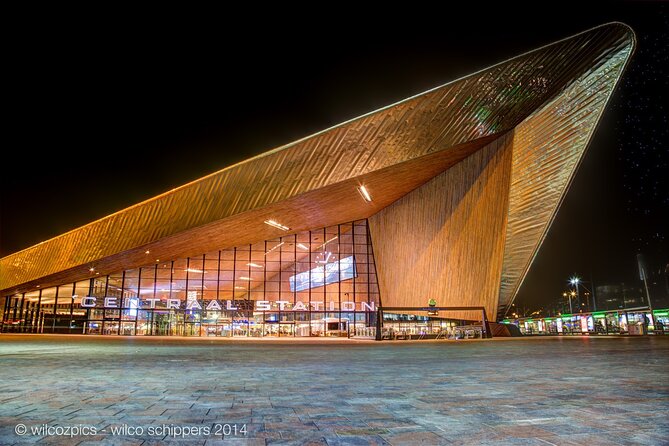
The meeting point is at Stationsplein 10, outside Rotterdam Centraal Station. Your guide introduces the city and sets up the architectural theme here. Since the tour is conducted in English, the opening explanation should be easy for international visitors to follow.
The first major historical stop is the Groot Handelsgebouw. Completed in 1953, it was one of the first large buildings constructed after the bombing. Its importance is not just visual. It represents the practical, optimistic mood of Rotterdam’s reconstruction.
This is a useful place to grasp the scale of the city’s recovery. Rotterdam was not simply repaired one building at a time. It was reshaped as a working port city with new commercial needs and a new urban plan.
The stop is brief, listed at about 10 minutes, so expect an explanation rather than a full architectural inspection. If you want detailed information about the building’s interior or later changes, you may need to explore separately.
West-Kruiskade and the Lijnbaan: rebuilding daily life
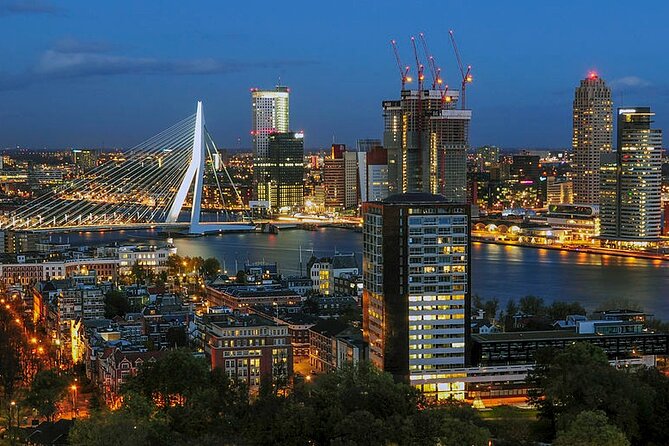
The route then reaches the West-Kruiskade and Kruiskade shopping streets. These areas give you a more ordinary view of central Rotterdam. You are not looking only at famous monuments. You are also seeing streets where shopping and daily city life continued after the war.
The Lijnbaan is especially important. Opened in 1953, it was designed as the main pedestrian shopping street in the rebuilt center. The old shopping district had been destroyed, so the Lijnbaan represented a new kind of urban planning.
I find this part valuable because it explains how reconstruction affected everyday movement. The postwar city was not designed solely for grand buildings. It also created places where people could walk, shop, and meet without heavy traffic dominating the street.
The route does not promise a long shopping break. These stops are short, around 10 minutes each. Treat them as guided orientation, not free time to browse stores.
The Luchtsingel and a forgotten part of Rotterdam
One of the more unusual stops is the Luchtsingel, a 390-meter wooden pedestrian bridge. It connects Rotterdam North with the city center and was created to bring new life to an area that had suffered from vacancy and neglect.
This is a good change of pace after the formal postwar buildings. The bridge shows how Rotterdam continues to experiment with public space. Its long wooden path also gives the city a different feel from the broad streets and shopping areas.
The tour allows about 10 minutes here, so you will not walk the entire length at a leisurely pace unless the group’s timing permits it. Still, the stop adds an important idea: Rotterdam’s building story did not end in 1953. The city keeps trying new ways to reconnect districts and make underused areas useful again.
A few more architecture tours around the Netherlands worth a look
- Rotterdam: Architectural Highlights Guided Walking Tour
★ 4.8 · 215 reviews - Rotterdam Walk: Hilights, Gems, Architecture & WWII | 2 or 3hrs
★ 5.0 · 149 reviews - Rotterdam Architecture Highlights Walking Tour
★ 5.0 · 66 reviews - Rotterdam: Architecture Highlights Tour including the Depot
★ 4.6 · 17 reviews
The Nieuwe Delftse Poort and the city’s lost gates
The Nieuwe Delftse Poort recalls the old entrance to Rotterdam. The original Delftsche Poort was a city gate, with the last version built in 1764. A later steel reconstruction, designed by artist Cor Kraat, was placed close to the original site on the Pompenburg.
This stop helps you picture the older city, much of which is no longer visible in the central streets. Rotterdam is often presented as a modern city, but the gate gives you a reminder that it once had a more traditional European center.
Do not expect a complete medieval structure. The current work is a reconstruction, and the stop is short. Its value comes from the story of what disappeared and how the city chooses to remember it.
Sint-Laurenskerk, the one medieval survivor
The Grote of Sint-Laurenskerk is the most important historic building on the route. It is the only remaining part of medieval Rotterdam, and it survived the wartime destruction that erased much of the surrounding center.
The church is Protestant, and you can enter for free. The itinerary allows around 10 minutes, which may be enough for a quick look inside if the group enters, but not for a full visit.
I would pay close attention here. The church gives the tour emotional balance. After seeing postwar offices, pedestrian streets, and experimental design, you encounter a building tied to Rotterdam’s much older identity.
If you want time to study the interior, check whether the tour schedule allows it and return after the walk if needed. The free entry makes a second visit easy, though opening access can depend on the church’s operation at the time.
Inside the Markthal, Rotterdam’s showpiece
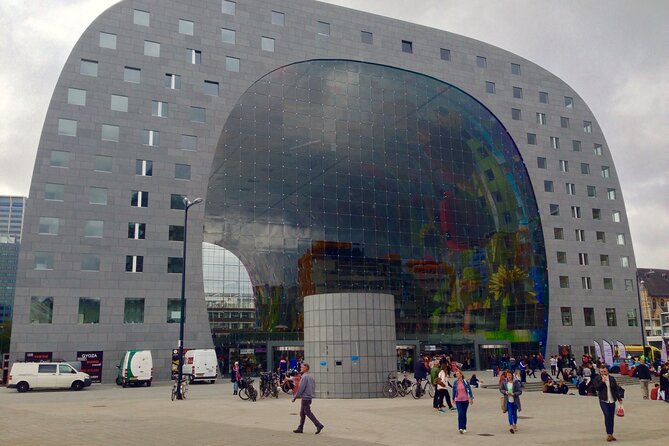
The Markthal is one of the tour’s major stops, with about 30 minutes listed for the area. Designed by MVRDV, it has a large arch-shaped form, often compared to a horseshoe. Its gray natural-stone exterior is only part of the appeal.
Inside, the ceiling artwork fills the arched space with enlarged images of fruits, vegetables, seeds, fish, flowers, and insects. Food stalls and restaurants occupy the market hall, giving you a chance to look, eat, or simply take in the design.
Food and drinks are not included, so budget separately if you want a snack or meal. The stop works well for independent wandering because the Markthal offers more visual detail than a guide can cover in a few minutes.
One practical point: the guide’s time here may focus on the building and its setting, not on a full food tour. If the Markthal is your main reason for booking, plan to return after the walk so you can browse without the group’s schedule in mind.
Oude Haven and the Cube Houses
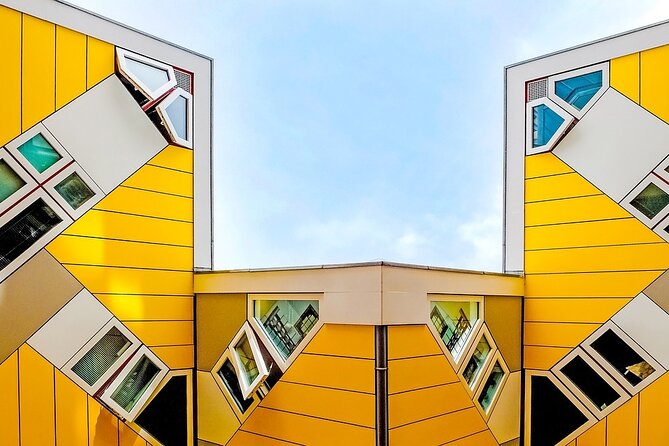
The route ends at the Oude Haven, or Old Harbour, a historic part of central Rotterdam on the north side of the Maas. This is one of the city’s most atmospheric areas, with water, older harbor connections, and the famous Cube Houses nearby.
The Cube Houses are difficult to understand from a quick photograph. Their angled forms challenge the usual idea of a home as a simple box, and the best part of seeing them with a guide is hearing how they fit into Rotterdam’s larger design story.
The Old Harbour also gives the walk a useful contrast. You move from a modern market hall to a historic harbor setting, then to architecture that looks almost playful. Rotterdam’s appeal is not one single style. It is the conversation between old remnants, practical rebuilding, and bold new design.
The stop is listed at about 20 minutes. That is enough to see the main area and get an introduction, but you may want extra time for photographs or to visit a Cube House if access is available separately.
How the guide can shape the experience
This is a guide-led tour, and the person leading it matters. Past departures have featured guides named Edwin, Susan, Michel, John, Stephan, Ed, and others. Their strengths appear to differ slightly, but the best feedback consistently centers on clear explanations, personal stories, and affection for Rotterdam.
Edwin has been praised for explaining the city’s reconstruction after WWII and connecting it with sculpture and architecture. Susan has been described as especially helpful with both buildings and shopping suggestions. Michel’s style has been noted as informative and easy to follow, while John has been praised for showing pride in his city.
The experience may therefore feel more conversational than scripted. That is good if you like asking questions. It also means the exact balance between architecture, shopping streets, and wartime history may vary by guide.
One useful detail is the small-group limit of 15. That is large enough to keep the price down, yet small enough for a guide to respond to questions. A late-arriving participant once received help arranging a faster meeting connection after a delayed ship arrival, but you should not count on special transport assistance. Plan to reach the station meeting point on time.
Price, pace, and who gets the best value
At $29.41 per person, this is a fair price for a two-hour guided introduction, especially if Rotterdam is new to you. You are paying for local interpretation, not admissions or a meal. Since the main sights are viewed from public spaces, there are no major entrance costs built into the price.
The value is strongest if you want context. A free self-guided walk can take you to the Cube Houses and Markthal, but it may not explain why the Lijnbaan matters, how the Groot Handelsgebouw fits into reconstruction, or why the Sint-Laurenskerk is so significant.
The pace is brisk. The tour covers many stops, and several are allotted only 10 minutes. I would recommend comfortable walking shoes and a willingness to keep moving. The route is not designed for long shopping breaks or extended time inside the church.
The tour suits first-time visitors, architecture fans, history-minded visitors, and anyone with only part of a day in Rotterdam. It also works well for people arriving by train because the walk starts at Centraal Station.
It may be less suitable if you want a slow food crawl, a museum visit, or a detailed interior tour of each building. One three-star experience found the explanations at some places too limited, particularly around the Markthal. That is a fair caution: the route is broad, so no single stop receives a full lecture.
Booking details worth keeping in mind
The tour is offered in English and accepts mobile tickets. Group discounts are available, and the maximum group size is 15. Most people can take part, and service animals are allowed.
The tour ends back at the meeting point, so allow time afterward if you have a train, cruise departure, or timed attraction. A two-hour duration is approximate, and the route’s many stops mean you should avoid scheduling something immediately afterward.
You can cancel for a full refund up to 24 hours before the start time. Changes or cancellations made inside that period are not accepted for a refund. The tour also requires a minimum number of participants, so a cancellation for that reason results in an alternative date, another experience, or a full refund.
Should you book this Rotterdam walk?
Book it if you want a well-priced introduction to Rotterdam’s architecture and wartime rebuilding. The route covers the city’s essential visual contrasts, from the medieval Sint-Laurenskerk to the Markthal and Cube Houses, while the guide explains why the modern center looks so different from older Dutch cities.
I would book it near the start of your stay, then revisit the Markthal, Oude Haven, or church at your own pace. If you have only two hours in Rotterdam, this tour gives you a useful framework. If you already know the city and want long stops, museum interiors, or a food-focused outing, choose a slower experience instead.
FAQ
How long does the Rotterdam Must Do Tour last?
The tour lasts approximately two hours.
Where does the tour begin?
It begins at Stationsplein 10, 3013 AJ Rotterdam, Netherlands, at Rotterdam Centraal Station.
Where does the tour end?
The activity ends back at the meeting point.
What language is the tour offered in?
The tour is offered in English.
What landmarks are included?
The route includes Rotterdam Centraal Station, Groot Handelsgebouw, West-Kruiskade, Lijnbaan, Luchtsingel, Nieuwe Delftse Poort, Sint-Laurenskerk, Markthal, Oude Haven, and the Cube Houses.
Is the Markthal included?
Yes. The tour visits the Markthal and allows approximately 30 minutes there. Food and drinks are not included.
How large is the group?
The tour has a maximum of 15 participants.
Is the tour accessible by public transportation?
Yes. The meeting point is at Rotterdam Centraal Station, and the experience is near public transportation.
What is the cancellation policy?
You can cancel up to 24 hours before the start time for a full refund. Cancellations or changes made less than 24 hours before the start time are not refunded.
Just added around the Netherlands
- Private Rotterdam Walking Tour – guided by Architects★ 5.0 · 2 reviews
- Rotterdam Architecture and Highlights Walking Tour (TOP RATED)★ 4.5 · 14 reviews
- Escape Room – l’Architecte★ 4.5 · 13 reviews
- Maastricht Highlights, Architecture & Heritage Tour★ 5.0 · 7 reviews
- Gouda Private Walking Tour: History, Architecture & Cheese★ 4.5 · 8 reviews
- Amsterdam Walking Tour. All about History, Architecture, Traditions & Anecdotes.★ 5.0 · 2 reviews
- Walking Tour about Golden Age Architecture, private local guide★ 5.0 · 15 reviews
- Amsterdam Architecture Tour★ 5.0 · 4 reviews
Historical Tours, compared.
Chicago in a Day: Food, History & Architecture Walking Tour
Read our review →
Kuala Lumpur: Batu Caves & Historic Buildings Tour
Read our review →
Charleston’s Best Highlights: History, Culture & Architecture
Read our review →
Palm Springs Modernism Architecture & History Bike Tour
Read our review →
Charleston: History and Architecture Guided Walking Tour
Read our review →
Historic Georgetown: History, Gossip, & Architecture Walking Tour
Read our review →
Charleston History, Homes, and Architecture Guided Walking Tour
Read our review →
Browse the lists this tour appears in