
Review · PRAGUE
Prague Renaissance & Baroque Gardens Walking Tour
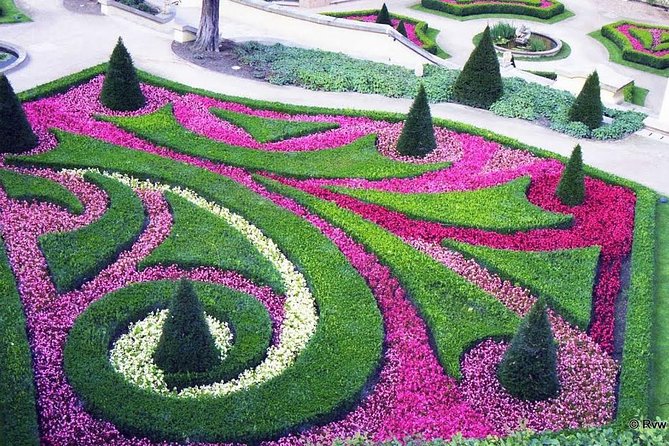
Prague’s gardens tell a quieter story than its castles and churches. On this three-hour walk, you move from the Royal Garden at Prague Castle to Wallenstein’s theatrical statues and fountains, then finish in the small, steeply terraced Vrtba Garden. The focus is not just flowers. It is power, mythology, architecture, and the people who designed these spaces to impress.
I like the small group, capped at eight, and the way the route links several gardens that are easy to miss on your own. I also like the guides’ art-history angle. Bonita and Vadim explain why Greek and Roman gods appear in garden sculpture and how those images served political purposes. The main consideration is cost: at $126.03, this is a premium walking tour, and Vrtba Garden admission is extra. Steep stairs in Vrtba may also trouble anyone with limited mobility.
Key details before you book
- The route uses Prague’s number 22 tram: You ride together from Malostranska Metro station toward the castle gardens, adding a useful slice of local transport to the outing.
- Vrtba Garden finishes the tour: This 1720 Baroque garden offers some of the best views of Prague and Prague Castle, but its upper terraces require steep stair climbing.
- Wallenstein Garden mixes art and politics: Look for the artificial grotto, aviary, mythological statues, and fountain by Adrian de Vries.
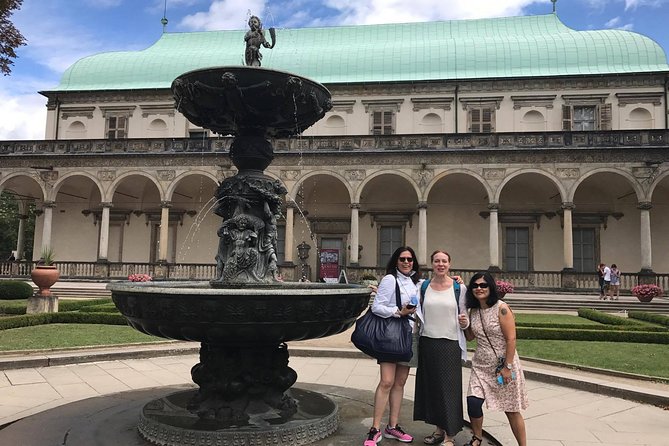
- Queen Anne’s Summer Palace is a Renaissance highlight: Its arcades and sculpted frieze make it one of the route’s finest architectural stops.
- Two departure times are offered: You can choose a 10 a.m. or 2 p.m. start, depending on how you plan your day.
- Extra admission fees need attention: Vrtba Garden costs CZK 130 for adults or CZK 100 for students and seniors. The listed Prague Castle garden fee is CZK 90 for adults or CZK 60 for students and seniors.
Why Prague’s gardens deserve three hours
Prague is famous for its Old Town lanes, Charles Bridge, and castle interiors. Its gardens are easier to overlook, partly because many sit behind palace walls or below the main tourist paths. That is exactly what makes this walk useful.
You are not simply passing through planted spaces. You are seeing how rulers and nobles used gardens as outdoor theaters. Statues represented military strength or classical virtue. Fountains created movement and sound. Exotic plants showed wealth and far-reaching connections. A guide gives these details a place in the larger story, so a row of sculptures becomes something to read rather than just something to photograph.
The tour lasts about three hours and is offered in English. A maximum of eight people keeps the group small enough for questions and conversation. That matters here because the best parts of the walk are often small: a myth hidden in a sculpture, a detail on a palace frieze, or a story about a plant that arrived in Central Europe from far away.
The tour begins at Bagel Lounge Malostranská, near Malostranska Metro station. From there, the group takes tram 22 together to the castle gardens. The tram ride is practical, not a sightseeing cruise, but it helps you get from the Lesser Town to the first garden without arranging your own route.
More Baroque architecture tours in Prague:
- Beer & Baroque: A Highbrow Brew Tour
★ 5.0 · 45 reviews - Beer & Baroque: A Private Highbrow Brew Tour
★ 5.0 · 33 reviews - Private Prague Renaissance & Baroque Gardens Walking Tour
★ 5.0 · 8 reviews
The Royal Garden and Queen Anne’s Summer Palace
The Royal Garden began on the site of medieval vineyards in the 1500s. It was developed as a Renaissance garden for the Prague Castle complex and became known for unusual botanical specimens and plants from distant countries.
That plant story gives the first part of the walk more depth. Garden design in this period was not only about beauty. Rare plants showed that a court had money, contacts, and curiosity. The gardens were places for display, study, and leisure, all wrapped into one.
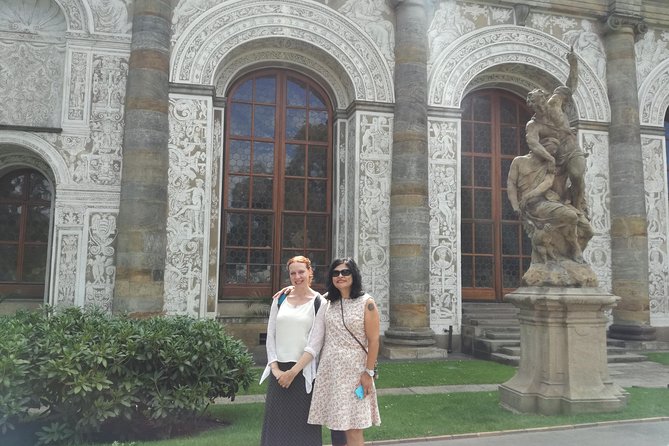
The most important building here is Queen Anne’s Summer Palace, also called the Belvedere. Completed in the middle of the 16th century, it is often described as one of the purest examples of Renaissance architecture outside Italy. You get only about five minutes at this stop, so this is mainly an exterior viewing and explanation rather than a palace visit.
Look up at the ornamental frieze and the arcades. The Tuscan capitals on the columns are carefully decorated, while the reliefs show scenes of mythology, hunting, and war. One detail ties the building to its royal patrons: Ferdinand I appears wearing the Order of the Golden Fleece and offering Queen Anna a fig-tree blossom.
The tour also visits the Fig House and Orangery. This is linked to some of the earliest cultivation of figs, almonds, oranges, and lemons in Central Europe. You will also hear about the arrival of tulips in Prague. These details make the garden feel connected to trade and science, not just court ceremony.
The Royal Garden is a strong opening because it combines plants, architecture, and royal ambition. The drawback is timing. The formal stops are short, so you will not have long to linger at every building or take photographs at your own pace.
The Ball Game Hall above the Stag Moat
The Ball Game Hall is another brief stop, lasting about five minutes. Built in the middle of the 16th century on the south side of the Royal Garden, it sits above the Stag Moat and was originally designed for ball games.
Its later uses included a riding school and stables. That change of purpose helps you see how castle buildings adapt over time. It is a compact stop, but the location gives the guide a chance to explain the working side of royal life, beyond the formal palace rooms and parade spaces.
If your main interest is architecture, this building deserves a closer look. If you prefer gardens and sculpture, you may find the short visit enough. The route keeps moving, which is sensible during a three-hour tour, but it also means you should not expect a full architectural study of every structure.
Wallenstein Garden’s statues, grotto, and peacocks

Wallenstein Garden brings a different mood. Built in the 1600s for Wallenstein Palace, it is now open to the public as the garden of the Czech Senate. The design has an Italian influence, with formal spaces, sculpture, water, and architectural drama.
The garden’s most memorable feature is its sculptural gallery of mythological heroes. Adrian de Vries created the fountain, and the statues turn classical mythology into a visual language of power. This is where a strong guide adds real value. The question is not just who each figure represents. It is why a 17th-century patron wanted that figure placed there.
You will also see an artificial grotto and an aviary. Peacocks may add a flash of color as you walk through, though they are living residents rather than a guaranteed part of the experience. The mix of stone, water, plants, and myth makes this one of the tour’s most visually varied stops.
Wallenstein Garden is allotted about 25 minutes. That is enough to understand its design and hear the key stories, but not enough for a slow private stroll. If you want to sit by the fountain or photograph every statue, plan to return on your own later.
This garden can be peaceful even when central Prague feels crowded. That quiet pause is one of the tour’s practical benefits. You get a break from streets and tour buses without leaving the center of the city.
More architecture walks in Prague:
- Prague Art Nouveau and Cubism Walking Tour
★ 5.0 · 77 reviews - Private Prague Art Nouveau and Cubism Walking Tour
★ 5.0 · 30 reviews - Prague Art Nouveau and Cubism Walking Tour
★ 5.0 · 29 reviews - Prague: Private Cubism & Art Nouveau Walking Tour
★ 5.0 · 15 reviews
Vrtba Garden and its steep upper terraces
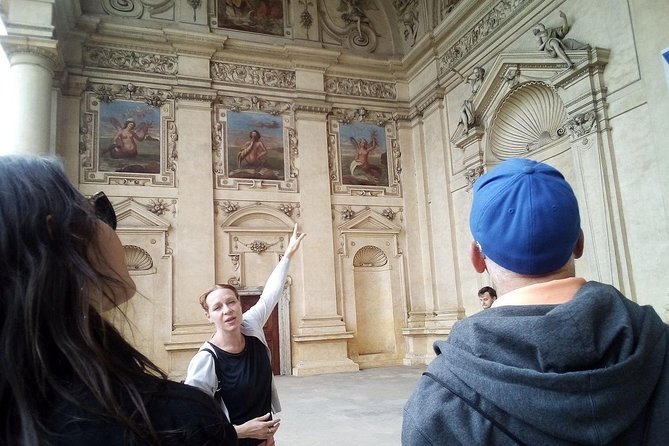
Vrtba Garden, also written Vrtbovská Garden, is the final stop and the tour’s most intimate setting. It is a walled Baroque garden dating from 1720, with sculptural decoration and terraces rising up the slope.
The layout is compact but dramatic. As you climb, the view opens toward Prague and Prague Castle. The upper terrace is the main reward, but reaching it requires steep stairs. If climbing is difficult, you can wait on the second terrace while the group continues. The guide can return after about 10 minutes.
The garden visit lasts about 25 minutes. That gives you time to examine the statues, understand the garden’s symbolism, and enjoy the city view. It is not a large park where you can wander for hours. Think of it as a carefully staged Baroque composition, built around movement upward and the changing view.
Vrtba admission is not included. The stated price is CZK 130 for an individual ticket and CZK 100 for students and seniors. That is a small extra charge compared with the tour price, but it should be included in your budget.
The supplied tour details contain two different end-point descriptions. The route description says the guide leaves you at Vrtba Garden, while the meeting information says the activity ends back at the meeting point. Confirm the final arrangement when you book, especially if you have a timed reservation afterward.
What the guide adds to the gardens
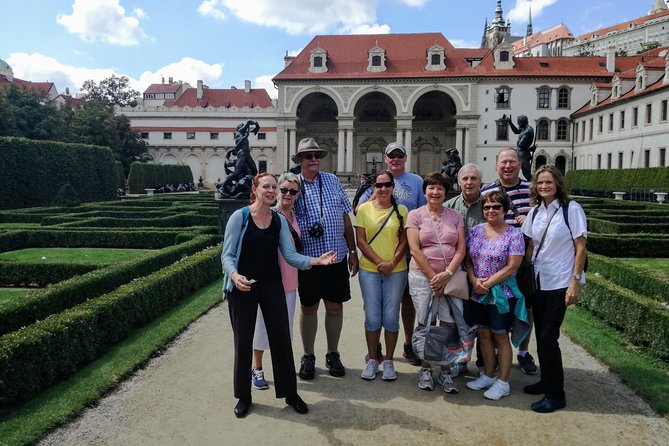
The strongest part of this experience is the explanation behind the visual details. A casual walk can show you statues, fountains, and palace walls. A guide helps you see how these features worked together.
Bonita is identified as one of the guides, and the tour information also mentions Vadim. Bonita’s approach is described as especially strong on Greek and Roman mythology, art, and storytelling. That suits this route because the gardens are full of figures whose meanings are not always obvious.
You may hear how classical gods and heroes were selected to support modern political messages. A statue was rarely placed only because it looked handsome. The myth could suggest courage, wisdom, military strength, fertility, or divine approval. Once you know that, the gardens become easier to read.
The small group also helps with questions. If you already know Prague well, you can ask about details you have passed before without understanding. The experience is not designed as a quick list of dates. It suits people who want to ask why a building or sculpture was made, and what it meant to its original audience.
Price, timing, and physical effort
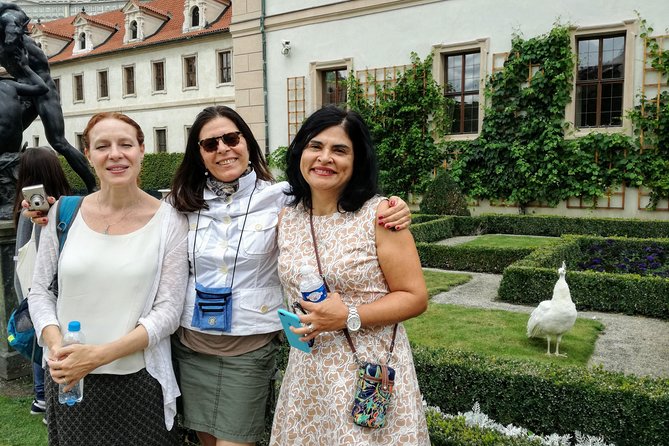
At $126.03 per person, this is expensive for a three-hour walking tour. The price is easier to justify if you value a specialist guide and would otherwise miss the gardens or fail to understand their art. It is less attractive if you mainly want a quiet walk and photographs, since you can visit some of these spaces independently.
The group limit of eight is important to the value. You are not paying for a large bus tour with a guide speaking over a crowd. You get a more personal format, with room for questions and some adjustment to the group’s interests.
You can select a 10 a.m. or 2 p.m. departure. The morning option leaves more time for other castle sights afterward. The afternoon option works well if you want to begin with Old Town or take a slower morning.
The stated admission information needs careful reading. Garden admission is included except for Vrtba in the highlights, but the separate cost section also lists a Prague Castle garden fee of CZK 90 for adults or CZK 60 for students and seniors. Budget for those amounts unless the operator confirms they are covered for your departure.
Wear shoes suitable for walking and stairs. The tour calls for moderate physical fitness, and Vrtba’s upper terraces are the clearest challenge. If you cannot climb them, the group can accommodate a wait on the second terrace, but the best view will be above you.
Who will enjoy this tour most
I would choose this walk if you have already seen Prague’s headline sights and want a different way to understand the city. It is also a good first-day option for visitors who like architecture, sculpture, gardens, and historical storytelling in equal measure.
It suits:
- People interested in Renaissance and Baroque design
- Garden lovers who want more than plant names
- Art fans curious about mythological sculpture
- Repeat visitors looking for places beyond the standard route
- Locals who enjoy seeing familiar Prague from a new angle
- Anyone comfortable walking for three hours and climbing stairs
I would skip it if your priority is a relaxed, self-guided garden visit. The schedule keeps you moving, and the guide’s detailed explanations are central to the experience. You should also think twice if you need guaranteed step-free access through every section.
Free cancellation is available if you cancel at least 24 hours before the start time. Changes made within 24 hours are not accepted, and the amount paid is not refunded for a late cancellation.
Should you book the Prague garden walk?
Book it if you want to understand what Prague’s gardens are saying. The route gives you royal plants, Renaissance architecture, Baroque sculpture, fountains, palace politics, and several fine views in one compact outing.
The best reason to go is the interpretation. Bonita and Vadim bring attention to details that are easy to pass without context, especially the mythological figures and their political meaning. The second-best reason is the group size, which keeps the walk personal.
Do not book it simply because you want the cheapest way into a garden. The price is high, Vrtba costs extra, and the route includes steep stairs. But if you enjoy art, history, and thoughtful guiding, this is a smart way to spend three hours in Prague.
FAQ
How long does the tour last?
The tour lasts approximately three hours.
Where does the tour begin?
It begins at Bagel Lounge Malostranská, at Letenská 118/1, near Malostranska Metro station in Prague’s Lesser Town.
What language is the tour offered in?
The tour is offered in English.
How large is the group?
The group has a maximum of eight travelers.
Are garden admission fees included?
The tour information states that garden admission is included except for Vrtbovská Garden. It also lists a Prague Castle garden fee of CZK 90 for individuals and CZK 60 for students and seniors, so confirm the exact inclusions when booking.
How much does Vrtbovská Garden cost?
Admission is listed as CZK 130 for individuals and CZK 100 for students and seniors.
Is the tour suitable for people who have trouble climbing stairs?
The tour requires moderate physical fitness and includes steep stairs in Vrtba Garden. If you have difficulty climbing, you can wait on the second terrace while the group visits the upper terrace.
Just added around Prague
- Private Prague Art Nouveau and Cubism Walking Tour★ 5.0 · 8 reviews
- Best of Prague Architecture – private tour with PERSONAL PRAGUE GUIDE★ 5.0 · 21 reviews
- Private Prague Renaissance & Baroque Gardens Walking Tour★ 5.0 · 8 reviews
- Prague: Private Prague Art Nouveau and Cubism Tour★ 4.8 · 6 reviews
- Prague Renaissance and Baroque Gardens Walking Tour★ 5.0 · 5 reviews
- Prague: Private Cubism & Art Nouveau Walking Tour★ 5.0 · 15 reviews
- Prague Art Nouveau Tour★ 4.9 · 12 reviews
- Prague: Modern Architecture and Design Guided Tour★ 3.9 · 20 reviews
Baroque Architecture Tours, compared.
Lecce: Baroque Architecture and Underground Walking Tour
Read our review →
Train Exp. through the Alps (Royal Baroque Route from Nice)
Read our review →
Dresden: Tour of the Baroque Quarter with a Night Watchman
Read our review →
Interpreti Veneziani Ensemble Baroque Concert in Venice Ticket
Read our review →
Borghese Gallery Max 6 People Tour: Baroque & Renaissance in Rome
Read our review →
Concert at the Palais Schönborn-Batthyány by the Vienna Baroque Orchestra
Read our review →
Guided Walking Tour of Rome: Top Sights & Baroque Treasures
Read our review →
Noto, Modica and Ragusa: The Baroque Tour from Catania
Read our review →Browse the lists this tour appears in