
Review · THE NETHERLANDS
Amsterdam, Eastern Docklands Architecture: Private Tour
Amsterdam’s Eastern Docklands is a remarkable urban experiment: an old working harbor turned into a residential district where bold modern buildings sit beside traces of Amsterdam’s industrial past. The tour’s real appeal is that you do not just look at unusual buildings. You learn why five separate districts were planned in such different ways.
I like the private format, which lets your guide adjust the pace and answer your questions. I also like the contrast between Java and KNSM, and the clever low-rise density of Borneo and Sporenburg. The main consideration is simple: this is an architecture and planning walk, not a general sightseeing tour, so it will suit you best if you enjoy understanding how a city is built.
Key points at a glance
- Five very different districts: Walk through Java, KNSM, Borneo, Sporenburg, and Riet Landen in one focused tour.
- Java and KNSM compared: See how two islands based on a related historical idea produced very different architectural results.
- Low-rise housing at high density: Learn how Borneo and Sporenburg fit single-family homes into a density usually associated with apartment blocks.
- Riet Landen’s unusual junction: Examine the meeting point of a traffic route, residential buildings, and a large park.
- Academic guides: Your guide has a background in architecture, sociology, art history, or a related field.
- Good group value: The $235 price covers a private group of up to 10 people, making the per-person cost much lower for a full group.
Why Amsterdam’s Eastern Docklands makes a good architecture walk
Amsterdam’s Eastern Docklands changed sharply from the 1970s onward. What had been a modest harbor area developed into a large residential district, with much of the major planning work taking place during the 1980s and 1990s and continuing into the new millennium.
That timing matters. You are seeing a concentrated record of modern urban planning rather than a single style repeated across one neighborhood. Architects and planners had to work with former port islands, old industrial uses, waterways, bridges, heavy traffic routes, and the need for new homes.
The result is an area where the setting is part of the lesson. The architecture is modern, but the harbor layout gives it a strong sense of place. The walk helps you read the district as a series of planning decisions rather than as a collection of eye-catching façades.
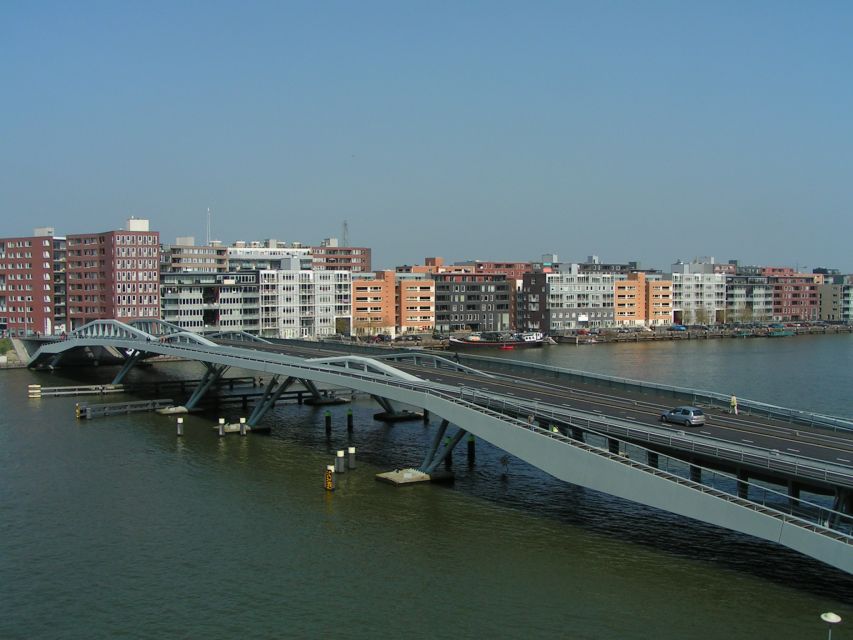
You meet in front of Pakhuis De Zwijger, next to Jan Schaeferbrug. From there, the guide introduces the former harbor and sets up the questions that shape the walk: How can a waterfront district feel urban without becoming a wall of tall apartment blocks? How can public space, housing, and traffic share a tight area? How much should new buildings reflect the past?
Those questions make the tour useful even if you are not an architecture specialist. Your guide explains the choices in practical terms, linking what you see to the way people live in the district.
More private architecture tours in the Netherlands:
- Walking Tour about Golden Age Architecture, private local guide
★ 5.0 · 15 reviews - Gouda Private Walking Tour: History, Architecture & Cheese
★ 4.5 · 8 reviews - Private Rotterdam Walking Tour – guided by Architects
★ 5.0 · 2 reviews
Java and KNSM, two islands with one starting point
Java and KNSM are one of the strongest parts of the route because they allow a direct comparison. Both islands were shaped by a shared concept inspired by Amsterdam’s past, yet they ended up looking and feeling very different.
That contrast gives the tour a clear rhythm. Instead of hearing a long general talk about urban design, you can look at one island, then compare it with the other. Your guide points out how the same broad idea can lead to different building forms, streets, open spaces, and relationships with the water.
Java is especially useful for seeing how historical references can be adapted for modern housing. KNSM provides the counterpoint. The two places are linked by a common starting point, but the completed districts are not mirror images.
I like this part because it turns architectural criticism into something you can test with your own eyes. You do not need to remember technical terms. Notice the scale of the buildings, the shape of the public spaces, and how the housing relates to the waterfront. Then ask yourself which island feels more successful and why.
The guide’s job here is not simply to name architects or buildings. The stated focus is Amsterdam’s development as a city, so you get help connecting design with broader planning goals. Guides have academic backgrounds in architecture, sociology, art history, and related subjects. Two have also published a book on the Eastern Docklands, which suggests that the discussion can go well beyond surface-level sightseeing.
Borneo and Sporenburg, small houses with city-level density
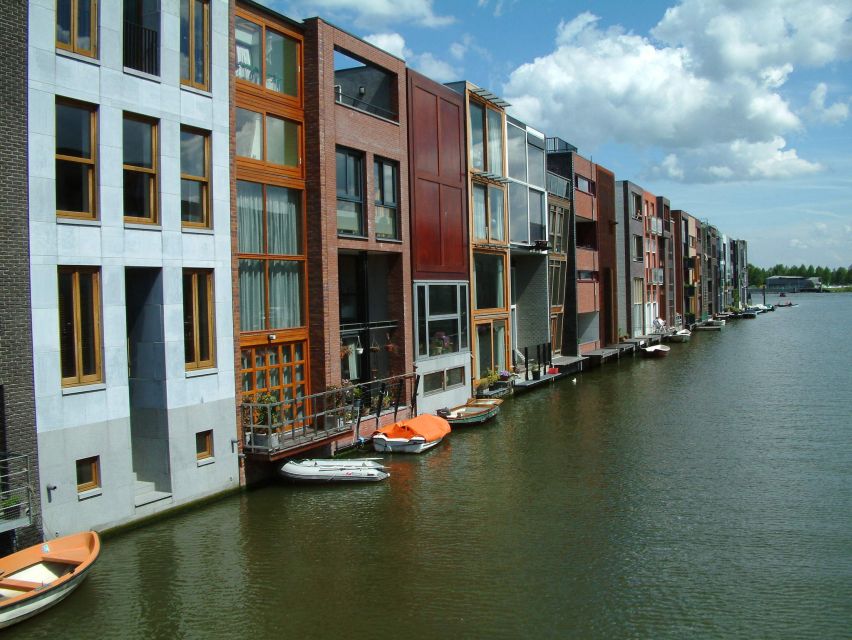
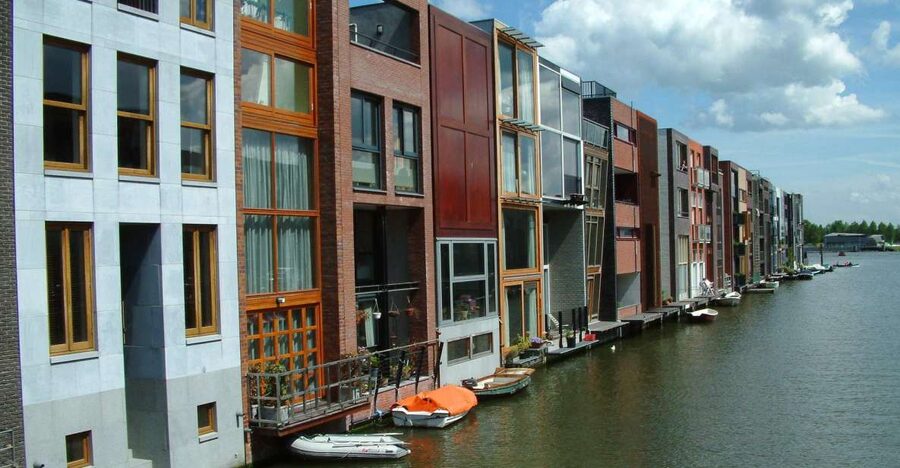
Borneo and Sporenburg address one of the hardest problems in urban housing: how do you provide single-family homes without spreading the city too far outward?
These districts fit low-rise homes into a density of about 100 apartments per acre, a level more often linked with multi-storey apartment complexes. That is the planning idea worth watching for. The achievement is not simply that the houses are low. It is that the area remains compact while offering a different kind of home.
As you walk, your guide explains how this housing model works within the larger district. The point is not that low-rise housing is always better than apartments. The point is that planners found another way to use a limited waterfront site.
This stop is valuable if you are interested in the everyday side of architecture. You can think about privacy, streets, building height, and the use of land rather than focusing only on unusual shapes. Borneo and Sporenburg also give the tour a useful balance. Java and KNSM encourage comparison between large island developments, while these districts show how a dense neighborhood can be made from smaller residential units.
Do not expect a museum-style presentation with interiors or formal exhibits. This is an outdoor walking tour, and the buildings are the material. The guide’s explanations help you notice details that could otherwise pass quickly, especially the relationship between the individual homes and the overall density.
Riet Landen, where housing meets a traffic junction
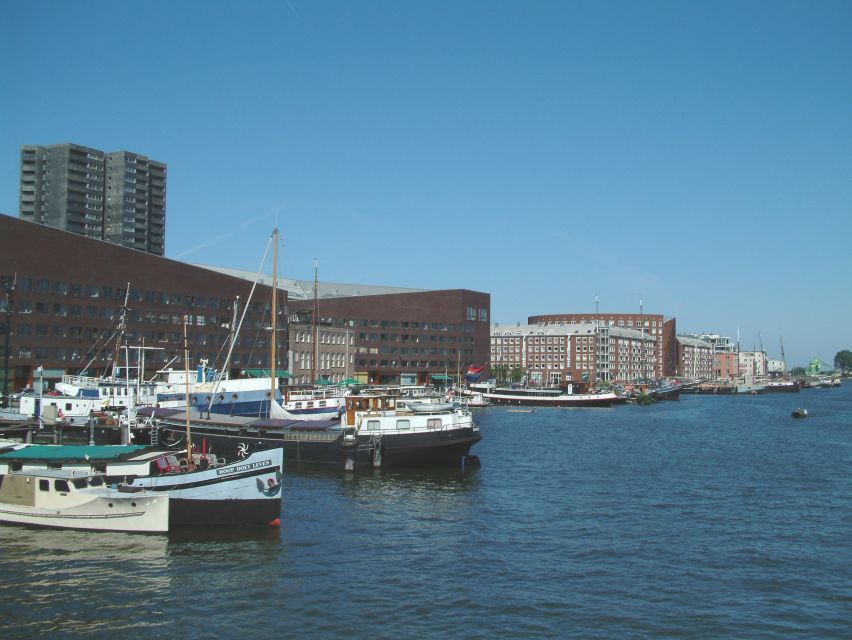
Riet Landen provides the tour’s most striking planning problem. Here, a traffic junction sits at the heart of a residential area and is wrapped by a notable park.
That combination could easily produce a harsh or divided place. Instead, the district offers a chance to see how planners dealt with movement, open space, and homes in one compact setting. Your guide explains how the traffic junction is tied to the park and the surrounding residential development.
This stop is less about one famous building and more about the way several uses are arranged together. You look at the relationship between roads and public space, and at how a park can shape the identity of a neighborhood even when major traffic routes are nearby.
Riet Landen is also a good reminder that city planning is often about compromise. Every attractive public space has to work with practical needs, and every residential district has to handle access and movement. If you enjoy seeing how a city solves awkward problems, this is likely to be one of the most memorable sections.
A few more architecture tours around the Netherlands worth a look
- Rotterdam: Architectural Highlights Guided Walking Tour
★ 4.8 · 215 reviews - Rotterdam: Highlights, Gems, Architecture & History Walk
★ 5.0 · 191 reviews - Rotterdam Walk: Hilights, Gems, Architecture & WWII | 2 or 3hrs
★ 5.0 · 149 reviews - Rotterdam Architecture Highlights Walking Tour
★ 5.0 · 66 reviews
What the guide adds to the buildings
The quality of this experience depends heavily on the guide. The available information is reassuring in a specific way: guides have studied fields such as architecture, sociology, and art history, and some work as architecture and heritage journalists.
That background matters because the Eastern Docklands can be confusing without context. You may see a striking building, but the important question is what role it plays in the district. Is it responding to the waterfront? Is it part of a larger housing plan? Does it preserve an industrial memory, or deliberately break from it?
A strong guide can move between those levels. You get the broad story of harbor redevelopment, then the smaller details that explain why one island feels different from another. The tour is also adapted to your needs, so a private group can ask for more detail in one area and less in another.
A past five-star booking praised the guide’s detailed and competent explanations, attention to questions and wishes, variety, and lively pace. That description fits the format well: this is not meant to be a stiff lecture. The best use of the private setting is to keep asking questions as you walk.
The practical shape of the two-hour walk
The standard duration is two hours, with the option of a three-hour walk adapted to your needs. Two hours is enough for a focused introduction to all five districts, but it is not a leisurely day of architectural study. If you want longer explanations, more time for photographs, or a slower pace, select the longer format if available.
The walk begins at Pakhuis De Zwijger beside Jan Schaeferbrug. You should arrange your own way to the meeting point because transfers are not included. Food and drinks are also not included, so plan those separately rather than expecting a café stop to be part of the route.
The tour is wheelchair accessible. At the same time, it is still a walking experience, and no luggage or large bags are allowed. Leave bulky bags elsewhere before arriving. That small bit of planning will make the start easier.
The guide can lead the tour in English, Dutch, or German. Since the group is private, you are not sharing the experience with a large crowd. The price is $235 per group of up to 10 people, rather than $235 per person. For a full group, that works out to $23.50 per person for two hours, or less per person if you choose the longer version and the same group price applies. For only two people, the cost is much higher per person, so the value improves considerably when you bring friends or family.
Who will get the most from this tour
I would recommend this walk to you if you like architecture, city planning, housing design, industrial redevelopment, or modern Amsterdam beyond the usual historic center. It is also a good choice for students, design professionals, urban planners, and curious visitors who want a more focused look at how cities change.
Families and mixed-interest groups can enjoy it if everyone is willing to spend two hours walking and listening. The private format helps because the guide can adapt the discussion rather than forcing the whole group through a fixed lecture.
I would think twice if your main goal is canals, old churches, museums, or classic Amsterdam streets. The Eastern Docklands has a different character, and the tour spends its time on modern development and architecture. That focus is the point, but it will not replace a traditional city highlights tour.
It is also worth knowing that the tour’s appeal depends on your willingness to look closely. Some of the most useful observations concern scale, density, traffic, and public space. If you prefer fast-moving sightseeing with one landmark after another, the pace may feel too analytical.
Value, flexibility, and the booking decision
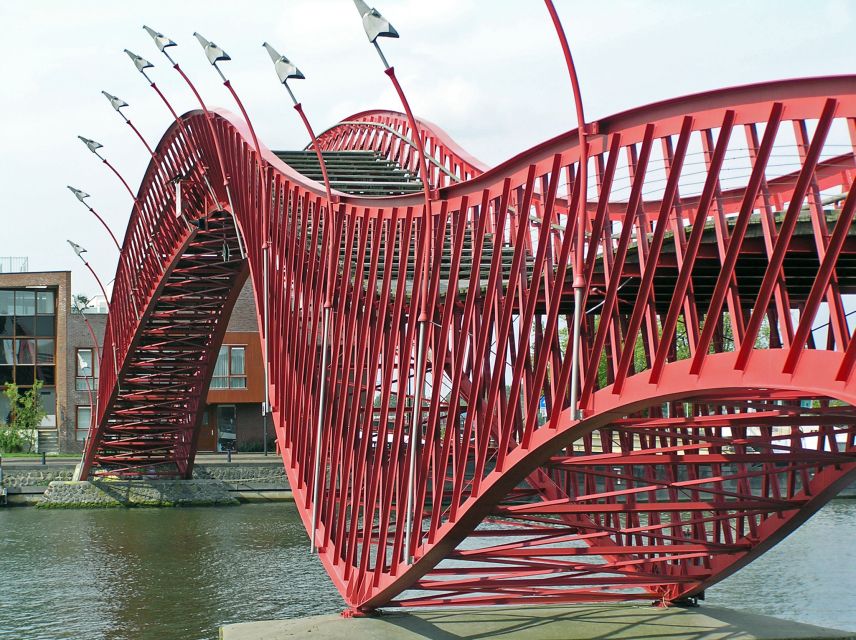
At $235 for a private group of up to 10, this tour offers strong value for a full group that wants expert attention. You are paying for a focused guide rather than a broad introductory walk, and the route covers five connected districts with very different planning ideas.
The value is less obvious for one or two people, though the private format still gives you flexibility and direct access to the guide. The option to reserve now and pay later also helps if your Amsterdam schedule is still changing. You can cancel up to 24 hours in advance for a full refund, according to the stated terms.
The most important choice is the subject. This is not a tour that merely passes through the Eastern Docklands. It asks you to understand what happened there and why the results differ from island to island. That makes it a smart add-on after you have seen central Amsterdam, especially if you want to compare the old city with its newer waterfront districts.
Should you book the Eastern Docklands architecture tour?
Book it if you want an informed, private look at one of Amsterdam’s most ambitious modern redevelopment areas. The five-district route gives you useful variety, and the comparison between Java and KNSM plus the low-rise density of Borneo and Sporenburg gives the walk a clear purpose.
The strongest reasons to go are the academic guide background, the chance to shape a private two or three-hour walk, and the practical value for groups of up to 10. Skip it if you want a standard sightseeing route or dislike walking tours centered on planning ideas.
For architecture-minded visitors, design students, and anyone curious about how Amsterdam created new neighborhoods from an old harbor, this is a worthwhile and unusually focused choice.
FAQ
Where does the Eastern Docklands architecture tour meet?
The meeting point is in front of Pakhuis De Zwijger, next to Jan Schaeferbrug.
How long does the tour last?
The standard duration is two hours. A three-hour version can be adapted to your needs.
Which Eastern Docklands districts are included?
The route covers Java, KNSM, Borneo, Sporenburg, and Riet Landen.
What is the price of the private tour?
The price is $235 per private group of up to 10 people.
Which languages are available?
The live guide can lead the tour in English, Dutch, or German.
Is this a private group experience?
Yes. The tour is offered for a private group.
What is included in the price?
The price includes the two or three-hour walk and the guide.
Are food, drinks, or transfers included?
No. Food, drinks, and transfers are not included.
Is the tour wheelchair accessible, and can I bring luggage?
The tour is wheelchair accessible, but luggage and large bags are not allowed.
Just added around the Netherlands
- Rotterdam Must Do Tour: Highlights, History, WW2 and Architecture★ 5.0 · 20 reviews
- Private Rotterdam Walking Tour – guided by Architects★ 5.0 · 2 reviews
- Rotterdam Architecture and Highlights Walking Tour (TOP RATED)★ 4.5 · 14 reviews
- Escape Room – l’Architecte★ 4.5 · 13 reviews
- Maastricht Highlights, Architecture & Heritage Tour★ 5.0 · 7 reviews
- Gouda Private Walking Tour: History, Architecture & Cheese★ 4.5 · 8 reviews
- Amsterdam Walking Tour. All about History, Architecture, Traditions & Anecdotes.★ 5.0 · 2 reviews
- Walking Tour about Golden Age Architecture, private local guide★ 5.0 · 15 reviews
the Netherlands Architecture Tours, compared.

Rotterdam: Architectural Highlights Guided Walking Tour
Read our review →
Rotterdam: Highlights, Gems, Architecture & History Walk
Read our review →
Rotterdam Walk: Hilights, Gems, Architecture & WWII | 2 or 3hrs
Read our review →
The rise of Haarlem: Culture, History, Art and Architecture Walking Tour
Read our review →
Rotterdam Must Do Tour: Highlights, History, WW2 and Architecture
Read our review →
Rotterdam: Architecture Highlights Tour including the Depot
Read our review →
Walking Tour about Golden Age Architecture, private local guide
Read our review →Browse the lists this tour appears in