
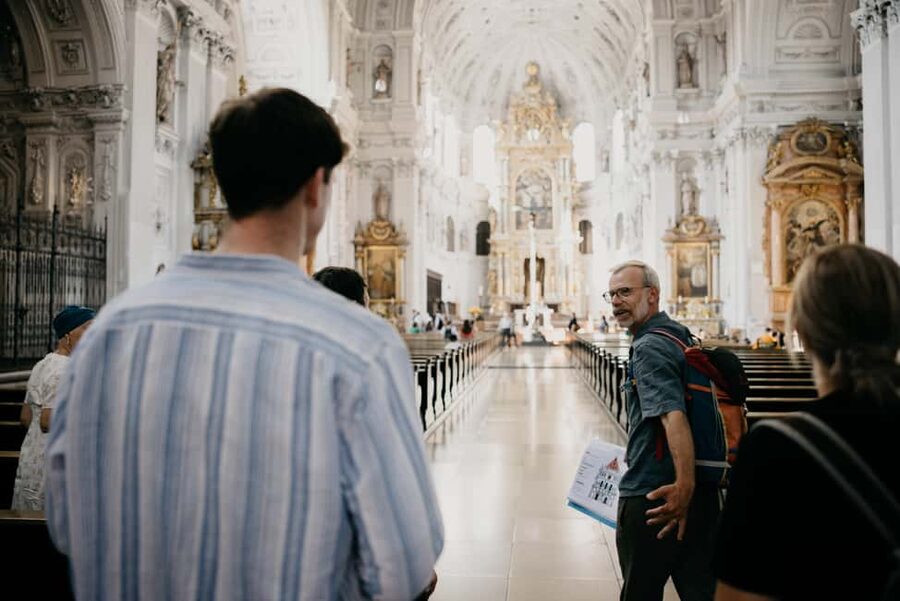
Review · MUNICH
500 Years of Munich Architecture (Max. 16 Guests)
Munich’s buildings tell a lively story of power, faith, war, wealth, and changing taste. This 150-minute tour follows that story from the Frauenkirche and St. Michael’s to Art Nouveau, street art, and modern architecture along the Isar River, with architect and official guide Philipp leading the way.
I like the small group, capped at 16 people, and the way the route moves beyond the old center. I also like that Philipp brings an architect’s eye to familiar sights, then finishes with a Gasteig rooftop view over Munich. The main consideration is mobility: the route is not suitable for wheelchair users or people with mobility impairments.
Key points at a glance
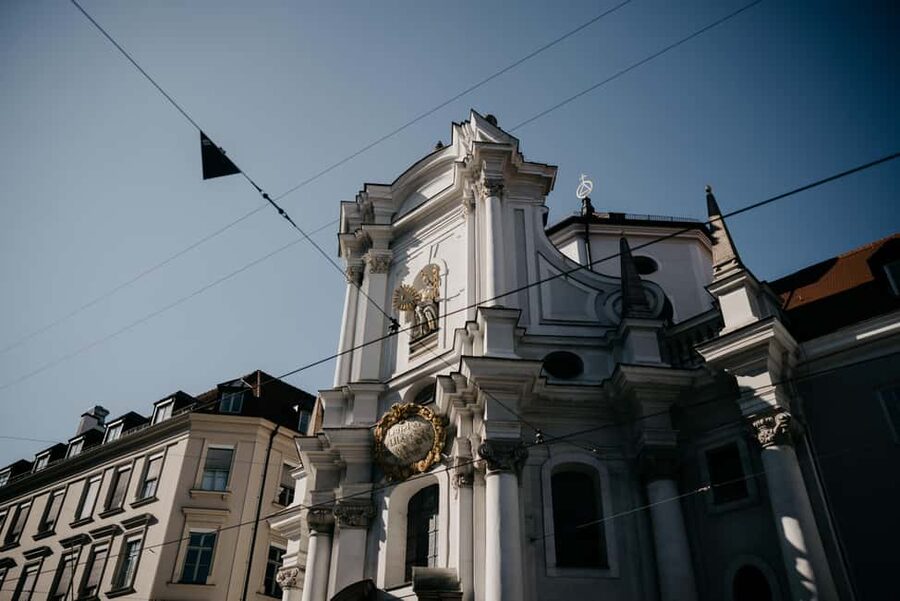
- A 500-year architectural timeline: See Gothic, Baroque, Rococo, Neoclassical, Historicist, Art Nouveau, and modern work in one outing.
- Philipp leads the tour: He is both an architect and a certified official Munich guide, and the tour is offered in English, German, and Spanish.
- The route leaves the postcard center: After major churches and grand streets, you reach the Isar River, street art, a modern museum, and Müllersche Volksbad.
- The group stays small: No more than 16 people can join, with private groups also available.
- The finish is memorable: The Dachgarten auf dem Gasteig offers broad city views when weather allows.
- Useful extras are included: You receive a postcard featuring a tour highlight and a digital map of Philipp’s favorite Munich spots.
Munich architecture explained through time
The best feature of this tour is its sense of progression. You are not simply shown a church, a palace, and a museum with a date attached. Philipp connects each style to the social and political forces behind it.
That matters in Munich, where architecture often reflects the city’s changing fortunes. Religious institutions shaped the old center. Rulers used grand buildings to express authority. Later styles borrowed from earlier periods, while the river route reveals a more practical and experimental side of the city.
The title refers to roughly 500 years of architectural development, though the opening churches also reach back to older traditions. You can expect the route to move quickly through many periods, so this is not a long interior study of one building. It is a broad, connected lesson in how Munich took shape.
Philipp’s professional background is useful here. He is not only an architect, but also a certified official city guide and a member of the MGV and BVGD. That combination should appeal if you want more than dates and construction details. The tone described by the experience is also relaxed and open to questions, including questions outside architecture.
A few more architecture tours around Germany worth a look
- Munich 3-Hour Segway Tour: Nazi Munich & Royal Architecture
★ 4.9 · 194 reviews - Düsseldorf: Guided City Architecture Walking Tour
★ 4.6 · 61 reviews - Hidden Architectural Gems of Munich (Max. 16 guests)
★ 4.9 · 52 reviews
Starting at Frauenplatz and the Frauenkirche
Meet Philipp outside the entrance to the Frauenkirche at Frauenplatz 1. He carries a tablet over his shoulder, making him easy to identify.
The Frauenkirche is the natural starting point. Its twin towers and broad brick form are among Munich’s most familiar sights, but the value here is seeing the cathedral as the first chapter in a larger story. You begin with Gothic Munich, then use that style as a reference point for everything that follows.
The meeting point is central and simple to reach. Take the S-Bahn or U3 or U6 subway to Marienplatz, then walk about 10 minutes. Because the tour continues through several parts of the city, wear comfortable shoes. You will spend much of the 150 minutes on foot, and the route includes outdoor sections.
The Frauenkirche visit also sets up a useful contrast. Munich’s later churches can be more ornate, theatrical, or playful, while the cathedral’s scale and restraint show a different idea of religious power. Philipp’s job is to help you notice those differences without turning the walk into a lecture.
St. Michael’s and the city’s church interiors
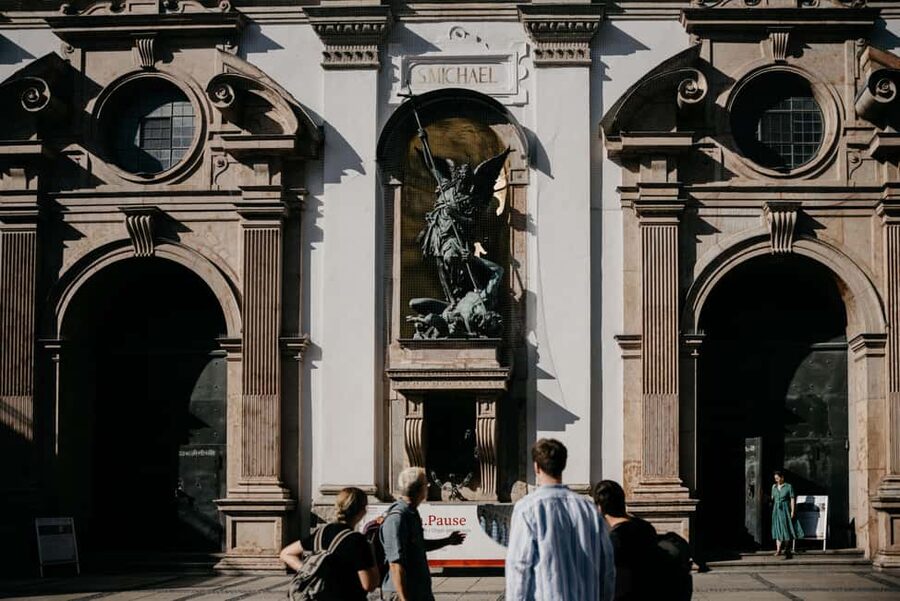
The next major stop is St. Michael’s Church, a key building for understanding the city’s religious and political ambitions. It is followed by Trinity Church, a Baroque church that offers a more intimate change of mood.
These churches make the tour especially useful for first-time visitors who might otherwise see them as a blur of impressive interiors. With Philipp’s explanations, you can compare the way each building uses space, decoration, light, and mass.
Trinity Church is one of the less obvious stops on a standard Munich sightseeing route. That is a strength. It gives the tour a local angle and shows that Munich’s architectural story is not limited to Marienplatz and the main royal avenues.
You then visit the Theatine Church, another major landmark in the old center. Its style helps show how Munich absorbed influences from outside Bavaria. The route is not only about identifying Baroque or Rococo features. It is also about asking who wanted these buildings, what they were meant to communicate, and how imported ideas were adapted locally.
From the Theatine Church to the Bavarian State Opera
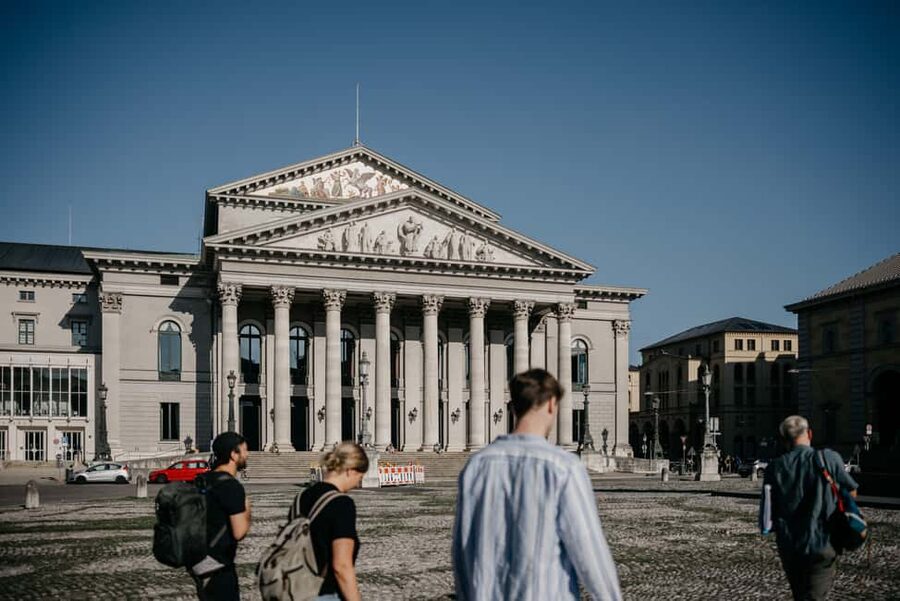
The Bavarian State Opera shifts the focus from religious architecture to royal and civic display. It is a good point in the route to consider how public buildings project order, taste, and authority.
From here, the tour continues along Maximilianstraße. This grand avenue is one of Munich’s clearest examples of architecture used to create a public image. Its buildings are not isolated objects. Together, they form an urban statement about wealth, monarchy, and the city’s place in Europe.
I like this part of the tour because a guide can show you how to read a street rather than simply photograph individual façades. Look for the relationship between the width of the avenue, the repeated building forms, and the sense of ceremony. You may find the discussion more useful than a list of famous architects.
The route covers a lot in a short time. If you want long interior visits or extended time inside every church, this will feel brisk. If you prefer a connected overview with several stops, the pace makes sense.
Same city, a completely different century:
- Dresden: Tour of the Baroque Quarter with a Night Watchman
★ 4.7 · 681 reviews - Potsdam: Guided Walking Tour of UNESCO Site and Architecture
★ 4.7 · 49 reviews - Private Taxi Tour City East & West History and Architecture 3-4h
★ 5.0 · 42 reviews - Stuttgart city library – an architectural tour
★ 4.4 · 27 reviews
Crossing into Munich’s Isar-side architecture
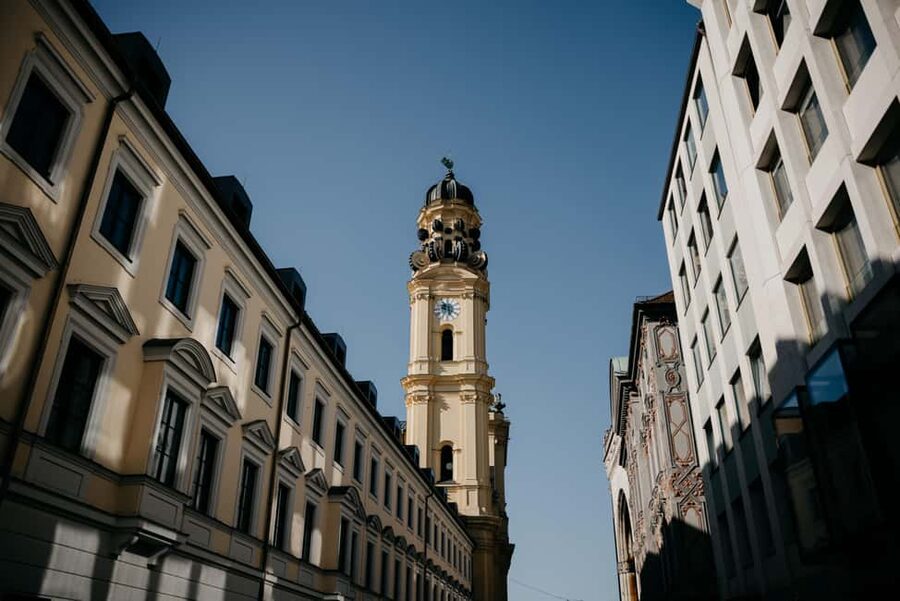
One of the more appealing changes in the route is the move away from the old center toward the Isar River. A review of the experience describes taking the tram out toward the river and the greener parts of the city. That shift gives you a break from grand churches and royal buildings.
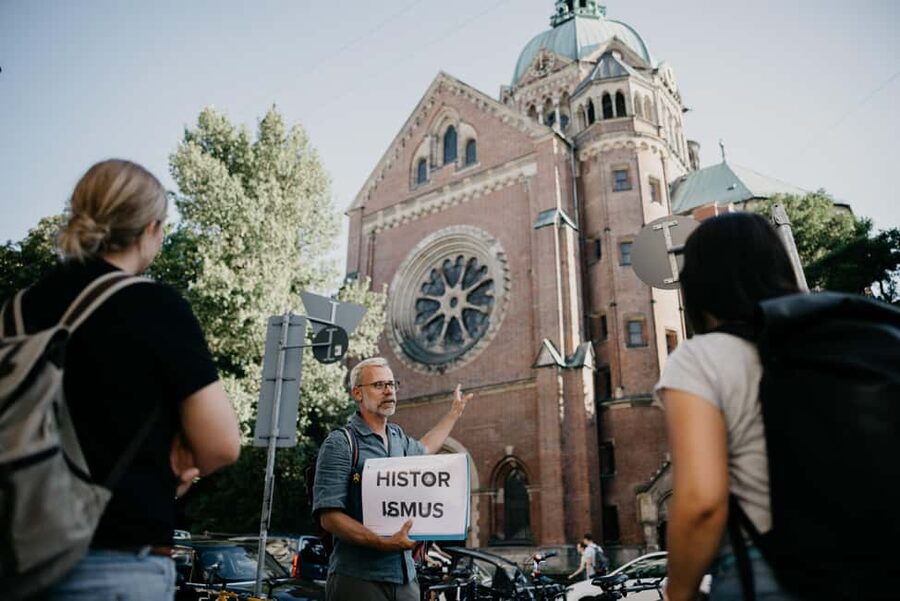
At St. Lukas, you encounter a different chapter of Munich architecture. The church is presented as part of the route through the city’s later development, where religious design meets a less court-centered urban setting.
The Isar section also adds nature to an otherwise built-up tour. You are still looking at architecture, but the river and open surroundings change how the buildings are experienced. This is one reason the tour feels broader than a standard old-town walk.
The route then includes Müllersche Volksbad, a well-known Art Nouveau building. Its design gives Philipp a chance to explain how curves, ornament, materials, and flowing forms differ from the formal styles seen earlier in the day.
This is a useful stop for anyone who thinks architecture history is just a sequence of church styles. Art Nouveau brings a clear change in mood. It is more decorative and organic, and the building’s original public purpose adds another layer. You are not looking only at a palace or place of worship, but at architecture made for city life.
Sudetendeutsches Museum and modern Munich
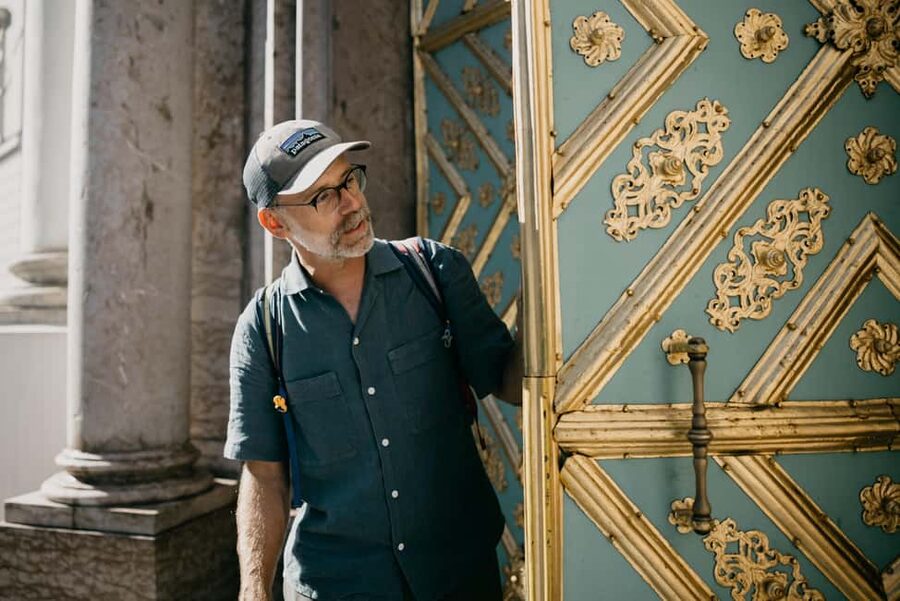
The Sudetendeutsches Museum brings the route into the modern period. Its inclusion helps show how a contemporary museum can address identity, memory, and public history through both its contents and its design.
The route also includes street art and another modern building before the final stop. These details matter because they prevent the tour from treating architecture as something finished in the nineteenth century. Munich continues to change, and the newer parts of the route let you compare current design with the older buildings in the center.
There is an intentionally wide range here: Gothic cathedral, Baroque churches, a royal opera house, a grand avenue, Art Nouveau, street art, and a modern museum. Philipp’s role is to give you a framework for comparing them.
You should not expect a specialist survey of every modern building in Munich. The modern portion is one part of a long route. Still, it gives the tour a welcome ending point: architecture is not merely a record of the past, but a continuing argument about how a city should look and function.
Finishing at the Gasteig rooftop terrace
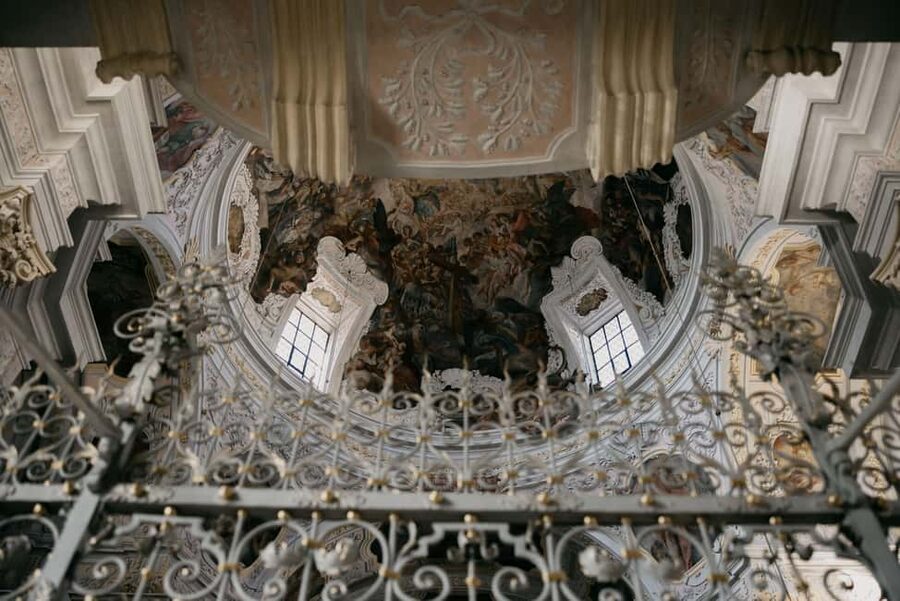
The tour ends at the Dachgarten auf dem Gasteig, the rooftop terrace associated with Gasteig. Weather permitting, you get a broad view over Munich’s skyline.
This is a smart finish. After hearing about architectural styles at street level, you get a chance to see the city as a whole. The churches, avenues, newer structures, and river area can be understood as parts of one urban setting rather than separate stops.
The view is weather dependent, so you should treat it as an added benefit rather than a guarantee. Even without perfect conditions, the ending gives the route a clear sense of place and helps you remember how far the tour has moved from the Frauenkirche.
What the small group adds
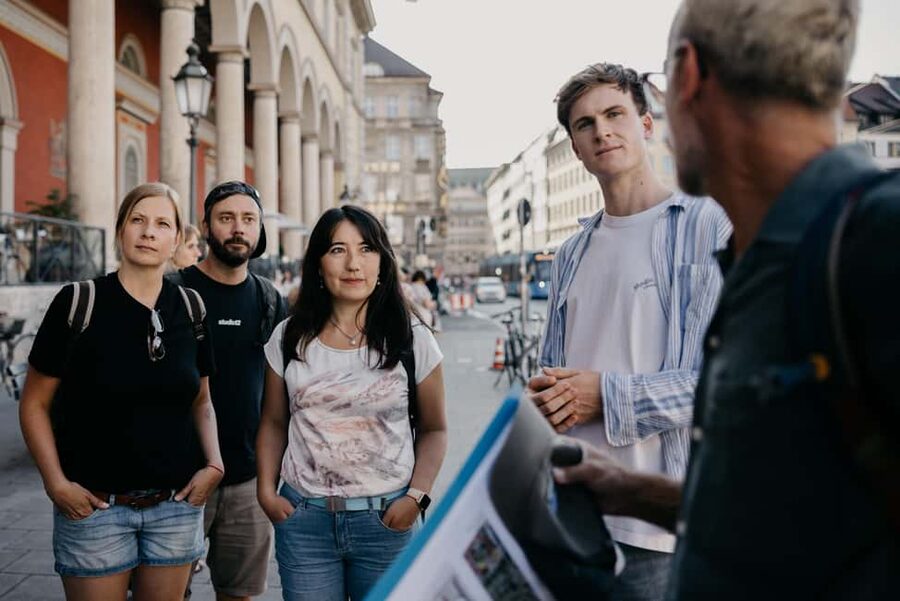
The maximum group size is 16 people. That is small enough for Philipp to answer questions without making the walk feel like a private tour, while still keeping the price at a reasonable $30 per person.
The size matters most at the churches and during explanations in busy public spaces. A very large group can make architecture tours hard to follow, especially when the guide is discussing details above street level. A group of 16 gives you a better chance to hear the guide and ask for clarification.
Private groups are available too. That may suit families, friends, or organizations that want a more tailored pace. The activity is described as family friendly, though the walking demands and the lack of wheelchair access should be considered before booking.
Philipp also provides a postcard featuring a tour highlight and a digital map with his favorite Munich spots. These are modest extras, but the map can be useful if you want to keep exploring after the tour. It turns the experience into more than a one-time route through the center.
Is $30 a fair price?
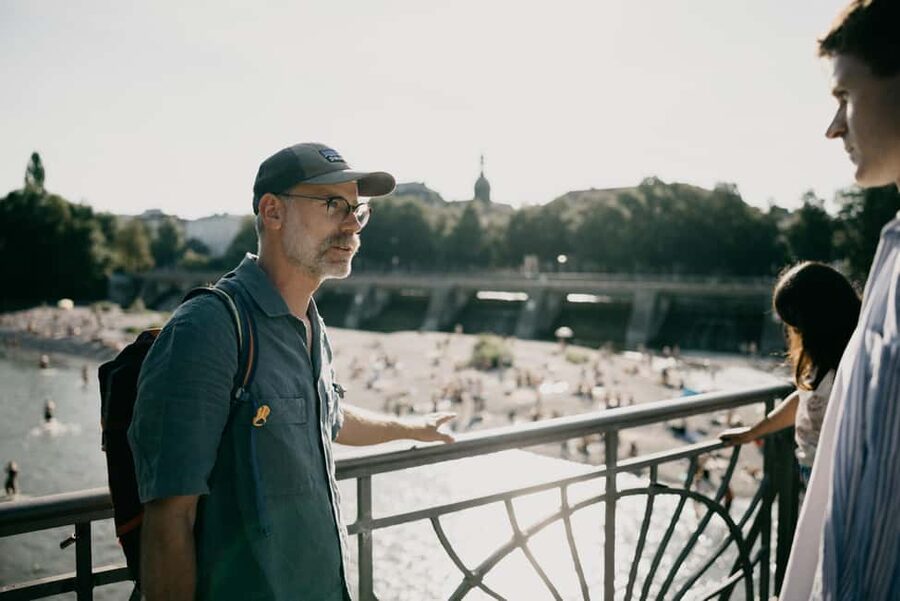
At $30, this tour is reasonably priced for a 150-minute guided experience led by someone who works both as an architect and an official city guide. You are paying for interpretation, route planning, and access to a wide range of examples rather than for a single monument ticket.
Food, drinks, and transportation to and from the meeting point are not included. You may also need to pay for the tram or other local transportation used during the route, so check the day’s arrangements when booking. The tour begins in the center, and reaching Frauenplatz is straightforward by public transport.
The value is strongest if you are interested in how buildings connect to politics, society, and urban change. If you only want a quick list of Munich’s top sights, a free orientation walk may cover some of the same central areas. This tour earns its price by going deeper into design and by continuing to the Isar and modern architecture.
Free cancellation up to 24 hours before the start and a reserve-now, pay-later option make the booking fairly flexible. The tour runs for 150 minutes, with start times shown when you check availability.
Who will enjoy this tour most?
I would recommend it to anyone who looks up at Munich’s buildings and wants to know why they look the way they do. It is especially suited to architecture students, design-minded visitors, history fans, and people who have already seen the main old-town sights.
It also works well for repeat visitors. The route includes famous places, but it adds Trinity Church, the Isar section, Art Nouveau, street art, and modern architecture. That mix gives you reasons to join even if you already know the Frauenkirche and Maximilianstraße.
The tour is offered in English, German, and Spanish. Philipp’s patient approach to questions is another reason it should suit people who prefer conversation over a tightly scripted talk.
It is less suitable if you have difficulty walking or need step-free access. The activity specifically excludes people with mobility impairments and wheelchair users. Smoking is not allowed, and participation is at your own risk.
Should you book 500 Years of Munich Architecture?
Book it if you want to understand Munich through its buildings rather than simply collect photographs. The combination of Philipp’s architectural training, a small group, major churches, lesser-known stops, the Isar River, and the Gasteig rooftop makes the route unusually varied for $30.
Skip it if your priority is a slow visit inside each church, a short old-town walk, or a fully accessible route. For everyone else, this is a smart way to connect Munich’s Gothic, Baroque, Rococo, royal, Art Nouveau, street-art, and modern sides in one well-planned afternoon.
FAQ
How long does the Munich architecture tour last?
The tour lasts 150 minutes, or two and a half hours.
What is the tour price?
The price is $30 per person.
Where does the tour begin?
The meeting point is outside the entrance to the Frauenkirche at Frauenplatz 1.
How do I reach the meeting point?
Take the S-Bahn or U3 or U6 subway to Marienplatz, then walk about 10 minutes to Frauenplatz.
How will I recognize Philipp?
Philipp will have a tablet slung over his shoulder.
What languages are available?
The live tour is available in English, German, and Spanish.
How large is the group?
The standard small group has a maximum of 16 people. Private groups are also available.
Does the tour visit the Frauenkirche?
Yes. The Frauenkirche is one of the scheduled stops, along with St. Michael’s Church, Trinity Church, and the Theatine Church.
Does the route include the Isar River?
Yes. The route includes the Isar River area, with Art Nouveau, street art, and modern architecture along the way.
Where does the tour finish?
The tour finishes at the Dachgarten auf dem Gasteig, where you can enjoy views over Munich when the weather permits.
Just added around Germany
- Beautiful Baroque Potsdam: A Self-Guided Audio Tour★ 4.5 · 4 reviews
- Munich Your Way: Private Tour with Architect & Guide★ 5.0 · 2 reviews
- Private Munich Tour for History Buffs with Architectural Gems and WWII sites★ 5.0 · 3 reviews
- Art Nouveau Meets Street Art in Munich (Max. 12 guests)★ 5.0 · 3 reviews
- Hidden Architectural Gems of Munich (Max. 16 guests)★ 5.0 · 2 reviews
- Architectural Frankfurt: Private Tour with a Local Expert★ 5.0 · 2 reviews
- Private Taxi Tour of City East History and Architecture 2-3h★ 5.0 · 2 reviews
- Architectural Berlin: Private Tour with a Local Expert★ 4.0 · 3 reviews
Munich Architecture Tours, compared.
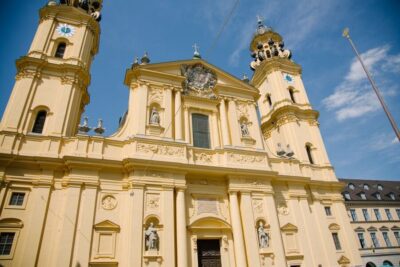
Munich 3-Hour Segway Tour: Nazi Munich & Royal Architecture
Read our review →
Hidden Architectural Gems of Munich (Max. 16 guests)
Read our review →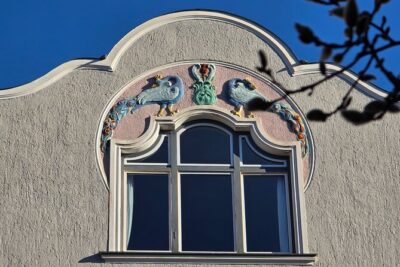
Art Nouveau Meets Street Art in Munich (Max. 12 guests)
Read our review →Art Nouveau Meets Street Art in Munich (Max. 12 guests)
Read our review →
Private Munich Tour for History Buffs with Architectural Gems and WWII sites
Read our review →Hidden Architectural Gems of Munich (Max. 16 guests)
Read our review →
Browse the lists this tour appears in