
Review · BARCELONA
Private Barcelona Old Town and Gothic Quarter Walking Tour
Barcelona’s oldest neighborhoods unfold in a compact walk from Roman walls to medieval palaces, lively squares, and the food stalls of La Boqueria. This private tour gives you a useful first look at Ciutat Vella, the Gothic Quarter, Las Ramblas, and the Born District without being tied to a large group’s pace.
I like the one-group-only format, which lets your guide adjust the route and answer questions as you go. I also like the mix of famous sights and easy-to-miss details, from ancient columns and city walls to Picasso connections and local food advice.
The main consideration is timing. The tour lasts about 2 hours 30 minutes, yet it covers nine areas, so several stops are viewing points rather than extended visits. The meeting information also needs a quick check, since Plaça de Catalunya and Carrer de Fontanella 2 both appear in the provided details.
Key things to know before booking
- Roman Barcelona appears beneath the medieval streets: Ciutat Vella and the Gothic Quarter reveal the city’s earliest foundations.
- Your guide can shape the walk around your interests: Past guests have had guides such as Isabel, Montse, Olga, Alba, Baggio, and Juan adapt the pace and subject matter.
- The route links the city’s classic sights: You pass La Rambla, La Boqueria, Barcelona Cathedral, Plaça Sant Jaume, Plaça del Rei, and Santa Maria del Mar.
- This is a true private experience: Only your own group takes part, making it easier to ask questions or slow down for photographs.
- The walk ends in the Born District: You finish at Passeig del Born, a handy contrast to the narrower Gothic lanes.
- Food advice is part of the value: Guides may point you toward tapas, Catalan specialties, Iberian ham, and local shops after the formal walk ends.
Why this walk works as a Barcelona introduction
Barcelona can feel confusing at first. Its oldest districts are a tight maze of lanes, squares, churches, former palaces, market halls, and later buildings. A map shows where to go, but it does not explain why a Roman wall appears beside a modern doorway or why Plaça Sant Jaume still matters to Catalan public life.
This tour gives you that framework in a short morning or afternoon. You begin near the center and move through the city’s oldest quarters on foot, ending in the Born District. That route helps you connect several parts of Barcelona instead of treating each sight as a separate stop.
The private setup matters here. I would rather ask a guide to explain Catalonia’s relationship with Madrid, point out ancient Roman remains, or recommend a good tapas lunch than listen to a fixed script meant for thirty people. Guides have also adjusted the walk for returning visitors, families, quieter groups, and people working with a tight schedule.
The strongest part of the experience is the guide’s role. Guides including Montse, Isabel, Olga, Juan, Alba, Miguel, and Baggio are praised for making history clear, adding humor, and keeping the pace comfortable. One guide even helped a family recover the sense of a missed Old Town visit by reshaping the route around what they had not yet seen.
That does not mean every minute is filled with formal sightseeing. The tour covers a lot of ground, and the attractions listed are not all admission visits. Think of this as a guided orientation walk with context, not a substitute for spending several hours inside the cathedral, market, or museums.
More Gothic quarter walks in Barcelona:
- Barcelona all included: Sagrada, Park Güell, Montjuic & Gothic
★ 5.0 · 2,169 reviews - Barcelona Gothic Quarter Tapas & Taverns Food & Wine Tour
★ 5.0 · 1,470 reviews - Barcelona: Old Town and Gothic Quarter Walking Tour
★ 4.8 · 1,393 reviews
Ciutat Vella and the first Roman clues
The walk starts in Ciutat Vella, Barcelona’s old city. This is where you begin to see how the modern city grew over its Roman foundation. Your guide leads you through narrow lanes and older structures, explaining the origins of Roman Barcelona and how the district changed over the centuries.
The atmosphere shifts quickly from central-city traffic to enclosed streets and small squares. You might see fragments of Roman walls, columns, or an aqueduct, details that are easy to pass without explanation. The historical value is in the connections: a wall is not simply an old wall when you understand how it once defined the city.
Allow about 30 minutes for this opening section. It is short, but useful. You get the basic map of the old city before the walk moves into the Gothic Quarter.
Gothic Quarter: medieval mood with modern Barcelona around it
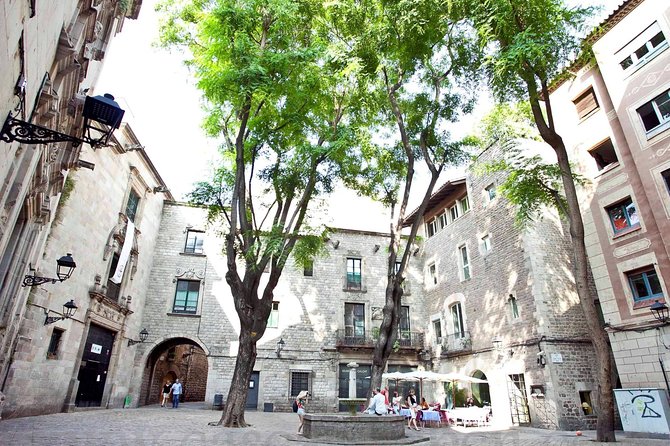
The Barri Gòtic is the tour’s main setting. It occupies the former Roman village and contains a mix of ancient remains, medieval buildings, later construction, shops, bars, and small restaurants. That mixture gives the area its appeal, but it can also make the history hard to read without help.
A good guide separates the periods for you. You may hear about the Roman wall, medieval power, Catalan traditions, and the way the neighborhood became part of modern Barcelona. Guides have also pointed out St. Jordi’s door, a photomosaic tile wall, old city boundaries, and sites tied to Barcelona’s long-established families.
This is where the private format earns its keep. You can stop for a question about Catalan identity, ask why a building looks older than it is, or request more detail about the medieval city. Guides such as Montse and Isabel have been praised for making the past understandable without turning the walk into a lecture.
Families should find the format workable. Baggio is specifically praised for keeping a child interested without making the material childish. The tour also suits quieter groups, since Isabel is noted for making an introverted family feel at ease.
Las Ramblas and La Boqueria
The route then reaches Las Ramblas, Barcelona’s famous pedestrian boulevard. It is a change of pace from the Gothic lanes, with cafés, street performers, food shops, and a steady flow of people.
Your guide explains why the boulevard became such an important visitor route, while also helping you read the commercial side of it. This is not the place to expect a quiet old street. It is lively, public, and heavily visited. Keep your belongings close, especially in crowded areas, and treat the walk as an introduction rather than a slow architectural study.
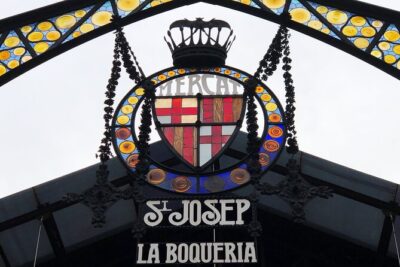
La Boqueria is usually a highlight for food-minded visitors. You pass in front of the market and see the colorful displays associated with Catalan cooking, including cured ham and other local products. The tour does not include food or drinks, so any tasting or shopping is at your own cost.
The market is a useful place to ask practical questions. Guides have offered advice on local tapas, Catalan foods, and where to eat after the walk. Berta, for example, is praised for explaining food while leading a small group between tapas restaurants, although this Old Town tour itself does not promise a tapas route.
More old town architecture walks in Barcelona:
- Barcelona in 1 Day: Sagrada Familia, Park Guell,Old Town & Pickup
★ 5.0 · 13,541 reviews - Barcelona: Sagrada Familia, Modernism, and Old Town Tour
★ 4.7 · 1,621 reviews - Barcelona Old Town & Gothic Quarter Small Group Tour
★ 5.0 · 1,308 reviews - Barcelona e-Bike Tour: Gaudí & Old Town Small Group
★ 5.0 · 769 reviews
Barcelona Cathedral and the city’s religious center
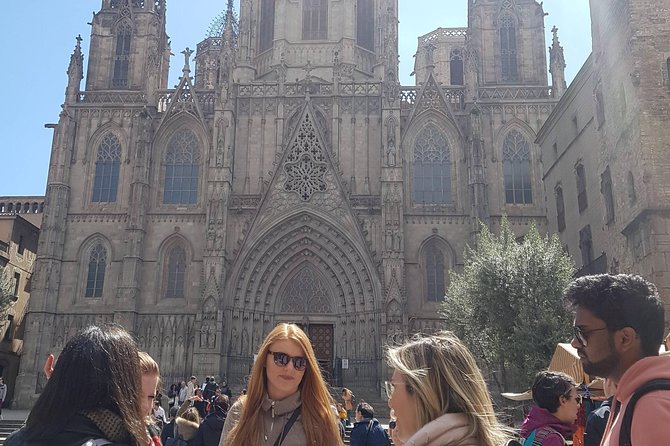
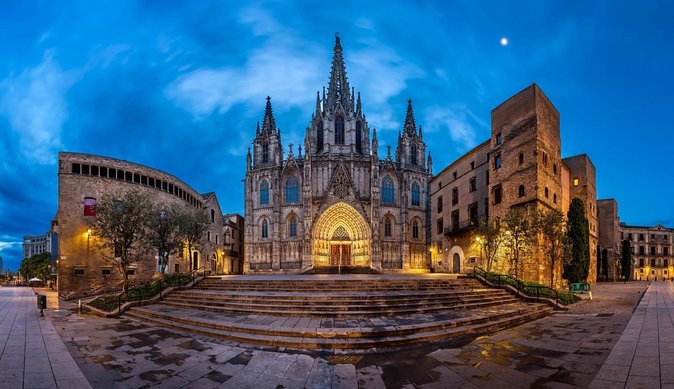
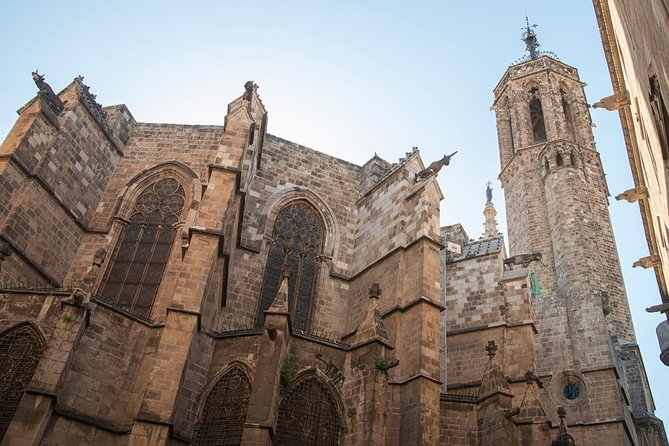
Barcelona Cathedral is another major sight along the route. You can admire its Gothic exterior, including the gargoyle figures high on the towers. The cathedral is dedicated to Saint Eulalia and serves as the seat of the city’s archbishopric.
The stop helps explain the religious and civic importance of the Gothic Quarter. Your guide can put the building in context with the surrounding streets, old city institutions, and the political life of Barcelona.
Be clear about the format. The information describes passing by and admiring the cathedral, not an included interior visit. If entering is important to you, ask your guide what is possible during your tour and plan extra time separately.
Plaça Sant Jaume and Catalan public life
Plaça Sant Jaume is one of the old city’s most important squares. It has served as a center of political power for centuries and remains closely linked with Catalan public life.
This is a particularly useful stop if you want more than dates and architectural labels. Guides have discussed Catalonia’s relationship with Madrid, the region’s cultural identity, and the way Barcelona fits within Spain. Montse is praised for helping a couple leave with a clearer understanding of Barcelona and Catalonia, not just a list of buildings.
The square also gives you a moment to pause. After weaving through narrow lanes, an open civic space makes the city’s scale easier to understand. Your guide can explain what surrounds the square and why it continues to matter.
Plaça del Rei and the medieval royal city
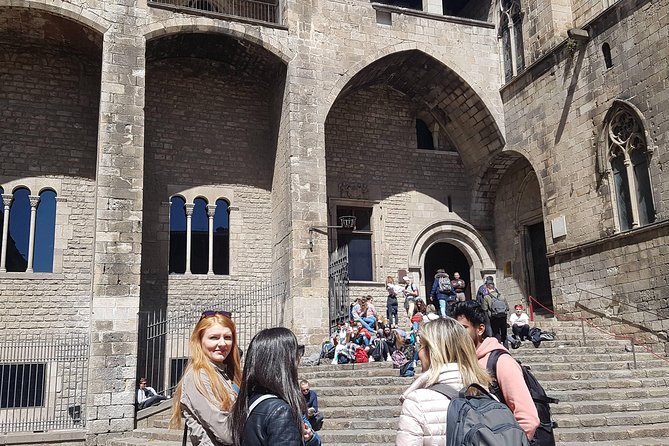
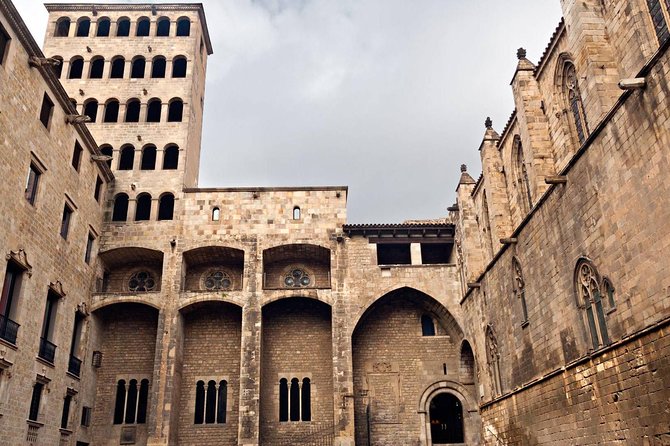
Plaça del Rei offers one of the clearest looks at medieval Barcelona. The Royal Palace and nearby buildings form a quiet architectural group that recalls the city’s royal and political past.
This stop is especially valuable after the Roman material earlier in the walk. You can compare the Roman origins, medieval growth, and later layers of Barcelona in one compact area. The best guides use the square to explain how the city functioned, rather than simply pointing out an attractive façade.
It is also one of the places where your pace matters. A private guide can give you a minute to take in the square or answer a specific question about the palace and surrounding buildings. On a large group tour, that pause can be harder to manage.
Santa Maria del Mar and the Born District
The walk continues toward the Born District and the Basilica of Santa Maria del Mar. This church is an important example of Catalan Gothic architecture and is linked with the work and effort of Barcelona’s citizens.
Santa Maria del Mar gives the route a strong closing section. You have already seen the Gothic Quarter’s lanes and cathedral, and now you encounter another major Gothic building in a different neighborhood. The shift toward Born also shows how the old city extends beyond the most famous tourist streets.
The listed experience includes the Born District and ends at Passeig del Born. As with the cathedral, the supplied details do not promise a paid interior admission. Plan on an exterior visit unless your guide confirms otherwise.
Passeig del Born is a practical ending point. You can continue exploring the district on your own, stop for food, or use the guide’s suggestions for the rest of the day.
What $96.75 per person buys you
At $96.75 per person, this is not a budget orientation walk. The price makes the most sense for couples, families, or a small group that values private attention and wants a flexible introduction to the old city.
The cost includes a private walking tour, a local professional guide, and the Old Town route through the Gothic Quarter and Born District. It does not include hotel pickup, food, drinks, or admission fees. Since most of the named sights are viewed from the outside, you are paying mainly for the guide’s interpretation, route planning, and ability to tailor the walk.
The value improves when several people share the booking, especially if the group wants to ask many questions or avoid a fixed large-group schedule. Group discounts are available, though the exact saving is not provided here. A first child is free when sharing with two paying adults, and additional children receive 50 percent off based on the price of two adults.
I would choose this tour over a cheaper general walk if you care about context and personal attention. I would not choose it if your main goal is long interior visits or food included in the price.
Timing, meeting point, and walking demands
The tour lasts approximately 2 hours 30 minutes. The route is on foot through old-city streets, so comfortable shoes are sensible. Most people can participate, children must be accompanied by an adult, and service animals are allowed.
The published meeting details need attention. The overview identifies Plaça de Catalunya, while the meeting point lists Carrer de Fontanella 2 in Ciutat Vella. The end point is Passeig del Born. Confirm the exact starting address before you go, rather than relying on a general reference to Plaça de Catalunya.
There is also a timing inconsistency worth checking. One booking experience involved confusion over a 9:00 arrival request, a 9:30 stated start, and a tour length of 2.5 hours rather than approximately three. I would confirm the start time directly and arrive a little early.
The route is close to public transportation. Hotel pickup and drop-off are not included, so you need to reach the meeting point yourself.
Which guide style suits you best
Guide quality is central to this experience, and the names associated with the strongest feedback include Isabel, Montse, Olga, Alba, Baggio, Juan, Miguel, Joris, Stephanie, Antonio, Katty, Oliver, Ane, and Adriano.
The praise is consistent in a few useful ways. Guides explain history clearly, answer questions, use humor, and adjust the pace. Joris is noted for keeping the information measured rather than overwhelming. Jose Carlos is praised for fitting the walk to a group’s interests and available time. Alba is noted for avoiding crowds when possible and bringing historical events to life with feeling and humor.
You may also be assigned another guide, and guide availability can change. The important point is that the experience depends heavily on the person leading it. English is offered, and other languages can be requested.
Who should book this private walk
I would recommend it to first-time visitors who want a solid mental map of central Barcelona before exploring alone. It also works well for families, adult groups, returning visitors who want different sights, and anyone who prefers to ask questions without speaking in front of strangers.
It is a good match if you want:
- Roman and medieval context in one walk
- A flexible pace
- Practical food and neighborhood advice
- A guide who can discuss Catalonia as well as architecture
- A short route that covers the city’s major old-center districts
I would look elsewhere if you want a full museum visit, a long cathedral interior tour, or a meal built into the experience. You should also allow extra time if your group walks slowly or wants to stop often, since nine listed areas in 2.5 hours leaves limited time at each one.
Should you book the Old Town and Gothic Quarter tour?
Book it if you want a private historical orientation with room for questions, local recommendations, and a pace shaped around your group. The route gives you Barcelona’s Roman beginnings, Gothic streets, civic squares, market culture, cathedral architecture, and Born District in one efficient outing.
The strongest reason to choose it is the guide. Names such as Montse, Isabel, Olga, Alba, Baggio, and Juan are associated with clear explanations, warmth, humor, and thoughtful adjustments for families and returning visitors.
Before paying, confirm the exact meeting address, start time, and what you will see inside versus outside. If those details suit your plans, the tour is a worthwhile first chapter in Barcelona, especially when you want the city’s old streets to make sense rather than simply look attractive.
FAQ
How long is the private Barcelona Old Town tour?
The tour lasts approximately 2 hours 30 minutes.
What is the price of the tour?
The listed price is $96.75 per person. Group discounts are available, though the exact discount is not specified.
Where does the tour start?
The meeting information identifies Carrer de Fontanella 2, Ciutat Vella, 08002 Barcelona. The tour overview also refers to Plaça de Catalunya, so confirm the exact meeting point before arrival.
Where does the tour end?
The tour ends at Passeig del Born in the Ciutat Vella area.
Is hotel pickup included?
No. Hotel pickup and drop-off are not included.
Is this a private tour?
Yes. Only your own group participates in the activity.
Are food and drinks included?
No. Food and drinks are not included. The route passes La Boqueria, and guides may provide food and restaurant recommendations.
Can children join the tour?
Yes. Children must be accompanied by an adult. The first child is free when sharing with two paying adults, and the second and additional children receive 50 percent off based on the price of two adults.
More Architecture Walks in Barcelona
- Ramblas, Old Town, Gothic and Gaudi Architecture Walking Tour
★ 5.0 · 723 reviews - Kids and Family Gothic Quarter Walking Tour in Barcelona
★ 5.0 · 465 reviews - Barcelona Gothic Quarter Walking Tour
★ 4.5 · 456 reviews - Barcelona: Gothic Quarter Walking Tour
★ 4.9 · 383 reviews
Just added around Barcelona
- Love in the Gothic Quarter Barcelona: Self-Guided Romantic Walk★ 4.5 · 9 reviews
- Walking tour of the Gothic Quarter of Barcelona + Cathedral★ 5.0 · 8 reviews
- Wine tasting with a view of the Sagrada Familia★ 4.5 · 13 reviews
- Visit to the Modernist houses of the Americans★ 5.0 · 2 reviews
- Barcelona Jewish & Gothic Tour★ 5.0 · 18 reviews
- Roman & Gotic & Gaudi in Barcelona: private walking tour★ 4.5 · 2 reviews
- Self-Guided Audio Tour-The Surrealist Barcelona of Dalí and Gaudí★ 3.5 · 8 reviews
- Barcelona Gaudi Tour: Sagrada Familia, Casa Batllo & Casa Mila★ 5.0 · 4 reviews
Gothic Quarter Tours, compared.
Barcelona all included: Sagrada, Park Güell, Montjuic & Gothic
Read our review →
Barcelona Gothic Quarter Tapas & Taverns Food & Wine Tour
Read our review →
Barcelona: Gothic Quarter Ghosts and Legends Walking Tour
Read our review →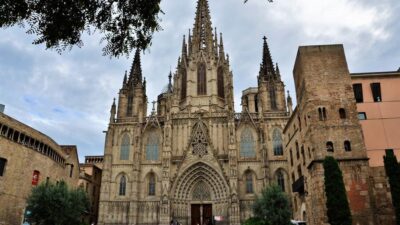
Barcelona: Old Town and Gothic Quarter Walking Tour
Read our review →
Barcelona Old Town & Gothic Quarter Small Group Tour
Read our review →
Ramblas, Old Town, Gothic and Gaudi Architecture Walking Tour
Read our review →
Barcelona: El Born and Gothic Quarter Wine & Tapas Bar Tour
Read our review →
Kids and Family Gothic Quarter Walking Tour in Barcelona
Read our review →Browse the lists this tour appears in