
Review · BARCELONA
Barcelona: Sagrada Familia, Modernism, and Old Town Tour
Barcelona reveals itself in layers on this 3 to 3.5-hour walking tour: Gaudí’s soaring Sagrada Família, the fanciful façades of Passeig de Gràcia, and medieval lanes around the cathedral. It is a smart way to get your bearings fast, especially if you have only a day or two.
I like the route’s range and its small group limit of 10. I also like that the guide is an artist or actor who tells stories rather than simply pointing at buildings. The main catch is important: you see the Sagrada Família and other monuments from outside, with no admission included.
The tour covers a lot of ground, so wear comfortable shoes and bring only a small bag. Guides such as Caio, David, Albert, Carlos, and Anastasiia have been praised for clear English, humor, patience, and useful food and sightseeing tips.
Key points at a glance

- Sagrada Família from the outside: Get a guided look at Gaudí’s great basilica, but plan a separate visit if you want to enter.
- Four Modernist façades: Compare Casa Milà, Casa Batlló, Casa Amatller, and Casa Lleó Morera along Passeig de Gràcia.
- One metro ride included: The Zone 1 ticket links the Sagrada Família area with central Barcelona.
- Gothic Quarter details: See Barcelona Cathedral, Bishop’s Bridge, the Temple of Augustus, the Roman Aqueduct, and more.
- Small group setting: With no more than 10 participants, it is easier to ask questions and stay close to the guide.
- Broad city introduction: This is best for a first look, not for long interior visits.
Why this route works for a first day in Barcelona
Barcelona can feel confusing at first. The Sagrada Família sits northeast of the central old city, while Passeig de Gràcia and the Gothic Quarter unfold farther toward Plaça de Catalunya and Las Ramblas. This tour connects those areas in one outing, giving you a useful mental map before you explore on your own.
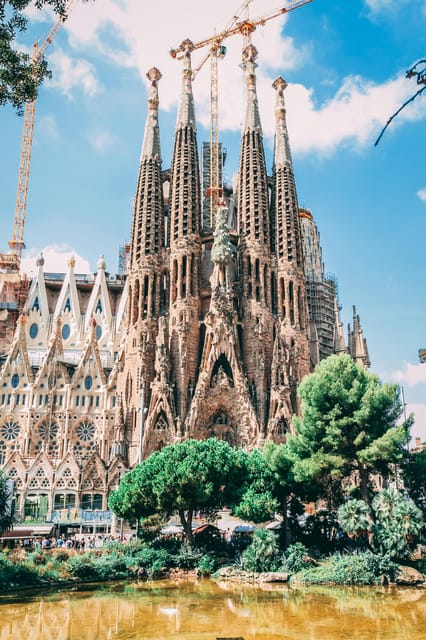
You begin near the KFC in front of the Sagrada Família. Look for the blue umbrellas. From there, the guide explains the basilica’s design, religious meaning, and place in Barcelona’s Modernist movement. The first stop lasts about 45 minutes, which gives you time to study the exterior from different angles and take photos.
That opening is a strong choice. The Sagrada Família is easy to admire, but harder to understand without help. Its towers, sculpted façades, and unusual forms can look like a great deal of stone and symbolism all at once. A guide can point out details you might otherwise miss.
Still, keep your expectations clear. This is not an interior visit. You will not go through security, see the columns and stained glass inside, or climb a tower. If entering the basilica matters to you, reserve a separate timed ticket and allow another part of your day for it.
More Sagrada Familia tours in Barcelona:
- Barcelona: Sagrada Familia Entry Ticket with Audio Guide
★ 4.6 · 105,312 reviews - Barcelona in 1 Day: Sagrada Familia, Park Guell,Old Town & Pickup
★ 5.0 · 13,541 reviews - Barcelona: Sagrada Familia Skip-the-Line Entry Ticket & Tour
★ 4.8 · 12,789 reviews
Reading Gaudí and Modernism on Passeig de Gràcia
After the Sagrada Família, the group uses the metro for about 15 minutes. That short ride saves you a long walk and gives the route a practical rhythm. Your included Zone 1 ticket covers the transport used during the tour, so there is no extra fare to arrange that day.
The next section focuses on Passeig de Gràcia, Barcelona’s grand Modernist avenue. Here the architecture is less about one isolated monument and more about comparison. Several celebrated façades sit close together, allowing you to see how different architects handled color, stone, balconies, windows, and organic shapes.
Casa Milà, also called La Pedrera
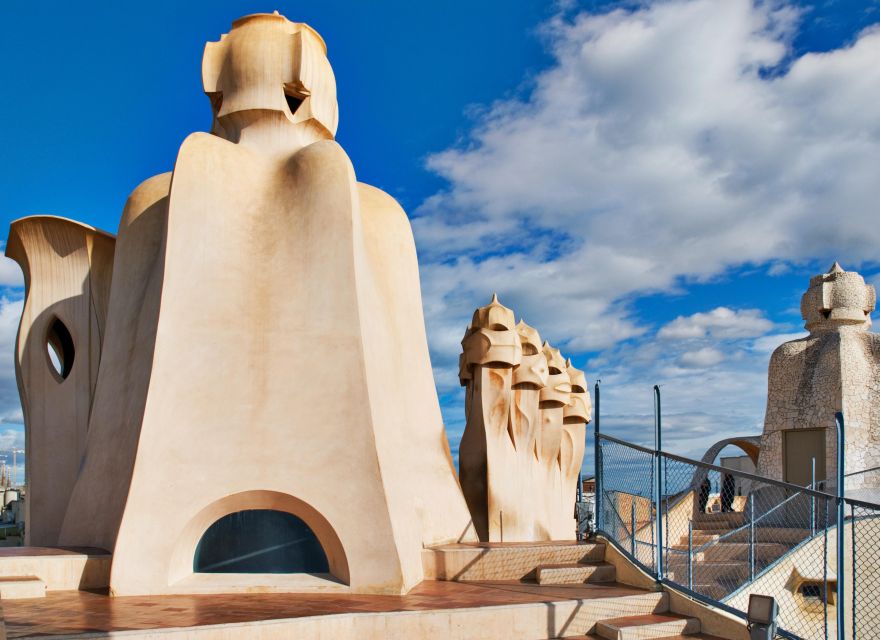
Casa Milà is the first major Modernist stop in this section. Its pale stone exterior and rolling lines make it look almost soft, even though it is a large apartment building. The guide explains the features from the street and gives you a better sense of why the building caused such a stir.
You have about 15 minutes here. That is enough for an explanation and photographs, but not for the rooftop, courtyard, or interior apartments. If La Pedrera is high on your list, treat this stop as an introduction and return later with an entry ticket.
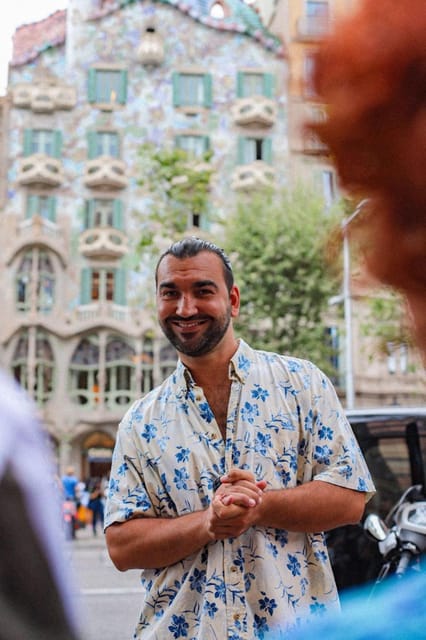
Casa Batlló
Casa Batlló brings a more theatrical mood. Its curved balconies, colorful surface, and unusual roofline make it one of the easiest buildings in Barcelona to recognize. The guide helps you read the façade instead of reducing it to a quick photo stop.
Again, the visit is from outside and lasts about 15 minutes. That limitation is worth noting because Casa Batlló has a detailed interior experience that you will not see here. The tour gives you context and lets you compare it with the buildings nearby, but it cannot replace admission.
More old town architecture walks in Barcelona:
- Barcelona: Old Town and Gothic Quarter Walking Tour
★ 4.8 · 1,393 reviews - Barcelona Old Town & Gothic Quarter Small Group Tour
★ 5.0 · 1,308 reviews - Barcelona e-Bike Tour: Gaudí & Old Town Small Group
★ 5.0 · 769 reviews - Ramblas, Old Town, Gothic and Gaudi Architecture Walking Tour
★ 5.0 · 723 reviews
Casa Amatller
Casa Amatller sits beside Casa Batlló, making the contrast especially useful. Its façade has a more ordered, decorative character, with a distinctive stepped roof and carefully framed details. Seeing the two buildings side by side shows how Barcelona’s Modernist architects could work on the same block yet produce very different results.
The guide’s role matters here. Without context, you might simply photograph both buildings and move on. With an explanation, the street becomes a lesson in competing ideas about art, craft, status, and urban design.
Casa Lleó Morera
Casa Lleó Morera completes the four-building comparison. The stop adds another style to the same architectural conversation and helps you see Passeig de Gràcia as more than a shopping street. You are looking at a concentrated display of Barcelona’s early 20th-century design culture.
The route also passes the House of Pascual and Pons and the Antonio Rocamora House. These additional façades keep the architectural theme going as the group moves toward Plaça de Catalunya. You do not stop for a long interior visit, but you get a sense of how widespread the Modernist style is in this part of town.
Plaça de Catalunya and the walk toward the old city
Plaça de Catalunya is the bridge between the newer central districts and Barcelona’s old core. The stop lasts around 10 minutes, enough for a quick explanation, orientation, and photographs. From here, the route heads toward Las Ramblas and the Gothic Quarter.
This transition is one of the tour’s practical strengths. You are not studying Barcelona’s architecture in a vacuum. You are watching the city change from broad avenues and ornate apartment buildings to narrower streets, older walls, courtyards, and church squares.
Do not expect a long break at every stop. The schedule lists many points, and the whole experience lasts only a few hours. The benefit is range. The tradeoff is that each sight receives a short explanation rather than a full lecture.
Barcelona Cathedral and the quiet side of the Gothic Quarter
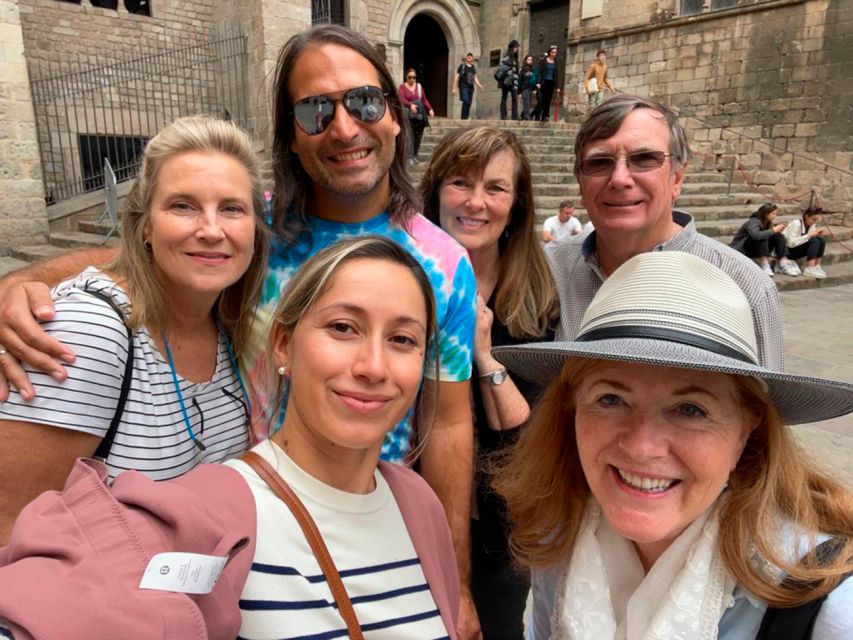
The Gothic section begins with places such as Plaça de Sant Felip Neri and Barcelona Cathedral. Sant Felip Neri is a small square with a more peaceful feel than the major streets nearby. It gives the guide room to discuss the old city in a setting that feels less hurried.
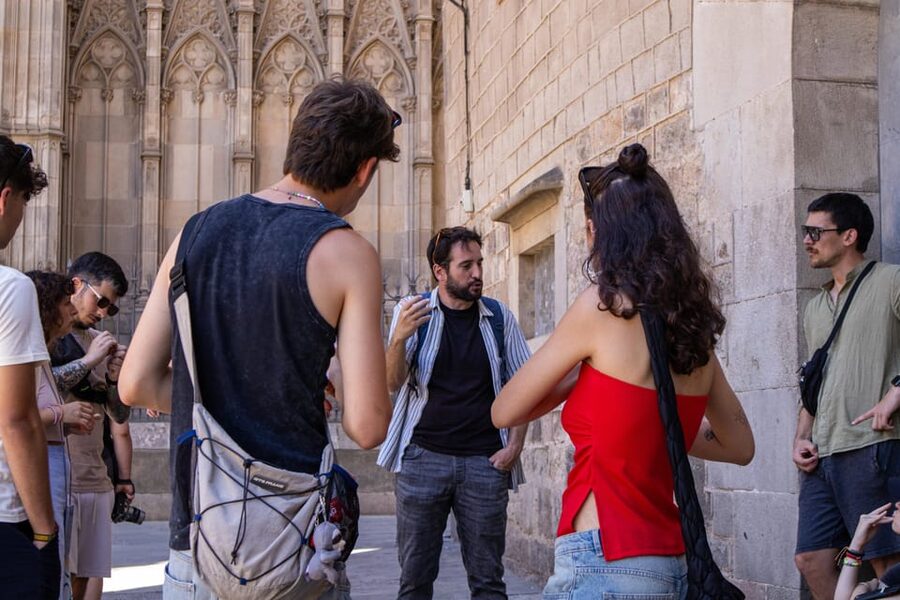
Barcelona Cathedral is one of the route’s main sights. You see it from outside and hear about its role in the city’s religious and civic story. The exterior rewards a slower look at its stonework, towers, and details, but you should remember that the tour does not include entry.
From there, the group passes La Casa de l’Ardiaca, the General Archive of the Crown of Aragon, and the Roman Aqueduct. These stops add texture to the Gothic Quarter. They also show that the old city is not simply medieval. Roman remains, later religious buildings, administrative houses, and modern public art all occupy the same compact area.
The Roman Aqueduct is particularly useful for understanding Barcelona’s age. You are not just walking through an attractive old neighborhood. You are moving through traces of several periods of urban life, often within a few minutes of one another.
Bishop’s Bridge, the Jewish Quarter, and the Temple of Augustus
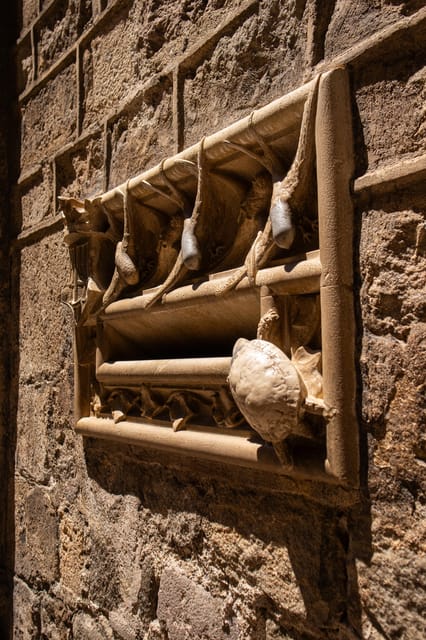
Bishop’s Bridge is among the most photographed details on the route. Its dramatic stone passage links buildings above a narrow street and has become a visual symbol of the Gothic Quarter. Your guide can explain its place in the district and help you frame a good photograph without stopping the group for too long.
The route continues through the Gothic Quarter and the former Jewish Quarter, then reaches Sant Jaume Square and the Temple of Augustus. The temple’s surviving columns are easy to miss because they sit within the modern city rather than in a wide archaeological park. That is exactly why a guide helps.
The Temple of Augustus offers one of the clearest reminders that Barcelona’s oldest story is tucked into its present-day streets. You get a short stop and explanation, not a museum visit. If ancient Roman remains are a major interest, you may want to return later and spend more time in the area.
The Kiss Mural and Plaça del Rei
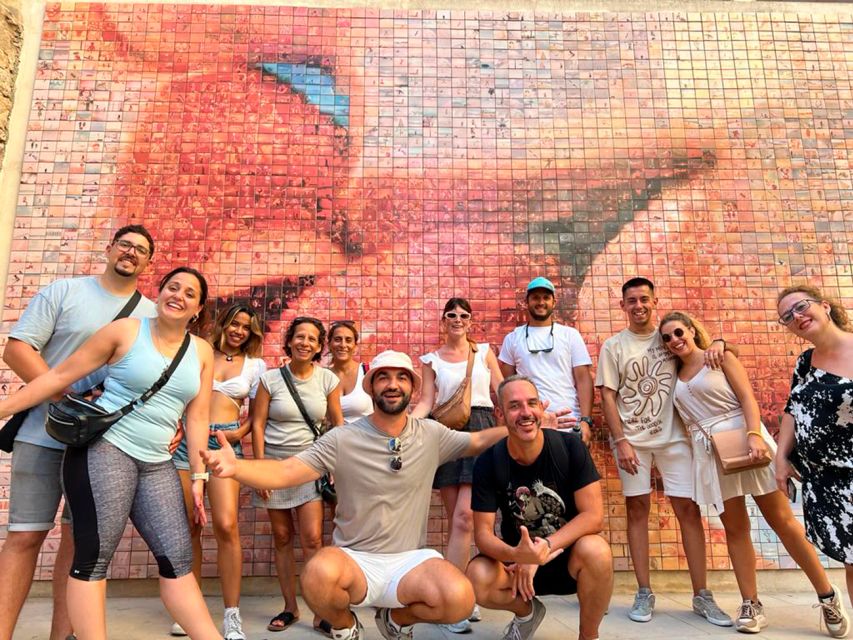
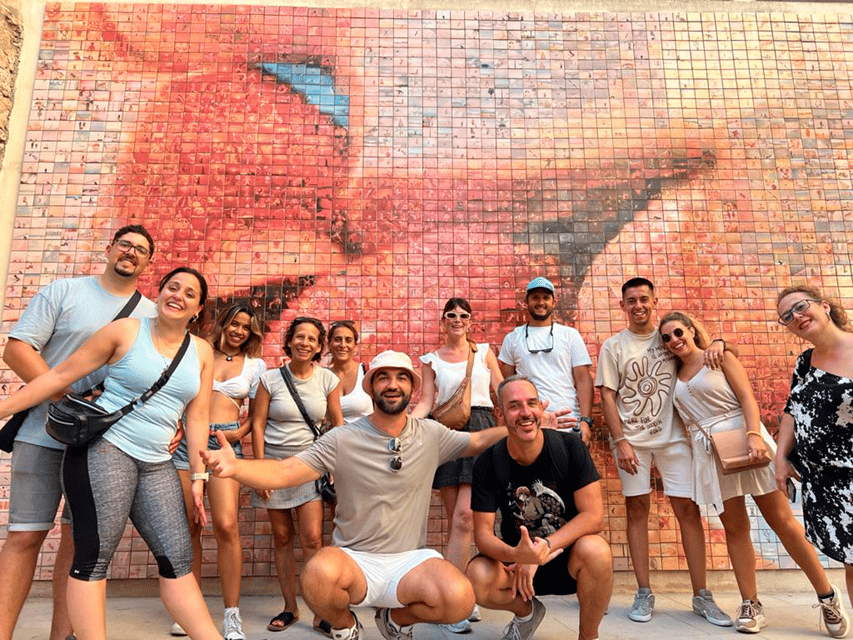
The final part of the route includes El Mural del Petó, or the Kiss Mural. Its thousands of small photographic tiles form a large image from a distance. It is a modern, public-art counterpoint to the churches, archives, and Roman remains seen earlier.
The tour ends around Plaça del Rei, one of the old city’s most atmospheric squares. This is a sensible finish because you are left in the historic center, close to more Gothic Quarter streets and other places to continue exploring. The listed drop-off is Plaça del Rei.
The route’s ending also reinforces the tour’s main idea: Barcelona is not one style or one period. Gaudí, Roman columns, Gothic churches, public murals, and grand 19th-century avenues all belong to the same city.
What the guides add to the experience
The guide can make or break a walking tour, and this one places unusual weight on storytelling. The guides are described as local artists or actors, and that shows in the emphasis on presentation, history, and visual detail.
Caio has been praised for combining an artist’s eye with warmth and humor. David is noted for clear English, strong historical explanations, patience, and useful restaurant suggestions. Albert has been described as responsive and especially good at explaining Sagrada Família details. Carlos is known for lively stories and a relaxed personality.
Other guides include Anastasiia, Nacho, Alex, Emma, Martin, Francisco, and Aldo. Languages offered are English, German, Spanish, French, and Italian. The exact guide depends on the departure, but the format favors conversation and questions rather than a recorded commentary.
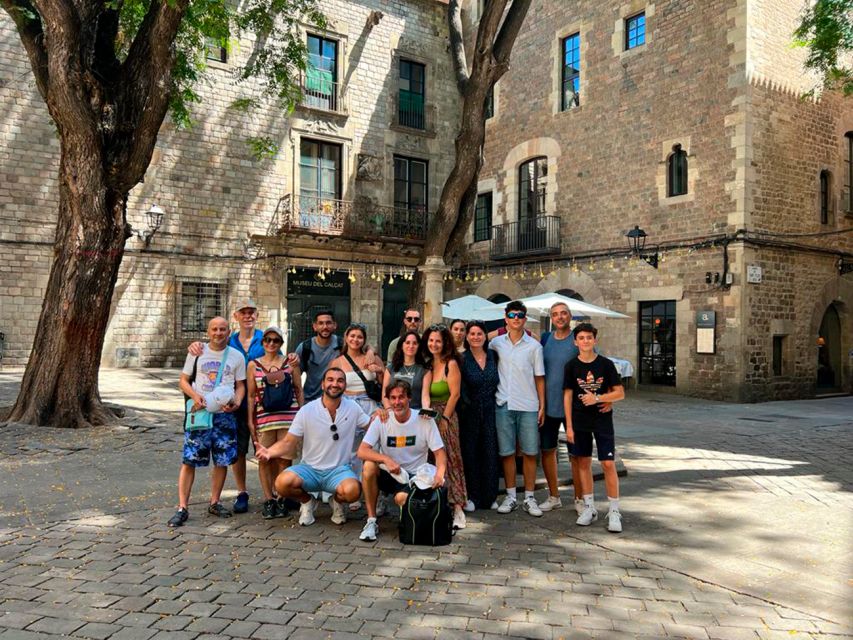
That small group of up to 10 matters. You can usually hear the guide more easily, ask about a building, and stay involved in the discussion. One practical benefit is that the guide can often adapt the pace or explanation to the group, although the route still covers a lot of ground.
The pace, walking, and value of $52
At $52 per person, the tour is not the cheapest way to walk around Barcelona. You are paying for a guide, a small group, storytelling, the included metro ride, and a route that links several parts of the city. You are not paying for monument admission.
I think the price makes sense if you want a polished first orientation and would otherwise spend time figuring out where the main sights are. The value is strongest for first-time visitors, short stays, solo travelers who want company, and anyone who enjoys architecture but prefers an explanation to a guidebook.
The value is weaker if you already know Barcelona well, want to enter several monuments, or prefer to set your own pace. In that case, you may do better with individual tickets and a self-guided walk.
The walking is continuous, with many short stops and one metro transfer. Comfortable shoes are essential. Large bags and luggage are not allowed, so arrive with a small day bag only. A scenic comfort break with restrooms is included, which is welcome on a route of this length.
The tour is wheelchair accessible, but the city’s historic streets and the amount of movement still make it sensible to confirm practical details when booking. The experience is designed to keep moving rather than settle into one site for a long period.
Who should book this Barcelona overview
I would choose this tour early in a Barcelona stay. It introduces the city’s major visual themes and helps you decide where to return for a longer visit. You can use the guide’s explanations to choose between entering the Sagrada Família, Casa Batlló, Casa Milà, or another sight later.
It also suits cruise passengers or anyone with a short stop. One participant described using the tour before a cruise, and the schedule fits a visitor who wants a broad city introduction in a single morning or afternoon.
Families and mixed-interest groups may also like the variety. The route changes from a huge basilica to Modernist façades, then to medieval squares and Roman columns. There is enough visual variety to keep the walk from feeling like one long architecture lecture.
I would be more cautious about booking it as your only Barcelona experience. Since the monuments are viewed from outside, you will still need separate planning if interiors matter to you. The tour gives you the city’s outline, not every major attraction in full.
Should you book the Sagrada Família and Old Town tour?
Book it if you want a small-group city overview with strong storytelling, a practical metro connection, and a useful blend of Gaudí, Modernism, Roman remains, and the Gothic Quarter. The guide’s personality is part of the product, and the limited group size gives the walk a more personal feel.
Skip it if your main goal is to enter the Sagrada Família or spend an hour inside each Modernist house. For that, buy admission separately and build your day around fewer sights.
For most first-time visitors, I would schedule this tour near the beginning of the trip, then return to the one or two interiors that caught your attention. That approach turns a fast-moving overview into a practical plan for the rest of Barcelona.
FAQ
Does the tour include entry to the Sagrada Família?
No. The tour provides a guided explanation and sightseeing from outside the Sagrada Família. Entry tickets are not included.
Are monument admission tickets included anywhere on the route?
No. The listed attractions are visited from outside, and admission tickets are not included.
How long does the tour last?
The tour lasts about 3 to 3.5 hours.
How large is the group?
The experience is limited to 10 participants.
Where is the meeting point?
Meet the guide in front of the KFC near the Sagrada Família. Look for the blue umbrellas.
Is public transportation included?
Yes. One Zone 1 metro ticket is included and is used during the tour.
Which languages are available?
The tour is offered in English, German, Spanish, French, and Italian.
Is the tour wheelchair accessible?
Yes, the activity is listed as wheelchair accessible.
What should I bring, and are large bags allowed?
Bring comfortable shoes. Luggage and large bags are not allowed.
Just added around Barcelona
- Love in the Gothic Quarter Barcelona: Self-Guided Romantic Walk★ 4.5 · 9 reviews
- Walking tour of the Gothic Quarter of Barcelona + Cathedral★ 5.0 · 8 reviews
- Wine tasting with a view of the Sagrada Familia★ 4.5 · 13 reviews
- Visit to the Modernist houses of the Americans★ 5.0 · 2 reviews
- Barcelona Jewish & Gothic Tour★ 5.0 · 18 reviews
- Roman & Gotic & Gaudi in Barcelona: private walking tour★ 4.5 · 2 reviews
- Self-Guided Audio Tour-The Surrealist Barcelona of Dalí and Gaudí★ 3.5 · 8 reviews
- Barcelona Gaudi Tour: Sagrada Familia, Casa Batllo & Casa Mila★ 5.0 · 4 reviews
Sagrada Familia Tours, compared.
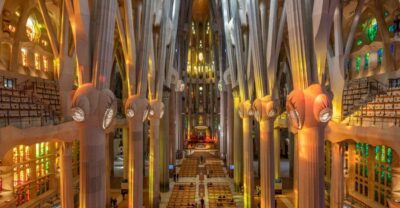
Barcelona: Sagrada Familia Entry Ticket with Audio Guide
Read our review →
Barcelona in 1 Day: Sagrada Familia, Park Guell,Old Town & Pickup
Read our review →
Barcelona: Sagrada Familia Skip-the-Line Entry Ticket & Tour
Read our review →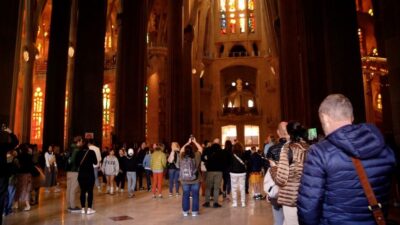
Barcelona: Sagrada Familia Skip-the-Line Guided Tour
Read our review →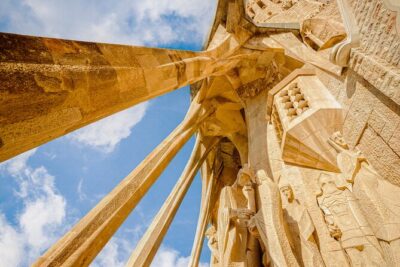
Barcelona: Sagrada Familia Priority Access Guided Tour
Read our review →
Barcelona: Sagrada Familia Tour & Optional Tower Visit
Read our review →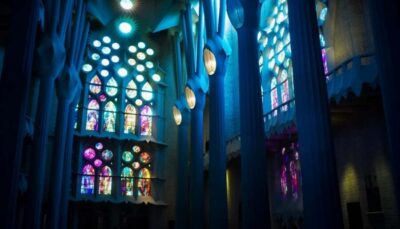
Barcelona: Sagrada Familia Guided Tour with Tower Access
Read our review →Barcelona: Sagrada Familia Skip-the-Line Guided Tour
Read our review →Browse the lists this tour appears in