
Review · ITALY
3-hour walking tour Discovering Ragusa Baroque
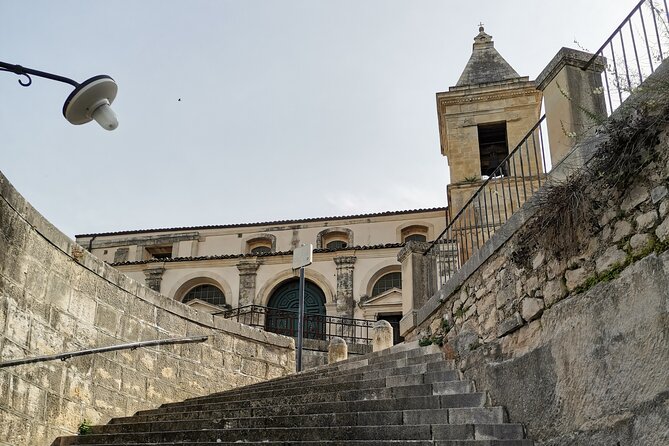
Ragusa’s best feature is the way the city unfolds as you walk downhill. This tour begins at San Giovanni Battista in Ragusa Superiore, crosses the old stairway route, and ends in Ibla among churches, gardens, and theatrical Baroque facades. Along the way, Serena explains the city’s history, architecture, customs, and feasts in clear English.
I like two things especially: the route gives you both halves of Ragusa rather than just the postcard center, and the small group size, capped at 10 people, leaves room for questions. I also like the practical shape of the walk, with the hardest part going downhill. The main drawback is clear: about 300 steps and uneven walking make this a poor choice for anyone with reduced mobility.
Key points at a glance
- Starts high and finishes low: Begin at San Giovanni Battista Cathedral and walk down to Ragusa Ibla.
- Three hours of Baroque detail: Expect churches, carved balconies, grotesque masks, gardens, and wide views.
- Serena is the guide: She brings strong knowledge of Ragusa, Sicily, architecture, and local traditions.
- Interiors depend on timing: Several churches may be open for visits, but access varies by season and time of day.
- Small groups matter: The maximum is 10 people, which suits a conversational history walk.
- Plan for stairs: Comfortable sneakers are essential, and the tour is not designed for reduced mobility.
Why the route from Superiore to Ibla works so well
Ragusa is easier to understand when you see its two levels in one continuous walk. The tour starts in Ragusa Superiore, the newer upper town, then descends toward Ragusa Ibla, the older district rebuilt after the earthquake that reshaped southeastern Sicily.
That downhill direction is a smart choice. You still need to manage many stairs, but you are not climbing the full route at the end of a three-hour walk. Serena uses the change in elevation to explain how Ragusa developed, why the two areas feel different, and how the Baroque rebuilding changed the city.
The route is not simply a church checklist. The buildings, stairways, views, and public squares work together. You begin with a large cathedral and end with gardens and a quieter sense of place. In between, the walk reveals the small details that are easy to miss alone: faces carved beneath balconies, unusual stonework, old portals, and buildings tied to local life.
More Baroque architecture tours in Italy:
- Lecce: Baroque Architecture and Underground Walking Tour
★ 4.6 · 1,248 reviews - Interpreti Veneziani Ensemble Baroque Concert in Venice Ticket
★ 4.5 · 403 reviews - Borghese Gallery Max 6 People Tour: Baroque & Renaissance in Rome
★ 5.0 · 185 reviews
San Giovanni Battista Cathedral sets the scene
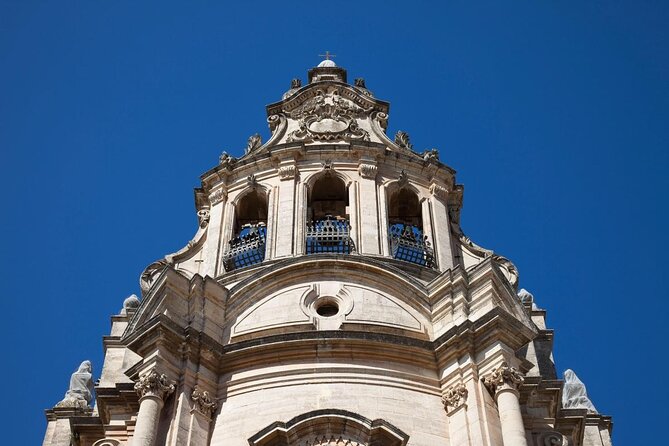
The first stop is San Giovanni Battista Cathedral in Piazza San Giovanni. You see its late Baroque exterior, broad terrace, balustrade, and side gardens before going inside.
Allow about 30 minutes here. That is enough time to look closely at the facade while Serena explains the cathedral’s story and the feast of Ragusa’s patron saint. The exterior gives you an immediate lesson in the theatrical style that defines the rest of the walk, with strong vertical lines, formal stonework, and a grand approach.
The interior visit is included without an extra admission charge. Church access can be affected by services or opening times, so the exact amount of time inside may vary. Still, beginning here gives the tour a useful anchor. You start with one of the city’s major religious buildings before moving into the tighter streets and stairways below.
Santa Maria delle Scale and the first great view
From the cathedral, the route descends toward Santa Maria delle Scale. The church is important because it preserves architectural elements from before the earthquake, giving you a glimpse of Ragusa before the Baroque rebuilding dominated the city.
The walk through this section is part of the experience. Rather than being moved between isolated sights, you pass through the old urban fabric on foot. The stairs are demanding, but they help you see how the upper and lower parts of town connect.
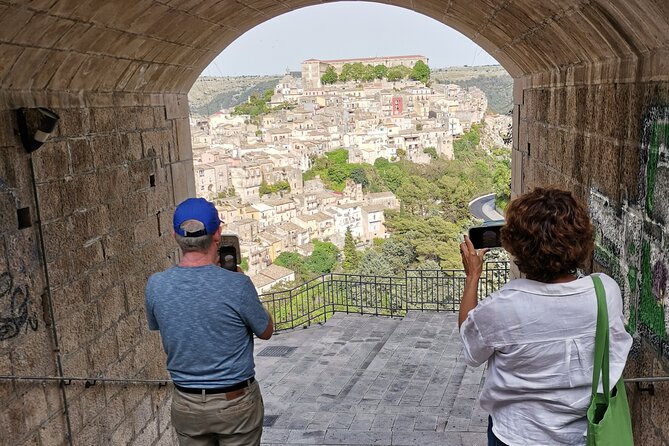
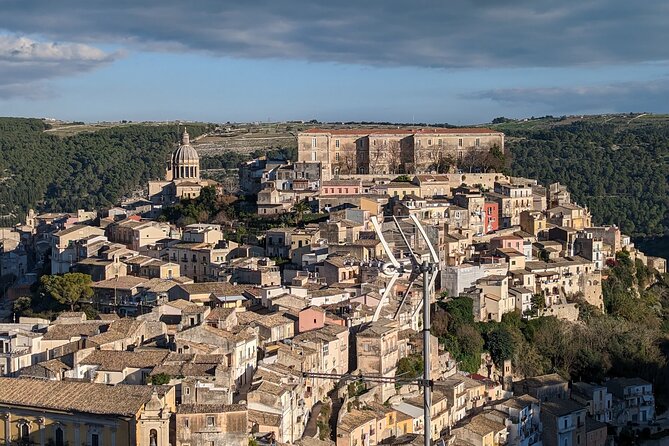
A viewpoint near Santa Maria delle Scale opens toward Ibla. This is one of the strongest visual moments of the tour. Depending on the time of day and season, you may also visit the church interior. Since access is not guaranteed, I would treat the exterior, the old architectural details, and the panorama as the reliable highlights.
This is also a good place to pause and take photographs. You get a wider view of Ragusa here than you do from the narrow lanes of Ibla, and the guide’s explanation gives the scene more meaning than a quick stop for a picture.
Grotesque masks and the language of Ragusa’s balconies
Several short stops focus on Baroque palaces and their decorated balconies. This is where the tour becomes especially useful for anyone who wants to understand Ragusa’s architecture rather than simply admire it.
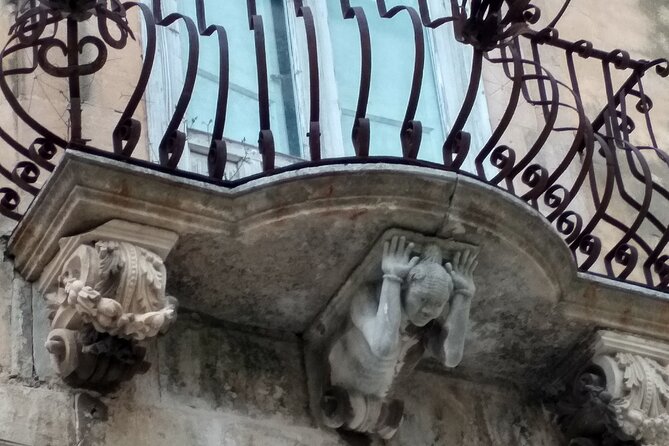
Look up as you walk. Balconies are not plain platforms here. Some carry grotesque masks, comic or strange stone faces that seem to peer down at the street. Other balconies have elaborate carved supports and dense decoration. The details can be easy to miss if you are concentrating only on church facades.
Serena explains what these features mean within the city’s Baroque style and points out differences between the buildings. You will see a late Baroque facade with six balconies decorated by grotesque masks, another facade with similar carved faces, and a palace whose balconies are the main attraction.
These stops are brief, but they break up the church visits. That matters because a three-hour tour focused only on interiors could feel repetitive. The balconies give you a more human and playful side of Ragusa’s architecture.
More architecture walks in Italy:
- Experience Florence’s Art and Architecture on a Walking Tour
★ 5.0 · 318 reviews - Guided Walking Tour of Rome: Top Sights & Baroque Treasures
★ 5.0 · 155 reviews - Palermo: Art and Architecture Walking Tour
★ 4.7 · 136 reviews - Rome’s Baroque Art Walking Tour: Who Killed Caravaggio?
★ 5.0 · 27 reviews
Santa Maria dell’Itria and Palazzo Cosentini
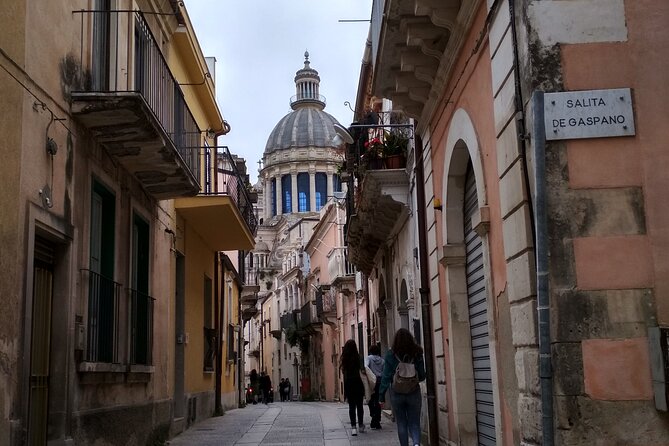
The next major stop is Santa Maria dell’Itria. Serena explains the church’s story and its connection with Palazzo Cosentini, whose late Baroque facade is one of the notable sights along the route.
The link between church and palace gives this stop extra interest. You are not just looking at two unrelated buildings. The former internal connection helps show how religious and private spaces once fitted together within the same part of the city.
Again, you may visit the church interior depending on the season and time of day. The exterior is the dependable part of the stop, especially the palace facade and its detailed stonework.
I like this section because it gives you a chance to compare styles. The tour has already introduced the grand cathedral, the pre-earthquake elements at Santa Maria delle Scale, and the theatrical balconies. At Santa Maria dell’Itria and Palazzo Cosentini, those ideas start to form a clearer picture of Ragusa’s rebuilding and civic identity.
San Giorgio, the Conversation Club, and local screen fame
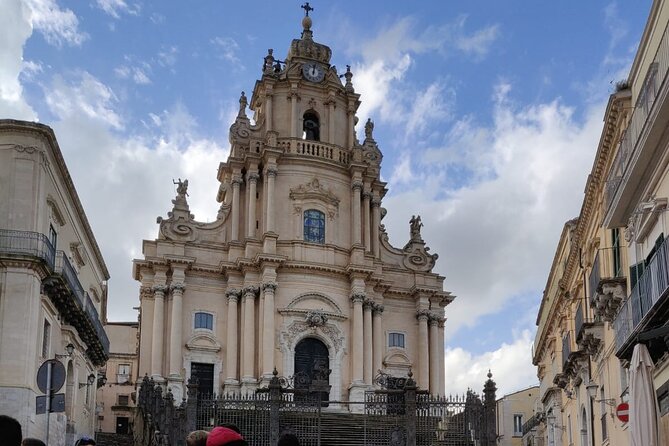
Duomo di San Giorgio is another 30-minute stop. Its facade rises at the top of a staircase, creating one of Ibla’s most memorable approaches. Serena tells you about the church, its saint, and the local feast before you look at the details of the exterior.
The setting matters as much as the building. The staircase frames the facade and gives the church a sense of arrival. Depending on opening hours, the interior may also be included.
Nearby, the tour passes the Conversation Club, sometimes called the Café of the Knights. The location is known for scenes from the Inspector Montalbano television fiction, so this is a fun point for anyone familiar with the series. It is not the main purpose of the walk, but it adds a modern pop-culture connection to the older streets.
The route also includes the late Baroque facade of a Benedictine church. If it is open, you may see its unusual oval-shaped interior. That shape gives the stop a different feel from the larger cathedral interiors and offers another example of how varied Sicilian church design can be.
The old portal of Saint George
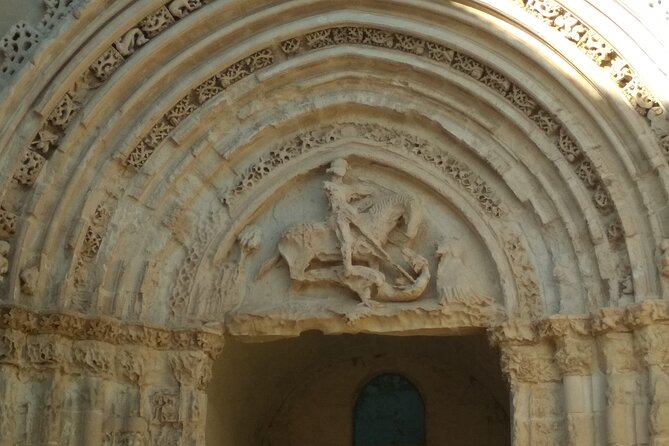
One of the shorter stops focuses on the ancient portal of Saint George church. This is another pre-earthquake survival, and it helps explain the contrast between Ragusa’s older architectural layers and the later Baroque facades.
Do not expect a long visit here. The value lies in the comparison. By this stage, you have seen ornate rebuilding, grand stairs, carved masks, and formal church fronts. The old portal brings you back to an earlier style and shows that Ragusa is not only a Baroque city.
This kind of detail is where a guide earns the fee. On your own, you might walk past the portal without knowing why it matters. With Serena, the fragment becomes part of a larger story about destruction, rebuilding, and the city’s changing appearance.
Iblean Gardens provide a calm finish
The tour ends at the Giardini Iblei, or Iblean Gardens, the green heart of Ragusa Ibla. After the stone facades and long stairways, the gardens give you a more open and relaxed final section.
The gardens contain three churches. Depending on the day and time of year, the route may include visits to the churches of St. James and St. Agata. As with the other interiors, you should regard these visits as possible rather than guaranteed.
Ending here is practical as well as pleasant. The tour finishes near the urban bus stop and taxi stand in Ibla, so you can continue exploring, return to upper Ragusa, or arrange transport onward. The final location also leaves you in a good position for a meal or a slower walk through the lower town.
Serena’s guiding style and what you can expect
Serena is the central strength of this experience. She explains history, architecture, art, local traditions, and Sicilian culture in clear English, with a calm and friendly manner. Her approach suits people who want plenty of information without being rushed through a memorized speech.
She is also reported to help with practical planning. That includes arrival guidance, restaurant suggestions, and ideas for further visits in the area. If you are staying in Ragusa, this can make the tour useful beyond its three-hour route.
The small group limit is important. With no more than 10 people, you should be able to hear the guide and ask questions at the churches and viewpoints. The format also allows some flexibility. The tour may run slightly longer when the group is small and conversation continues, though you should not count on extra time if you have another fixed booking.
The strongest praise centers on Serena’s ability to make the past understandable and lively. That is especially valuable in Ragusa, where much of the interest is in details that need explanation. You get more than dates and names. You get the reasons behind the architecture and the stories connected with the buildings.
Is $78.44 a fair price?
At $78.44 per person, this is not the cheapest way to walk around Ragusa. The churches listed here have no separate admission charge, so you are paying mainly for Serena’s time, planning, local expertise, and the structure of the route.
I think the price can be fair if you want a serious introduction to Ragusa in one morning or afternoon. You cover both Superiore and Ibla, see major churches and palaces, hear the local context, and finish in the lower town. A self-guided walk costs less, but it may not explain the link between the buildings or help you notice the masks, old portal, and architectural contrasts.
Group discounts may be available, which could improve the value for larger parties. The tour is also often booked well ahead, around 26 days in advance on average, so you should not assume you can always arrange it at the last minute.
What to bring and who should book
Wear comfortable sneakers. The route includes many steps, and one detailed account describes roughly 300 steps from the upper town toward Ibla. The walk is described as casual rather than athletic, but the stone stairways still require steady footing.
This tour suits you best if:
- You want to understand Ragusa’s Baroque architecture.
- You prefer a small group to a large guided crowd.
- You enjoy churches, historic buildings, and local stories.
- You want to see both Ragusa Superiore and Ragusa Ibla.
- You are comfortable with extended walking and stairs.
- You have only a few hours and want a structured introduction.
It is less suitable if you have reduced mobility, dislike stairs, or want a tour centered mostly on food and free time. It is also worth remembering that several interiors depend on the day, season, and opening hours.
The tour is offered in English, service animals are allowed, and most people can participate if they can manage the walking. Confirmation is provided when you book. You can cancel for a full refund up to 24 hours before the start, while poor weather or failure to meet the minimum group size may lead to a new date or full refund.
Should you book this Ragusa walking tour?
Book it if you want Ragusa explained, not just photographed. The route gives you the city’s main Baroque sights, a memorable view from the stairway, old architectural remains, local television connections, and a gentle finish in the Iblean Gardens.
I would especially choose it for a first visit, a short stay, or anyone curious about the difference between Ragusa Superiore and Ibla. Serena’s clear English and strong command of local history add real value.
Skip it if stairs are a serious problem or if you prefer exploring without a set pace. For everyone else, this is a well-shaped introduction to Ragusa, with enough architecture and local detail to make the city easier to read after the walk ends.
FAQ
How long does the Discovering Ragusa Baroque tour last?
The walking tour lasts approximately three hours, including time between the stops and the visits themselves.
Where does the tour begin?
It begins at San Giovanni Battista Cathedral, at Piazza San Giovanni, 41/45, in Ragusa Superiore.
Where does the tour end?
It ends near the Iblean Gardens in Ragusa Ibla, close to an urban bus stop and taxi stand.
Is the tour offered in English?
Yes. The tour is offered in English, and Serena guides the experience in clear English.
How many people can join the tour?
The group has a maximum of 10 people.
Is the tour suitable for people with reduced mobility?
No. The tour is not recommended for people with reduced mobility because the route includes many steps.
Are church admission fees included?
The listed church visits have no separate admission charge. Access to several interiors depends on the time of day and the season.
More 3-Hour Experiences in Italy
- Discover Lecce’s Baroque Secrets: A 3-Hour tour
★ 4.8 · 31 reviews - 3H Rome: Baroque, Ancient and food experience by Golf Cart
★ 3.3 · 3 reviews - Brussels 3-Hour Guided Art Nouveau Tour
★ 4.0 · 282 reviews - Munich 3-Hour Segway Tour: Nazi Munich & Royal Architecture
★ 4.9 · 194 reviews
Just added around Italy
- Vicenza: discovering the city of Palladio by e-bike★ 5.0 · 4 reviews
- Vicenza: Palladian Architecture Private Walking Tour★ 3.3 · 3 reviews
- Turin: Art Nouveau Walking Tour with Coffee★ 5.0 · 11 reviews
- Vatican: Exclusive Baroque Evening With Aperitivo & Dinner★ 3.1 · 2 reviews
- Venice Music Project – Baroque Autumn – Season 2025★ 4.5 · 7 reviews
- Walking tour in Venice with an architect★ 5.0 · 16 reviews
- Palladio. A wonderful live tale through time&soul, from Ve/Pd/Vr★ 5.0 · 7 reviews
- Turin, Art Nouveau walking tour and coffee break★ 4.0 · 7 reviews
Baroque Architecture Tours, compared.
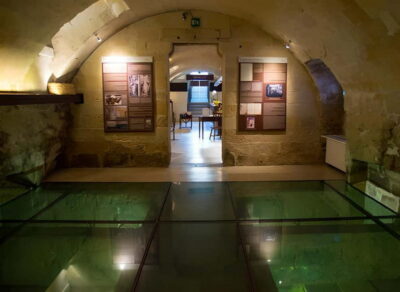
Lecce: Baroque Architecture and Underground Walking Tour
Read our review →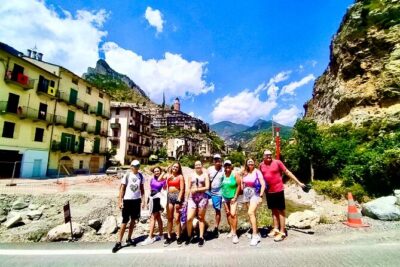
Train Exp. through the Alps (Royal Baroque Route from Nice)
Read our review →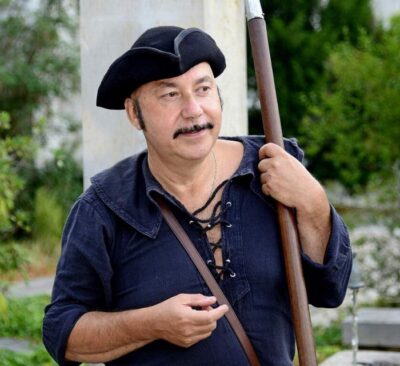
Dresden: Tour of the Baroque Quarter with a Night Watchman
Read our review →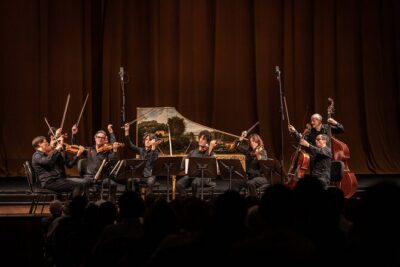
Interpreti Veneziani Ensemble Baroque Concert in Venice Ticket
Read our review →
Borghese Gallery Max 6 People Tour: Baroque & Renaissance in Rome
Read our review →
Concert at the Palais Schönborn-Batthyány by the Vienna Baroque Orchestra
Read our review →
Guided Walking Tour of Rome: Top Sights & Baroque Treasures
Read our review →
Noto, Modica and Ragusa: The Baroque Tour from Catania
Read our review →Browse the lists this tour appears in