
Review · CHICAGO
Private Chicago Architecture Walking Tour
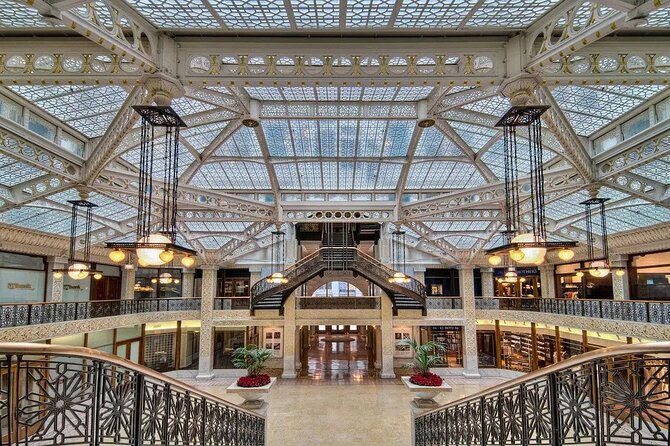
Chicago’s architectural story comes alive in eight downtown buildings, from the investor-driven Marquette Building to the soaring clock tower of the Wrigley Building. This is a compact walk through the Loop and along Michigan Avenue, with interiors at several stops when they are open.
I like the private format, which lets your guide adjust the pace and explain details without a large group crowding a lobby. I also like the route’s range: speculative offices, a grand hotel, a former department store, a private club, a stained-glass civic center, and two famous towers.
The main caution is building access. You will not necessarily enter every property, and weekend hours can limit indoor visits. Lunch is listed as included, but that detail has caused confusion, so confirm it before booking.
Key things to know before you book
- Eight major buildings in about three hours: The route covers the Marquette, Rookery, Palmer House, Sullivan Center, Chicago Athletic Association, Cultural Center, Tribune Tower, and Wrigley Building.
- A private English-speaking guide: Only your group participates, making it easier to ask questions and set a comfortable walking pace.
- A route through Chicago’s early skyscraper era: You’ll see how offices, department stores, hotels, clubs, and civic buildings shaped the Loop.
- Interiors are part of the plan, but not guaranteed: Access depends on opening hours and building rules, with weekends usually more restricted.
- The tour begins near the Fine Arts Building and ends at the Wrigley Building: You finish on Michigan Avenue rather than returning to the start.
- Lunch needs checking: It is listed among the inclusions, but one booking experience reported that lunch was not provided despite prior confirmation.
Why this Chicago walk works
At $211 per person, this is not a cheap way to look at downtown buildings. You are paying for a private guide, a focused route, admission fees where applicable, bottled water, and roughly three hours of organized sightseeing.
The value depends on how much you want from the buildings. If you simply want to photograph the Wrigley Building and Tribune Tower, you can do that for free. If you want help reading Chicago’s architecture, comparing styles, and making sense of the city’s commercial rise, a private walk gives you much more.
The route is especially useful on a first visit. Downtown Chicago can feel like a wall of stone, steel, and glass until someone points out why one facade uses terra cotta, why another building opens around a light court, or how hotel and office design reflected social status.
You also get a useful mix of famous places and less obvious stops. The Rookery and Tribune Tower attract plenty of attention, but the Marquette Building and Sullivan Center help explain how ordinary commercial needs pushed architects toward new forms.
The pace is brisk but reasonable on paper. Eight stops in three hours leaves roughly 20 minutes at several buildings, with shorter visits at the Palmer House, Tribune Tower, and Wrigley Building. You will want comfortable shoes, even though the route is concentrated downtown.
More architecture walks in Chicago:
- Chicago in a Day: Food, History & Architecture Walking Tour
★ 5.0 · 1,153 reviews - Chicago’s Secret Interiors Architectural Walking Tour
★ 5.0 · 635 reviews - Chicago: Secret Interiors Architecture Walking Tour
★ 4.9 · 498 reviews
Starting at the Fine Arts Building and the Marquette Building
The meeting point is the Fine Arts Building at 410 South Michigan Avenue. From there, the walk heads into Chicago’s Loop, where the first stop is the Marquette Building.
The Marquette was built during the late 19th-century construction boom as a speculative office property. That phrase matters. It was not designed as a palace for one company or a private home for one powerful family. It was a stack of premium offices meant to attract tenants and make money for investors betting on Chicago’s future.
Your guide can use the building to explain the practical side of early skyscraper development. Chicago’s tall buildings were not only technical experiments. They were business machines, built to pack valuable office space into a small downtown footprint.
You have about 20 minutes here, and admission is included. The stop works best when you pay attention to the details that reveal the building’s original purpose: the sense of movement, commerce, and rented office space rather than royal grandeur.
The Rookery, Chicago’s early office showpiece
The Rookery sits at LaSalle and Adams, in the heart of the old financial corridor. When it opened, it was regarded as one of the largest and finest office buildings in the United States.
This is one of the strongest stops on the walk. The building shows Chicago reaching for a new urban identity after the city’s rapid growth. It was meant to impress companies, clients, and investors, while also solving the hard problem of housing many offices in a tall downtown structure.
You get about 20 minutes and admission is included. That is enough for a focused look, though not enough for a slow architectural study. If the building is open during your visit, pay attention to how light, circulation, and decoration work together. This is a place where your guide’s explanation adds real value, since a quick photograph does not tell you why the design mattered.
The Rookery also gives the tour a strong historical center. It is not simply an old building in a modern city. It helps you see Chicago as a place where office architecture was being tested, refined, and sold as a business advantage.
Palmer House, where hotel technology made a statement
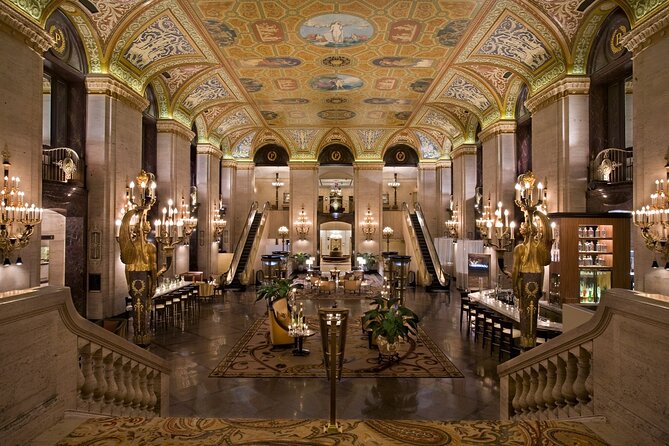
The Palmer House Hilton is a short but worthwhile stop. You spend about 10 minutes in the historic lobby, and there is no separate admission fee.
The hotel is described as the longest continuously operating hotel in North America. It was also the city’s first hotel with elevators, and the first to offer electric light bulbs and telephones in guest rooms. Those details turn a quick lobby visit into a lesson in comfort, speed, and modern convenience.
I like this stop because it changes the subject. The Marquette and Rookery focus on office buildings and investment. Palmer House shows how hotels competed by offering new technology and a more polished urban experience.
Ten minutes will not allow a long look around, especially if the lobby is busy. Still, it is a useful pause in the route and a reminder that Chicago’s building history is also a story about how people worked, slept, met, and moved through the city.
More private architecture tours in Chicago:
- Best of Chicago: Architecture & Highlights City Private Tour
★ 5.0 · 94 reviews - Chicago in a Day: Food and Architecture Private Walking Tour
★ 5.0 · 53 reviews - Private Frank Lloyd Wright Architectural Tour by Luxury Vehicle
★ 3.5 · 7 reviews - Chicago: Private Architecture Tour – 3 or 6 Hours
★ 4.0 · 6 reviews
Sullivan Center and the commercial Chicago School
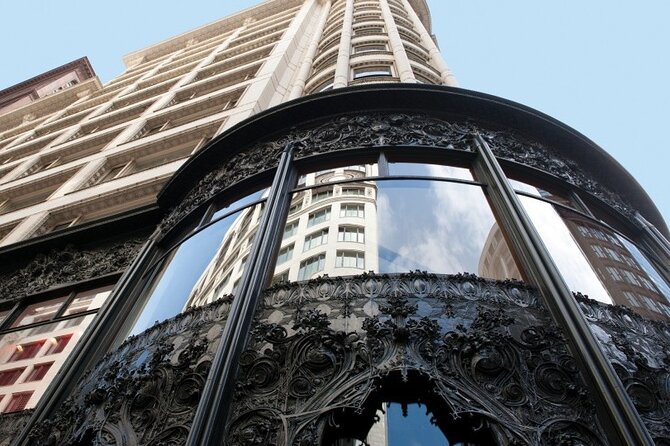
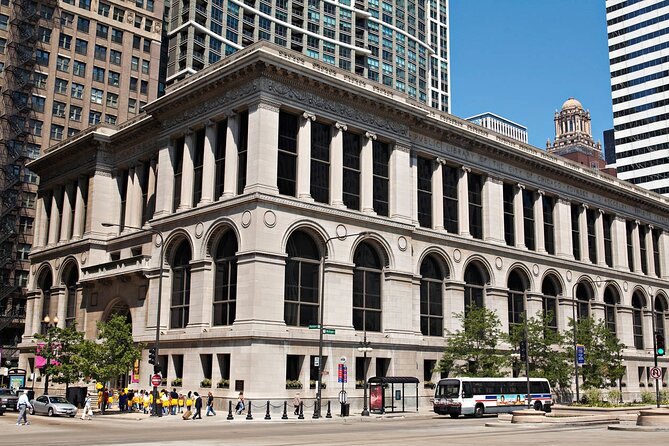
The Sullivan Center, formerly the Carson Pirie Scott department store, is one of the clearest examples of Chicago School architecture on the route. Built from 1899 to 1903, it remained tied to retail use throughout its life and was designated a Chicago landmark in 1975.
You get about 20 minutes here, with admission included. The building is valuable because it connects architectural invention to shopping. Its design had to attract people from the street, handle large amounts of merchandise, and create a strong identity for a department store.
This is an excellent place to ask your guide how commercial architecture changed as Chicago grew. The lower levels and upper office areas did different jobs, and the building’s decoration helped make a practical retail structure memorable.
The stop also gives you a clear example of Louis Sullivan’s importance to the Chicago School. Even if you do not arrive with an interest in architectural theory, you can understand the basic point: a tall building needed a useful structure, but it also needed a convincing public face.
The Chicago Athletic Association’s Venetian Gothic interior
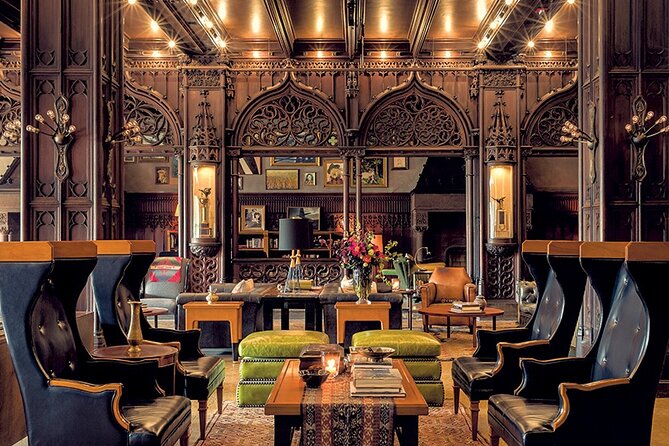
The Chicago Athletic Association occupies an 11-story Venetian Gothic building designed by Henry Ives Cobb and completed in 1893. It functioned as a private club for wealthy Chicagoans until 2007, then became a hotel.
The tour allows about 30 minutes here, with no admission fee. That is one of the longer stops, and it makes sense. The interior contains ornate paneling, elaborate molding, and detailed trim, while the current hotel use keeps the space active rather than frozen in the past.
The building sits across from Millennium Park and includes restaurants, pubs, ballrooms, and Lake Michigan views. The tour does not promise time for a meal or a full exploration of hotel facilities, but you can expect an important look at how an old private club has been adapted for modern public use.
This stop is also a good test of the tour’s private format. In a large group, it can be hard to stop and inspect small details without blocking hotel traffic. With only your group, you should have more room to ask about the club’s former role and the changes made during its conversion.
Chicago Cultural Center and the Tiffany glass dome
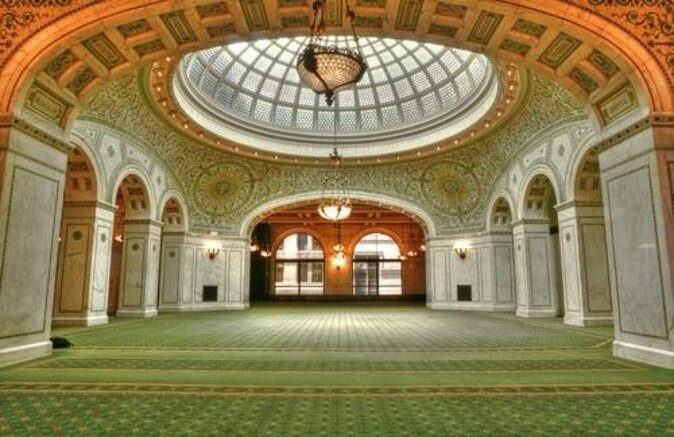
The Chicago Cultural Center takes up a full city block and is one of the most rewarding indoor stops on the route. Its best-known feature is the world’s largest Tiffany stained-glass dome.
You have about 30 minutes here, and admission is included. The building now serves as the cultural heart of the Loop, with more than 700 humanities programs each year, many of them free and open to the public.
This is a welcome change from the commercial buildings earlier in the walk. The Marquette, Rookery, and Sullivan Center were built to make money. The Cultural Center shows Chicago using grand architecture for civic and cultural life.
Give yourself time to look upward. The dome is the obvious attraction, but the larger lesson is how much visual drama a public building can offer without charging an admission fee. If you return later, you could spend much longer here than the scheduled half hour.
The stop is also practical for visitors who want an indoor break. The tour is still moving at a steady pace, but this is one place where you can pause, look carefully, and let the architecture carry the experience.
Tribune Tower and the Gothic face of Michigan Avenue
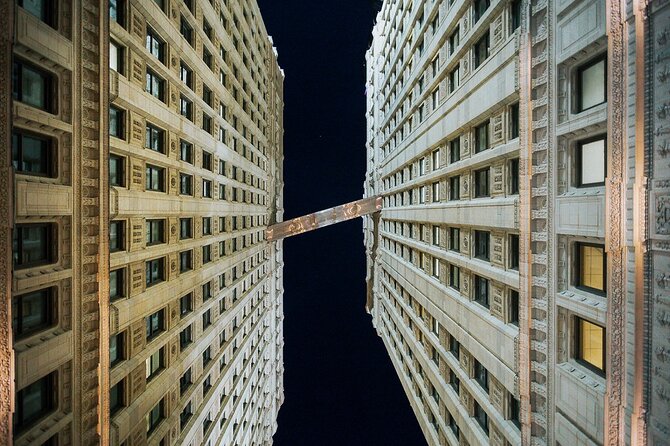
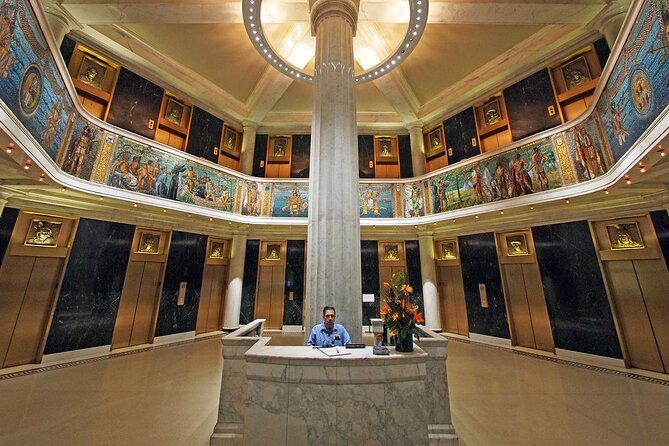
The Tribune Tower is one of Chicago’s most recognizable buildings. It rises 36 stories, with Gothic spires and a shrine-like lobby decorated with inspirational quotations.
You spend about 15 minutes here, with admission included. That is enough for a concise introduction, but not a full building tour. The tower’s importance comes from its personality. It does not try to hide its Gothic references behind a plain modern office facade. It presents itself as a symbolic landmark.
This is a useful moment to compare styles. Earlier stops show the practical growth of office and retail architecture. Tribune Tower uses historic-looking detail to give a newspaper headquarters a sense of authority and permanence.
If you care about photography, this is one of the route’s strongest exterior stops. The building’s spires are easy to recognize, and the lobby adds another layer if access is available during your visit.
Wrigley Building, the finish on the Chicago River side
The walk ends at the Wrigley Building, at 400 to 410 North Michigan Avenue. This is a fitting final stop because the building is one of downtown’s most familiar landmarks and a clear visual marker of 1920s Chicago.
The building uses French Renaissance ornament, but its clock tower is the feature most people remember. The tower reaches 425 feet, or about 130 meters, giving the structure a strong vertical presence along the avenue.
You get about 15 minutes here, with admission included. The short stop focuses on the building’s exterior identity and the way its bright ornament and tower help define Michigan Avenue.
Ending here also makes practical sense. You finish near public transportation and in one of the city’s busiest sightseeing areas. The tour does not return you to the Fine Arts Building, so plan your next stop from the Wrigley Building rather than assuming a round trip.
What the private format is worth
The private setup is the clearest reason to consider paying $211 per person. You are not sharing the guide with a large public group, and the itinerary can feel more like a conversation than a lecture.
That matters in buildings with active hotels, offices, and public spaces. Your guide can answer questions about construction, use, and style as they come up. You can also ask for more detail at a building that interests you, though the fixed three-hour schedule may limit major changes.
The English-only format is simple and clear. Bottled water and all fees and taxes are included. Lunch is also listed as included, but because one booking experience found that lunch was not provided despite prior confirmation, I would get written clarification before paying.
The tour has a rating of 4.8 from six reviews, with the strongest praise aimed at the guide’s detailed explanations, friendly manner, planning, and personalized feel. One useful warning runs alongside that praise: indoor access can be limited, especially on weekends.
Timing, access, and practical planning
The tour starts at the Fine Arts Building and ends at the Wrigley Building. It lasts about three hours and is offered in English.
Confirmation arrives when you book. The route is near public transportation, service animals are allowed, and most people can participate. You should still expect a continuous urban walk with time on your feet.
Building entry is the biggest variable. The schedule lists admission at the Marquette Building, Rookery, Sullivan Center, Cultural Center, Tribune Tower, and Wrigley Building. The Palmer House and Chicago Athletic Association have no admission fee listed. That does not mean every interior is guaranteed at every hour.
Weekend tours may have fewer indoor opportunities. If historic interiors are your main reason for booking, ask about the planned date and access before committing. A closed lobby does not ruin the route, since the exteriors are important too, but it changes the experience.
Free cancellation is available until 24 hours before the start time. Cancellations inside that window are not refunded, and changes are not accepted. If your schedule is uncertain, keep that deadline in mind.
Should you book this architecture walk?
Book it if you want a private, guided introduction to Chicago’s built history and prefer a clear route over wandering downtown on your own. It suits first-time visitors, architecture fans, and anyone who wants context for famous buildings rather than a series of exterior photographs.
The price makes less sense if you mainly want free public views or if you need guaranteed access to every interior. The lunch issue also deserves a direct check before booking.
My call: choose this tour for the guide, the private pace, and the mix of office buildings, hotels, retail spaces, civic architecture, and towers. Go in expecting a well-planned walking overview, not an exhaustive building tour. Ask about weekend access and lunch in advance, wear comfortable shoes, and you will have a much clearer view of why Chicago became one of the world’s great architecture cities.
FAQ
How long does the private Chicago architecture walking tour last?
The tour lasts approximately three hours.
Where does the tour begin?
It begins at the Fine Arts Building, 410 South Michigan Avenue, Chicago, Illinois 60605.
Where does the tour end?
The tour ends at the Wrigley Building, 400 to 410 Michigan Avenue, Chicago, Illinois 60611.
Is the tour private?
Yes. Only your group participates in the activity.
What language is the tour offered in?
The tour is offered in English with an English-speaking guide.
Is lunch included?
Lunch is listed as included, but one booking experience reported that lunch was not provided despite prior confirmation. Confirm this detail with the provider before booking.
Can I cancel for a full refund?
Yes. You can cancel at least 24 hours before the local start time for a full refund. Cancellations made less than 24 hours before the start time are not refunded.
Just added around Chicago
- Private Chicago Architecture Tour★ 5.0 · 5 reviews
- Private Frank Lloyd Wright Architectural Tour by Luxury Vehicle★ 3.5 · 7 reviews
- Chicago Luxury Minibus City Tour and Architecture River Cruise★ 4.5 · 8 reviews
- Chicago History and Architecture Walking Tour with Boat Cruise★ 4.5 · 10 reviews
- Small Group History And Architecture Walking Tour of Chicago★ 4.5 · 8 reviews
- Chicago: Evolution of the Skyscraper Walking Tour★ 4.9 · 10 reviews
- Chicago’s Modern Skyscrapers Guided Walking Tour★ 5.0 · 6 reviews
- Chicago Walking Tour: See Inside Art Deco Masterpieces★ 4.9 · 8 reviews
Walking Tours, compared.
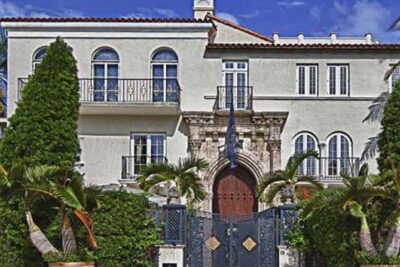
The Official Art Deco Walking Tour by The Miami Design Preservation League
Read our review →
Barcelona: Gothic Quarter Ghosts and Legends Walking Tour
Read our review →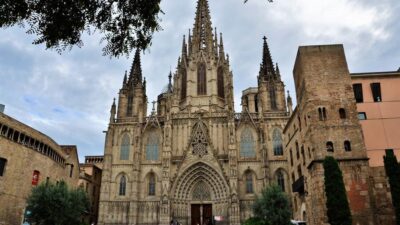
Barcelona: Old Town and Gothic Quarter Walking Tour
Read our review →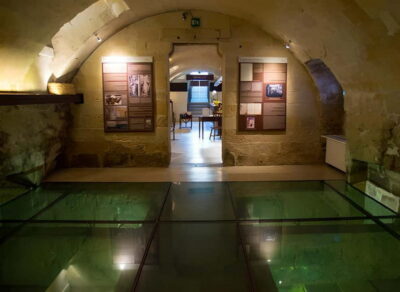
Lecce: Baroque Architecture and Underground Walking Tour
Read our review →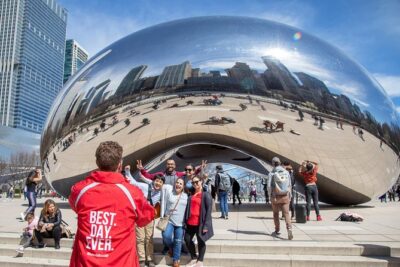
Chicago in a Day: Food, History & Architecture Walking Tour
Read our review →
Ramblas, Old Town, Gothic and Gaudi Architecture Walking Tour
Read our review →
Chicago’s Secret Interiors Architectural Walking Tour
Read our review →Browse the lists this tour appears in