
Review · ITALY
Palermo Tour: Magnificent Mixture Of Architectural Styles
Palermo’s story is written in its streets. On this walk, you move from grand 19th-century avenues to narrow lanes shaped by Arabic influence, then on to a cathedral where Frederick II and his family are buried. I like that the route joins major landmarks with ordinary squares and market streets, so you get more than a parade of grand façades.
I also like the private-group format and the guides’ personal touch. Roberta is noted for bringing local and world history together, while Marilou presents Palermo in an authentic, personal way. The main consideration is time: two hours is enough for an excellent introduction, but not enough for a leisurely interior visit at every stop. Tickets for the royal tombs, food, and transportation cost extra.
Key points to know before you book
- Politeama is the starting point: Meet in Piazza Ruggiero Settimo, in front of the Politeama Theater near the statue.
- Teatro Massimo anchors the early route: You see Italy’s largest lyric theater and Europe’s third largest.
- The walk connects two famous markets: The route passes through Capo Market and later reaches Vucciria.
- The cathedral adds royal history: Frederick II of Swabia and family members rest in the cathedral’s royal tombs, but entry to the tombs is not included.
- A private group keeps the pace personal: The price is $344.39 for up to 25 people, so the value improves sharply with a larger group.
- The tour is built for orientation: In two hours, you cover a broad slice of central Palermo without arranging taxis or transfers.
Palermo in two hours: what this walk really offers
This is a compact introduction to central Palermo, not a full museum tour. You spend the time on foot, moving through streets, squares, market lanes, and landmark exteriors with a licensed guide.
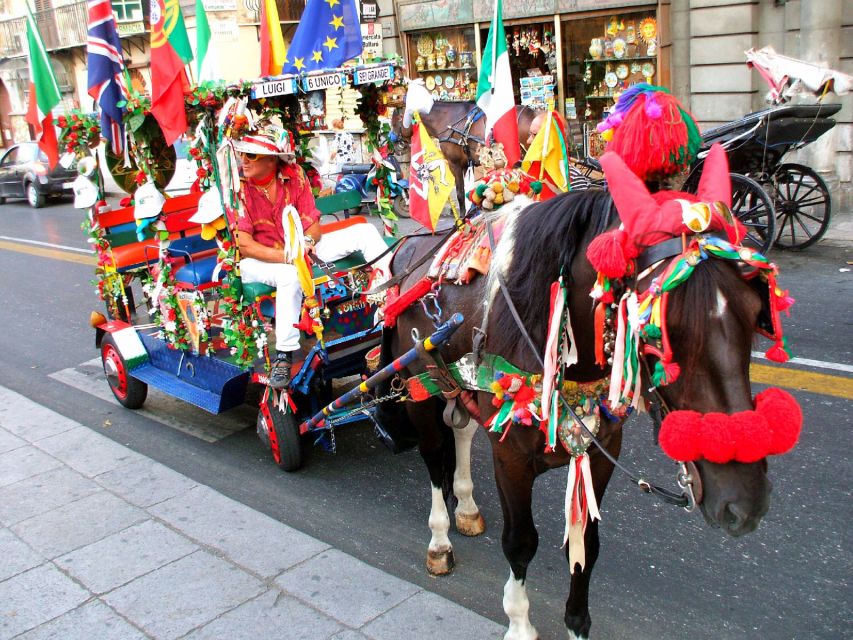
That format suits you if you want help making sense of Palermo before exploring on your own. The city’s center can feel like several places at once. Wide shopping streets, grand theaters, old palaces, Arabic-influenced lanes, and open-air markets all sit within the same walking route.
The guide gives the route its value. A good guide can point out how the city’s architecture changes from one block to the next, explain why a square matters, and help you see beyond the first photograph. The available languages are English, Italian, Spanish, French, and German.
At $344.39 per group, this is not a bargain for one or two people. For a group of four, it comes to about $86 per person. For ten people, it is about $34 per person, and for a larger family or group of friends, the cost becomes more reasonable. Since the price covers up to 25 people, the private format is the main value rather than the number of sights included.
A few more architecture tours around Italy worth a look
- Lecce: Baroque Architecture and Underground Walking Tour
★ 4.6 · 1,248 reviews - Experience Florence’s Art and Architecture on a Walking Tour
★ 5.0 · 318 reviews - Palermo: Art and Architecture Walking Tour
★ 4.7 · 136 reviews
Starting at Politeama Square
The walk begins at Piazza Ruggiero Settimo, usually called Piazza Politeama, in front of the Politeama Theater and beside the statue. This is a useful meeting point because the city’s main roads come together here.
You begin near one of Palermo’s best-known public spaces, then head along Via Ruggero VII. The street is also called the living room of Palermo, a fitting label for a broad, central route lined with city activity and historic buildings.
Next comes Via Principe di Belmonte, known for its historic shops. This opening section helps you get your bearings. Instead of starting in a remote corner, the guide places you in the middle of Palermo’s central street plan, then gradually leads you toward older lanes.
I would arrive a little early. The meeting point is specific, but a large square can still take a few minutes to cross, especially if you are unfamiliar with the area. Look for the statue near the Politeama Theater.
Teatro Massimo and Palermo’s grand stage
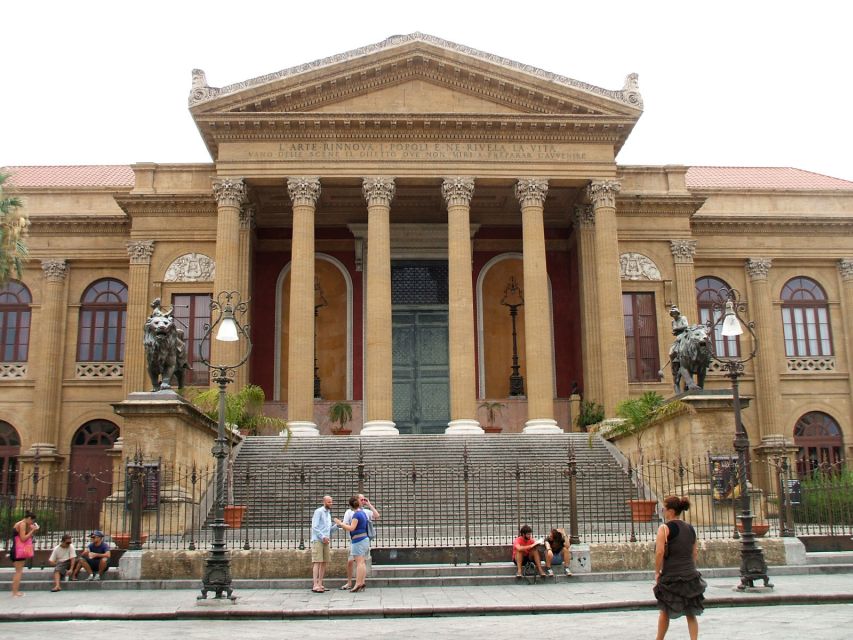
The next major stop is Teatro Massimo, the largest lyric theater in Italy and the third largest in Europe. Even if your interest in opera is limited, the building gives the walk a strong visual centerpiece.
This is a good point to hear how Palermo presents itself through public architecture. The theater belongs to the city’s grand, formal side, with scale and ceremony built into its design. After walking along the central streets, arriving at such a large cultural building makes the city feel bigger than the market lanes that follow.
The available details specify a visit to Teatro Massimo, but they do not include a separate theater admission or interior performance. You should therefore treat this as a guided stop within the walking route, not as an opera house tour. If entering the theater is important to you, ask the provider what the visit includes when you book.
The short duration also matters here. You can appreciate the exterior and hear the guide’s explanation, but you are unlikely to spend a long time studying every detail before moving on.
Through the Arabic-influenced lanes
After Teatro Massimo, the route changes character. You leave the broad central streets and move into alleys and lanes in the neighborhood shaped by Arabic origins.
This shift is one of the best reasons to choose the walk. Palermo is not a city you understand from its grand buildings alone. The narrower streets show another side of the center, with tighter passages, crowded squares, and architecture that reflects the city’s long contact with different cultures.
The walk does not present Palermo as a neat collection of separate monuments. Instead, it links places that feel different from one another. You move from the polished streets around Politeama and Via Principe di Belmonte into a more crowded, less formal part of town.
That contrast is useful for first-time visitors. It gives you a sense of how quickly Palermo’s mood can change. It also makes a guide especially helpful, since the lanes can be harder to read on your own and the Arabic influence may be easier to notice when someone explains what you are seeing.
Expect ordinary city movement here. The route includes crowded squares and market streets, so this is not a quiet, carefully controlled museum environment. If you prefer a slow walk with frequent stops, tell the guide at the start. The private format should make that conversation easier.
Same city, a completely different century:
- Florence: Cathedral & Brunelleschi’s Dome Ticket & Audio App
★ 4.4 · 6,973 reviews - Florence: Brunelleschi’s Dome Climb Entry Ticket & Duomo
★ 4.5 · 3,815 reviews - Florence: Brunelleschi’s Dome Reserved Entry Ticket & Duomo
★ 4.6 · 2,216 reviews - Florence Skip-the-Line Duomo Tour with Guide & Brunelleschi Dome
★ 5.0 · 1,176 reviews
Capo Market: Palermo’s working side
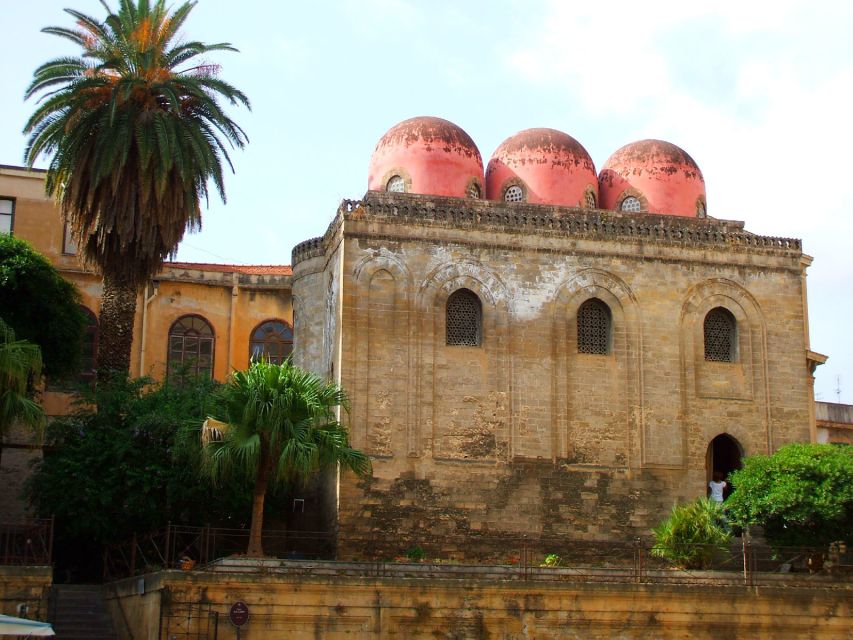
The route reaches Capo Market, described as Palermo’s most famous market. This is where the walk moves from architectural sightseeing into daily city life.
Open markets are often the most useful places for understanding how a city functions. You see stalls, customers, narrow passages, and the practical rhythm of local shopping. The market also gives the tour a welcome change from monuments and formal squares.
Food tastings are not included, so do not book this expecting a guided eating tour. You may see food being sold and you can ask the guide questions about the market, but any meal, snack, or tasting is your own expense.
The market can also be the least predictable part of a walking tour. Crowds, noise, and tight lanes are part of the setting. That may be exactly what you want if you are looking for a direct taste of Palermo, but it could feel less comfortable if you prefer a calm route.
I like the placement of Capo Market in the itinerary. It comes after the theater and the city’s grand streets, showing you that Palermo’s identity is not limited to monumental architecture. The market makes the tour feel connected to the present day.
Palermo Cathedral and the royal tombs
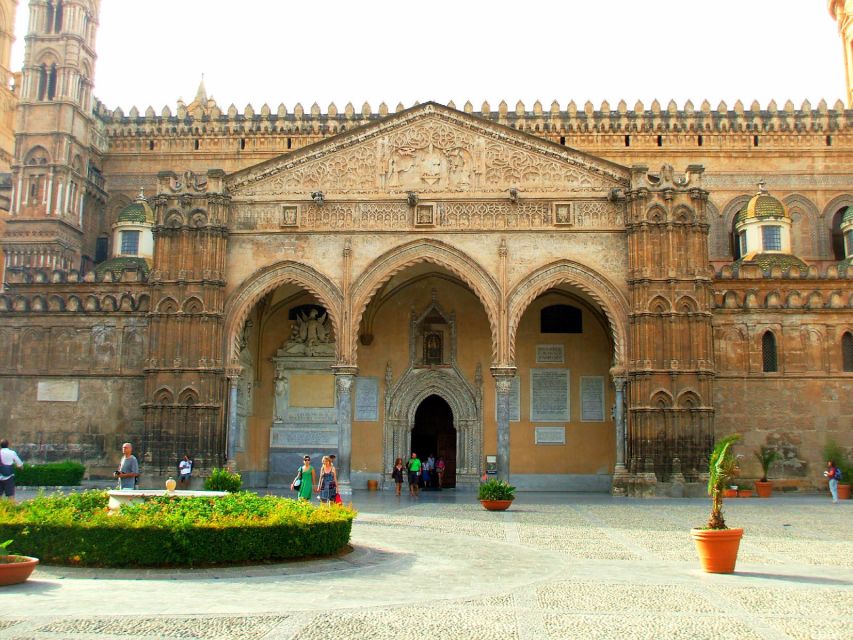
From Capo, the walk continues toward Palermo Cathedral. This is the route’s main religious and historical landmark.
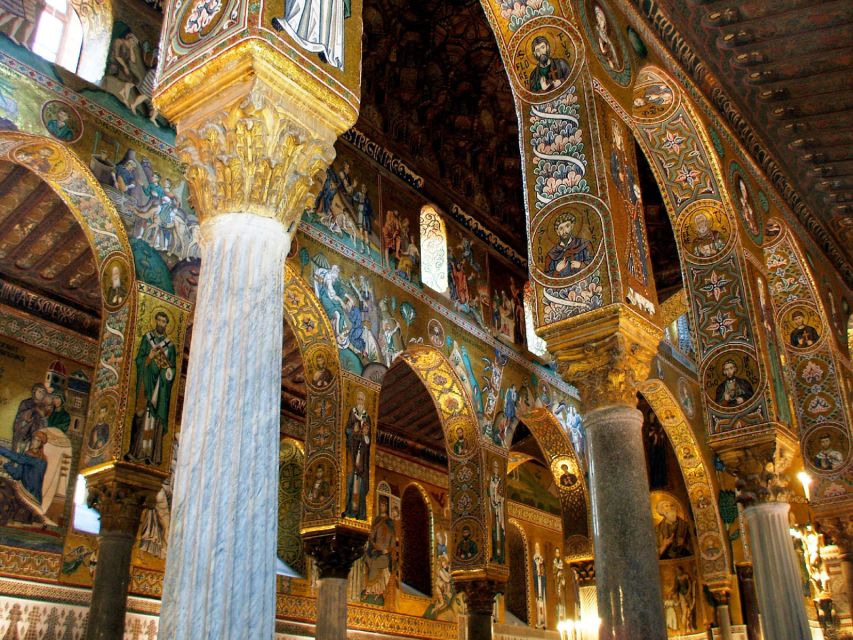
The cathedral is important not only for its architecture but also for the royal tombs inside. The remains of Frederick II of Swabia and members of his family are kept there. That detail gives the stop a clear historical focus and helps explain why the building matters beyond its appearance.
The cathedral is also where you should pay attention to the difference between seeing a landmark and entering its special areas. The ticket for the royal tombs is not included. If you want to visit them, budget separately for admission.
The provided information does not state that a full cathedral ticket is included either, so ask the guide or provider exactly how much interior access is part of the two-hour walk. That small question can prevent disappointment, especially if you expect a long indoor visit.
For most people, the cathedral works best as a central point in the story of Palermo. You have already seen the city’s modern grand avenue, theater, old lanes, and market. The cathedral brings those threads together through its connection to rulers, religion, and the city’s changing architectural character.
Vucciria and the route back
The final major market stop is Vucciria, Palermo’s historic open market. It gives the walk another look at the city’s street life after the cathedral.
Capo and Vucciria are not interchangeable. Having both on the route lets you compare two market districts rather than seeing only one. The guide can help you notice the different setting and atmosphere, while the walk itself gives you a practical sense of how central Palermo is arranged.
The tour then finishes around Piazza San Domenico according to the route description. The activity details also identify the end as the meeting point, so I would confirm the precise finishing location before setting up a taxi, dinner reservation, or another timed activity.
This is a useful ending for a walking tour because you finish in the center rather than at a distant transport stop. Still, no pickup or drop-off is provided. You need to make your own way to the start and continue on your own after the walk.
What the private format changes
Private does not mean a completely custom itinerary here. The route has a clear structure, with Politeama, Via Ruggero VII, Via Principe di Belmonte, Teatro Massimo, Capo Market, the cathedral, Vucciria, and Piazza San Domenico.
It does mean the guide is working with your group rather than a large mixed crowd. That can make a real difference in Palermo’s narrow lanes and busy market areas. You can ask about a building, pause for clarification, or request a little more explanation at a stop without worrying about losing a large group.
The maximum group size is 25. That is a generous limit for a private booking, and it affects the price calculation. A couple paying the full group rate may find the tour expensive. A family reunion, school group, or group of friends can get much better value.
The named guides add a personal element. Roberta is described as combining local and world history with a spiritual side of Palermo and taking groups to places beyond the standard sights. Marilou is noted for presenting her city in an authentic way. Guide quality can vary by assignment, but these details suggest that the experience depends heavily on who leads your walk.
Timing, comfort, and practical limits
Two hours is a sensible length for an introduction. You cover a lot of ground without giving up an entire morning or afternoon. It also leaves room for you to return to the cathedral, markets, or theater later if one place catches your interest.
The tradeoff is pace. The route includes several major areas, so you should expect steady walking and brief stops rather than long visits at every site. The tour is not the right choice if your main goal is to inspect every interior, shop slowly at both markets, or spend a long time at the royal tombs.
Wear comfortable shoes. That is simple advice, but it matters on a route that uses central streets, alleys, squares, and market areas. You should also keep your plans flexible after the tour since market conditions and the guide’s timing can affect the exact pace.
No transportation is included, and there is no hotel pickup or drop-off. You meet at Piazza Ruggiero Settimo and handle your own arrival and departure. Meals and tastings are also separate, as is the royal tomb ticket.
The cancellation policy is helpful for uncertain plans. You can cancel up to 24 hours before the activity for a full refund, and the reserve-now, pay-later option lets you hold a place without paying immediately.
Who will get the most from this Palermo walk
I would recommend this tour if you are visiting Palermo for the first time and want a quick framework for the center. The route covers the major sights while still giving you time in streets and markets that feel less formal.
It also suits families and groups of friends who want a private guide and can share the group price. The range of guide languages makes it practical for international groups, and the two-hour length is manageable when different people have different energy levels.
History-minded visitors will appreciate the cathedral and Frederick II connection. Architecture fans will enjoy the change from the theater and grand streets to Arabic-influenced lanes. Food-focused visitors may like seeing Capo and Vucciria, but should choose this only if they want market atmosphere rather than included tastings.
I would be more cautious if you want a detailed interior tour of Teatro Massimo or the cathedral. The schedule is broad, and the royal tomb ticket is extra. In that case, use this walk as an orientation, then plan separate visits.
Should you book it?
Book this Palermo walk if you want a private introduction to the city’s central contrasts: grand streets, Teatro Massimo, Arabic-influenced lanes, Capo Market, the cathedral, and Vucciria. The guides are the main reason to choose it, especially if Roberta or Marilou is assigned to your group.
The price makes sense for a larger group, but it is harder to justify for only one or two people. Also confirm the exact entry arrangements for the cathedral and Teatro Massimo, since the royal tomb ticket is not included and the experience is only two hours.
For a first look at Palermo, this is a useful, focused walk. It gives you enough context to explore the city with more confidence afterward, while leaving the deeper interior visits and food stops for your own time.
FAQ
Where does the Palermo walking tour start?
The tour starts at Piazza Ruggiero Settimo, also known as Piazza Politeama, in front of the Politeama Theater next to the statue.
How long does the tour last?
The walking tour lasts two hours. Starting times depend on availability when you book.
Which languages are available?
The live guide is available in English, Italian, Spanish, French, and German.
Is this a private tour?
Yes. It is offered as a private group experience for up to 25 people.
Are the royal tombs, food, and transportation included?
No. The ticket for the royal tombs, tastings, lunch, dinner, transportation, and pickup or drop-off are not included.
Can I cancel for a refund?
Yes. You can cancel up to 24 hours in advance for a full refund. You can also reserve now and pay later.
Just added around Italy
- Vicenza: discovering the city of Palladio by e-bike★ 5.0 · 4 reviews
- Vicenza: Palladian Architecture Private Walking Tour★ 3.3 · 3 reviews
- Vatican: Exclusive Baroque Evening With Aperitivo & Dinner★ 3.1 · 2 reviews
- Turin: Art Nouveau Walking Tour with Coffee★ 5.0 · 11 reviews
- Venice Music Project – Baroque Autumn – Season 2025★ 4.5 · 7 reviews
- Walking tour in Venice with an architect★ 5.0 · 16 reviews
- Palladio. A wonderful live tale through time&soul, from Ve/Pd/Vr★ 5.0 · 7 reviews
- Turin, Art Nouveau walking tour and coffee break★ 4.0 · 7 reviews
Italy Architecture Tours, compared.
Florence: Cathedral & Brunelleschi’s Dome Ticket & Audio App
Read our review →
Florence: Brunelleschi’s Dome Climb Entry Ticket & Duomo
Read our review →
Florence: Brunelleschi’s Dome Reserved Entry Ticket & Duomo
Read our review →
Lecce: Baroque Architecture and Underground Walking Tour
Read our review →
Florence Skip-the-Line Duomo Tour with Guide & Brunelleschi Dome
Read our review →
Florence: Duomo Area Tour and Brunelleschi Dome Climb Ticket
Read our review →
Florence: Brunelleschi’s Dome Climb and Duomo Complex Pass
Read our review →
Florence in a Day: David, Cathedral & City Highlights Guided Tour
Read our review →Browse the lists this tour appears in