
Review · ROME
Moonlight Walking Tour in the Heart of the Imperial & Baroque Rome
Rome changes after sunset. Traffic thins, the stone glows under warm lights, and places that feel crowded by day become easier to appreciate. This 2.5-hour evening walk links Rome’s Baroque center with its Imperial heart, ending near the Colosseum.
I like the route for two clear reasons: it puts Piazza Navona, the Pantheon, and Trevi Fountain into one easy story, then finishes with the Roman Forum under the night sky. I also like the small maximum of 15 people, which gives a guide such as Rina, also referred to as Rena and Lascarina, room to answer questions and help with photographs.
The main drawback is that most stops are viewed from outside, and the price is $82.80 per person. You are paying for a guided evening walk and the guide’s storytelling, not entry to monuments or private transportation. Good walking shoes and a steady pace will help.
Key points to know before booking
- Rome after dark: The walk begins at 8:00 p.m., when fountains, piazzas, monuments, and ruins take on a quieter mood.
- A strong city-center route: You move from Piazza Navona through the Pantheon, Trevi Fountain, Piazza Venezia, Trajan’s Column, and the Roman Forum.
- The Roman Forum is viewed from outside: You see the illuminated ruins and hear their stories, but no admission ticket is included.
- A guide-led history walk: Expect explanations of Baroque art, Rome’s foundation, the Roman Republic, the Empire, and later Roman history.
- Small-group format: The maximum group size is 15 people, with a local guide included.
- Weather matters: The tour requires good weather, and cancellation is possible if conditions are poor or the minimum group size is not met.
Why Rome works better on an evening walk

Rome’s famous center can be hard work in daylight. Cars, scooters, tour groups, heat, and bright sun compete for your attention. At night, the city’s fountains and monuments become the main event.
This route is especially well suited to that change in mood. Piazza Navona’s fountains catch the light. Trevi Fountain becomes a theatrical wall of water. The Altar of the Fatherland shines above Piazza Venezia. The Roman Forum, seen from the streets after dark, feels less like a collection of ruins and more like a stage set for the city’s long story.
I would not choose this as your only ancient Rome visit if you want to enter the Colosseum or walk inside the Forum. It is better understood as a guided introduction and evening overview. You get orientation, context, and atmosphere in one sitting, then you can decide which sites deserve a longer visit during the day.
The walking route also gives you a useful sense of Rome’s layout. You begin in the Baroque city, pass through the modern political center, and finish among the remains of Imperial Rome. That progression gives the evening a clear shape instead of feeling like a string of unrelated photo stops.
More Baroque architecture tours in Rome:
- Borghese Gallery Max 6 People Tour: Baroque & Renaissance in Rome
★ 5.0 · 185 reviews - Guided Walking Tour of Rome: Top Sights & Baroque Treasures
★ 5.0 · 155 reviews - Rome’s Baroque Art Walking Tour: Who Killed Caravaggio?
★ 5.0 · 27 reviews
Piazza Navona begins with Baroque rivalry
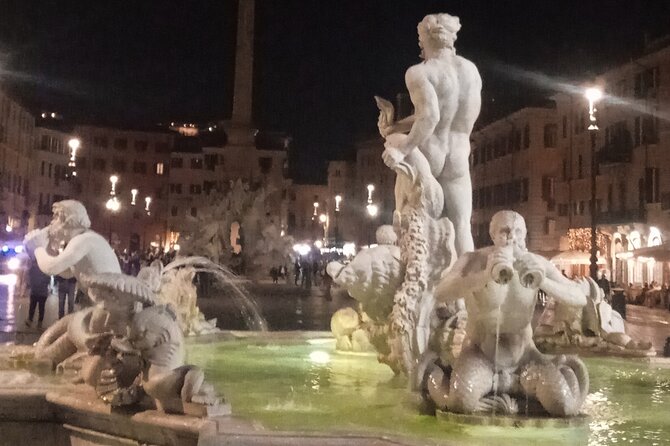
The meeting point is by the Fountain of Neptune, at the Piazza Navona end of the route. From there, the guide introduces Piazza Navona, one of central Rome’s grandest public spaces.
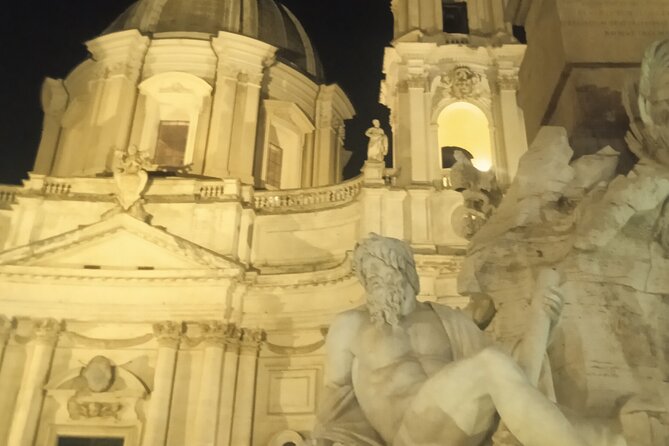
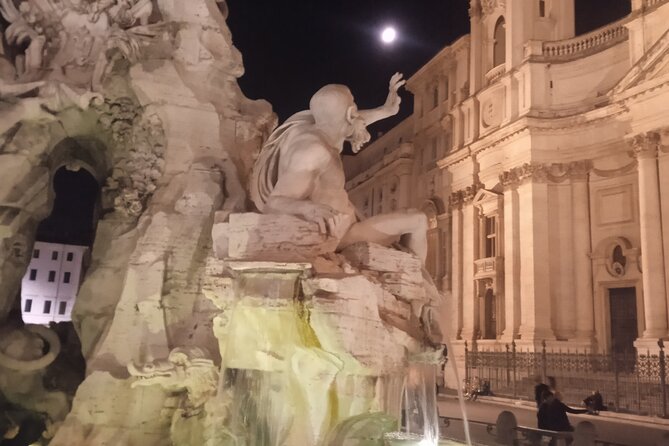
The main focus is Bernini’s Fountain of the Four Rivers. Its large figures and central obelisk give the fountain a sense of movement, even when the square is quiet. The church of Sant’Agnese in Agone provides the other half of the scene, with its dramatic Baroque facade facing the piazza.
This is where the guide’s storytelling matters most. The tour explains the legends connected with two great Baroque artists of the period, giving you more than a quick description of statues and architecture. The rivalry and creative competition of Baroque Rome make the square easier to read.
You have about 20 minutes here. That is enough for an introduction and photographs, but not enough for a detailed church visit. Admission to the stop is free because the tour does not include a paid entry.
The Pantheon offers a short ancient pause
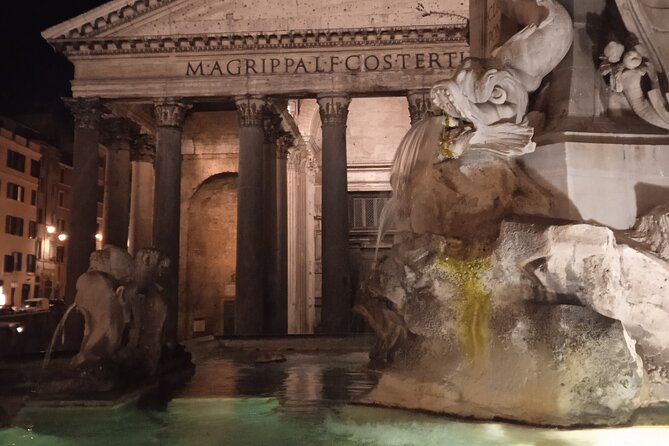
From Piazza Navona, the walk continues to the Pantheon. The guide views it from the outside and explains its unusual past. The building was constructed three times and destroyed twice, a simple fact that gives the monument a remarkable sense of survival.
The Pantheon is still in use today and is described as the best-preserved ancient monument in the world. The tour allows about 20 minutes here, enough to admire the exterior and hear the main points without turning the evening into a full architectural lecture.
This stop is valuable because it connects the Baroque streets with an older Rome. You have just been looking at fountains and churches shaped by seventeenth-century artists. Suddenly, the focus shifts to an ancient structure that has lasted through repeated rebuilding.
The limitation is clear: you do not enter. If seeing the interior is important to you, plan a separate visit. The evening walk gives you context and a good exterior view, but it is not a Pantheon admission tour.
Trevi Fountain brings the biggest visual moment
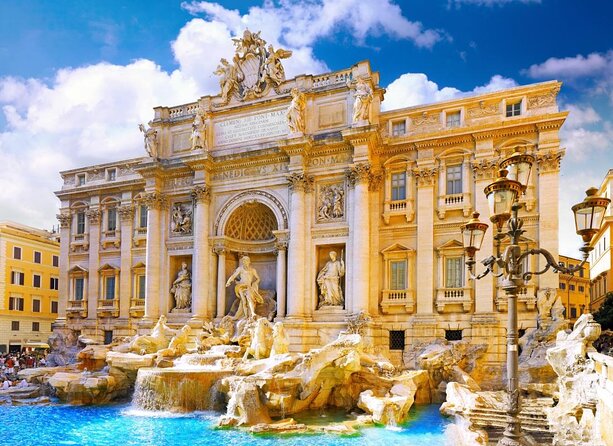
Trevi Fountain gets about 20 minutes, and that is probably enough for the basic purpose of this evening route. You see the fountain, hear about its design by Nicola Salvi, and have time to watch the water and take photographs.
The fountain is presented as a major Baroque symbol of Roman beauty. That description fits the setting. Its scale, sculpture, and constant movement make it one of the few city sights that can stop conversation for a moment.
The guide also connects the fountain with cinema, including its famous appearance in La Dolce Vita. That film link helps explain why the fountain has become more than an architectural monument. It is part of the modern image of Rome.
Do not expect a private or empty Trevi Fountain. It remains one of Rome’s most popular sights, even after dark. The benefit of this tour is not guaranteed solitude. It is the chance to arrive with a guide who can give the fountain a place in Rome’s art and film story, rather than leaving you to look, take a picture, and move on.
More architecture walks in Rome:
- City Walk with Architect: Private walking tour of Rome
★ 5.0 · 22 reviews - Rome Baroque: Fountains and Squares Private Walking Tour
★ 5.0 · 7 reviews - Rome: Renaissance & Baroque Walking Tour
★ 5.0 · 2 reviews - The Official Art Deco Walking Tour by The Miami Design Preservation League
★ 5.0 · 1,580 reviews
Piazza Venezia links modern Rome to the ancient city
The next stop is Piazza Venezia, with about 10 minutes devoted to the square. This is the shortest stop, but it serves an important purpose.
The illuminated Altar of the Fatherland, often called the Vittoriano, is the visual anchor. Designed by Giuseppe Sacconi, it was built to honor the unification of Italy. Its bright white stone and imposing steps make it hard to miss, especially at night.
Here, the guide shifts from Baroque art and ancient monuments to modern Roman history. That change helps you understand that Rome is not simply an archaeological site. It is also the capital of a modern nation, and its public spaces carry political meaning.
Ten minutes is enough for an explanation and a look at the monument. It is not enough to explore the building or nearby streets in depth. I see this as a useful bridge between the earlier stops and the Imperial Rome section that follows.
Trajan’s Column marks the entrance to Imperial Rome
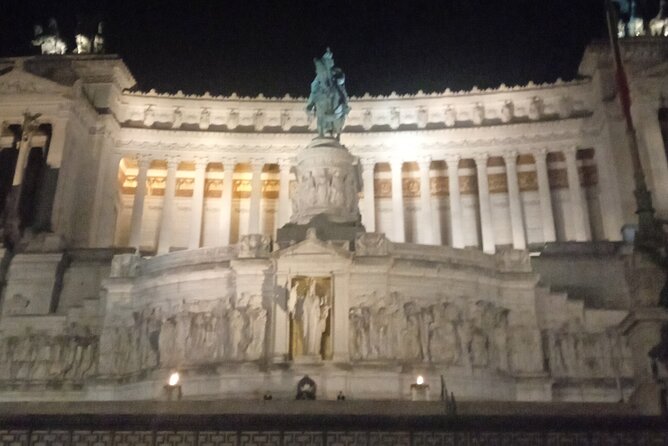
At Trajan’s Column, the route begins to feel more firmly ancient. The column is tied to the story of Imperial Rome, and the guide uses it to introduce legends about Rome’s foundation.
The stop lasts about 20 minutes. That gives the guide time to explain what you are looking at and to place the column within the larger story of Roman power. You also get a good pause before the final walk toward the Forum and the Colosseum.
This part of the route is useful for visitors who want history presented as a connected story. Rome’s foundation legends lead into the city’s three major periods, as the guide presents them: its early beginnings, the Republic, and the Empire. The tour also brings in personal stories, secrets, and scandals involving important figures.
Those details can make dates and political changes easier to remember. You are not simply looking at a tall column. You are hearing why public monuments mattered and how Rome used them to display power.
The Roman Forum closes the night under the stars
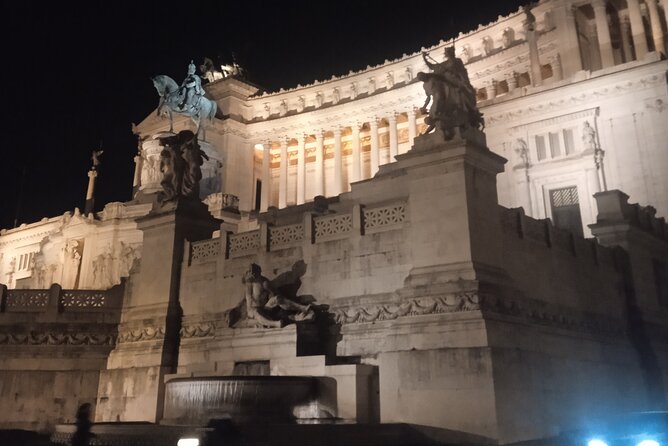
The Roman Forum is the final major stop, with about 20 minutes set aside for the illuminated ruins. You view the Forum from outside rather than entering the archaeological area.
This is the most atmospheric part of the walk. The ruins are spread out, and the evening light picks out columns, arches, and broken walls against the dark. Without daytime crowds pressing around you, you have more room to think about the site as the center of Roman public life.
The guide uses the Forum to bring together the evening’s historical thread. Rome’s founding, the Republic, the Empire, and the lives of major personalities all come back into view. Stories of secrets and scandals add a human edge to a place that can otherwise feel like a confusing field of stones.
I would keep your expectations practical. Twenty minutes is a short time for a site as large as the Forum, and you will not explore every corner. The value is the setting and the overview. If the Forum is a major reason for your trip, book a daytime entry visit separately. If you want a memorable first look, the night view can be very effective.
The tour ends at the Colosseum on Piazza del Colosseo. The Colosseum is an important visual finish, but the information provided for this experience does not include an interior visit or admission.
What the guide adds to the price
At $82.80 per person, this is not a bargain-priced orientation walk. The fee covers a local guide, but not transportation, entrance tickets, food, or any private vehicle.
The value depends on how much help you want making sense of Rome. A guide can connect a fountain in Piazza Navona with Baroque politics, a column with Imperial power, and a ruin with the development of Roman society. That is more useful than simply walking between famous addresses with a map.
The small group limit also matters. With no more than 15 people, the guide can respond to questions and give some personal attention. One account of the tour describes the guide taking photographs for the group and offering suggestions for the rest of a Rome visit. That kind of help can be worth paying for, especially on a first evening in the city.
The strongest praise centers on Rina, also identified as Rena or Lascarina in the supplied information. She is described as warm, engaged, and highly informed about Roman events and history. The personal connection seems to be a major part of the experience, so the tour makes the most sense if you enjoy learning through conversation rather than reading fixed information from an audio guide.
Still, price matters. If you are comfortable researching Rome in advance and only want to see the monuments at night, you can walk much of this route independently. If you want a guide to explain the art, legends, political changes, and scandals as you go, the fee becomes easier to justify.
Timing, walking, and practical details
The tour begins at 8:00 p.m. at the Fountain of Neptune in Piazza Navona and ends at the Colosseum. The route is point to point, not a return loop, so think about what you want to do after the walk.
You receive a mobile ticket, and the activity is offered in English. It is near public transportation, which helps at the beginning or end of the evening. Private transportation is not included, so you are responsible for reaching Piazza Navona and continuing from the Colosseum afterward.
The advertised duration is about two hours and 30 minutes. Since the walk includes several stops and city streets between them, wear shoes that you can use comfortably for a full evening. The information says most people can participate, but it does not give a detailed accessibility description, so anyone with specific mobility needs should confirm the route before booking.
The tour requires good weather. If poor weather causes cancellation, you are offered another date or a full refund. The same applies if the minimum number of participants is not reached. Otherwise, you can cancel for a full refund up to 24 hours before the start time. Changes or cancellations made less than 24 hours before the start are not refunded.
Who will get the most from this Rome walk
I would recommend this tour to a first-time Rome visitor who wants a strong evening orientation. The route covers several of the city’s major sights without asking you to spend the night inside a museum or archaeological site.
It also suits you if you enjoy stories about artists, emperors, political change, and unusual details. The guide’s personal attention seems to be one of the chief reasons this walk feels special, particularly when the group is small enough for questions.
Families with older children may find the evening timing helpful, especially if the children are more interested in legends and personalities than formal lectures. The exact age suitability is not specified, so use your judgment about a 2.5-hour walk beginning at 8:00 p.m.
I would be less likely to book it for someone who wants interior access. The Pantheon, Roman Forum, and Colosseum are viewed from outside, and there is no private transportation. It is also not the best choice if your main goal is an empty Trevi Fountain. Rome’s famous center can still be active after dark.
Should you book the Moonlight Walking Tour?
Book it if you want Rome’s best-known central sights arranged into one evening story, with a local guide explaining Baroque art, ancient monuments, Roman politics, legends, and scandals. The route is well chosen, the night setting adds real atmosphere, and the small group size gives the guide room to interact with you.
Think carefully about the $82.80 cost. It is fair only if you value the guide’s explanations and personal help. Since entry tickets and transportation are not included, this is not a sightseeing pass. It is a guided walk with a strong sense of place.
For a first evening in Rome, I think the format makes good sense. You see the fountains and monuments at their most dramatic, finish beside the Colosseum, and gain a useful map in your head for the rest of your visit. Just treat it as an evening introduction, not a substitute for entering the city’s major ancient sites.
FAQ
Where does the Moonlight Walking Tour begin?
It begins at the Fountain of Neptune in Piazza Navona, Rome.
What time does the tour start?
The tour starts at 8:00 p.m.
Where does the tour end?
It ends at the Colosseum, at Piazza del Colosseo, 1.
How long does the tour last?
The tour lasts approximately two hours and 30 minutes.
What language is the tour offered in?
The tour is offered in English.
Is a guide included?
Yes. A local guide is included.
Are entrance tickets included?
No. The stops are listed with free admission, and the tour does not include entry tickets to the monuments or archaeological sites.
What happens if bad weather cancels the tour?
If poor weather causes cancellation, you are offered a different date or a full refund.
Just added around Rome
- Vatican: Exclusive Baroque Evening With Aperitivo & Dinner★ 3.1 · 2 reviews
- Rome Pantheon Highlights From Ancient Rome to Baroque★ 5.0 · 5 reviews
- Borghese Gallery Private Tour: The Greatest Baroque Masterpieces★ 5.0 · 6 reviews
- Private Baroque Tour: Discover Bernini & Caravaggio’s Best Works★ 5.0 · 3 reviews
- Private Personalized Architecture Tour of Rome with an Architect★ 5.0 · 5 reviews
- New Year’s Baroque Concert at Doria Pamphilj Palace★ 5.0 · 2 reviews
- Rome Baroque: Fountains and Squares Private Walking Tour★ 5.0 · 7 reviews
- Renaissance Rome and Baroque Rome★ 5.0 · 19 reviews
Baroque Architecture Tours, compared.
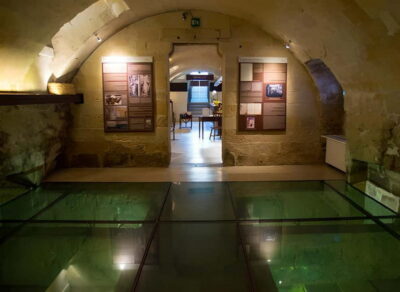
Lecce: Baroque Architecture and Underground Walking Tour
Read our review →
Train Exp. through the Alps (Royal Baroque Route from Nice)
Read our review →
Dresden: Tour of the Baroque Quarter with a Night Watchman
Read our review →
Interpreti Veneziani Ensemble Baroque Concert in Venice Ticket
Read our review →
Borghese Gallery Max 6 People Tour: Baroque & Renaissance in Rome
Read our review →
Concert at the Palais Schönborn-Batthyány by the Vienna Baroque Orchestra
Read our review →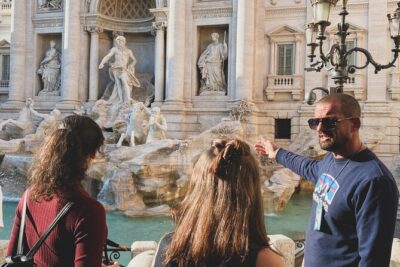
Guided Walking Tour of Rome: Top Sights & Baroque Treasures
Read our review →
Noto, Modica and Ragusa: The Baroque Tour from Catania
Read our review →Browse the lists this tour appears in