
Review · ITALY
Milan: Guided Dog-Friendly Tour, From Gothic to Eclectic
Milan’s best stories are not all found inside its grandest buildings. This two-hour walking tour links the Duomo with a bone-lined church, a former hospital turned university, medieval trading streets, modern sculpture, and the stylish Brera district. It gives you a quick but varied look at the city, with plenty of changes in mood along the way.
I like the visit to San Bernardino alle Ossa, where the interior is unusual enough to stay with you long after the tour ends. I also like the small-group format, capped at eight people, and the fact that guide Luca is praised for explaining Milan’s history clearly and leading the group through several different parts of the center.
The main drawback is the pace. Two hours is enough for orientation and stories, but not for lengthy visits inside every church or time at the opera house. You should also expect to walk the entire route, and food, drinks, and transportation are not included.
Key points at a glance
- San Bernardino alle Ossa: See one of Milan’s most unusual church interiors, with its mysterious decoration and solemn atmosphere.
- Hospital to university: Learn how the old Ospedale Maggiore became the University of Milan.
- Galleria to La Scala: Follow the elegant route from the world’s first shopping mall to Milan’s famous opera house.
- Bankruptcy and finance: Connect medieval commerce at Piazza Mercanti with the modern Stock Exchange at Piazza Affari.
- Cattelan’s L.O.V.E.: Consider the meaning and controversy behind the oversized hand sculpture outside the financial district.
- Brera finale: End among art galleries, boutiques, cafés, and useful suggestions for a Milanese aperitivo or lunch.
A two-hour route with more variety than mileage
This is not a single-monument tour. It is a compact walk through several versions of Milan: Gothic, religious, academic, commercial, theatrical, financial, artistic, and fashionable.
That variety is the real selling point. You do not spend two hours hearing the same type of story in one square. Instead, the route keeps changing its subject. One stop deals with medieval devotion, the next with public health, then fashion, opera, banking, sculpture, and design.
The experience costs $57 per person. That is a fair price if you want an English-speaking guide to connect the sights and explain what you are seeing, rather than simply walk between famous addresses. It is less attractive if you prefer to enter major museums, linger inside churches, or explore independently.
Because the group is limited to eight, you should get a more personal walk than on a large city tour. Guide Luca is specifically praised for his explanations and knowledge of Milan’s cultural and historic sights. His presence is not guaranteed unless confirmed at booking, but the guide quality matters here because much of the value comes from the stories between stops.
More Gothic quarter walks in Italy:
- Sorrento: Gothic-Baroque Art Tour & Free local Tasting
★ 5.0 · 16 reviews - Private tour: The Gothic Line in Borgo a Mozzano (Lucca)
★ 5.0 · 9 reviews - Barcelona all included: Sagrada, Park Güell, Montjuic & Gothic
★ 5.0 · 2,169 reviews
Starting at the Gothic Duomo
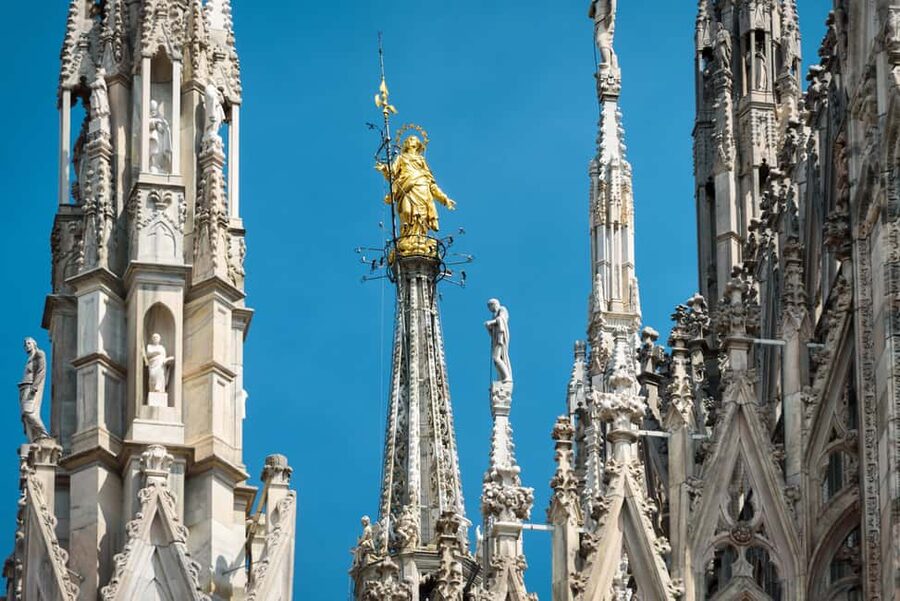
The walk begins at Milan Cathedral, or the Duomo, one of the clearest examples of the city’s Gothic character. The façade, spires, and statues provide a strong opening because they immediately raise the basic question behind the whole tour: how did Milan become a city where medieval stonework, luxury shopping, finance, and modern art sit within a short walk of one another?
You should expect to see the cathedral from the outside rather than take a full guided visit inside or to the roof. That keeps the tour moving and helps fit so many stops into two hours.
The Duomo area is also a practical meeting point. Someone from Tour in Milan will wait there with the company logo. Look for the staff member rather than assuming the guide will be easy to spot in the crowded square.
The opening commentary focuses on the cathedral’s façade, including the stories behind its spires and statues. That is useful even if you have already seen the Duomo, since the exterior can otherwise become a quick photograph and a blur of pale marble.
The eerie calm of San Bernardino alle Ossa
A short walk from Piazza del Duomo brings you to the Basilica of San Bernardino alle Ossa. This is the tour’s most striking stop for many people, not because it is large, but because its interior is so unexpected.
The church is known for its unusual decoration involving human bones. The effect is solemn, eerie, and fascinating rather than cheerful or polished. Your guide reveals the story of the interior during the visit, giving the stop more meaning than a quick look through the doorway.
This is a good example of why a guide helps. Without context, the room can seem like a strange visual shock. With an explanation of the church and its setting, you can place the decoration within Milan’s religious and civic past.
The stop may not suit everyone. If you are uncomfortable with ossuaries or solemn religious spaces, this is the part of the route to consider carefully. Appropriate clothing is advised because the tour includes churches and historic religious sites.
From Ospedale Maggiore to the University of Milan
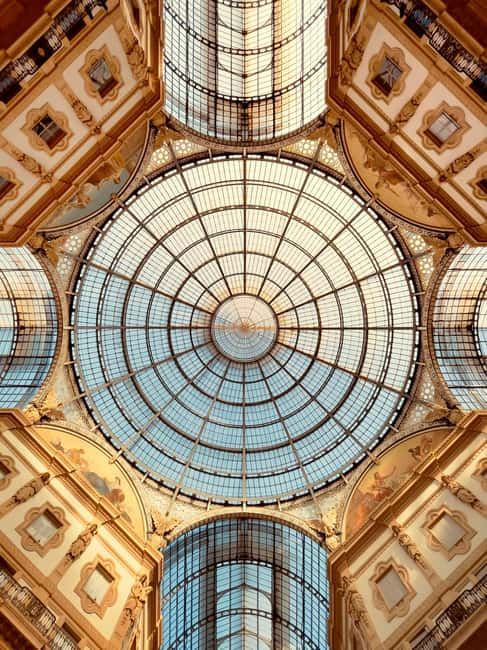
The route then reaches the University of Milan, known as La Statale. Its setting has an unusual civic story: the buildings once belonged to the Ospedale Maggiore, Milan’s first public hospital.
You will hear why the hospital was founded and how the complex later became one of the city’s important academic institutions. This is a valuable change of subject after the church because it shows Milan through public service and education, not only through monuments and luxury.
The stop is also a reminder that historic buildings often keep working in new ways. You are not simply looking at an old façade. You are seeing a former hospital serving as a university, with the past still shaping the appearance and identity of the site.
Do not expect a full university visit or a long campus tour. The value here is the explanation of the transformation and the chance to connect Milan’s social history with its architecture.
More guided tours in Italy:
- Florence Skip-the-Line Duomo Tour with Guide & Brunelleschi Dome
★ 5.0 · 1,176 reviews - Florence in a Day: David, Cathedral & City Highlights Guided Tour
★ 4.5 · 947 reviews - Florence: David, Cathedral & City Highlights Guided Tour
★ 4.8 · 471 reviews - Guided Walking Tour of Rome: Top Sights & Baroque Treasures
★ 5.0 · 155 reviews
A brief look at San Nazaro in Brolo
The Basilica of San Nazaro in Brolo is one of Milan’s oldest churches, and the tour makes a brief stop outside.
This is a shorter pause than the visit to San Bernardino alle Ossa, but it adds another layer to Milan’s religious past. The contrast is useful: one church is known for its unusual interior, while San Nazaro represents the city’s long Christian history and early foundations.
Since the stop is brief and outside, keep your expectations in check. It is mainly a chance to hear why the basilica matters and to see another historic church without turning the walk into a church-by-church survey.
That restraint helps the tour maintain its pace. You get several landmarks, but you do not spend the full two hours in only one district.
The grand passage from Galleria to La Scala
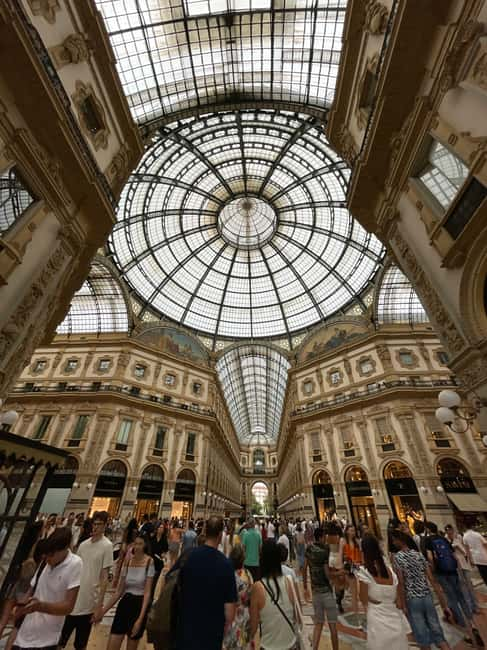
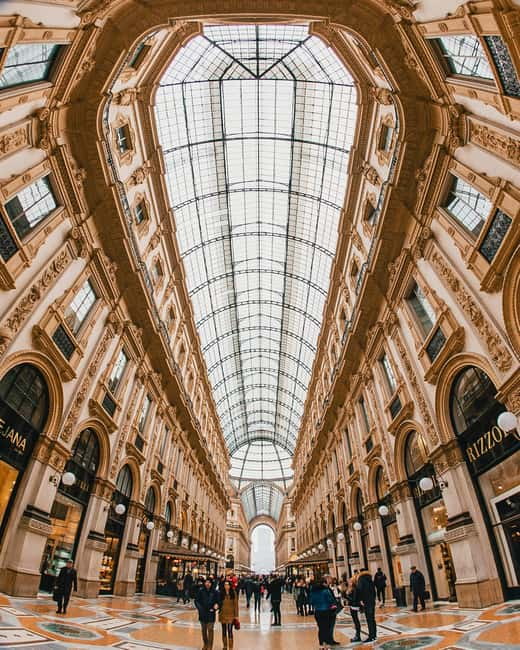
The Galleria Vittorio Emanuele II brings a sharp change in tone. Its glass roof, ornate decoration, shops, and polished floor make it one of Milan’s most elegant public spaces.
The Galleria is described as the world’s first shopping mall, and the guide explains its role in Milan’s commercial and social life. It connects Piazza del Duomo with La Scala, making the passage important not only as a shopping destination but also as part of the city’s ceremonial center.
You will see luxury stores and grand architecture, but the tour is not a shopping excursion. The point is to understand how this covered arcade became a place for fashion, status, meeting, and display.
From there, the walk continues to Teatro alla Scala. The opera house is visited from outside, so this is not the tour for you if your main goal is to see the auditorium or museum interiors. Instead, you hear how Milan’s upper classes once experienced a night at the opera, including social rules, rituals, and lesser-known details.
That approach gives La Scala a human side. You learn not just what the building is, but how people used it and what behavior was expected inside its social world.
Medieval trade at Piazza Mercanti
Piazza Mercanti offers a quieter look at Milan’s commercial past. It was the medieval center of trade, and the guide uses the square to explain how business worked before modern offices, electronic markets, and formal financial systems.
The tour also connects Milan with the development of modern bankruptcy. That is an intriguing detail because it turns a financial idea into part of the city’s story. You begin to see Milan not merely as a fashion capital, but as a place where commerce and financial rules developed over centuries.
Piazza Mercanti is especially useful for visitors who might otherwise rush from the Duomo to the Galleria. It sits close to the major sights, yet its purpose and atmosphere are different. The guide helps you notice the relationship between the grand center and the older marketplace nearby.
Modern controversy at Piazza Affari
At Piazza Affari, the route reaches the home of the Italian Stock Exchange. Here the subject shifts from medieval commerce to modern finance.
Outside is Maurizio Cattelan’s sculpture L.O.V.E., a large hand making a provocative gesture. The work has caused international debate, and the tour gives you a chance to consider why contemporary art appears in front of one of Italy’s most important financial institutions.
This is one of the route’s best contrasts. You have just heard about a medieval trading center, and now you are looking at a modern artwork addressing money, power, and institutions. You do not need to be an art expert to appreciate the conversation between the sculpture and its setting.
The stop is outdoors and brief. It works best as a thoughtful pause rather than a full contemporary-art lesson.
Ending in Brera, Milan’s creative quarter
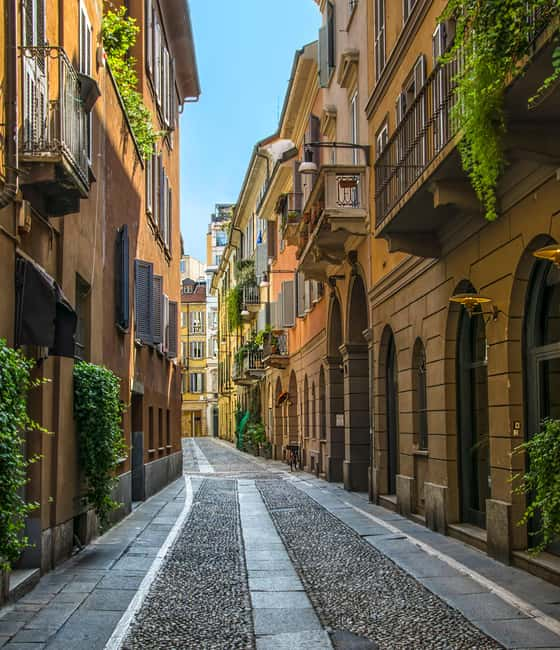
The walk finishes in Brera, one of Milan’s most appealing areas for a relaxed wander. Its streets, older buildings, boutiques, galleries, and cafés provide a gentler ending after the Duomo, financial district, and formal landmarks.
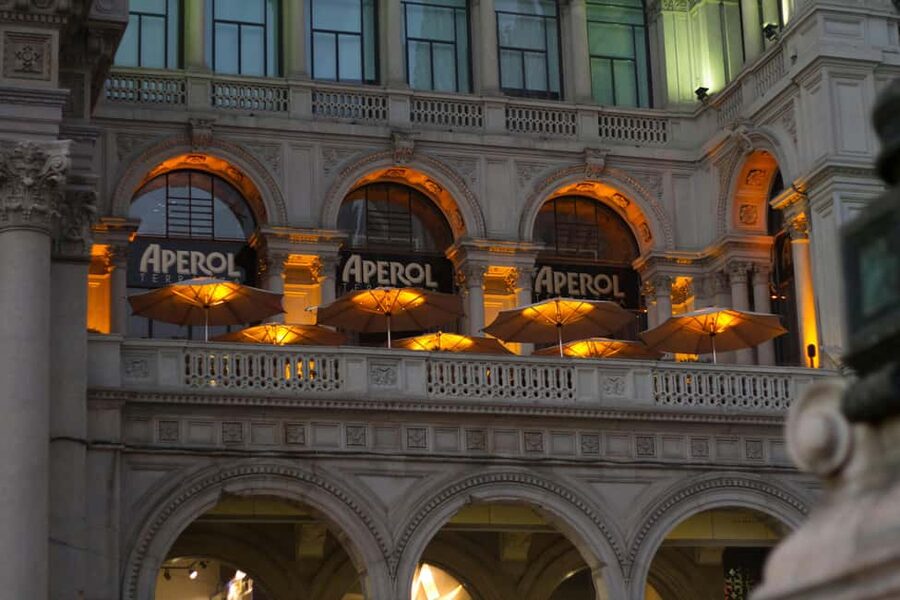
Brera is also closely tied to Milan Design Week and the city’s creative life. That makes it a useful final stop if you want to continue exploring after the guide leaves. You can stay for a meal, browse local galleries, or settle into an aperitivo.
Your guide will suggest places for a Milanese aperitivo or a traditional lunch. Food is not included, so treat these suggestions as a helpful handoff rather than part of the tour itself.
Ending here is practical. You are not left at an anonymous street corner after the last sight. You finish in an area where you can make an evening plan, and the guide’s local suggestions can help you choose what to do next.
What the small group and dog-friendly format mean
The group is limited to eight participants, which should make it easier to hear the guide and ask questions. That matters on a walking route through busy central streets, where a large group can become slow and difficult to manage.
The tour is described as dog-friendly, making it useful if you want to see central Milan without leaving your dog behind. The supplied information does not give specific rules for dogs inside each church, so confirm any site restrictions before booking. Religious buildings may have their own policies.
You will be on foot for the full two hours. Wear comfortable shoes, since the route includes several districts and does not use transportation. The walk is not presented as a food tour, and no food or drinks are included.
Appropriate clothing is advised for the churches. This is worth taking seriously, especially if you plan to spend the rest of the day in casual summer clothing.
Booking value, timing, and who should choose it
At $57, the tour offers good value for a first visit to Milan if you want a guide to supply context and keep the route organized. You are paying less for entry tickets and more for interpretation, local orientation, and access to several places that are easy to pass without understanding.
It is particularly suited to you if:
- You have only a short time in Milan.
- You want a broad introduction rather than one long museum visit.
- You enjoy architecture, church history, finance, and modern art in equal measure.
- You prefer a small group.
- You are traveling with a dog and want a dog-friendly walking option.
- You would like suggestions for an aperitivo or lunch in Brera.
It is less suited to you if you want a slow-paced tour with extended interior visits. The churches, university, Galleria, La Scala, financial district, and Brera are a lot to cover in two hours. You will get orientation and explanation, not hours of independent exploration at each stop.
The cancellation policy gives you flexibility: cancel up to 24 hours before the tour for a full refund. You can also reserve now and pay later. Starting times vary, so check availability when choosing your date.
Should you book this Milan walk?
Book it if you want Milan’s center explained as a connected story rather than a list of famous buildings. The best moments are the unusual ones: San Bernardino alle Ossa, the hospital turned university, the link between medieval trade and modern finance, and Cattelan’s bold sculpture.
Skip it if you mainly want to enter the Duomo, tour La Scala’s interior, or spend a long time inside museums. For everyone else, especially first-time visitors with limited time, this small-group route offers a smart introduction and ends in Brera, where you can continue the day on your own. Guide Luca is a strong reason to value the experience when he is leading it, thanks to his clear explanations and command of Milan’s cultural story.
FAQ
How long does the tour last?
The tour lasts two hours.
What language is the tour conducted in?
The live tour guide speaks English.
How large is the group?
The group is limited to eight participants.
What places are included in the tour?
The route includes San Bernardino alle Ossa, the University of Milan, San Nazaro in Brolo, the Galleria Vittorio Emanuele II, the exterior of Teatro alla Scala, Piazza Mercanti, Piazza Affari, and the Brera district.
Are food, drinks, or transportation included?
No. Food, drinks, and transportation are not included.
Can I cancel or pay later?
You can cancel up to 24 hours in advance for a full refund. The tour also offers a reserve-now, pay-later option.
Just added around Italy
- Vicenza: discovering the city of Palladio by e-bike★ 5.0 · 4 reviews
- Vicenza: Palladian Architecture Private Walking Tour★ 3.3 · 3 reviews
- Vatican: Exclusive Baroque Evening With Aperitivo & Dinner★ 3.1 · 2 reviews
- Turin: Art Nouveau Walking Tour with Coffee★ 5.0 · 11 reviews
- Venice Music Project – Baroque Autumn – Season 2025★ 4.5 · 7 reviews
- Walking tour in Venice with an architect★ 5.0 · 16 reviews
- Palladio. A wonderful live tale through time&soul, from Ve/Pd/Vr★ 5.0 · 7 reviews
- Turin, Art Nouveau walking tour and coffee break★ 4.0 · 7 reviews
Gothic Quarter Tours, compared.
Barcelona all included: Sagrada, Park Güell, Montjuic & Gothic
Read our review →
Barcelona Gothic Quarter Tapas & Taverns Food & Wine Tour
Read our review →
Barcelona: Gothic Quarter Ghosts and Legends Walking Tour
Read our review →
Barcelona: Old Town and Gothic Quarter Walking Tour
Read our review →
Barcelona Old Town & Gothic Quarter Small Group Tour
Read our review →
Ramblas, Old Town, Gothic and Gaudi Architecture Walking Tour
Read our review →
Barcelona: El Born and Gothic Quarter Wine & Tapas Bar Tour
Read our review →
Kids and Family Gothic Quarter Walking Tour in Barcelona
Read our review →Browse the lists this tour appears in