
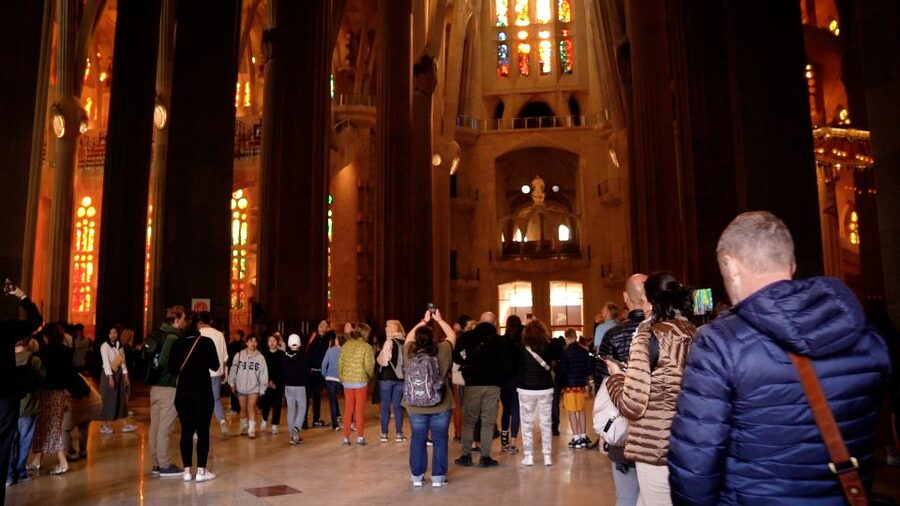
Review · BARCELONA
Barcelona: Sagrada Familia Skip-the-Line Guided Tour
The Sagrada Familia is easiest to appreciate when someone helps you read it. Gaudí’s basilica is packed with symbols, religious stories, unusual engineering, and details that can blur together when you walk in alone. This tour gives you a certified English-speaking guide, skip-the-line admission, and a clear route through the building and museum.
I like two things especially: the guide explains not only Gaudí’s ideas but also the generations of craftspeople still bringing them to life, and the visit includes the Sagrada Familia Museum, with original plans, sketches, and plaster models. The main drawback is that $64 is a fair amount for 1.5 hours, and skip-the-line admission does not remove the required security wait, which may take 20 to 30 minutes.
Key points at a glance
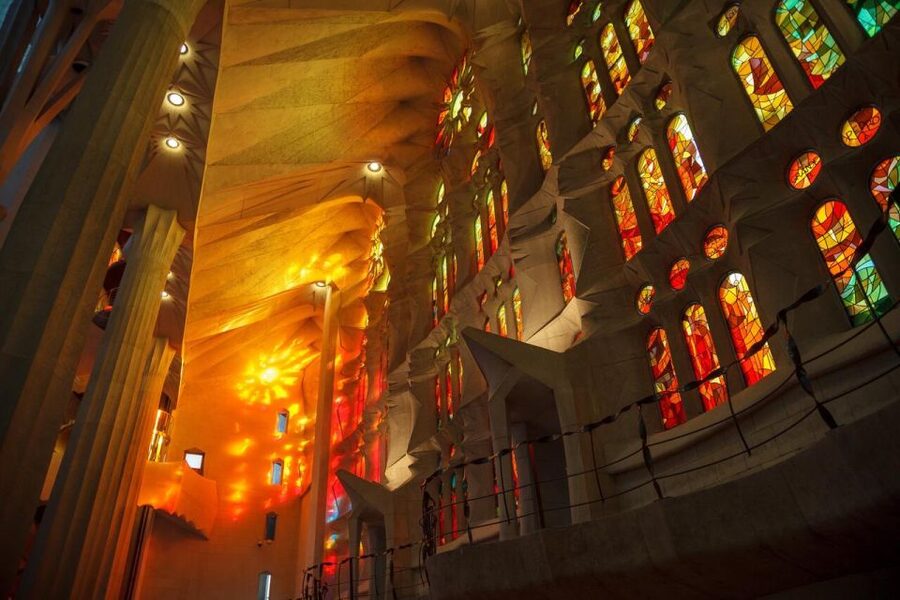
- Gaudí’s forest-like interior: Branching columns and colored window light create the feeling of standing beneath a stone canopy.
- More than a quick church visit: The route covers the Nativity Façade, interior, Passion Façade, Sagrada Familia Schools, and museum.
- Strong guide quality: Guides including Ania, Alba, José, Txell, and Aurelia have been praised for clear explanations, energy, and command of the subject.
- Skip-the-line ticketing: You use a separate entrance, but everyone still passes through metal detectors.
- Useful audio headsets: You can keep listening even when the guide is hard to see in the crowd.
- A good short introduction: The 90-minute format works well for first-time visitors who want context without spending half a day inside.
Why a guide helps at Sagrada Familia
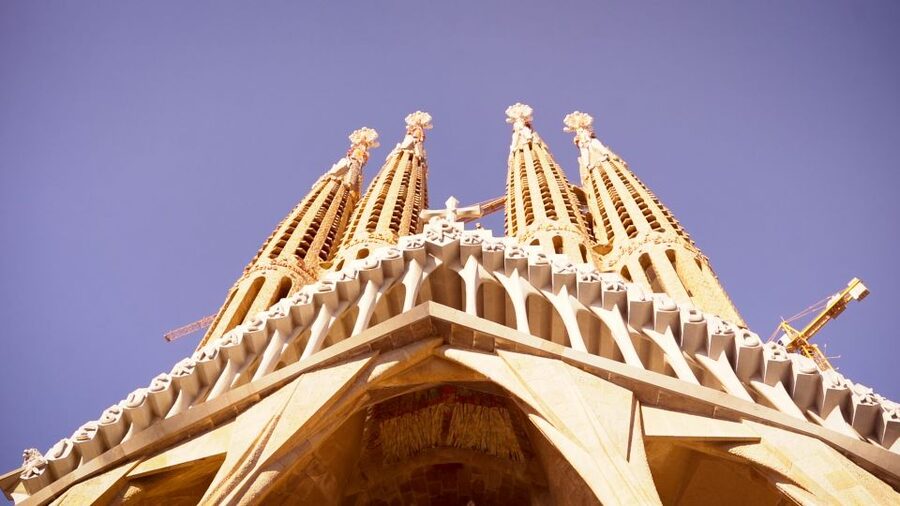
You can admire the Sagrada Familia without a guide. You cannot easily understand it all without one.
The basilica is not simply a large church with an odd exterior. Its facades tell different parts of the Christian story, its columns imitate trees, its light changes the mood of the interior, and its design reflects both Gaudí’s imagination and the work of many people who continued after his death.
A good guide gives you a way to sort those ideas. You will hear about Gaudí’s original vision, the long building process, and the predicted completion date. You will also learn that the basilica is a continuing project rather than a finished monument frozen in time.
The strongest part of the experience is the human element. The tour explains the architects, artists, craftspeople, and workers who have carried the project forward over generations. That helps you see the Sagrada Familia as a living work site as well as a famous Barcelona attraction.
The guides appear to be the main strength of this experience. Ania is praised for having worked at the basilica and for explaining its facades and interior with ease. Alba is described as energetic and well informed about both the building and the religious ideas behind it. José is praised for patience, care, and an engaging style. Other guides, including Txell, Aurelia, Carlos, Mark, and Javier, are singled out for clear storytelling and detailed answers.
That consistency matters. The architecture can be overwhelming, especially on a first visit. A guide who knows where to point your eyes can turn a wall of decoration into a story you can follow.
More Sagrada Familia tours in Barcelona:
- Barcelona: Sagrada Familia Entry Ticket with Audio Guide
★ 4.6 · 105,312 reviews - Barcelona in 1 Day: Sagrada Familia, Park Guell,Old Town & Pickup
★ 5.0 · 13,541 reviews - Barcelona: Sagrada Familia Skip-the-Line Entry Ticket & Tour
★ 4.8 · 12,789 reviews
Meeting at Mallorca Street
The meeting point is inside the Ringels souvenir shop at C/ de Mallorca, 418, near the basilica. Look for the guide holding a Golden Tour Guide sign, and arrive 15 minutes early.
This is one detail to take seriously. The Sagrada Familia area can be crowded, and one visitor found the guide hard to identify among the people nearby. The Golden Tour Guide sign is the key marker, but give yourself time to enter the shop, locate the correct person, and join the group without rushing.
There are restroom facilities at the meeting point. The tour does not include transportation, food, or drinks, so plan to arrive independently and handle refreshments before or after the visit.
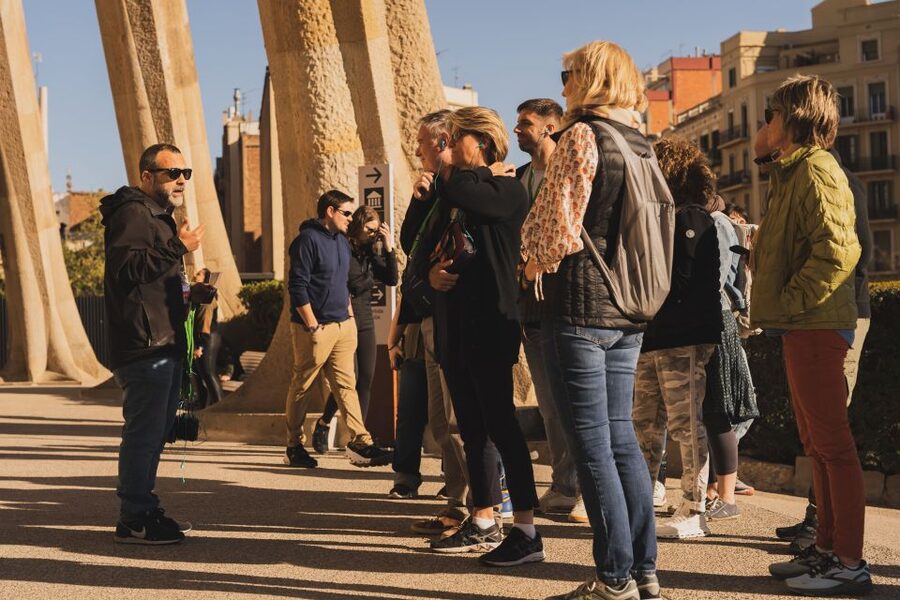
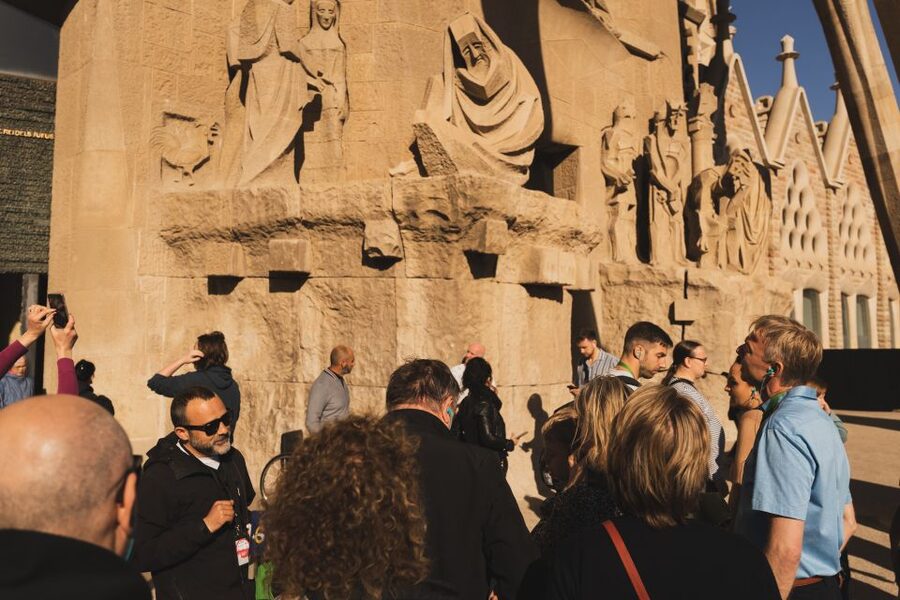
You receive an audio headset so you can hear the guide while moving through the basilica. This is more useful than it may sound. The interior can be busy, and you may not always have a direct view of the guide. The headset lets you look upward at the architecture without losing the explanation.
The Nativity Façade sets the tone
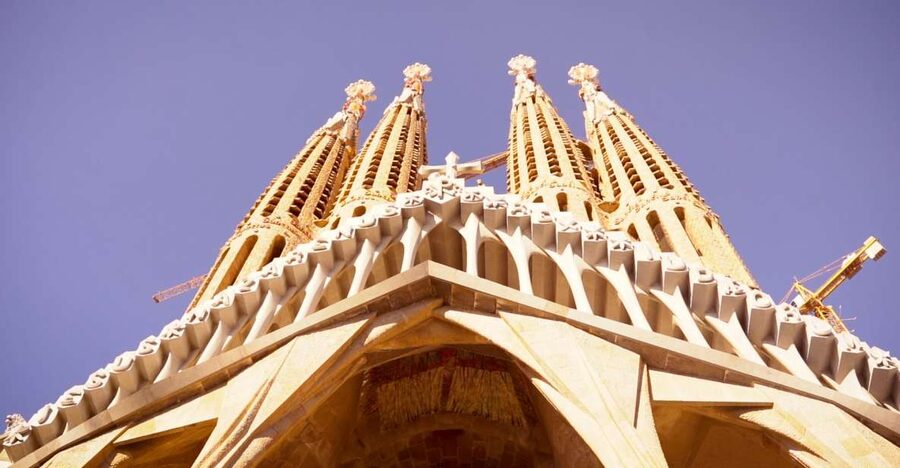
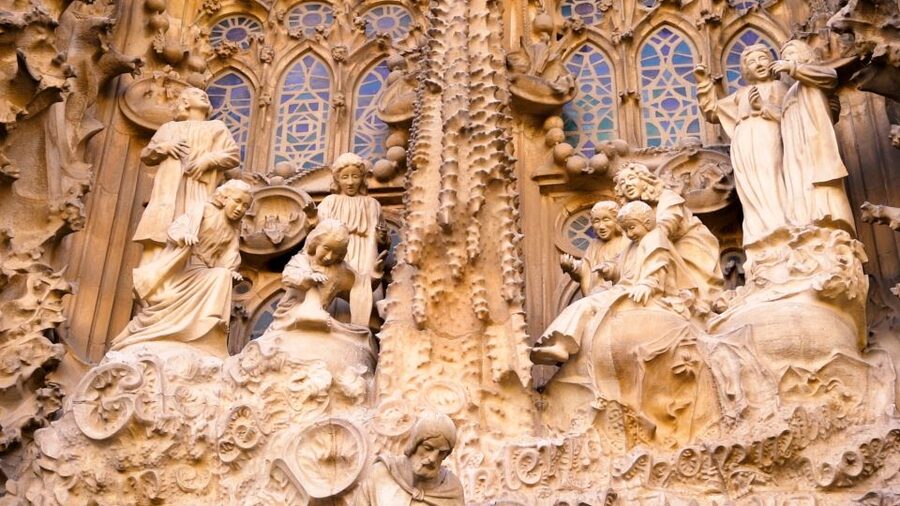
The tour begins with an introduction before you enter the basilica. After security, the guide discusses the Nativity Façade, the first completed section of the Sagrada Familia.
This side of the building has a more organic and decorative character. Your guide will help you make sense of its religious scenes and the many figures worked into the stone. Without explanation, it is easy to spend your time pointing at unusual shapes without seeing how the scenes fit together.
The façade is also a useful starting point for understanding Gaudí’s approach. He did not treat the building as a plain box with decoration added afterward. The structure, sculpture, natural forms, and religious message were meant to work together.
Skip-the-line entry helps reduce the ticket queue, especially when regular admission is limited or sold out. One visitor found a guided tour useful for getting a last-minute place when standard tickets were no longer available. Still, the phrase skip-the-line needs a practical footnote: you do not skip the security checkpoint.
All visitors pass through metal detectors, and the wait can take approximately 20 to 30 minutes. Keep this in mind when planning another appointment immediately afterward.
Inside the basilica, look up slowly
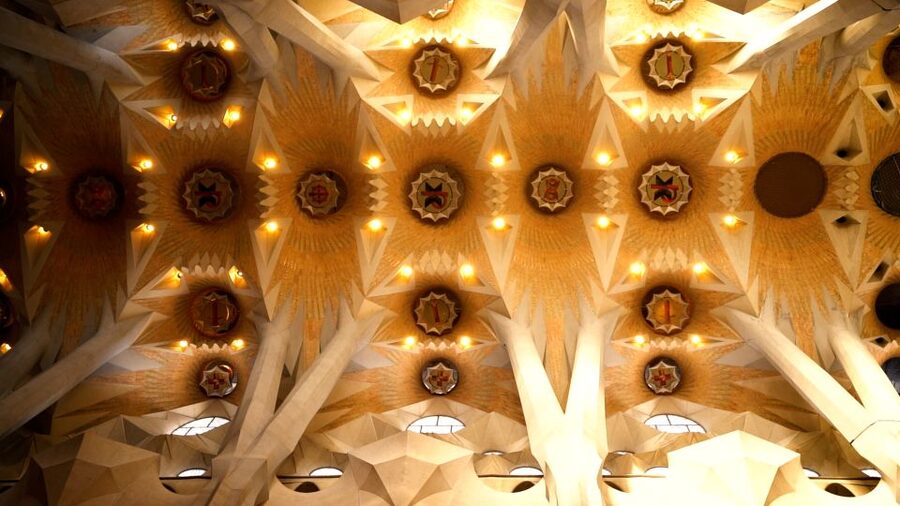
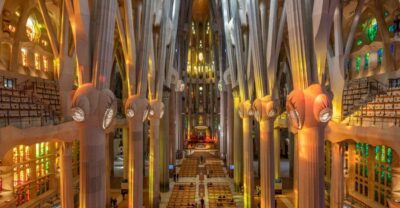
The interior is where the tour becomes most memorable. Sunlight through the stained glass windows fills the space with shifting color, while the columns branch toward the ceiling like the trunks and limbs of a stone forest.
Gaudí wanted the interior to feel like walking through woods. The guide explains how the columns and light support that idea. This is one of those places where a small amount of context changes what you see. Instead of viewing the columns as fanciful decoration, you begin to notice their structural purpose and their connection to the natural world.
The stained glass is particularly dependent on the hour and the weather. A visit on a gray day may look subdued at first, while sunlight can suddenly bring the colored windows to life. A late afternoon visit has been praised for the way the light moved through the basilica, and another visitor described the sun appearing during the visit as a memorable moment.
You cannot control the sky, of course. But if you have flexibility, think about light when choosing a starting time. The tour lasts 1.5 hours, so you should have enough time to listen, look around, and absorb the space without being pushed through at a frantic pace.
The pace is one of the better features for first-time visitors. The route contains a lot of information, but the guide can give you the main ideas without turning every sculpture into a lecture. You should still expect a steady stream of facts. If you want to study every detail in silence, the free time after the guided portion will matter.
More skip-the-line tickets in Barcelona:
- Park Guell and Sagrada Familia Tour with Skip the Line Tickets
★ 5.0 · 6,384 reviews - Barcelona: Sagrada Familia Skip-the-Line Guided Tour
★ 4.3 · 5,365 reviews - Barcelona: Sagrada Família Skip the Line Tour & Entry Ticket
★ 4.7 · 3,528 reviews - Sagrada Familia Guided Tour with Skip the Line Ticket
★ 4.5 · 3,030 reviews
The Passion Façade offers a sharp contrast
After leaving the basilica, the guide discusses the Passion Façade, which depicts the crucifixion of Jesus.
The mood here differs from the Nativity side. The sculptures are stark and angular, and the overall effect is more severe. The tour explains how the Passion Façade represents the drama of the story and how much of this section was built after Gaudí’s death.
This contrast helps you understand that the Sagrada Familia is not visually uniform. Different periods, artists, and approaches shaped the building. The tour can also help you separate Gaudí’s original work from later contributions, a useful distinction when the entire structure is often casually described as if one person completed it alone.
You will likely spend less time here than inside the basilica. That is reasonable. The façade is best appreciated from a few deliberate viewpoints, with time to notice the sculptures and their relationship to the larger structure.
The workers’ school reveals Gaudí’s practical side
The next stop is the Sagrada Familia Schools. Gaudí designed this building for the children of the workers constructing the basilica.
This is a small but worthwhile part of the route because it shows Gaudí working on a practical problem, not just creating grand religious architecture. The school was reconstructed more than once and moved to make way for the basilica.
The stop also brings the building project back to ordinary people. Behind the grand towers and elaborate facades were families, workers, teachers, and generations of local effort. That connection makes the Sagrada Familia feel less like an isolated artistic object.
The tour does not require a great deal of walking, which suits anyone who wants a focused architectural visit rather than a long city walk. You should still expect time on your feet and movement through security and public areas.
The museum puts the complicated pieces together
The final major stop is the Sagrada Familia Museum. Here you see original sketches, plans, objects connected to Gaudí’s life, and artifacts from the basilica’s construction.
The plaster models are especially useful. Gaudí worked with physical models to explore complex forms, including an upside-down model of the basilica. Seeing these models gives you a clearer sense of how the unusual structure could be planned and tested.
This is also where the tour’s explanation of construction becomes more concrete. The Sagrada Familia is difficult to understand from the finished interior alone. Plans and models show the design process, the engineering challenges, and the amount of work required to turn Gaudí’s vision into stone, glass, and towers.
I would not treat the museum as an optional afterthought. If your interest is mainly photography, you may be eager to return to the main interior. But if you want to understand why the building took so long and why so many specialists remain involved, the museum adds real value.
Free time after the guided visit
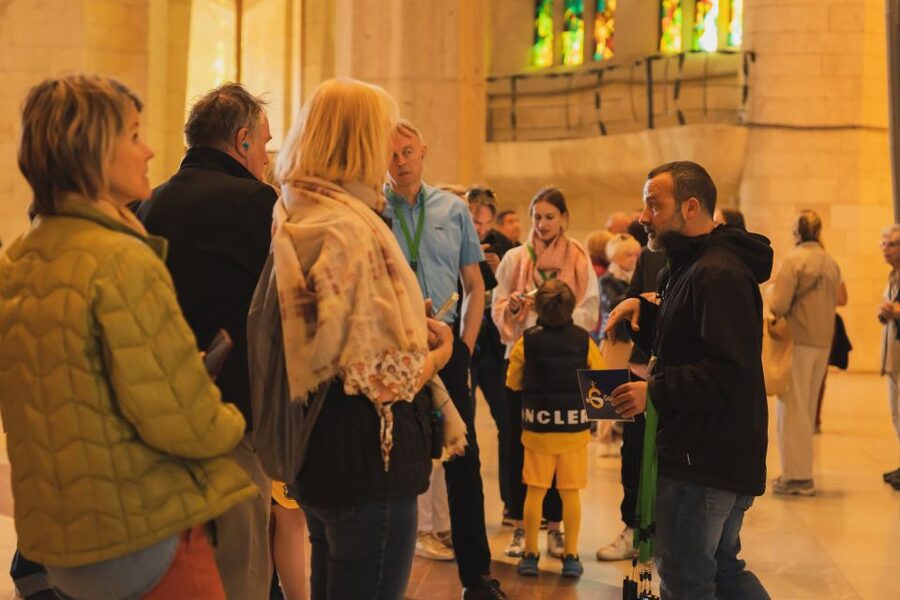
The guided portion lasts about 1.5 hours, followed by free time at the Sagrada Familia. That extra time gives you a chance to revisit details, take photographs, or sit quietly and look up.
Use the guided part to listen and the free time to inspect. Trying to photograph every detail while the guide is speaking usually means you do neither well. The headset helps, but it is still better to give the explanation your attention and save your close-up viewing for afterward.
One guide even offered advice on the best photo locations and camera settings. That sort of practical help can be useful because the basilica contains more visual information than you can capture in a few casual pictures.
The free time also makes the tour feel less rushed than a strict point-to-point visit. You are not simply escorted out as soon as the final explanation ends.
Is $64 a fair price?
At $64 per person, this is not the cheapest way to see the Sagrada Familia. The value depends on how much you want from the visit.
If you already understand Gaudí’s work, prefer to read signs on your own, and have secured a standard ticket at a lower price, you may find the guided option expensive. One visitor felt the cost was high compared with other Spanish attractions offering similar detail.
For a first visit, the calculation is different. The price includes admission, a certified guide, an English audio headset, access to the basilica, and the museum route. It also offers a separate ticket entrance, which can be helpful when ordinary tickets are hard to obtain.
The guide quality is another part of the value. Names such as Ania, Alba, José, Txell, Aurelia, Carlos, and Javier appear repeatedly in praise for clear, lively explanations. Of course, you cannot select your guide from the information provided, but the range of strong guide experiences makes the added cost easier to defend.
I would pay for this tour if the Sagrada Familia is a major reason for your Barcelona visit, especially if you want to understand the architecture rather than simply see it. I would skip it if your budget is tight and you are happy with a shorter, self-guided look.
Dress, identification, and timing
Bring identification to prove your age. If you cannot show the correct proof, entry may be refused without a refund.
Dress for a Catholic church. Tank tops, strapless shirts, short shorts, and sandals are not permitted. Clothing intended for celebrations or festivities is also not allowed. The rule is simple: choose respectful, covered clothing rather than treating the basilica like a casual sightseeing stop.
Arrive 15 minutes before the start time. The meeting point is separate from the basilica entrance, and security can add 20 to 30 minutes once the group reaches the checkpoint.
The tour is offered in English, with an English-speaking live guide and English audio support. Small-group availability is offered, and the smaller format is worth choosing if you want to hear answers and stay close to the guide.
You can cancel up to 24 hours before the activity for a full refund, and you can reserve now while paying later. Those terms are useful if your Barcelona schedule is still shifting.
Who should book this Sagrada Familia tour?
I recommend this experience most strongly for a first-time visitor, an architecture fan, or anyone who wants religious and historical context without spending several hours on a full-day tour.
It also suits families. A clear guide can give children something to look for, and one family found the guide kind and helpful with young children. The museum models and unusual shapes offer plenty of visual hooks for younger visitors.
It is less suitable for someone who wants a quiet, unstructured visit. The group follows a set route and listens to a guide, so you will not control every stop. The 1.5-hour format is focused rather than leisurely.
It can also work well when tickets are sold out elsewhere. The separate entrance and organized booking may be worth the extra cost if seeing the Sagrada Familia is one of your fixed Barcelona priorities.
Should you book it?
Book this tour if you want the Sagrada Familia to make sense, not just look impressive. The guide connects the facades, forest-like interior, stained glass, construction process, workers’ school, and museum models into one readable story.
Skip it if you already have strong knowledge of Gaudí’s architecture or if $64 feels too high for a 90-minute visit. You will still need to wait through security, and the tour cannot give you unlimited time inside.
For most first-time visitors, I think the guided format earns its price. The basilica is too full of ideas to rush through with only a camera. Arrive early, dress properly, bring identification, and give the guide your attention. Then use the free time to enjoy the building at your own pace.
FAQ
How long does the Sagrada Familia guided tour last?
The guided tour lasts 1.5 hours. You also receive free time at the Sagrada Familia after the guided portion.
How much does the tour cost?
The price is $64 per person.
What language is the tour offered in?
The live tour guide speaks English, and the included audio support is also in English.
Where is the meeting point?
Meet your guide inside the Ringels souvenir shop at C/ de Mallorca, 418, 08013 Barcelona. Look for a guide holding a Golden Tour Guide sign.
How early should I arrive?
Arrive 15 minutes before the scheduled start time.
Does skip-the-line entry avoid security?
No. The separate entrance helps with ticket lines, but all visitors must pass through metal detectors. Security may take approximately 20 to 30 minutes.
Is an audio headset included?
Yes. An audio headset is included so you can hear the guide during the visit.
What parts of the Sagrada Familia are included?
The route includes the Nativity Façade, basilica interior, Passion Façade, Sagrada Familia Schools, and Sagrada Familia Museum.
Do I need to bring identification?
Yes. You must bring identification to prove your age. Without the correct proof, entry may be refused and a refund may not be available.
What clothing is not allowed?
Tank tops, strapless shirts, short shorts, and sandals are not permitted. Clothing intended for celebrations or festivities is also not allowed because the Sagrada Familia is a Catholic church.
Just added around Barcelona
- Love in the Gothic Quarter Barcelona: Self-Guided Romantic Walk★ 4.5 · 9 reviews
- Walking tour of the Gothic Quarter of Barcelona + Cathedral★ 5.0 · 8 reviews
- Wine tasting with a view of the Sagrada Familia★ 4.5 · 13 reviews
- Visit to the Modernist houses of the Americans★ 5.0 · 2 reviews
- Barcelona Jewish & Gothic Tour★ 5.0 · 18 reviews
- Roman & Gotic & Gaudi in Barcelona: private walking tour★ 4.5 · 2 reviews
- Barcelona Gaudi Tour: Sagrada Familia, Casa Batllo & Casa Mila★ 5.0 · 4 reviews
- Self-Guided Audio Tour-The Surrealist Barcelona of Dalí and Gaudí★ 3.5 · 8 reviews
Sagrada Familia Tours, compared.
Barcelona: Sagrada Familia Entry Ticket with Audio Guide
Read our review →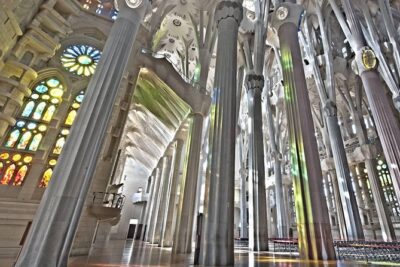
Barcelona in 1 Day: Sagrada Familia, Park Guell,Old Town & Pickup
Read our review →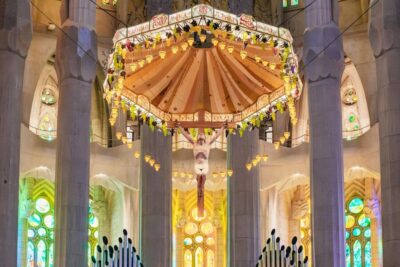
Barcelona: Sagrada Familia Skip-the-Line Entry Ticket & Tour
Read our review →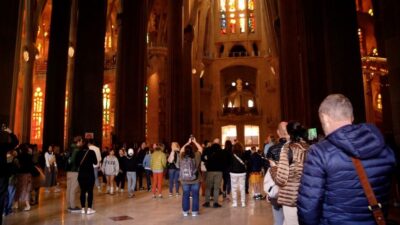
Barcelona: Sagrada Familia Skip-the-Line Guided Tour
Read our review →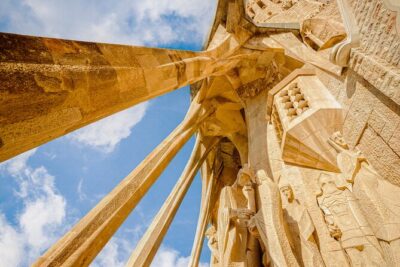
Barcelona: Sagrada Familia Priority Access Guided Tour
Read our review →
Barcelona: Sagrada Familia Tour & Optional Tower Visit
Read our review →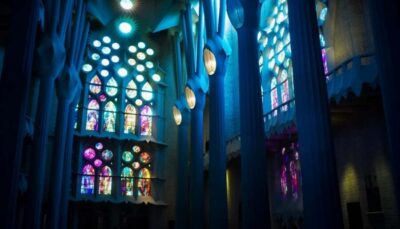
Barcelona: Sagrada Familia Guided Tour with Tower Access
Read our review →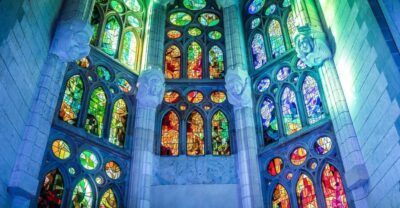
Barcelona: Sagrada Família Skip the Line Tour & Entry Ticket
Read our review →Browse the lists this tour appears in