
Review · BARCELONA
Barcelona Gothic Quarter Self Guided Walking Tour with Mobile App
Barcelona’s Gothic Quarter is best understood on foot, where a Roman column can appear beside a medieval doorway and a quiet square can carry the scars of modern war. This self-guided route links 14 historic stops, including the Temple of Augustus, Barcelona Cathedral, Picasso’s large outdoor mural, and the old Archdeacon’s house.
I like the freedom to pause, repeat the audio, or take the route again during the one-year access period. I also like the low price, $5.09 per person, which makes this a useful introduction before spending money on larger guided tours. The trade-off is that the app does the guiding, not a person, and the map may not always place you perfectly.
Key points to know
- Fourteen central Barcelona stops: The route covers Roman, medieval, Catalan, artistic, and modern history in about two hours and 15 minutes.
- A phone-based tour: You receive audio, written commentary, stop images, and an interactive map in English.
- Outside visits only: You see every location from the street, without admission to the cathedral, churches, or other interiors.
- Download before you start: Offline access helps, but the full route can use your phone battery.
- A few wonderfully odd details: Look for the dancing egg, Picasso’s mural, the 13 geese, and the dragon legend at Pont del Bisbe.
- A practical bargain: At $5.09, this works well for independent walkers who want context without a fixed group schedule.
Starting with Catalan identity at Plaça de Catalunya
The walk begins at Plaça de Catalunya, the broad meeting point between Barcelona’s newer Eixample district and the old city. From here, the route quickly points you toward the Monument dedicated to Francesc Macià.
The monument is more than a statue with a name attached. Its bold design carries a message linked to Catalan heritage and leadership, and the app explains how to read that symbolism. This is a useful opening because it gives you a political and cultural frame before the route turns into narrow medieval streets.
There is also a small practical curiosity at this first stop. A bird lady offers pigeons for hand-feeding, and you should carry a few euros if that appeals to you. It is not part of the tour price, so treat it as an optional street-side extra rather than an included activity.
From Plaça de Catalunya, you move along Avinguda del Portal de l’Àngel. This was once a textile center and is now lined with international brands. The contrast is the point: Barcelona’s old commercial artery has changed its products, but not its role as a place for shopping and movement.
I would not linger here for the shops unless you want a break. The useful part is the historical shift, especially if you are trying to picture how the Gothic Quarter has changed from working trade district to modern retail zone.
More Gothic quarter walks in Barcelona:
- Barcelona all included: Sagrada, Park Güell, Montjuic & Gothic
★ 5.0 · 2,169 reviews - Barcelona Gothic Quarter Tapas & Taverns Food & Wine Tour
★ 5.0 · 1,470 reviews - Barcelona: Old Town and Gothic Quarter Walking Tour
★ 4.8 · 1,393 reviews
Santa Anna and Barcelona’s oldest urban layers
The Church of Santa Anna is one of the route’s most rewarding surprises. Tucked just off the busy streets, this 12th-century church combines Romanesque and Gothic features. You visit it from outside, so do not expect a full look at the interior, but the setting helps you notice how easily old religious buildings disappear behind modern city life.
The church is particularly good for showing the layered character of Barcelona. You can move from a shopping street into a quieter medieval setting within minutes. The app’s commentary gives you a reason to stop rather than simply walk past another old façade.
The next stop is a historic restaurant associated with Antoni Gaudí, Pablo Picasso, and Ramon Casas i Carbó. The appeal here is not just the building or the menu. It is the idea of a meeting place connected with artists who helped shape Barcelona’s public image.
The tour does not include a meal or a restaurant visit, so you should see this as a cultural marker. If you are hungry, you can decide for yourself if the location deserves a return visit, but the walking route is focused on exterior viewing.
You then pass the 14th-century Font de Santa Anna. This fountain once served as a watering trough for horses. It is a modest stop, yet it shows how practical objects supported daily city life long before modern transport and public infrastructure.
Picasso, the dancing egg, and clever medieval details
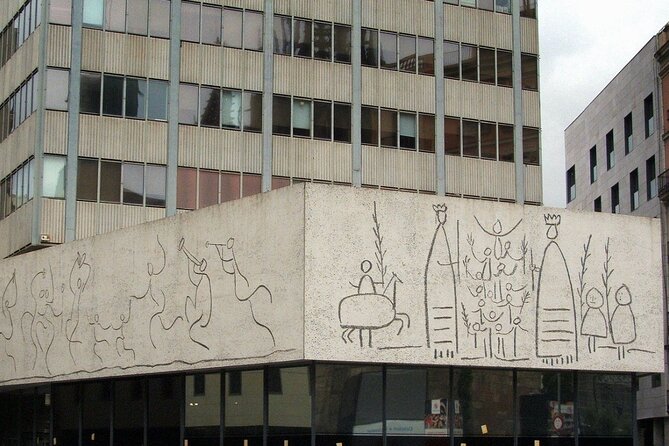
One of the strongest stops is the Col·legi d’Arquitectes de Catalunya, where you can see one of Picasso’s largest works without paying an admission fee. The mural is displayed on the exterior, making it an easy addition to a walking route.
This is a good example of the tour’s range. You are not only looking at medieval stone. You are also seeing how 20th-century art entered the old quarter and how a modern building can contribute to the street scene.
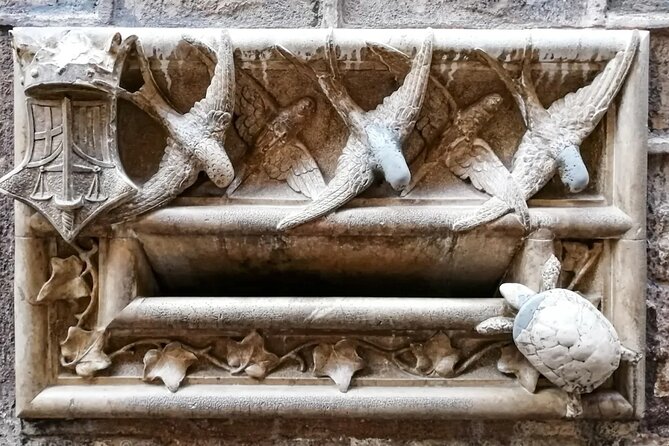
The route continues to the former residence of Archdeacon Lluís Desplà, a 15th-century building with two details worth slowing down for. The letterbox has symbolic decoration, and the courtyard is associated with the whimsical dancing egg tradition.
The dancing egg is exactly the sort of detail that can be missed if you walk without context. The app points out what to look for, while its images can help you confirm that you are at the right stop. Since the map is not always exact, the visual clues matter.
This section is also where the app format works best. You can stop the commentary, examine the doorway, and restart it without worrying about holding up a group. If you prefer asking questions as you go, though, a human guide would be more useful.
Barcelona Cathedral and the 13 geese of Saint Eulalia
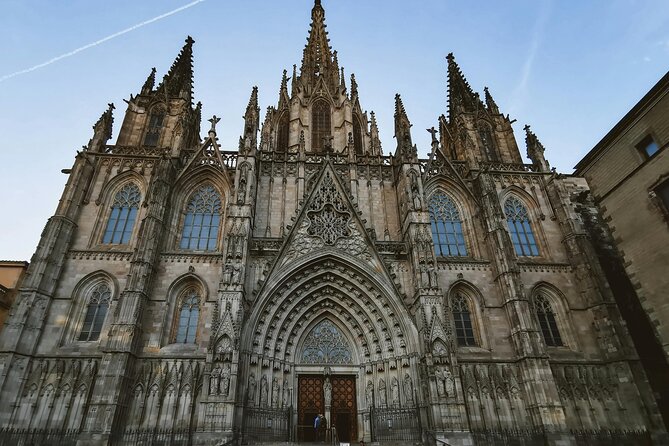
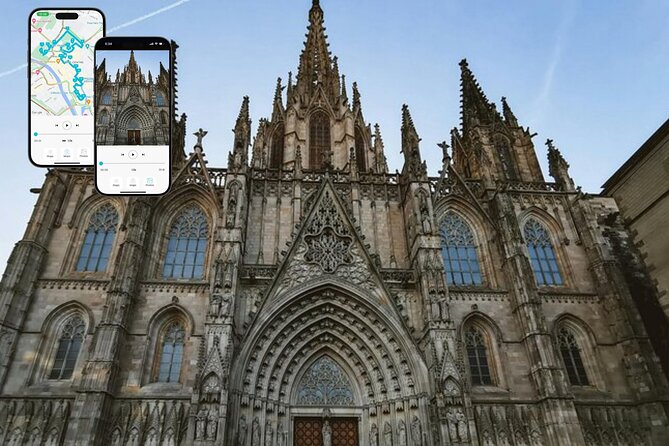
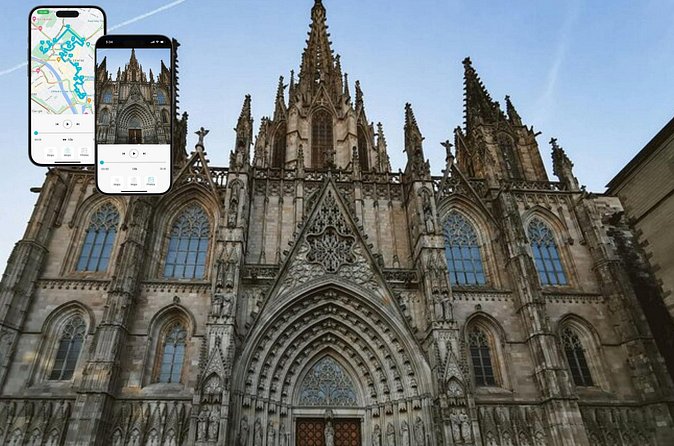
Barcelona Cathedral is the grandest sight on the route. The exterior gives you plenty to examine, from its tall Gothic form to the stories connected with the city’s patron saint, Saint Eulalia.
The app explains the connection between Saint Eulalia and the 13 geese kept within the cathedral. The number is tied to her age at martyrdom, and the birds provide one of those memorable details that helps the building stay in your mind after the walk.
Remember that this experience visits the cathedral from outside. You will not enter to inspect the cloister, chapels, or interior artworks through this booking. If the cathedral is a major reason for your visit, plan a separate admission or church visit, subject to opening arrangements at the time of your trip.
The outside-only rule is both a limitation and a useful time saver. You can hear the main story without waiting in an entry line, but you will miss the interior spaces that make the cathedral more than a façade.
More architecture walks in Barcelona:
- Ramblas, Old Town, Gothic and Gaudi Architecture Walking Tour
★ 5.0 · 723 reviews - Kids and Family Gothic Quarter Walking Tour in Barcelona
★ 5.0 · 465 reviews - Barcelona Gothic Quarter Walking Tour
★ 4.5 · 456 reviews - Barcelona: Gothic Quarter Walking Tour
★ 4.9 · 383 reviews
War, memory, and the quiet Plaça de Sant Felip Neri
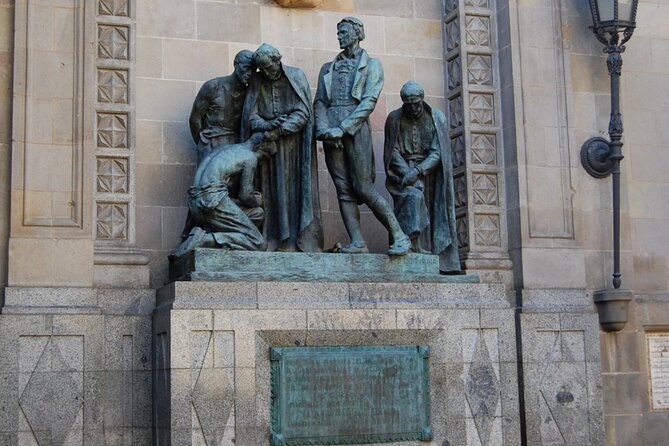
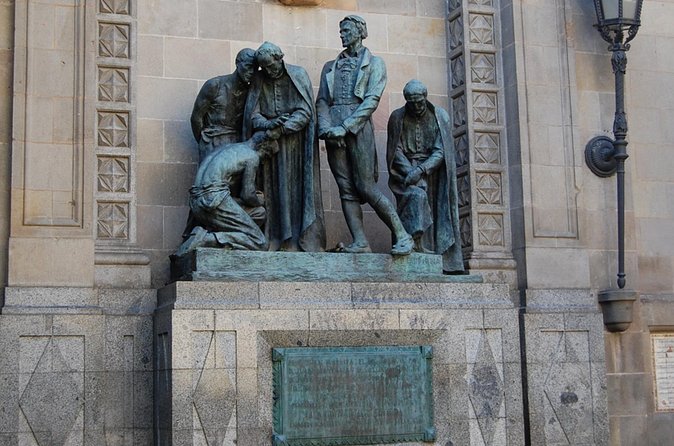
The Monument to the Heroes of 1809 turns the walk toward Barcelona’s more difficult past. The stop recalls dramatic events that shaped the city and gives the route a clear break from its architectural focus.
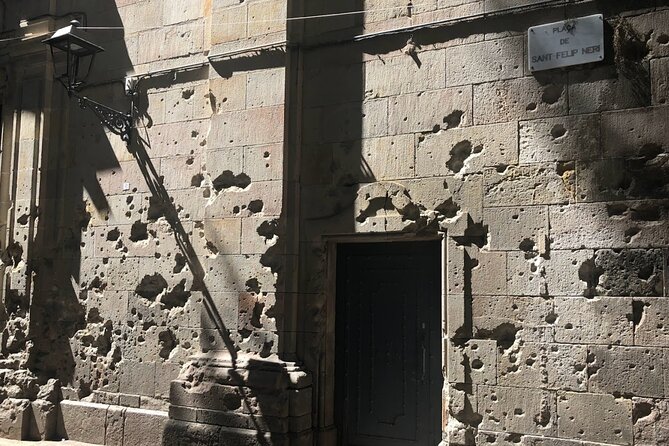
Then comes Plaça de Sant Felip Neri, one of the most affecting places on the walk. Its walls still show scars from the 1938 bombings. The square is quiet, and the damaged stone makes history feel physical rather than abstract.
This is a place where you should pause the audio for a moment and simply look. The tour provides the facts, but the square itself does much of the work. The visible damage is a reminder that the Gothic Quarter is not frozen in the Middle Ages. It has also lived through political violence and war.
Because the route includes this stop, it offers more than a quick checklist of pretty buildings. You get religious history, art, local identity, and the memory of conflict within a compact walk.
Pont del Bisbe and the legend of Sant Jordi
The walk passes beneath or near Pont del Bisbe, the famous bridge linking buildings across the street. The app connects it with the legend of Saint George, or Sant Jordi, the knight who defeats the dragon.
The bridge is one of the most photographed points in the Gothic Quarter, but the legend gives you a better reason to stop than simply taking a picture. Sant Jordi is deeply connected with Catalan culture, and the story helps explain why the saint appears so often in local symbols and celebrations.
This is also a good spot to check the app’s photos. Gothic Quarter streets can be confusing, and an image of the bridge or nearby façade is often more useful than relying only on the blue location marker.
One important warning: the route’s map icon may not always show your position accurately. Download the audio, written notes, photos, and map before leaving your accommodation. Keep your phone charged, and do not depend on a live connection to rescue you if the signal or battery fades.
Roman Barcelona at the Temple of Augustus
The Temple of Augustus is one of the most striking changes in scale on the route. Behind the medieval streets are columns from a 2,000-year-old Roman temple, one of the city’s oldest surviving remains.
The site is hidden in the sense that it is easy to miss from the surrounding lanes, not because it is far away. That makes the stop especially satisfying. You are standing in the Gothic Quarter, yet the evidence beneath the city reaches back to Roman Barcelona.
Again, the booking provides an outside visit only. You can see the columns and hear the story, but entry to the site is not included. The app helps you understand why these fragments matter instead of treating them as isolated stones.
For me, this is one of the best reasons to choose the route. A normal walk through the quarter can leave you focused on medieval architecture. This stop pushes your timeline back many centuries and makes the city feel layered.
Saints Justus and Pastor, the final church, and the route’s shape
The Basilica of Saints Justus and Pastor is both a stop and the ending point. It is one of Barcelona’s oldest churches and carries its own legends and long religious story.
The stated end point is Plaça de Sant Just, at the basilica. The route also lists the Parliament of Catalonia as a historic landmark in the Gothic Quarter. Since all locations are visited from outside, the sequence is best treated as a city walk with exterior viewing rather than a set of museum entries.
The finish is convenient for continuing through central Barcelona, though the tour does not provide transport. You can walk from the start at Plaça de Catalunya and complete the route on foot, with the total time including the distance between stops and the time needed to listen to the commentary.
At about two hours and 15 minutes, the schedule is manageable for most people who can walk through city streets. You will want comfortable shoes, since the route moves through paved streets and busy public areas rather than a single controlled attraction.
What the app does well, and where it needs help
The Tourific app gives you one year of access on iOS and Android. You can listen as often as you like, repeat a section, or use the route on another day. That flexibility is more useful than it first sounds, especially if you want to split the walk around meals or other sightseeing.
You receive:
- English audio commentary
- Written descriptions
- Photos to help identify stops
- An interactive map
- Offline access after downloading the tour
The audio and written guide are AI-generated. That keeps the price low, but it also means you should not expect a local guide who can answer follow-up questions or adjust the route to your interests.
The phone battery is the main practical concern. One person nearly reached the end before the battery died, so charge fully before beginning. A portable battery is sensible if you plan to take pictures or use your phone for other Barcelona plans at the same time.
The map can also be imperfect. One stop was difficult to find, and the location icon did not always work as expected. Use the stop photos and written directions together, and do not assume the blue dot is always correct.
Is $5.09 good value for this Barcelona walk?
At $5.09, the value is easy to see if your goal is a low-cost introduction to the Gothic Quarter. You receive a planned route, historical context, repeat access for a year, and offline tools for less than the cost of many snacks and drinks in central Barcelona.
The price does not cover cathedral or church entry, transport, food, headphones, or a physical device. You also need your own phone and must handle navigation yourself. Those limits are fair at this price, but they matter if you want a polished guided experience with every detail handled for you.
I would compare it this way:
- Choose this if you like walking alone, setting your own pace, and stopping for photos.
- Choose a human-led tour if you want conversation, questions, and help with confusing streets.
- Choose this if you mainly want exterior sights and concise background.
- Plan another visit if entering the cathedral, churches, or Temple of Augustus is essential.
The 100 percent satisfaction guarantee offers a little extra protection, with a full refund available when you cancel at least 24 hours before the start time. Cancellations inside 24 hours are not refunded, and changes in that period are not accepted.
Who should book this self-guided route?
I would recommend it to independent visitors who want a simple first walk through central Barcelona. It suits solo visitors, couples, and families who prefer not to keep pace with a group.
It is also useful for a short stay. Starting at Plaça de Catalunya puts you near a major city crossroads, and ending at Sant Just leaves you in the old center. You can fit the walk into a morning or afternoon, though the route itself does not include breaks.
People with limited mobility should consider the walking requirement and city streets before booking. The tour information says most people can participate, service animals are allowed, and public transport is nearby. It does not provide a vehicle or transport between stops.
Should you book the Barcelona Gothic Quarter app tour?
Book it if you want a cheap, flexible orientation walk with strong visual stops: the Temple of Augustus, Picasso’s mural, Barcelona Cathedral, the 13 geese of Saint Eulalia, Pont del Bisbe, and the bomb-scarred walls of Plaça de Sant Felip Neri.
Skip it if you want interior access, a live guide, or perfectly precise navigation. Download everything before you start, charge your phone, carry a few euros for the optional pigeon feeding at the first stop, and keep the stop photos handy.
For $5.09, this is a practical way to put the Gothic Quarter into context. Just see it as a guided audio walk on your own terms, not a full admission tour or a substitute for a local historian.
FAQ
Where does the Barcelona Gothic Quarter self-guided tour start?
The tour starts at Plaça de Catalunya, Eixample, 08002 Barcelona, Spain.
Where does the tour end?
It ends at the Basilica of Saints Justus and Pastor in Plaça de Sant Just, Ciutat Vella, 08002 Barcelona.
How long does the tour take?
The approximate duration is two hours and 15 minutes, including walking between stops and time to listen to the commentary.
Is a human guide included?
No. This is a self-guided experience using a mobile app. No human guide is provided at the location.
What language is available?
The tour is offered in English.
Can I use the tour without internet?
Yes. You can use it offline after downloading the tour.
What is included in the mobile app?
The app includes AI-generated audio and written commentary, stop images, an interactive map, and one year of access on iOS and Android.
Do I enter the cathedral, churches, or other sights?
No. All stops are visited from outside, and entry into locations is not included.
Do I need headphones or a physical device?
Headphones and physical devices are not included. You need to use your own phone, and you may use your own headphones if desired.
Can I cancel for a full refund?
Yes, if you cancel at least 24 hours before the experience start time. Cancellations or changes made less than 24 hours before the start time are not accepted for a refund.
More Self-Guided Architecture Routes in Barcelona
- Barcelona: Sagrada Familia Entry Ticket with Audio Guide
★ 4.6 · 105,312 reviews - Casa Batllo Admission Ticket with Intelligent Audio Guide
★ 4.5 · 3,168 reviews - The Gothic Trail – Ghosts of Barcelona Exploration Game
★ 4.5 · 33 reviews - Gaudi and La Sagrada Familia Exterior Self-Guided Audio Tour
★ 3.5 · 25 reviews
Just added around Barcelona
- Love in the Gothic Quarter Barcelona: Self-Guided Romantic Walk★ 4.5 · 9 reviews
- Walking tour of the Gothic Quarter of Barcelona + Cathedral★ 5.0 · 8 reviews
- Wine tasting with a view of the Sagrada Familia★ 4.5 · 13 reviews
- Visit to the Modernist houses of the Americans★ 5.0 · 2 reviews
- Barcelona Jewish & Gothic Tour★ 5.0 · 18 reviews
- Roman & Gotic & Gaudi in Barcelona: private walking tour★ 4.5 · 2 reviews
- Self-Guided Audio Tour-The Surrealist Barcelona of Dalí and Gaudí★ 3.5 · 8 reviews
- Barcelona Gaudi Tour: Sagrada Familia, Casa Batllo & Casa Mila★ 5.0 · 4 reviews
Gothic Quarter Tours, compared.
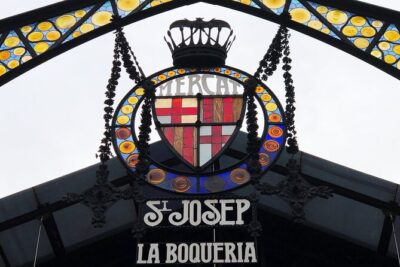
Barcelona all included: Sagrada, Park Güell, Montjuic & Gothic
Read our review →
Barcelona Gothic Quarter Tapas & Taverns Food & Wine Tour
Read our review →
Barcelona: Gothic Quarter Ghosts and Legends Walking Tour
Read our review →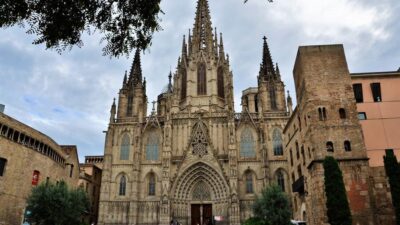
Barcelona: Old Town and Gothic Quarter Walking Tour
Read our review →
Barcelona Old Town & Gothic Quarter Small Group Tour
Read our review →
Ramblas, Old Town, Gothic and Gaudi Architecture Walking Tour
Read our review →
Barcelona: El Born and Gothic Quarter Wine & Tapas Bar Tour
Read our review →
Kids and Family Gothic Quarter Walking Tour in Barcelona
Read our review →Browse the lists this tour appears in