
Review · ITALY
Noto: Sicilian Baroque Architecture Guided Walking Tour
Noto’s Baroque center is a grand outdoor theater of honey-colored stone, broad stairways, carved masks, statues, and church facades. This private walk takes you from Porta Reale to the cathedral, Palazzo Ducezio, Santa Chiara, and Palazzo Nicolaci, with an Italian or English-speaking guide explaining what you are seeing.
I like the efficient two-hour route and the chance to enter several important buildings rather than simply photograph their fronts. I also like the private format, which lets the guide adjust the pace. The main drawback is the $346.65 group price: it can be sensible for a large party, but expensive for one or two people.
Key points to know before you book
- Porta Reale is the starting point: Meet beneath the historic gate at the entrance to Noto’s old center.
- Santa Chiara includes an interior visit: Climb the church steps to see frescoes, stucco work, apostles, and putti.
- Palazzo Ducezio is more than a town hall: Its frescoed roof and mirrored rooms add an unusual visual trick to the tour.
- San Nicolò Cathedral is the main landmark: You visit the interior of Noto’s honey-colored cathedral and learn about its repeated rebuilding.
- Via Nicolaci is flower-carpet country: When the Infiorata is set up, this is one of Noto’s most memorable streets.
- The tour is private and returns to the start: It lasts two hours, runs in Italian or English, and ends back at Porta Reale.
Why Noto works so well on foot
Noto rewards a guided walk because its central streets are packed with visual details that are easy to miss when you are simply moving from one church to the next. The city is known as the capital of Sicilian Baroque, and the style here is not shy. Facades swell with columns, balconies carry carved figures, and stairways turn ordinary changes in level into grand entrances.
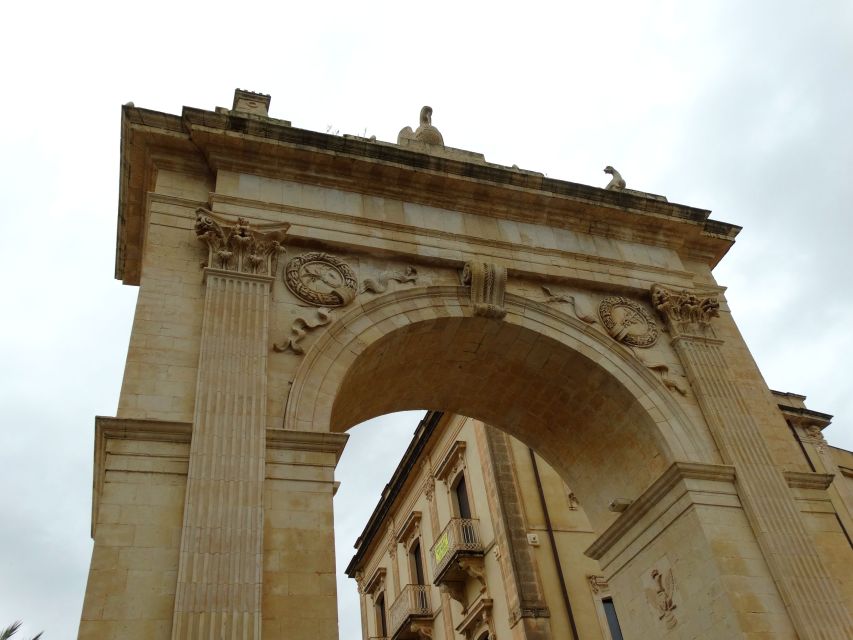
You begin at Porta Reale, also called Porta Ferdinandea. This gate marks the entrance to the historic center and gives the walk a clear starting point. Meet the guide underneath the gate, where the official license badge should be visible.
I like this meeting point because you begin with a landmark rather than a vague street corner. It also places you close to the Church of St. Francis of Assisi and the former Convent of the Holy Savior, the first major sights on the route.
More Baroque architecture tours in Italy:
- Lecce: Baroque Architecture and Underground Walking Tour
★ 4.6 · 1,248 reviews - Interpreti Veneziani Ensemble Baroque Concert in Venice Ticket
★ 4.5 · 403 reviews - Borghese Gallery Max 6 People Tour: Baroque & Renaissance in Rome
★ 5.0 · 185 reviews
Inside Santa Chiara near the former monastery
From Porta Reale, the tour heads toward the Church of Santa Chiara beside the former Benedictine monastery. You climb its attractive staircase, then enter one of Noto’s most decorated church interiors.
The details here are smaller and more intimate than the broad drama of the cathedral. Look for columns covered in stucco, statues of apostles, and putti worked into the decoration. Frescoes and ornamental surfaces give the church a sense of a carefully built stone garden, which is a useful way to understand the local Baroque taste.
This stop gives the tour welcome variety. Noto is not only about enormous facades viewed from the street. You also get to see how the same decorative language continues inside: columns become sculptural, walls gain layers of ornament, and religious figures appear throughout the space.
You should wear comfortable shoes. The route includes stairways, and a polished central street does not mean every part of a church visit is level or effortless. Comfortable clothing is also advised, particularly if you are walking in warm weather.
Palazzo Ducezio and the visual tricks of the town hall
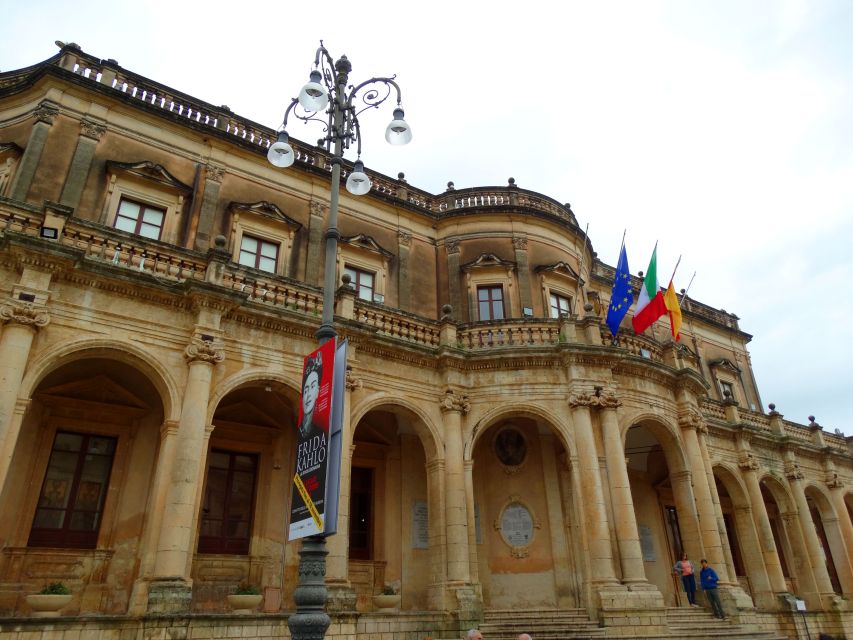
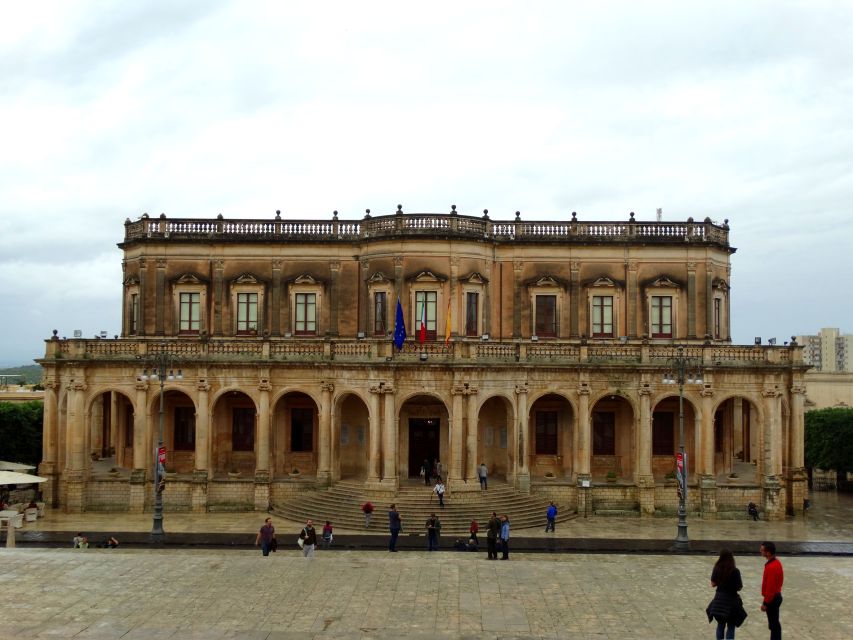
The walk continues to Piazza del Duomo, the civic and religious heart of Noto. Here, Palazzo Ducezio faces the monumental staircase leading to San Nicolò Cathedral.
Palazzo Ducezio houses Noto’s town hall and was built between the eighteenth and nineteenth centuries. Its importance is not only political. Inside, the building has a frescoed roof and rooms lined with mirrors that create visual illusions, making the spaces appear larger than they are.
That mirror effect is one of the tour’s most unusual details. You are not just seeing another ornate palace. You are seeing how decoration and architecture can alter your sense of space. It is a brief but useful reminder that Baroque design was meant to impress the eye and shape your movement through a room.
The palace visit also balances the churches. Santa Chiara and San Nicolò show religious Baroque. Palazzo Ducezio shows how the same taste shaped civic buildings.
The two-hour schedule matters here. You have enough time to pause for the main interiors and listen to explanations, but this is not a slow architectural study. If you enjoy stopping for long photography sessions or examining every carving, you may want extra time in Noto after the guided walk.
San Nicolò Cathedral and Noto’s honey-colored symbol
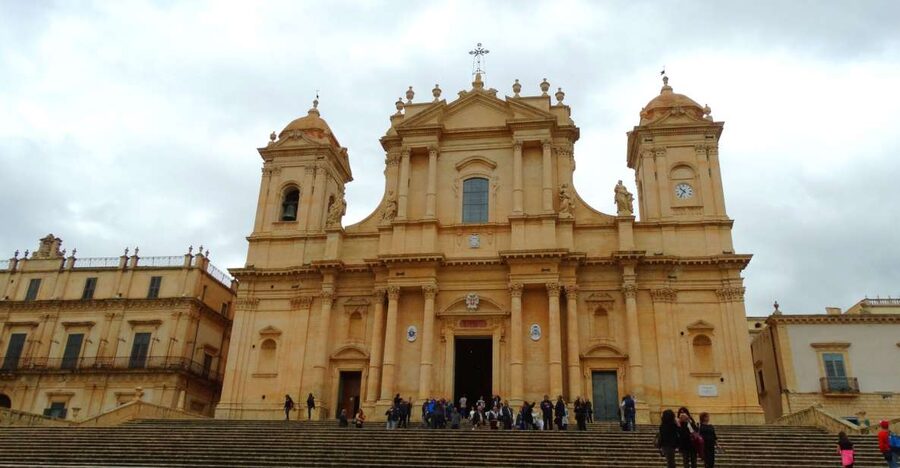
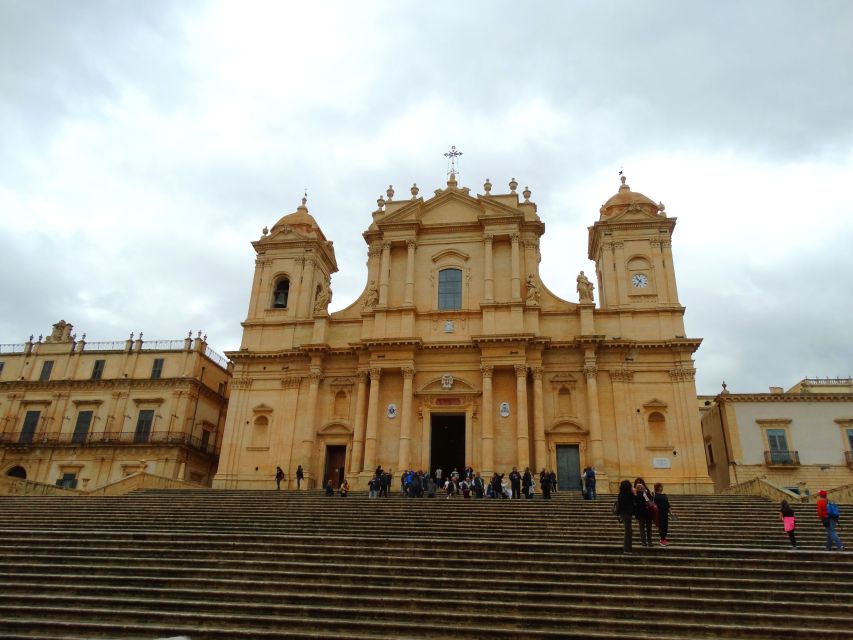
Across the piazza, a wide staircase rises to the Cathedral of San Nicolò. This is the visual center of the tour and the building most closely tied to Noto’s public image.
The cathedral is built in the eighteenth-century Baroque style, with a facade framed by two bell towers. One tower holds a bell, while the other has a clock. The pale stone can take on a warm honey color at sunset, so the building may look especially appealing later in the day.
You go inside the cathedral rather than viewing it only from the piazza. The interior has changed over time because the building collapsed three times and was rebuilt. Many frescoes were lost, but the surviving structure and decoration still make the visit worthwhile.
I appreciate the way this stop adds context to the polished exterior. A photograph of the facade tells you little about the building’s setbacks. Inside, you can better understand that Noto’s Baroque character is not frozen in one perfect moment. It includes rebuilding, loss, and restoration.
The cathedral staircase also gives you one of the tour’s strongest public-space views. From the piazza, you can look across at Palazzo Ducezio and take in the deliberate pairing of civic power and religious power. The tour does not require a separate transfer between these sights, which keeps the route focused and easy to follow.
More architecture walks in Italy:
- Experience Florence’s Art and Architecture on a Walking Tour
★ 5.0 · 318 reviews - Guided Walking Tour of Rome: Top Sights & Baroque Treasures
★ 5.0 · 155 reviews - Palermo: Art and Architecture Walking Tour
★ 4.7 · 136 reviews - 3-hour walking tour Discovering Ragusa Baroque
★ 5.0 · 51 reviews
Via Nicolaci and the famous flower street
From the cathedral area, the walk continues to Via Nicolaci, one of Noto’s best-known streets. This is where the Infiorata flower display is set up, creating a carpet of flowers along the road.
The flower design is a seasonal feature, so you should not assume the street will always be covered during your visit. Even without the floral display, Via Nicolaci remains important for its Baroque buildings and its place in Noto’s city center.
The key palace here is Palazzo Nicolaci. The tour views it from the outside, where its balconies provide some of the most playful stone carving in town. Look for masks, animals, statues, and other figures carved into the lower sections of the balconies.
These carvings reward a slow look upward. The street-level view can make the palace seem restrained at first, but the balconies reveal faces and creatures projecting from the stone. This is where Noto’s Baroque style becomes humorous as well as grand.
You may find the street crowded during the flower event or other busy periods, but the supplied tour information does not promise a specific Infiorata date. Check your travel dates separately if seeing the flower carpet is a main reason for booking.
The market loggia, theater, and Fountain of Hercules
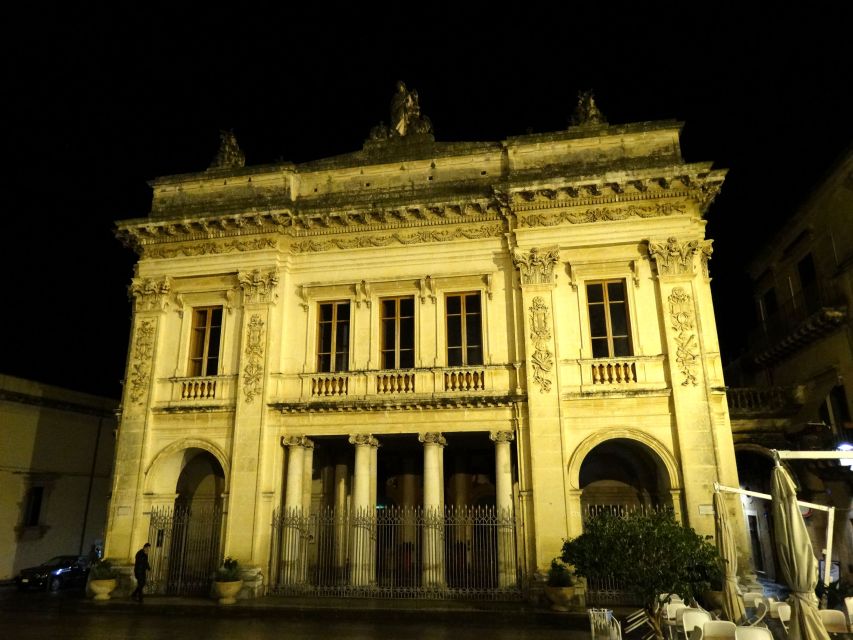
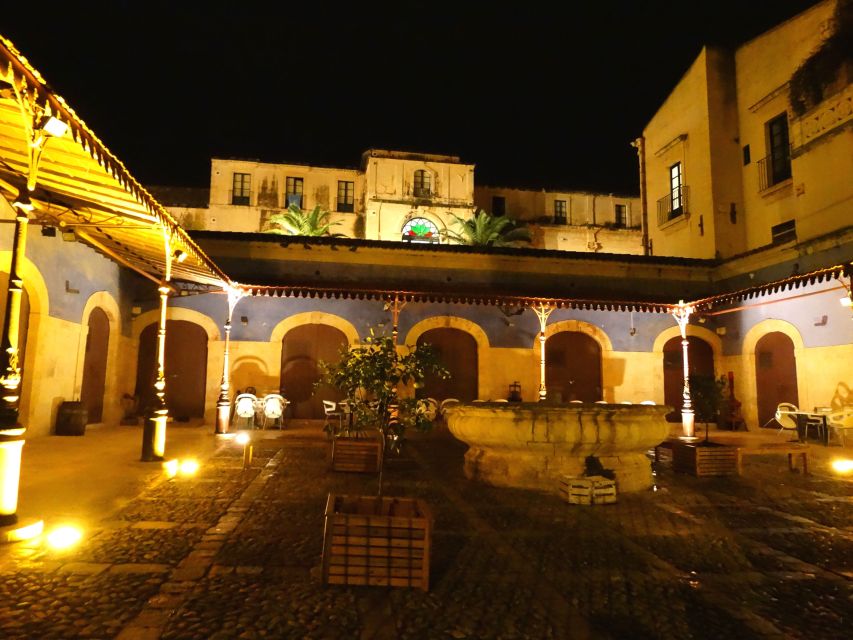
The last part of the route leaves the major piazzas and moves through the historic center’s smaller streets. You reach the Loggia del Mercato, once the site of Noto’s market.
Its wrought-iron loggia gives the building a lighter character than the heavy stone churches and palaces. It is now used for cultural events, so the space links Noto’s old commercial life with its present-day public use.
Next comes the Tina di Lorenzo Theater, an elegant building in the neoclassical style. This is a helpful change of mood. After several stops dominated by Baroque curves, statues, and elaborate carving, the theater offers a cleaner and more restrained architectural language.
The tour ends at the marble Fountain of Hercules, built in the eighteenth century. It is a modest closing point compared with the cathedral, but that is part of its value. You finish with a street-level work of civic decoration rather than another enormous church interior.
The activity ends back at the meeting point under Porta Reale. That makes it easy to continue exploring on your own, return to a nearby accommodation, or stop for a meal in the historic center.
What the private format adds
This is a private group tour for up to 25 people. That setup is useful for families, friends, and larger parties who want one guide without being combined with strangers.
A private walk may also help if you need to adjust the pace. One guide, Elia, is associated with the experience, and a past tour was adapted to the amount of time the group wanted to spend. The guide also made an effort to find shade during a warm day, which is practical in a city where much of the route is exposed.
That does not guarantee a particular guide or weather arrangement, but it shows why a private format can matter. You can ask for a little more time at Santa Chiara, move briskly through a stop that interests you less, or pause when the heat becomes tiring.
The tradeoff is price. The total is $346.65 per group, not per person, with up to 25 people included. For a full group, the cost works out to about $13.87 per person. For two people, the same fee is much harder to justify unless you place a high value on a private guide and a tailored pace.
Is two hours enough for Noto?
Two hours is enough for a well-shaped introduction. You cover the main religious, civic, and cultural sights without needing transport, and the route returns to its starting point.
I would treat this as an orientation walk rather than a complete visit to every building in Noto. The itinerary includes several interiors, but some palaces are viewed externally. You also may want more time at the cathedral, along Via Nicolaci, or at the flower display if it is in place.
The best approach is to use the tour to understand the city’s layout and main architectural language. Afterward, you can revisit the places that caught your eye and spend more time with details that were hard to examine while keeping up with the group.
Starting times vary, so check availability before booking. The tour is offered in Italian and English, and the guide is live rather than prerecorded. That matters when you want to ask about a carving, a fresco, or the unusual layout of a building.
Who should book this walking tour?
I would recommend it to you if Noto is a major stop in your Sicily trip and you want a clear introduction to its Baroque center. It suits first-time visitors, architecture fans, families who prefer a private guide, and groups that want to keep everyone together.
It is also a good match if you want to see interiors rather than spend two hours photographing facades. Santa Chiara, Palazzo Ducezio, and San Nicolò Cathedral each add something different to the route.
I would think twice if you are traveling alone or as a couple on a tight budget. The two-hour length is efficient, but the group price is high for a very small party. You should also avoid booking it with the expectation of a guaranteed flower carpet on Via Nicolaci, since the Infiorata is tied to particular dates.
Free cancellation is available up to 24 hours before the tour for a full refund, and you can reserve now and pay later. Those terms are helpful if your Sicily schedule is still changing.
Should you book the Noto Baroque walking tour?
Book it if you want the main story of Noto delivered in a compact, private walk, especially if you are traveling with a larger group. The strongest parts are the church interiors, the mirrored rooms of Palazzo Ducezio, the cathedral staircase, and the carved balconies of Palazzo Nicolaci.
For a small party, compare the price with the value of hiring a guide just for your group. If that cost works for you, this is a focused way to see Noto’s most important Baroque sights without wasting time finding each one yourself. If not, use the route as your own walking plan and spend extra time at the cathedral, Via Nicolaci, and the smaller streets around the market loggia.
FAQ
Where does the Noto walking tour begin?
The tour begins under the Porta Reale or Porta Ferdinandea gate at the entrance to Noto’s historic center. The guide should wear a clearly visible license badge.
Where does the tour end?
The activity ends back at the meeting point under Porta Reale.
How long does the tour last?
The guided walk lasts two hours.
What languages are available?
The live guide is available in Italian and English.
Is this a private tour?
Yes. It is a private group experience for up to 25 people.
How much does the tour cost?
The price is $346.65 per group of up to 25 people.
Which buildings are visited inside?
The route includes interior visits to the Church of Santa Chiara, Palazzo Ducezio, and the Cathedral of San Nicolò.
Can I see the Infiorata flower display?
The tour visits Via Nicolaci, where the Infiorata flower carpet is set up. The available information does not specify the dates when the display is present.
What should I bring?
Bring comfortable shoes and comfortable clothes for the walking route and stairways.
Can I cancel the tour for a refund?
You can cancel up to 24 hours in advance for a full refund. You can also reserve now and pay later.
Just added around Italy
- Vicenza: Palladian Architecture Private Walking Tour★ 3.3 · 3 reviews
- Vicenza: discovering the city of Palladio by e-bike★ 5.0 · 4 reviews
- Turin: Art Nouveau Walking Tour with Coffee★ 5.0 · 11 reviews
- Vatican: Exclusive Baroque Evening With Aperitivo & Dinner★ 3.1 · 2 reviews
- Venice Music Project – Baroque Autumn – Season 2025★ 4.5 · 7 reviews
- Walking tour in Venice with an architect★ 5.0 · 16 reviews
- Palladio. A wonderful live tale through time&soul, from Ve/Pd/Vr★ 5.0 · 7 reviews
- Turin, Art Nouveau walking tour and coffee break★ 4.0 · 7 reviews
Baroque Architecture Tours, compared.
Lecce: Baroque Architecture and Underground Walking Tour
Read our review →
Train Exp. through the Alps (Royal Baroque Route from Nice)
Read our review →
Dresden: Tour of the Baroque Quarter with a Night Watchman
Read our review →
Interpreti Veneziani Ensemble Baroque Concert in Venice Ticket
Read our review →
Borghese Gallery Max 6 People Tour: Baroque & Renaissance in Rome
Read our review →
Concert at the Palais Schönborn-Batthyány by the Vienna Baroque Orchestra
Read our review →
Guided Walking Tour of Rome: Top Sights & Baroque Treasures
Read our review →
Noto, Modica and Ragusa: The Baroque Tour from Catania
Read our review →Browse the lists this tour appears in