
Review · SICILY
Noto Baroque Masterpieces: small-group tour (max 6 Guests)
Noto’s best sights are packed into a short stretch of Corso Vittorio Emanuele, and this 90-minute small-group tour gives you a clear way to read them. I like the limited group size, capped at six, and the chance to explore with Dr. Enrica De Melio, a licensed guide and PhD archaeologist. Her focus on art, legends, and local stories adds meaning to facades that can otherwise blur together.
I also like the range of stops: an oval church, a grand cathedral, trompe-l’oeil chapels, an elaborate palace, and a working theater. The main drawback is the brisk pace. With seven stops in an hour and a half, you will get a well-shaped introduction rather than time for long interior visits or quiet study.
Key points at a glance
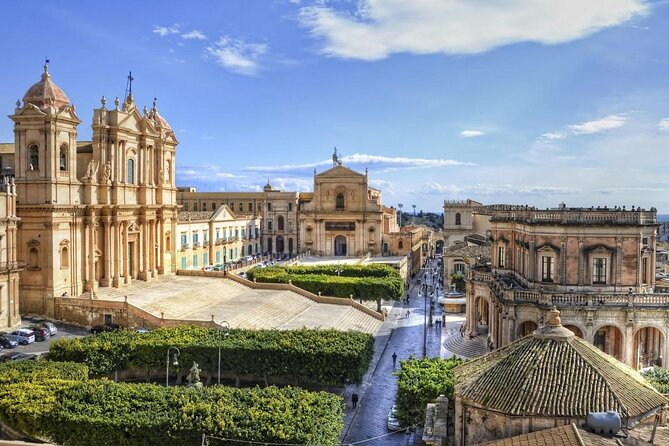
- A seven-stop route through central Noto: The tour links major Baroque churches, Palazzo Nicolaci, the cathedral, and Teatro Tina Di Lorenzo.
- A group limited to six people: The small size should make it easier to hear explanations and ask questions.
- A specialist guide: Dr. Enrica De Melio is both a licensed tourist guide and PhD archaeologist.
- The 1996 cathedral collapse explained: San Nicolò’s partial rebuilding gives the architecture a modern chapter as well as an older one.
- The Infiorata setting: Via Corrado Nicolaci is the place to hear about Noto’s famous annual flower display.
- A useful first look at Noto: The short route works well at the start of a stay, before you return to the places you want to examine more closely.
Why this short Noto tour works
Noto is easy to admire and surprisingly easy to misunderstand. Its honey-colored Baroque buildings line a compact center, but a quick glance does not explain why the churches have such unusual shapes, why the palace balconies are so theatrical, or why the city had to be rebuilt.
This tour gives you a framework for those details. Instead of seeing seven unrelated buildings, you move through a sequence of religious, civic, and aristocratic landmarks. That matters in Noto, where the pleasure is often in comparing one facade with the next.
I especially like the size of the group. A maximum of six people is small enough for a conversation rather than a lecture delivered over a crowd. You can ask about a painted detail, stop to check a facade, or request clarification without holding up a large party.
The guide, Dr. Enrica De Melio, brings a useful academic background to the route. Her work covers art, archaeology, history, and local legends, according to the experience details and past comments about her tours. The strongest praise centers on her preparation, warmth, and ability to keep a family interested while covering a lot in a short time.
That last point is important. Ninety minutes is not much for seven stops. The tour is best understood as an introduction, not a slow study visit. You will leave with a sense of what deserves more of your time.
More Baroque architecture tours in Italy:
- Lecce: Baroque Architecture and Underground Walking Tour
★ 4.6 · 1,248 reviews - Interpreti Veneziani Ensemble Baroque Concert in Venice Ticket
★ 4.5 · 403 reviews - Borghese Gallery Max 6 People Tour: Baroque & Renaissance in Rome
★ 5.0 · 185 reviews
Starting at Porta Reale and entering Santa Chiara
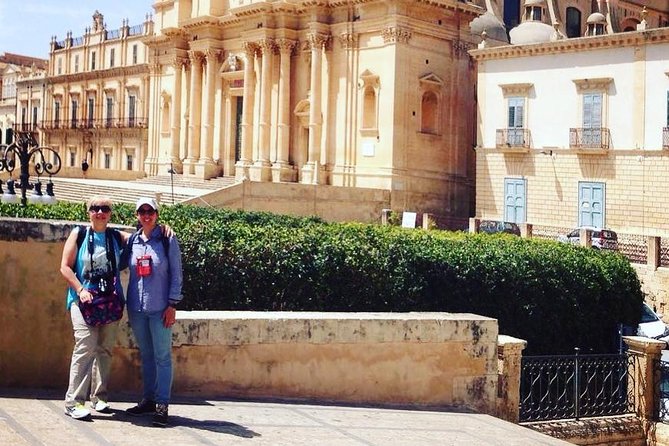
The meeting point is Porta Reale, also called Porta Ferdinandea, at Corso Vittorio Emanuele 182. It is a practical starting place on the main avenue and gives the tour a clear sense of direction from the outset.
The first stop is Chiesa Santa Chiara, where you spend about 15 minutes. The church has an unusual oval plan, an architectural feature worth noticing before you focus on its paintings. An oval interior changes the way the space feels, since the eye is drawn around the room rather than straight toward a conventional rectangular nave.
The visit includes the interior and its painted works. Admission is listed as free. This is one of the places where a guide adds real value, since the shape may register as simply attractive if you do not know to look for how it controls the interior.
You should expect a compact explanation rather than a long museum-style visit. The route has six more stops ahead, so use this first church to get a sense of the tour’s pace.
San Nicolò and the story of the fallen dome
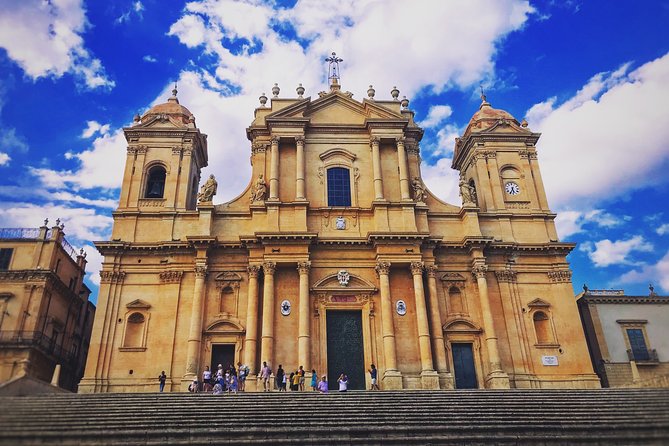
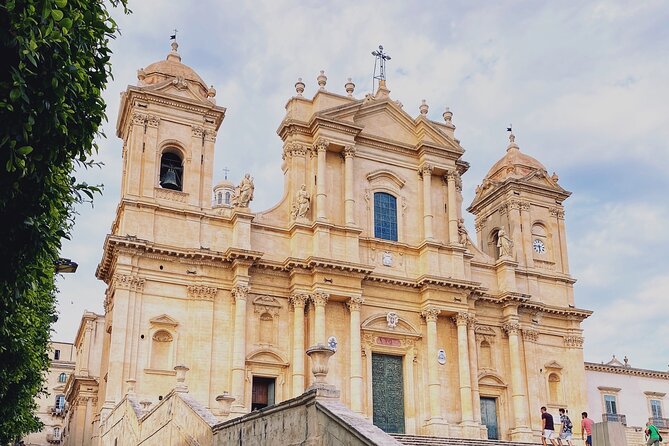
The cathedral, Cattedrale di San Nicolò, receives about 15 minutes. The building is one of Noto’s central landmarks, but its present form also carries a difficult modern story: the eighteenth-century dome collapsed in 1996, and the cathedral was partly reconstructed afterward.
That detail changes how you look at the building. You are not seeing an untouched Baroque monument. You are seeing a place shaped by collapse, repair, and the decisions that followed. A good explanation here helps you separate old work from later rebuilding and understand why the cathedral may look both historic and newly restored.
There is an important practical wrinkle. The itinerary says cathedral admission is not included at the stop, while the inclusions list says a cathedral entrance ticket is provided. Since those two details conflict, confirm the current arrangement when you book or before the tour begins.
The cathedral stop is short, so do not expect enough time to inspect every chapel or decorative feature. Still, the combination of architecture and recent events makes this one of the most useful stops on the route.
Via Corrado Nicolaci and Noto’s flower tradition
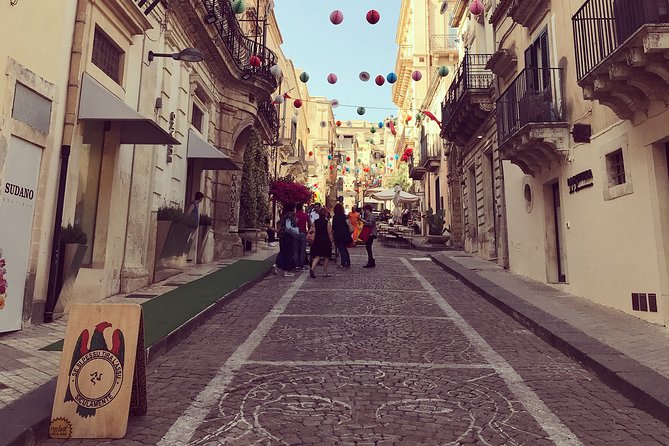
The tour then moves to Via Corrado Nicolaci for about 10 minutes. This street is closely linked to the Infiorata, Noto’s annual flower festival, when floral designs turn the roadway into a temporary work of art.
The timing of your visit matters here. If you are in Noto during the festival, you may see the street in its most decorated form. At other times, the guide’s explanation gives you the context needed to picture the event and understand why this particular street is so closely associated with it.
This is a good example of the tour’s wider approach. It is not only about church interiors and stone facades. It also connects the city’s architecture with the public celebrations that still give the center a strong local identity.
Ten minutes is enough for an explanation and a look at the setting. It is not enough to explore every side street, so keep your expectations focused.
Same city, a completely different century:
- Florence: Cathedral & Brunelleschi’s Dome Ticket & Audio App
★ 4.4 · 6,973 reviews - Florence: Brunelleschi’s Dome Climb Entry Ticket & Duomo
★ 4.5 · 3,815 reviews - Florence: Brunelleschi’s Dome Reserved Entry Ticket & Duomo
★ 4.6 · 2,216 reviews - Florence Skip-the-Line Duomo Tour with Guide & Brunelleschi Dome
★ 5.0 · 1,176 reviews
Palazzo Nicolaci and the art of the facade
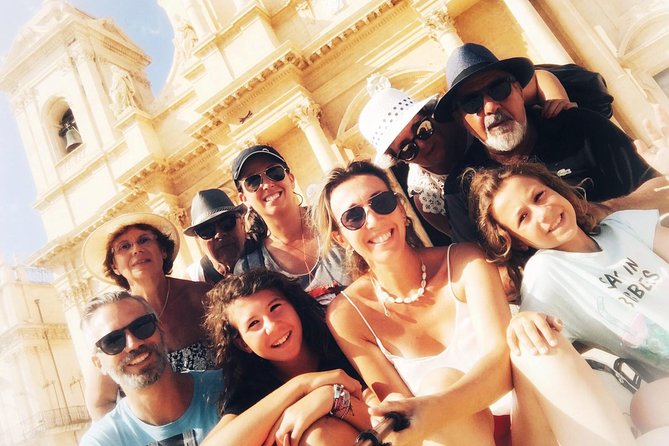
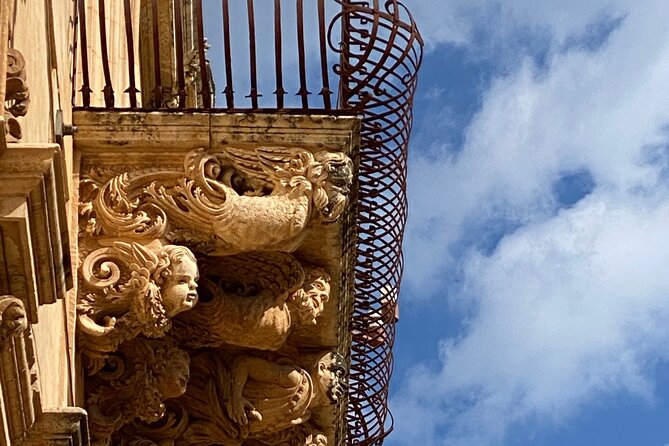
Palazzo Nicolaci gets about 15 minutes. The guide explains the facade and the family who lived there, giving you a way to read the building as more than an ornate backdrop.
Nicolaci is especially useful for understanding how private wealth appeared in public. The palace facade communicates status through its decoration and placement along one of Noto’s most recognized streets. Look closely at the details above eye level, where the building’s theatrical character becomes most apparent.
The tour description does not promise an interior visit to the palace. You should therefore expect the emphasis to be on the outside and on the Nicolaci family. That is still worthwhile, since Noto’s Baroque style is often most readable from the street, where churches, palaces, balconies, and public spaces face one another.
If you plan to return later for a longer look, this stop helps you decide what to notice. A guide can point out details that are easy to miss when you are simply walking toward the next church.
Trompe-l’oeil at San Carlo Borromeo
Chiesa di San Carlo Borromeo takes about 10 minutes. Its main feature on this route is two side chapels decorated with painted trompe-l’oeil work.
Trompe-l’oeil means that painted forms create the effect of three-dimensional architecture. Columns, moldings, and other elements can appear to project from a flat surface. The trick is simple to describe but more interesting to see in person, especially when you know which painted edges and shadows create the illusion.
Ten minutes is a sensible amount of time for this stop. It gives the guide room to explain the technique and lets you look at the chapels without turning the visit into a lengthy art lesson.
This church also shows why a specialist guide can improve a compact city tour. Decorative painting is easy to pass without understanding what makes it clever. A short explanation gives you a visual test to apply in other churches across Sicily.
San Domenico and the Gagliardi connection
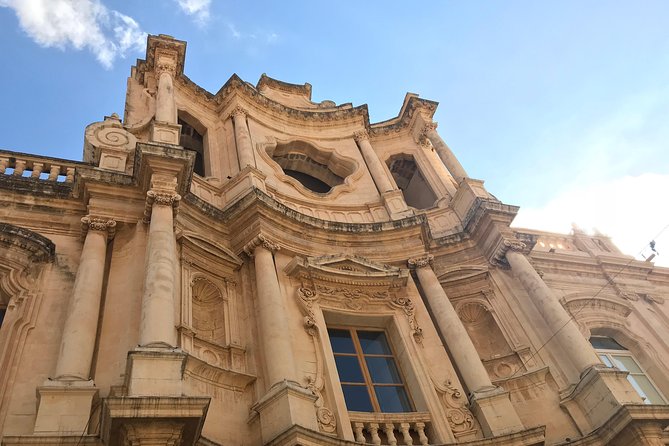
Chiesa San Domenico is another 10-minute stop. The church was designed by Gagliardi and has been restored recently.
The name matters because Gagliardi is closely linked with the Baroque rebuilding of Noto. Here, the guide can help you place the church within the city’s larger architectural plan rather than treating it as one more pretty facade.
The recent restoration is also worth noting. Restored buildings can look crisp and complete, but restoration raises questions about what is original, what was repaired, and how a historic place is kept in use. The tour does not promise a technical restoration lecture, yet the combination of Gagliardi’s design and the recent work gives this stop a useful point of focus.
As with San Carlo Borromeo, the visit is brief. If you are an architecture enthusiast, you may want to return independently after the tour and take more time with the exterior.
Teatro Tina Di Lorenzo, the final stop
The tour ends at Teatro Tina Di Lorenzo in Piazza XVI Maggio after about 15 minutes. Built in 1880, the theater is still used for Noto’s theater and concert season.
That current use gives the final stop a different feel from the churches and palace. You are looking at a historic civic building that remains part of the city’s cultural life, not simply a monument preserved behind a rope.
The theater also makes a good ending because it broadens your view of Noto. The city is not only a collection of Baroque religious buildings. It also has spaces for performance, public gatherings, and modern cultural activity.
The listed endpoint is Piazza XVI Maggio. Since the tour starts at Porta Reale and ends elsewhere, you finish in a useful central area rather than returning to the starting gate. Transportation between attractions is not provided, but this is a compact city-center experience designed around the listed stops.
What the six-person limit means
A maximum of six people is one of the clearest reasons to choose this experience over a large city tour. In a small group, you have a better chance of hearing the guide inside churches and asking about details without waiting for a whole crowd to gather.
The limit also suits the subject. Noto’s facades reward small observations: a painted illusion, a family emblem, the shape of an oval church, or the way a palace presents itself along the street. These details are easier to discuss when the guide can respond to individual questions.
Small groups are not automatically better for everyone. If you prefer to wander alone or spend 20 minutes in one church, the fixed 90-minute route may feel restrictive. The experience is built for structure and explanation, not free exploration.
The tour is offered in English. Confirmation is provided at booking, and service animals are allowed. Most people can participate, though the supplied information does not give a detailed route assessment for every mobility need. Smart casual clothing is requested.
How much value does the tour offer?
No tour price is provided in the information available here, so I cannot judge it against a specific euro amount. I would measure the value in three parts: the guide’s specialist background, the very small group, and the cathedral admission if that ticket is indeed included.
A paid guide is most useful in Noto when the explanation helps you see relationships between buildings. Santa Chiara’s oval plan, the trompe-l’oeil chapels, Gagliardi’s church, and the Nicolaci facade each become more useful when placed in a wider story about the city.
The small group adds practical value. Six people or fewer means less waiting and a more personal exchange. The short duration also fits neatly into a day of sightseeing, especially if you want to leave time for lunch, shops, or a second look at the places that catch your eye.
The cathedral ticket needs checking because the information is inconsistent. If it is included, that removes one small task during the visit. If it is not, you should know before arriving so there is no confusion at the cathedral entrance.
Who should book this Noto experience?
I would choose this tour if you are visiting Noto for the first time and want a clear introduction without giving up half a day. It is also a good match for families, since the route changes subjects often and does not ask you to study one building for too long.
You will likely appreciate it if you care about art, architecture, archaeology, or local stories. Dr. Enrica De Melio’s background suits anyone who wants more than surface-level descriptions, while her friendly style appears suited to mixed-age groups.
The tour is less ideal if you already know Noto well, want long interior visits, or prefer to set your own pace. In that case, you might use the route as a refresher and return on your own to Santa Chiara, the cathedral, or Palazzo Nicolaci.
The experience provider is Viaggio a Sud-Est. Free cancellation is available up to 24 hours before the start time for a full refund. Changes or cancellations inside that window are not accepted for a refund, and poor weather may lead to a different date or a full refund.
Should you book it?
Book this tour if you want a focused introduction to Noto’s Baroque center, a very small group, and a guide with formal training in archaeology. The strongest reason to choose it is the balance between major sights and small details, from the cathedral’s 1996 collapse to painted architectural illusions and the Infiorata street.
Skip it if you want a slow, highly detailed visit to each church or if you dislike a fixed pace. For most first visits, though, 90 minutes with Dr. Enrica De Melio should give you a useful map of Noto’s art and architecture, leaving you free to return to your favorite stop afterward.
FAQ
How long is the Noto Baroque Masterpieces tour?
The tour lasts approximately 1 hour and 30 minutes.
How many people can join the tour?
The group has a maximum of six people.
Is the tour offered in English?
Yes. The experience is offered in English.
Who leads the tour?
The guide is Dr. Enrica De Melio, a licensed tourist guide and PhD archaeologist.
Is cathedral admission included?
The information gives conflicting details. The inclusions list says a cathedral entrance ticket is provided, while the cathedral stop says admission is not included. Confirm this point when booking.
Where does the tour begin and end?
The tour begins at Porta Reale, also called Porta Ferdinandea, at Corso Vittorio Emanuele 182 in Noto. It ends at Piazza XVI Maggio.
Just added around Italy
- Vicenza: discovering the city of Palladio by e-bike★ 5.0 · 4 reviews
- Vicenza: Palladian Architecture Private Walking Tour★ 3.3 · 3 reviews
- Turin: Art Nouveau Walking Tour with Coffee★ 5.0 · 11 reviews
- Vatican: Exclusive Baroque Evening With Aperitivo & Dinner★ 3.1 · 2 reviews
- Venice Music Project – Baroque Autumn – Season 2025★ 4.5 · 7 reviews
- Walking tour in Venice with an architect★ 5.0 · 16 reviews
- Palladio. A wonderful live tale through time&soul, from Ve/Pd/Vr★ 5.0 · 7 reviews
- Turin, Art Nouveau walking tour and coffee break★ 4.0 · 7 reviews
Baroque Architecture Tours, compared.
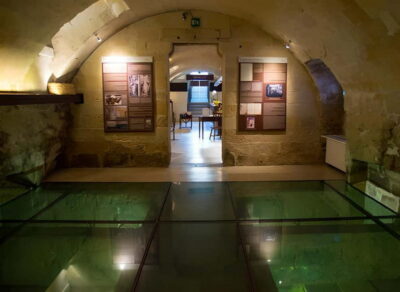
Lecce: Baroque Architecture and Underground Walking Tour
Read our review →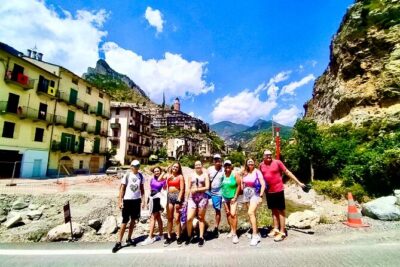
Train Exp. through the Alps (Royal Baroque Route from Nice)
Read our review →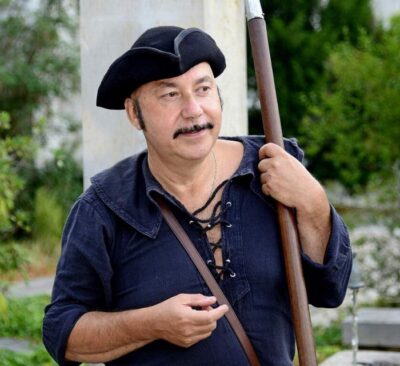
Dresden: Tour of the Baroque Quarter with a Night Watchman
Read our review →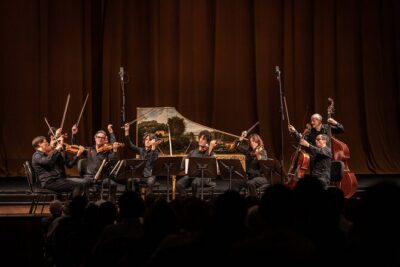
Interpreti Veneziani Ensemble Baroque Concert in Venice Ticket
Read our review →
Borghese Gallery Max 6 People Tour: Baroque & Renaissance in Rome
Read our review →
Concert at the Palais Schönborn-Batthyány by the Vienna Baroque Orchestra
Read our review →
Guided Walking Tour of Rome: Top Sights & Baroque Treasures
Read our review →
Noto, Modica and Ragusa: The Baroque Tour from Catania
Read our review →Browse the lists this tour appears in