
Review · BARCELONA
Luca’s Hidden Old Barcelona: the Gothic and El Born Tour
Barcelona’s old center is easy to walk past and surprisingly hard to understand. Luca’s tour gives you the missing pieces, from Roman columns tucked behind a quiet street to the political meaning of a memorial most people pass without a second look. You cover the Gothic Quarter and El Born on foot, with stops that connect architecture to Barcelona’s long struggle over identity and power.
I especially like the small maximum of 15 people, which makes it easier to hear Luca and ask questions. I also like his practical follow-up: he is known for sharing food, café, market, and sightseeing tips that can shape the rest of your stay. The main drawback is the pace of the information. Luca talks with great energy, and on a hot day the sunny streets can feel tiring.
Key points to know before you book
- Roman Barcelona in four surviving columns: The Temple of Augustus stop offers a quick look at the city’s oldest known objects.
- A tour with political context: Plaça de Sant Jaume and El Fossar de les Moreres help explain Catalan and Spanish tensions.
- Small-group format: The group can include up to 15 people, and smaller departures may feel almost private.
- More than postcard sights: Sant Felip Neri, the old Jewish quarter, and narrow side streets add quieter, less obvious stops.
- Useful local advice: Luca often gives recommendations for food, ice cream, tapas, shops, and places to visit later.
- Bring stamina for walking: The route takes about 2 hours and 15 minutes and covers roughly three miles.
Why this old Barcelona walk works so well
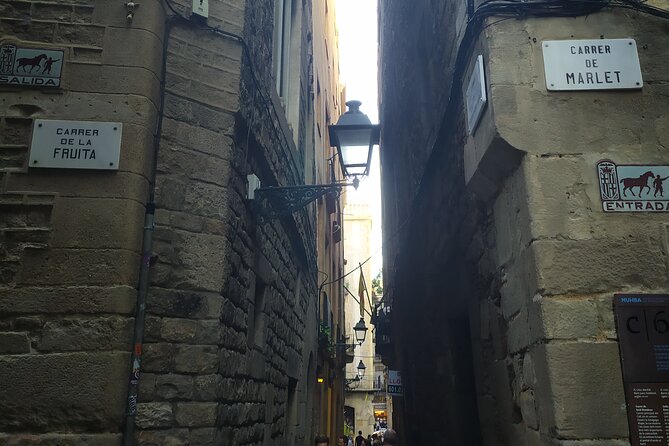
Barcelona’s Gothic Quarter can feel like a maze of handsome stone walls, small squares, church façades, and tourist traffic. You can wander here alone, but it is easy to miss what you are seeing. A modern-looking wall may copy Gothic design. A small square may carry the memory of wartime violence. A church may tell one story through its architecture and another through Catalan politics.
Luca’s strength is connecting those layers. He brings a lively, opinionated style, uses photographs in a binder to clarify what buildings and streets looked like in earlier periods, and invites questions along the way. His humor helps keep several centuries of dates and political struggles from turning into a lecture.
The tour has a 4.9 rating from 66 reviews, with 98 percent of participants recommending it. Those figures fit the experience described by the available feedback: Luca’s energy, clear English, local suggestions, and command of Barcelona’s past receive the strongest praise. One point comes up as a useful caution: he can speak quickly, so you will get more from the tour if you are comfortable following English at a brisk pace.
The price, about $13.27 per person, is low for more than two hours with a professional guide. Since the major stops are viewed from public streets and several have free admission, you are mainly paying for interpretation and route planning. That is good value if you want context rather than a list of famous façades.
More Gothic quarter walks in Barcelona:
- Barcelona all included: Sagrada, Park Güell, Montjuic & Gothic
★ 5.0 · 2,169 reviews - Barcelona Gothic Quarter Tapas & Taverns Food & Wine Tour
★ 5.0 · 1,470 reviews - Barcelona: Old Town and Gothic Quarter Walking Tour
★ 4.8 · 1,393 reviews
Plaça de Sant Jaume, where Barcelona’s power gathers
The walk begins at Plaça de Sant Jaume, a natural starting point because this square has been a political and social center for roughly 2,000 years. Barcelona’s city hall and the regional government headquarters face one another here.
Luca uses the square to set up the larger story of Barcelona. This is not only an attractive public space. It is a place where local government, Catalan identity, and the relationship with Madrid come into view. You begin to understand why a walking tour focused on old streets can also become a lesson in modern politics.
The stop lasts about 15 minutes. It is a good orientation point, though anyone hoping to enter the government buildings should know that the tour focuses on the outside and the surrounding history.
Four Roman columns inside the Gothic Quarter
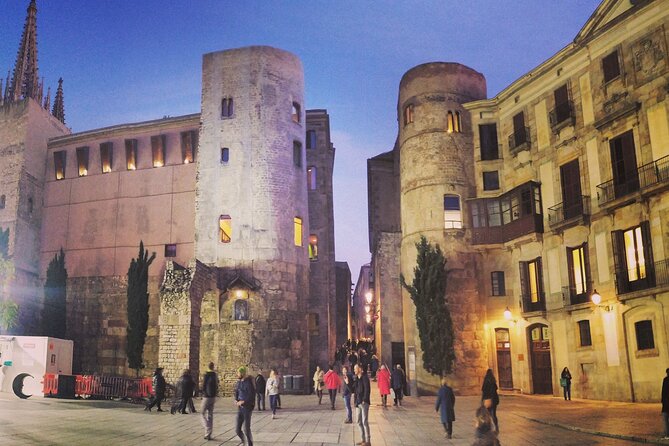
The MUHBA Temple d’August offers one of the route’s best surprises. Four columns from a large temple dedicated to Augustus remain in this area, surrounded by later buildings.
These columns are easy to overlook without a guide. Their setting makes them especially useful for understanding how Barcelona grew in layers. Roman foundations, medieval streets, later homes, and modern city life occupy the same compact area.
You spend about 10 minutes here. It is a short stop, but the contrast is memorable: an ancient monument appears in a place that otherwise feels thoroughly medieval. Admission is free.
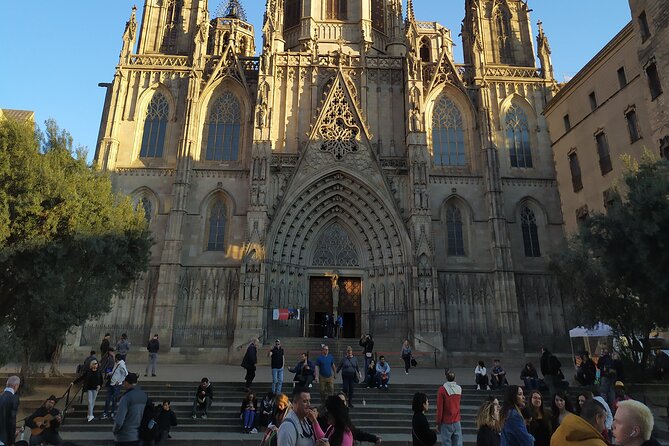
Barcelona Cathedral from the outside
The Cathedral of Barcelona is one of the Gothic Quarter’s main landmarks. The tour explores the cathedral exterior rather than taking you inside.
That distinction matters. You will hear about the building, its Gothic character, and its place in the old quarter, but an interior visit is not part of the experience. The cathedral stop takes about 15 minutes, and admission is not included.
I like this approach for a first orientation because it keeps the route moving and leaves you free to return later if you want a longer visit. If seeing the interior is a priority, plan separate time and check the cathedral’s current entry arrangements.
Same city, a completely different century:
- Barcelona: Sagrada Familia Entry Ticket with Audio Guide
★ 4.6 · 105,312 reviews - Barcelona: Casa Batlló Entry with Self-Audioguide Tour
★ 4.7 · 25,359 reviews - Barcelona in 1 Day: Sagrada Familia, Park Guell,Old Town & Pickup
★ 5.0 · 13,541 reviews - Barcelona: Sagrada Familia Skip-the-Line Entry Ticket & Tour
★ 4.8 · 12,789 reviews
El Call, Barcelona’s medieval Jewish quarter
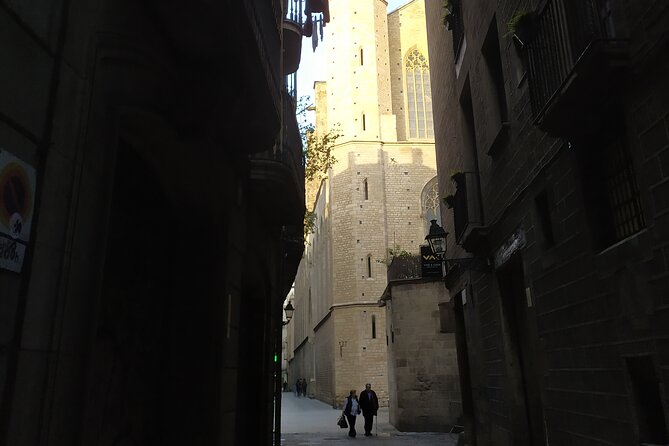
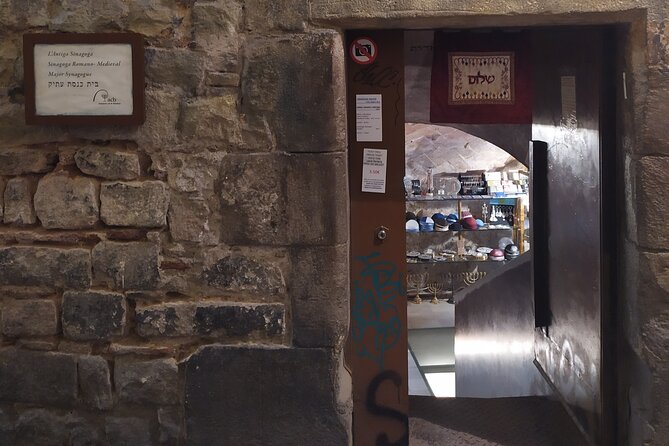
The walk then reaches MUHBA El Call, the medieval Jewish neighborhood. Here, the value comes less from a single grand monument and more from learning how a community once occupied these tight streets.
A guide helps you read the street plan and notice details that can disappear beneath the general Gothic Quarter scenery. The stop also broadens the story beyond kings, churches, and government buildings. Barcelona’s past included different religious and cultural communities, and El Call gives that part of the city a place in the tour.
The visit takes about 15 minutes and is free. It is another example of Luca choosing a meaningful corner rather than rushing only between the city’s most photographed sights.
Sant Felip Neri and the darker side of the old city
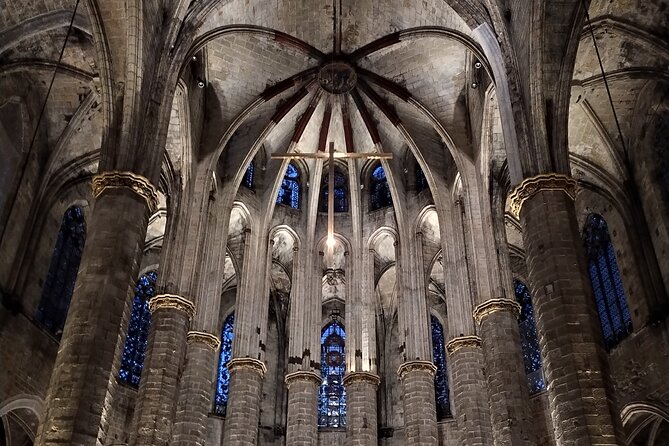
Plaça de Sant Felip Neri is one of the prettiest small squares in the old center, but the tour does not treat it as a simple beauty stop. Luca discusses the church, Antoni Gaudí’s affection for it, and the square’s more painful recent past.
The conversation turns to the Spanish Civil War, giving the place a serious edge. That contrast is one of the tour’s strongest ideas: a charming setting can carry difficult memories. You are encouraged to look beyond the postcard view and ask what happened here and whose stories are remembered.
The church and square are free to visit from the route. The stop lasts about 15 minutes. Because the subject matter is heavier than the surrounding architecture suggests, this is not just a quick photo pause.
Crossing into El Born and La Ribera
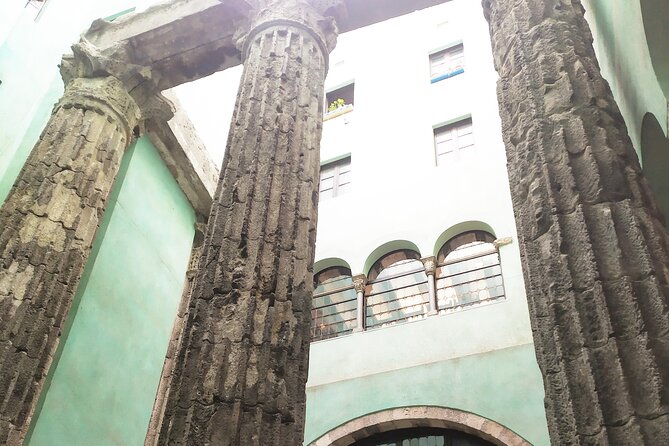
The route moves from the Gothic Quarter toward El Born and La Ribera, a medieval neighborhood that feels different from the streets you have just walked.
You spend about 30 minutes in this part of the city, making it the longest stop. That extra time gives Luca room to explain the district’s role in Barcelona’s growth and its relationship to trade, public life, and later urban change.
El Born is also a useful area for independent wandering after the tour. You finish with a better sense of how its streets relate to the Gothic Quarter, rather than treating both districts as one endless old town. Luca’s food and shopping suggestions are especially useful here, and the route gives you a practical area to revisit later.
Santa Maria del Mar, Barcelona’s beloved church
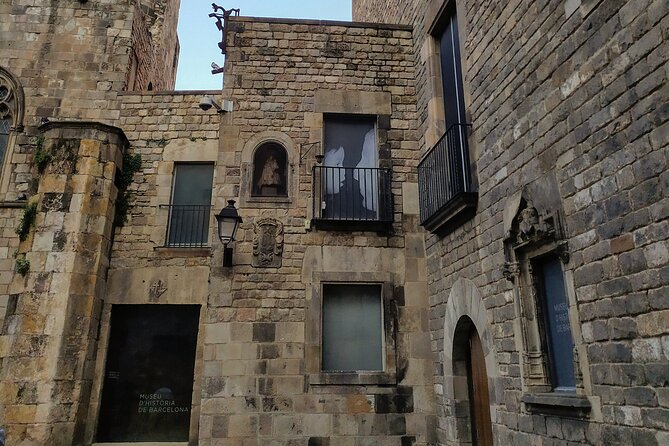
The Basilica of Santa Maria del Mar is one of El Born’s best-known sights and a major emotional point on the walk. Luca presents it as Barcelona’s most loved church, then places it within the life of the surrounding medieval neighborhood.
The stop lasts about 10 minutes and is listed as free. As with the cathedral, the emphasis is on the tour’s route and explanation rather than a long interior visit. If you want quiet time inside, arrange a separate visit.
This stop works well after the Gothic Quarter because it lets you compare two important religious buildings in different parts of the old city. You are not simply collecting church façades. You are learning how religious buildings fit into neighborhood life and Barcelona’s wider story.
El Fossar de les Moreres and Catalan memory
At El Fossar de les Moreres, the tour turns directly toward the political conflict between Madrid and Barcelona. The memorial is a key stop for understanding Catalan memory, especially the way past defeats and struggles remain part of public life.
This is where Luca’s approach becomes especially useful. A guide can explain why the site matters instead of leaving you with a monument and no context. You may not agree with every political interpretation, but you will have a clearer sense of why Catalan identity is such a force in Barcelona.
The stop lasts about 15 minutes. It is one of the places that can change how you read the rest of the city. Flags, public buildings, and political references make more sense once you have heard the background.
Passeig del Born, the medieval entertainment square
The final stop is Passeig del Born, once a medieval entertainment square. The visit is brief, about five minutes, but it provides a fitting ending because it returns the tour to everyday public life.
After churches, political sites, Roman remains, and wartime memory, you finish in a place connected with gathering and amusement. The endpoint is El Born Centre de Cultura i Memòria at Mercat del Born, on Plaça Comercial.
That location is practical. You end in El Born rather than back at the starting square, so you can continue exploring the neighborhood, follow Luca’s restaurant suggestions, or make your own way elsewhere in the city.
What the walking format means for you
This is a real walking tour, not a stop-and-go sightseeing ride. One participant estimated the route at about three miles, and the listed duration is approximately 2 hours and 15 minutes. Comfortable shoes matter more than fashionable ones.
The old streets are often narrow, uneven, and crowded. You will also spend much of the tour outdoors. One important practical issue is sun and heat. A participant found the sunny side of the street uncomfortable during weather around 100 degrees Fahrenheit with high humidity. The route may not always offer shade, so carry water, use sun protection, and consider choosing a cooler part of the day if you have options.
The tour is open to most people, and service animals are allowed. It is not designed for people with reduced mobility, although the pace can be adapted. A private experience may be arranged for someone who needs a slower or more flexible route. Ask before booking if stairs, long walks, or uneven streets are a serious concern.
Luca’s guide style and the value of his advice
The strongest reason to choose this tour is Luca himself. He brings enthusiasm, humor, and a personal interest in Barcelona’s past. He asks questions, speaks with people in the group individually, and makes room for questions during the walk.
His style is not quiet or minimalist. He may give you a lot of information in a short time, and his opinions about historical figures can be pointed. That suits you if you want a guide with a clear personality. If you prefer a slow, spare presentation with only a few facts at each stop, this may feel like too much.
The practical advice at the end adds real value. Luca has given recommendations for food, cafés, ice cream, tapas, markets, pizza, shops, and further sightseeing. He may also send follow-up information after the tour. I would book this early in your stay, then use those suggestions during the rest of your visit.
The tour is offered in English. Since Luca can speak quickly, you should be reasonably comfortable with spoken English to catch every detail. The group maximum is 15, though some departures may be much smaller. A group of six or ten gives you a better chance to interact with the guide than a large city walk.
Who should book Luca’s Gothic and El Born tour?
I would choose this tour for a first visit to Barcelona, especially if you want a strong base for exploring on your own. It gives you dates, places, political context, and food ideas in one outing.
It also suits anyone who has already seen the main landmarks but wants the old city to make more sense. The Roman columns, Jewish quarter, Sant Felip Neri, and El Fossar de les Moreres add substance beyond the usual cathedral photographs.
You may want another option if you dislike long walks, struggle with fast spoken English, or want extended time inside churches and museums. This tour is mainly about the streets, exteriors, stories, and connections between places.
At about $13.27, the value is hard to dispute if Luca’s subject matter and energetic style fit you. You are not paying for entry tickets or a luxury vehicle. You are paying for a carefully chosen route and an explanation of Barcelona that would be difficult to assemble alone.
Should you book it?
Book Luca’s Hidden Old Barcelona tour if you want to understand the Gothic Quarter and El Born rather than simply photograph them. The mix of Roman remains, medieval neighborhoods, churches, Civil War memory, and Catalan politics gives the walk real range.
Go prepared for a brisk flow of information, outdoor walking, and possible sun. Wear sensible shoes, bring water, and leave room in your plans for Luca’s food recommendations. For a low-cost first-day introduction with a lively guide and a small group, this is a smart choice.
FAQ
How long is Luca’s Hidden Old Barcelona tour?
The tour lasts approximately 2 hours and 15 minutes.
Where does the tour begin?
It begins at Pl. de Sant Jaume, 3, in Barcelona’s Ciutat Vella.
Where does the tour end?
The tour ends at El Born Centre de Cultura i Memòria, Mercat del Born, Plaça Comercial, 12.
What language is the tour offered in?
The tour is offered in English.
How many people can join the tour?
The maximum group size is 15 people.
Is admission to the sights included?
The professional guide is included. Several listed stops are free, while admission to Barcelona Cathedral is not included. The cathedral portion focuses on the exterior.
Is the tour suitable for people with reduced mobility?
The tour is not specifically suitable for people with reduced mobility. The pace can be adapted, and a private experience may be arranged for someone who needs more flexibility.
Can I cancel for a full refund?
Yes. You can cancel at least 24 hours before the experience start time for a full refund. Cancellations or changes made less than 24 hours before the start time are not accepted for a refund.
Just added around Barcelona
- Love in the Gothic Quarter Barcelona: Self-Guided Romantic Walk★ 4.5 · 9 reviews
- Walking tour of the Gothic Quarter of Barcelona + Cathedral★ 5.0 · 8 reviews
- Wine tasting with a view of the Sagrada Familia★ 4.5 · 13 reviews
- Visit to the Modernist houses of the Americans★ 5.0 · 2 reviews
- Barcelona Jewish & Gothic Tour★ 5.0 · 18 reviews
- Roman & Gotic & Gaudi in Barcelona: private walking tour★ 4.5 · 2 reviews
- Self-Guided Audio Tour-The Surrealist Barcelona of Dalí and Gaudí★ 3.5 · 8 reviews
- Barcelona Gaudi Tour: Sagrada Familia, Casa Batllo & Casa Mila★ 5.0 · 4 reviews
Gothic Quarter Tours, compared.
Barcelona all included: Sagrada, Park Güell, Montjuic & Gothic
Read our review →
Barcelona Gothic Quarter Tapas & Taverns Food & Wine Tour
Read our review →
Barcelona: Gothic Quarter Ghosts and Legends Walking Tour
Read our review →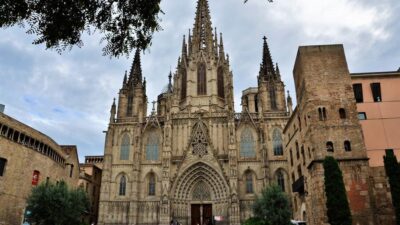
Barcelona: Old Town and Gothic Quarter Walking Tour
Read our review →
Barcelona Old Town & Gothic Quarter Small Group Tour
Read our review →
Ramblas, Old Town, Gothic and Gaudi Architecture Walking Tour
Read our review →
Barcelona: El Born and Gothic Quarter Wine & Tapas Bar Tour
Read our review →
Kids and Family Gothic Quarter Walking Tour in Barcelona
Read our review →Browse the lists this tour appears in