
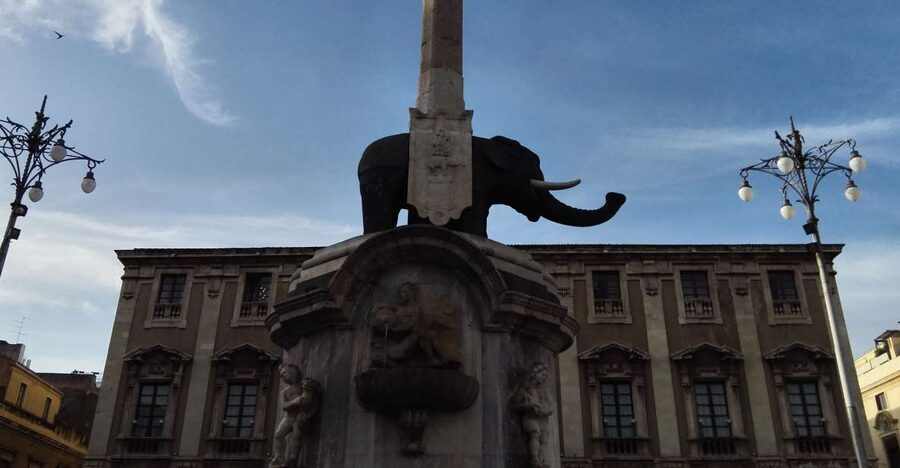
Review · CATANIA
From Naxos: Syracuse, Noto, and Catania Baroque Tour
Syracuse, Ortigia, Noto, and Catania pack three thousand years of Sicilian history into one long day. You’ll see Greek ruins, an ancient island city, honey-colored Baroque streets, and Catania’s lava-dark architecture, all with a private driver and guide handling the roads.
I like the private group format, especially for up to six people sharing the $677.54 price. I also like the guide’s practical approach: Fabio and Ignazio are praised for explaining local history and culture during the drive and pointing you toward the best sights before you walk off on your own. The tradeoff is important: most city visits are self-guided, with roughly one to two hours at each stop rather than a detailed walking tour.
Key points to know before booking
- Three major Sicilian stops in one day: Visit Syracuse, Ortigia, Noto, and Catania during an eight-hour private outing.
- The archaeological site is a major highlight: See Syracuse’s Greek Theatre, the Ear of Dionysius, and the Latomie.
- Ortigia rewards a slow stroll: Look for the Temple of Apollo, the Cathedral of Saint Mary of the Immaculate Conception, and the Aretusa Fountain.
- Noto is the Baroque centerpiece: Walk through Porta Reale, the Church of St. Francesco, Palazzo Ducezio, and the cathedral square.
- Guidance happens largely in the vehicle: Your guide explains what you’re seeing, then gives you time to explore independently.
- Best value for a small group: At six people, the listed price works out to about $113 per person, before any costs not specifically included.
What this private Sicily day is really designed to do
This is a sightseeing sampler, not a slow-paced town tour. In eight hours, you cover a large stretch of eastern Sicily and see three very different sides of the island: ancient Greek Syracuse, elegant Baroque Noto, and Catania’s grand city center.
That pace is both the appeal and the limitation. If you have only one free day and want to connect several major places without arranging transport yourself, this tour is efficient. You can sit back between stops while your guide, Fabio, Ignazio, or another English or Spanish-speaking driver-guide explains what matters.
If you prefer lingering over coffee, entering every church, and hearing a full lecture at each monument, you may find the schedule tight. The city time is generally independent. Your guide gives directions and suggestions, but the supplied details do not indicate a dedicated walking tour at every stop.
Pickup and drop-off are included at an agreed location in Catania, Taormina, or Giardini Naxos. You are asked to wait in your hotel lobby about 10 minutes before pickup, and the driver carries a sign with your last name. That simple arrangement matters in Sicily, where navigating unfamiliar streets and parking can eat into a short day.
More Baroque architecture tours in Italy:
- Lecce: Baroque Architecture and Underground Walking Tour
★ 4.6 · 1,248 reviews - Interpreti Veneziani Ensemble Baroque Concert in Venice Ticket
★ 4.5 · 403 reviews - Borghese Gallery Max 6 People Tour: Baroque & Renaissance in Rome
★ 5.0 · 185 reviews
Syracuse begins with Greek drama and ancient stone
The Syracuse portion centers on Neapolis, the city’s major archaeological area. Here, the Greek Theatre is the headline sight. Its scale gives you a clear sense of Syracuse as a powerful ancient city, not just a pretty coastal stop.
The Ear of Dionysius is another memorable feature. This tall, cave-like stone quarry is known for its unusual shape, and the Latomie add to the feeling of a place shaped by excavation and human labor over centuries. These are not isolated monuments placed neatly beside a road. They form part of a wider archaeological setting, so comfortable walking shoes make sense.
The visit is especially useful if you want the ancient background before seeing the later streets of Ortigia and Noto. You begin with Syracuse’s Greek foundations, then move through its medieval and Baroque layers.
Allow for a practical point here: the tour information confirms transport and guiding, but it does not specify that archaeological admission is included in the price. Ask about entrance tickets when booking, and budget for any admission not covered.
Ortigia turns history into an easy walking route
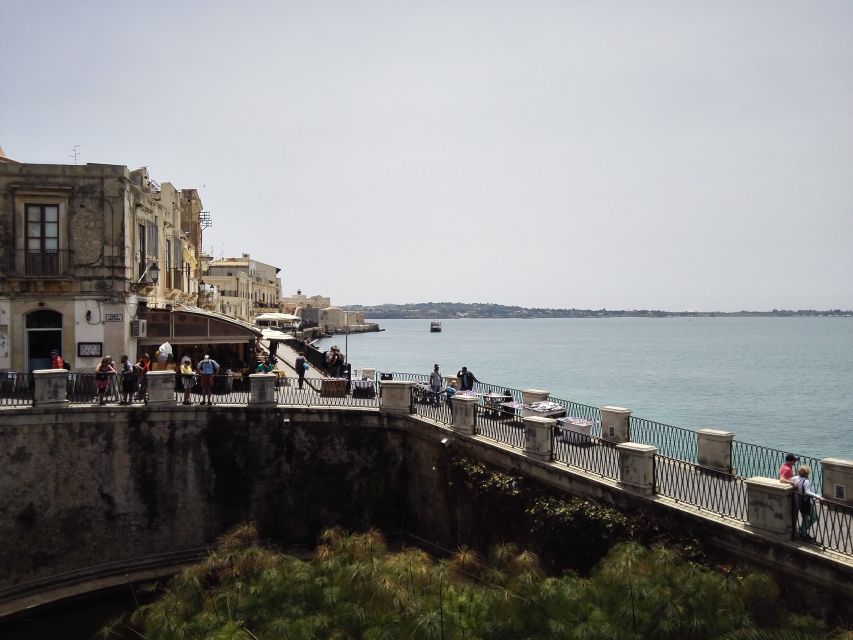
Ortigia is the compact island at the heart of Syracuse. Compared with the spread-out archaeological area, it is a place to walk from one major sight to the next, with old stone streets and open squares shaping the visit.
The Temple of Apollo is one of the first landmarks to look for. Its surviving columns give you a direct link to the city’s Greek past, even as modern Ortigia carries on around it.
The Duomo square is the visual center of the stop. The Cathedral of Saint Mary of the Immaculate Conception occupies a site with ancient origins, and the square gives you room to appreciate the contrast between the cathedral, surrounding Baroque buildings, and pale Sicilian stone.
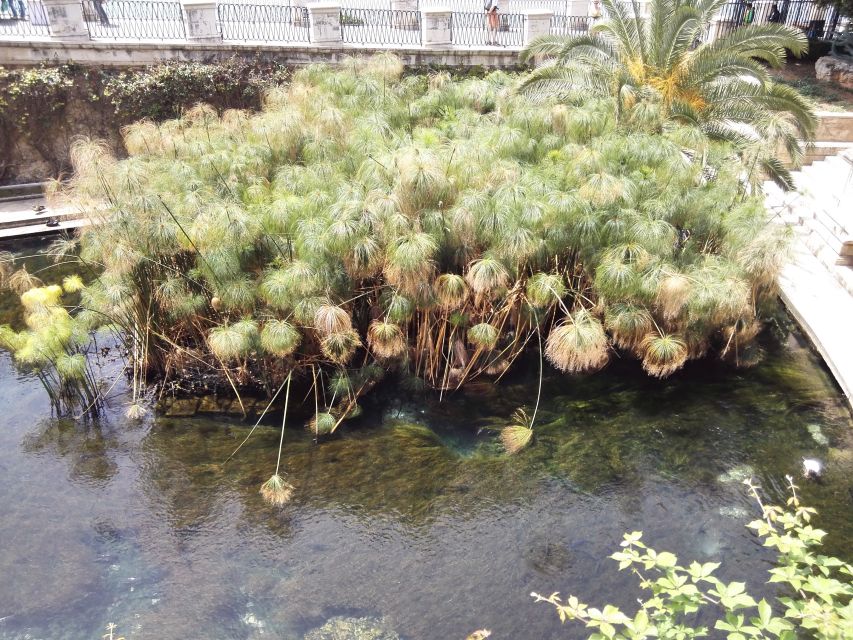
The Aretusa Fountain adds a more local, atmospheric pause. It is one of Ortigia’s best-known sights and gives the walk a different mood from the formal cathedral square.
You are likely to get a useful orientation from the driver before walking off independently. That is where the guide’s local knowledge helps most. A short explanation can save you from wandering past the key sights, especially when your time is limited.
Still, do not expect to see every lane or museum. The stop is designed to give you the main visual and historic points. If Ortigia is the part of Syracuse you most want to savor, you may wish you had more than the usual one to two hours.
Noto shows why Sicily is famous for Baroque towns
Noto is the tour’s clearest change of mood. Syracuse gives you ruins and layered urban history. Noto gives you a carefully composed Baroque city, with grand staircases, formal facades, and warm stone that changes character in the sun.
The walk begins at Porta Reale, the monumental entrance to the city. From there, the route leads toward the Church of St. Francesco and its striking staircase. The staircase is more than a way into the church. It frames the building and creates the kind of broad architectural view that makes Noto easy to appreciate even during a short visit.
Palazzo Ducezio and the cathedral are other key stops. Together, they help you read Noto as a planned civic center rather than a random collection of attractive buildings. Look up as you walk. The details are often above street level, around balconies, cornices, and church fronts.
Noto is a good match for you if you enjoy architecture but do not want to spend the entire day inside museums. Much of the pleasure comes from walking the streets and comparing the buildings from different angles.
The possible drawback is that a short stop can make Noto feel like a picture-taking visit. You may have time to see the principal buildings but not enough time to explore side streets or sit down for a relaxed meal. The guide’s advance suggestions are useful here, since you can decide quickly which sights matter most to you.
Same city, a completely different century:
- Florence: Cathedral & Brunelleschi’s Dome Ticket & Audio App
★ 4.4 · 6,973 reviews - Florence: Brunelleschi’s Dome Climb Entry Ticket & Duomo
★ 4.5 · 3,815 reviews - Florence: Brunelleschi’s Dome Reserved Entry Ticket & Duomo
★ 4.6 · 2,216 reviews - Florence Skip-the-Line Duomo Tour with Guide & Brunelleschi Dome
★ 5.0 · 1,176 reviews
Catania ends the day with Via Etnea and Saint Agata
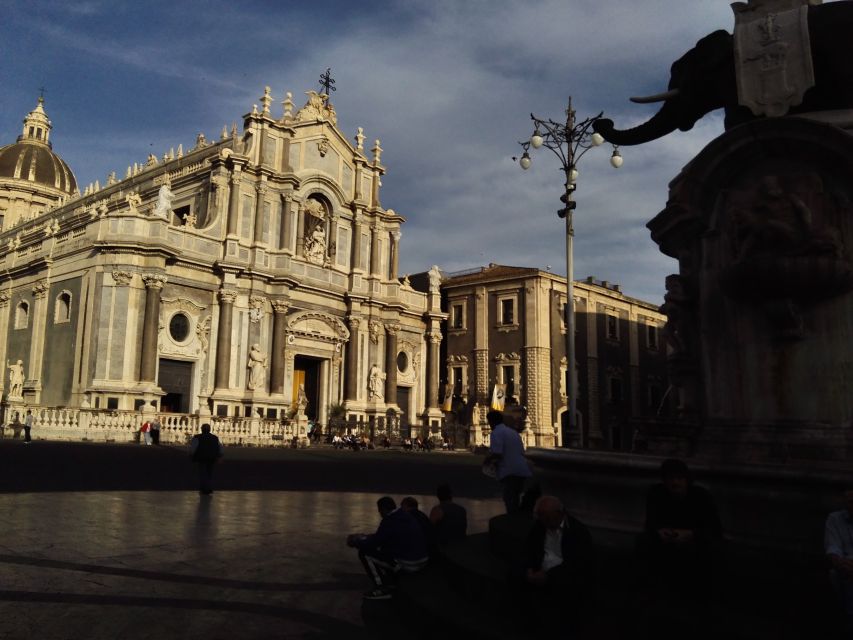
Catania is handled as a panoramic city tour, with time on Via Etnea and in the Baroque center. Via Etnea is the city’s main north-south street, and it gives you a straightforward way to read central Catania as you move toward the cathedral.
The architecture here has a different feel from Noto. Catania’s buildings use the dark volcanic stone associated with the city, set against lighter masonry and formal Baroque design. That contrast gives the center a strong visual identity.
The route ends at the Cathedral of Saint Agata, the city’s principal cathedral. It is a fitting final sight because the day has moved from Greek foundations to Baroque planning and then to a major urban center shaped by Sicily’s volcanic setting.
The details describe this as a panoramic tour rather than a long guided walk. That distinction matters. You should expect to see the city’s principal route and cathedral area, with explanations from the guide, but not a full neighborhood-by-neighborhood tour.
Catania may be the least satisfying stop if you want time to shop, eat, or explore at street level. It works better as a final introduction, especially if you are staying in or returning to the Catania area and plan to come back on your own.
The guide makes the long drive more useful
The strongest part of this tour is not a tightly scripted walking commentary. It is the way a good driver-guide can turn travel time into context.
Fabio is described as accommodating and very well informed about the places on the route. Ignazio is also praised for explaining Sicilian history and culture in the car and for giving clear instructions about what to see at each stop. That approach suits a day covering several cities, because you receive background while moving between them instead of spending all your limited stop time standing in one place.
You should still set your expectations correctly. The guide may explain the route, history, and key sights, but the city visits are generally independent. If you want to ask questions as you go, a private group makes that easier. You can also tell the guide which stop matters most to you, within the limits of the schedule.
English and Spanish guiding are available. The private format means you are not sharing the vehicle with a large group, which can make pickup, timing, and conversation much easier.
How the $677.54 price works for a group
The price is $677.54 for a private group of up to six people. That is a strong value for six passengers, at about $112.92 each for an eight-hour private day, assuming the group is full.
For two people, the same price becomes about $338.77 per person. At that size, you are paying for convenience, private transport, and a full day of coverage rather than saving money compared with public transportation or a single-city visit.
The price includes pickup and drop-off at an agreed location. The available information does not list meals, entrance tickets, or other personal expenses as included, so clarify those items before departure. That is particularly important for the Syracuse archaeological area and any church or monument where admission may apply.
The reserve-now, pay-later option is useful if your Sicily plans are still shifting. Free cancellation is available up to 24 hours in advance for a full refund, which gives you some protection if weather or plans change.
Timing, comfort, and accessibility
An eight-hour day covering Syracuse, Ortigia, Noto, and Catania will feel full. You are not getting a leisurely regional tour. You are getting a practical route through several major sights with transport between them.
The order can vary. One reported schedule began with Noto, continued to Syracuse, and finished in Catania, while the general route description presents Syracuse, Ortigia, Noto, and Catania. Ask about the planned order and expected time at each stop when you confirm your booking.
You should wear shoes suitable for walking over historic paving and archaeological ground. The information confirms that the activity is wheelchair accessible, though the amount of independent walking and the exact access at each monument should still be discussed directly if that is important for your party.
Pickup is available from Catania, Taormina, and Giardini Naxos. That makes the tour especially useful if you are based along Sicily’s eastern coast and do not want to arrange separate transport to Syracuse or Noto.
Who will enjoy this tour most
I would choose this tour if you have one open day and want to see the biggest cultural sights in southeastern Sicily without renting a car. It is also a good fit for families or friends who can share the private vehicle and divide the cost.
History and architecture fans will get the most from it. Syracuse supplies ancient Greek remains, Ortigia adds a more intimate city walk, Noto offers carefully designed Baroque streets, and Catania gives you a larger urban finish.
The tour is less suited to anyone who wants long meals, unplanned wandering, or in-depth museum visits. It is also not the best choice if you want every stop delivered as a formal guided walk. The value comes from coverage, private transport, and helpful orientation.
Should you book this eastern Sicily tour?
Book it if your priority is seeing several important places in one day, especially with five or six people sharing the cost. The route is ambitious but sensible, and the guidance from Fabio, Ignazio, or another English or Spanish-speaking driver can make a complicated day much easier.
Before booking, confirm the exact pickup point, route order, time allowed in each city, and whether entrance tickets are extra. If you accept that the walking time is mostly self-guided, this is an efficient way to connect Syracuse, Ortigia, Noto, and Catania. If you want a slower, more detailed look at one city, choose a focused tour instead.
FAQ
How long does the tour last?
The tour lasts eight hours.
What cities and sights are included?
The route includes Syracuse’s Neapolis archaeological area, Ortigia, Noto, and Catania. Highlighted sights include the Greek Theatre, Ear of Dionysius, Latomie, Temple of Apollo, Aretusa Fountain, Porta Reale, Church of St. Francesco, Palazzo Ducezio, Noto Cathedral, Via Etnea, and Saint Agata Cathedral.
Where can pickup and drop-off be arranged?
Pickup and drop-off can be arranged in Catania, Taormina, and Giardini Naxos. You should wait in your hotel lobby 10 minutes before the scheduled pickup time.
How will I identify the driver?
The driver will hold a sign showing your last name.
Is this a private tour?
Yes. It is a private group activity for up to six people.
What languages are available?
The live guide service is available in English and Spanish.
Are the city walks fully guided?
The available details indicate that you generally receive one to two hours to explore the cities independently. The guide explains what to see and provides historical and cultural information, often during the drive.
Is the tour wheelchair accessible?
Yes, the activity is listed as wheelchair accessible. You should still confirm the practical arrangements for each stop when booking.
What is the cancellation policy?
You can cancel up to 24 hours in advance for a full refund. You can also reserve now and pay later.
Just added around Italy
- Vicenza: discovering the city of Palladio by e-bike★ 5.0 · 4 reviews
- Vicenza: Palladian Architecture Private Walking Tour★ 3.3 · 3 reviews
- Turin: Art Nouveau Walking Tour with Coffee★ 5.0 · 11 reviews
- Vatican: Exclusive Baroque Evening With Aperitivo & Dinner★ 3.1 · 2 reviews
- Venice Music Project – Baroque Autumn – Season 2025★ 4.5 · 7 reviews
- Walking tour in Venice with an architect★ 5.0 · 16 reviews
- Palladio. A wonderful live tale through time&soul, from Ve/Pd/Vr★ 5.0 · 7 reviews
- Turin, Art Nouveau walking tour and coffee break★ 4.0 · 7 reviews
Baroque Architecture Tours, compared.
Lecce: Baroque Architecture and Underground Walking Tour
Read our review →
Train Exp. through the Alps (Royal Baroque Route from Nice)
Read our review →
Dresden: Tour of the Baroque Quarter with a Night Watchman
Read our review →
Interpreti Veneziani Ensemble Baroque Concert in Venice Ticket
Read our review →
Borghese Gallery Max 6 People Tour: Baroque & Renaissance in Rome
Read our review →
Concert at the Palais Schönborn-Batthyány by the Vienna Baroque Orchestra
Read our review →
Guided Walking Tour of Rome: Top Sights & Baroque Treasures
Read our review →
Noto, Modica and Ragusa: The Baroque Tour from Catania
Read our review →Browse the lists this tour appears in