
Review · BARCELONA
The Timeless Beauty of Barcelona’s Gothic and Born Quarters
Barcelona’s oldest streets hold Roman columns, medieval gargoyles, Jewish history, Civil War scars, and the grand stone interior of Santa Maria del Mar. This two-hour walk with Luca BCN links those pieces into one lively route, rather than treating each sight as a separate postcard.
I like the focus on Temple of Augustus and the ancient synagogue, two places that are easy to miss on your own. I also like the finish at Santa Maria del Mar, where the walk moves naturally from narrow Gothic lanes into the broad, atmospheric Born district.
The main concern is pace. There is a lot to cover in two hours, and one recent booking report described a tour that ended after 90 minutes. The old streets also involve uneven surfaces, tight lanes, and moderate walking, so this is not a good fit for wheelchair users or anyone with limited mobility.
Key points at a glance
- Roman Barcelona in plain sight: See the Temple of Augustus and learn how Barcino shaped the modern city.
- A look at the old Jewish Quarter: Visit Barcelona’s ancient synagogue and hear about the medieval Jewish community.
- Civil War history at Sant Felip Neri: Learn about Barcelona’s resistance and the painful events linked to this quiet square.
- Catalan legends and characters: Meet figures such as Santa Eulalia, Sant Jordi, Wilfred the Hairy, and el Caganer.
- A strong finish in El Born: End at Santa Maria del Mar, the people’s church made famous by books and television.
- A personal guide rather than a large operation: Luca BCN describes the experience as a one-person business, with more than 20 years of guiding in cities including Barcelona, London, Berlin, and Italy.
Why this Barcelona walk is worth your time
This is a history walk, but it is not only about dates and buildings. You move through streets where Roman remains sit below medieval walls, where local legends still shape Catalan identity, and where a lively restaurant district occupies what was once a tightly packed medieval quarter.
I like that the route covers two different personalities of central Barcelona. The Gothic Quarter feels enclosed and layered, with narrow lanes, old religious buildings, and fragments of Roman Barcelona. El Born opens into a more relaxed district of artisan shops, bars, restaurants, and broad historic spaces.
At $14 per person, the price is modest for a live, English-language tour lasting two hours. You are paying mainly for interpretation and direction, not entry tickets or transport. That is good value if you want the city to make more sense quickly, especially during a first stay.
You should not book this expecting a formal museum tour or a long stop inside every church. The route has many points, so most locations receive a short explanation rather than a full visit. If your priority is the interior of Barcelona Cathedral or Santa Maria del Mar, you may want to return separately with more time.
More Gothic quarter walks in Barcelona:
- Barcelona all included: Sagrada, Park Güell, Montjuic & Gothic
★ 5.0 · 2,169 reviews - Barcelona Gothic Quarter Tapas & Taverns Food & Wine Tour
★ 5.0 · 1,470 reviews - Barcelona: Old Town and Gothic Quarter Walking Tour
★ 4.8 · 1,393 reviews
Meeting Luca BCN at Sant Jaume
The tour begins at Plaça de Sant Jaume, in front of Starbucks at number 3. This is a practical starting point because the square sits at the heart of the Gothic Quarter and near several important civic and religious buildings.
The guide is presented as Luca BCN, a one-person operation rather than a large company using rotating staff. Luca says he has guided for more than 20 years in Italy, London, Berlin, and Barcelona, and has built his approach around books, travel, and storytelling.
That background matters here. The tour crosses Roman, medieval, early modern, and 20th-century history in a short time. You will likely get more from it if you enjoy connections between places, legends, and political events, rather than a simple list of architectural facts.
The meeting arrangement is easy, but check the exact start time when booking. Starting times can vary, and the tour does not include hotel pickup.
Entering the Gothic Quarter
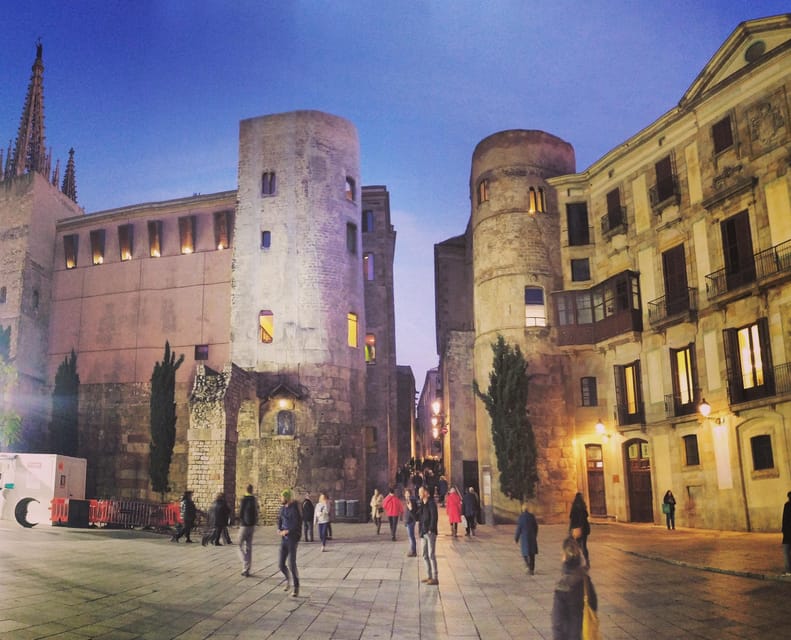
The first section leads through the Gothic Quarter, where the narrow streets are part of the experience. Locals still live among tapas bars, small shops, church walls, and carved medieval details.
The district can feel confusing if you explore it alone. Streets change direction, plazas appear without warning, and the most interesting details are often above eye level. A guide can point out the difference between Roman foundations, medieval construction, and later additions that are easy to treat as one old mass.
Expect a moderate amount of walking. The route is not described as strenuous, but the surface can be uneven and the streets are not designed for modern accessibility. Wear shoes with a firm sole, carry water, and keep your bag close in crowded areas.
The Gothic Quarter is also where the tour’s atmosphere is strongest. You may pass under stone arches, look up at gargoyles, and pause in small squares that have served as gathering places for centuries. Photography is encouraged, but the best pictures often require patience because the lanes can be busy.
The ancient synagogue and medieval Jewish Barcelona
One of the most worthwhile stops is Barcelona’s ancient synagogue. The visit brings attention to the medieval Jewish Quarter, an area that can be overlooked when visitors focus only on the cathedral and Roman walls.
The synagogue is a reminder that Barcelona was shaped by several religious and cultural communities. A short explanation here helps you understand the city as more than a Christian medieval center.
Do not expect a large museum-style building or an extended indoor program. The stop is listed at about 10 minutes, which means Luca has to make the setting understandable with focused storytelling. That can be useful if you have little background, but it will feel brief if you want a detailed study of the building.
This is one reason the tour works best as an introduction. It gives you enough context to recognize the area and decide what deserves a later visit.
Same city, a completely different century:
- Barcelona: Sagrada Familia Entry Ticket with Audio Guide
★ 4.6 · 105,312 reviews - Barcelona: Casa Batlló Entry with Self-Audioguide Tour
★ 4.7 · 25,359 reviews - Barcelona in 1 Day: Sagrada Familia, Park Guell,Old Town & Pickup
★ 5.0 · 13,541 reviews - Barcelona: Sagrada Familia Skip-the-Line Entry Ticket & Tour
★ 4.8 · 12,789 reviews
Sant Felip Neri and Barcelona’s difficult memories
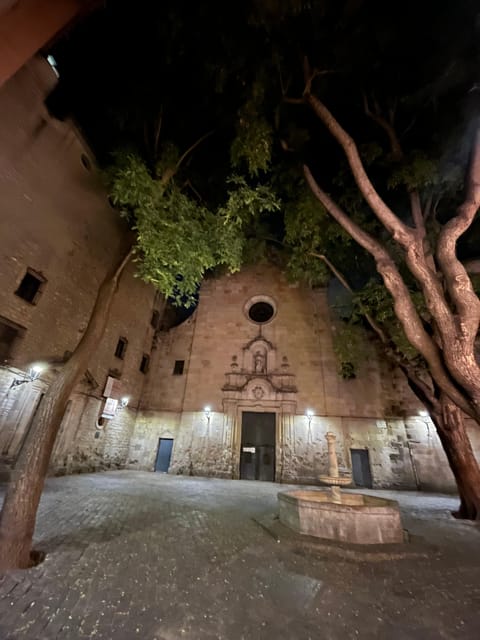
Plaça Sant Felip Neri is one of the most emotionally charged places on the route. The square is quiet and enclosed, with a church and walls that carry the marks of violence.
Here, the focus turns to Barcelona’s resistance against Franco’s uprising during the Civil War. The story adds a modern layer to a quarter that is often presented only through medieval architecture.
I value this stop because it prevents the Gothic Quarter from becoming a collection of pretty stone lanes. Barcelona has a complicated political identity, and the square gives you a chance to consider the cost of that past.
The visit is scheduled for about 10 minutes. That is enough for a concise account, but not for every detail of the Civil War or Franco’s rule. If this subject matters greatly to you, treat the stop as a starting point rather than a complete lesson.
Bishop’s Bridge, Roman columns, and the cathedral
The Bishop’s Bridge is a short stop, but it is one of the quarter’s most photographed details. Its pointed forms and stonework fit the medieval mood of the area, even as the surrounding street life keeps the setting firmly in the present.
From there, the route reaches the Temple of Augustus. The surviving Roman columns are a powerful reminder that Barcelona began long before the Gothic buildings most people associate with the city.
The columns are especially useful for understanding scale. You are not looking at a remote archaeological site. Roman Barcelona is woven into the modern city, with fragments preserved beside ordinary streets and newer buildings.
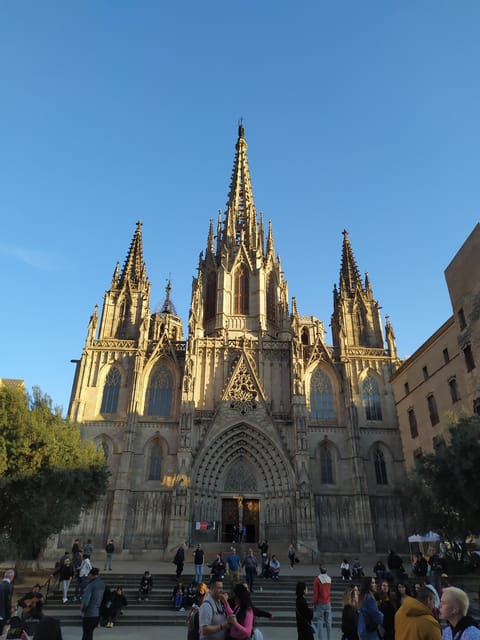
The walk then continues to Barcelona Cathedral. The cathedral gives Luca a chance to explain the religious and civic role of the Gothic Quarter, as well as the legends tied to Santa Eulalia, one of the city’s patron saints.
The stop is planned for about 10 minutes. That is enough to place the cathedral in context and admire the exterior, but you should check separately if you want a full interior visit or more time with the chapels and artwork.
Palau Reial Major and the city’s heroes
Palau Reial Major adds royal and political weight to the route. The site helps connect the Gothic Quarter’s religious buildings with the rulers and institutions that shaped medieval Barcelona.
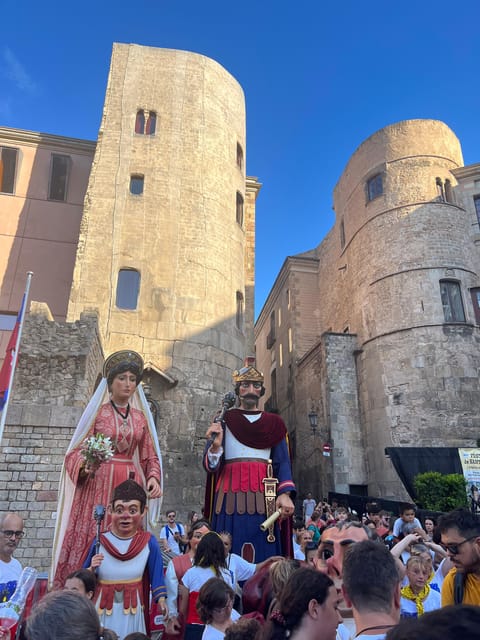
The tour also introduces several figures from Catalan tradition. Santa Eulalia represents the city’s Christian identity, Sant Jordi is tied to one of Catalonia’s best-known legends, and Wilfred the Hairy belongs to the region’s medieval political mythology.
Then there is el Caganer, a deliberately comic figure associated with Catalan Christmas traditions. Including him keeps the presentation from becoming too solemn. Catalan culture has room for saints, warriors, national symbols, and earthy humor.
This mixture is one of the tour’s strengths. You are not only looking at façades. You are learning how a city uses stories to explain itself.
Crossing into La Ribera and El Born
The route moves from the Gothic Quarter into Barri de La Ribera and then El Born. The change is gradual, but the mood shifts. The streets become a little more open, and the district is known for artisan shops, bars, and restaurants.
El Born is a useful contrast to the Gothic Quarter. The Gothic lanes can feel compressed and solemn, while Born offers a more social setting where old buildings support everyday commerce and evening life.
Luca’s presentation also gives you practical orientation. The walk can help you decide where to return for a meal or a drink, although food and drinks are not included in the $14 price.
Because the route covers several neighborhoods, you should expect commentary while walking rather than long pauses at each location. This is a good format for people who want a broad sense of central Barcelona in one sitting. It is less suitable if you prefer to spend 20 minutes examining one building.
Santa Maria del Mar, the people’s church
The final stop is the Basilica of Santa Maria del Mar, also called the Cathedral del Mar. It is a fitting end because it connects the Born district with the religious and working life of medieval Barcelona.
The church has become widely known through books and television, but the tour places it in a local setting. Luca presents it as Barcelona’s spiritual people’s temple since the 14th century, a phrase that points to its association with the residents and laborers of the district.
The outside alone makes a strong closing view. If you have time after the tour, consider returning for a slower look at the interior. The walk ends here, so you are free to continue through El Born without needing to retrace your steps to the starting point.
Ending at Santa Maria del Mar is also practical. You finish in an area with restaurants and bars, rather than beside a major transport hub where the experience simply stops.
How much information do you receive?
The guide’s approach is strongly story-based. The tour covers heroes, legends, religion, Roman Barcelona, the Jewish Quarter, the Civil War, and Catalan customs. That is a substantial range for two hours.
The clearest positive pattern in the available booking feedback is the praise for the breadth and clarity of the information. One French-language booking noted that the explanations were relevant and that the guide worked to make sure everyone understood. Two Spanish-language comments also praised the amount and clarity of the information.
That focus is important because the tour contains many short stops. A guide who explains connections clearly can make the route feel coherent rather than rushed from one address to the next.
There is also a caution to keep in mind. One German-language booking described a loud presentation, omitted details, and a tour lasting 90 minutes instead of the advertised two hours. That account does not erase the tour’s strengths, but it is a reason to confirm the starting time and expected duration, and to speak up if you cannot hear or if the pace becomes too fast.
Who should book this walk?
I would recommend it to you if you want:
- A first look at both the Gothic Quarter and El Born
- Roman, Jewish, Christian, political, and Catalan cultural context in one walk
- A live English-speaking guide rather than an audio guide
- Plenty of exterior photography opportunities
- A low-cost introduction before choosing which sights deserve a longer visit
- Stories about local figures and legends alongside architecture
You may want another option if you need step-free access, dislike uneven historic streets, or want extensive time inside churches and monuments. The route is not suitable for wheelchair users or people with mobility impairments.
It also suits independent visitors who want help getting oriented without surrendering an entire day. Two hours leaves room for lunch, a museum, or a separate visit to Santa Maria del Mar afterward.
Practical advice before you go
Wear comfortable walking shoes. The route passes through old streets, and the moderate walking is made less comfortable by poor footwear.
Bring water and sunscreen on hot days. For cooler or rainy weather, carry a jacket or umbrella. The tour runs outdoors for much of its duration, so dress for the forecast rather than relying on the narrow streets for shelter.
Bring a camera, but keep it ready for details rather than only major buildings. Gargoyles, stone textures, Roman columns, small squares, and the changing street views are among the best subjects.
Watch your belongings. The Gothic Quarter and Born can draw crowds, and the tour information specifically warns about pickpockets. Use a closed bag and avoid leaving a phone or wallet in an open pocket.
The price is $14 per person, with free cancellation up to 24 hours before the start and an option to reserve now and pay later. Those terms make it easy to fit the walk into a changing Barcelona schedule, though you should still check the available start times before booking.
Should you book The Timeless Beauty of Barcelona’s Gothic and Born Quarters?
Book it if you want a compact, story-led introduction to central Barcelona at a very fair price. The route covers more than the usual cathedral photo stop, with Roman remains, the old Jewish Quarter, Sant Felip Neri, Catalan legends, and Santa Maria del Mar all included.
Go in with realistic expectations. This is a fast walking overview, not a series of long monument visits. The streets are uneven, the route is not accessible for people with mobility impairments, and the advertised two hours should be confirmed when you arrive.
For a first or second day in Barcelona, I think the walk offers good value. It gives you a useful map of the Gothic Quarter and El Born, adds human stories to the stonework, and leaves you with several places worth exploring at your own pace.
FAQ
How long does the tour last?
The advertised duration is two hours. Starting times vary, so check availability when booking.
Where does the tour begin?
Meet the guide in front of Starbucks at Plaça de Sant Jaume, number 3.
Where does the tour finish?
The walk ends at the Basilica of Santa Maria del Mar in El Born.
What language is the tour in?
The live tour guide speaks English.
Is the tour suitable for wheelchair users?
No. The tour is not suitable for wheelchair users or people with mobility impairments because of the narrow historic streets and walking conditions.
What should I bring?
Bring comfortable shoes, water, sunscreen, and a camera. For cooler or rainy conditions, bring a jacket or umbrella, and keep your belongings close in busy streets.
Just added around Barcelona
- Love in the Gothic Quarter Barcelona: Self-Guided Romantic Walk★ 4.5 · 9 reviews
- Walking tour of the Gothic Quarter of Barcelona + Cathedral★ 5.0 · 8 reviews
- Wine tasting with a view of the Sagrada Familia★ 4.5 · 13 reviews
- Roman & Gotic & Gaudi in Barcelona: private walking tour★ 4.5 · 2 reviews
- Visit to the Modernist houses of the Americans★ 5.0 · 2 reviews
- Barcelona Jewish & Gothic Tour★ 5.0 · 18 reviews
- Self-Guided Audio Tour-The Surrealist Barcelona of Dalí and Gaudí★ 3.5 · 8 reviews
- Barcelona Gaudi Tour: Sagrada Familia, Casa Batllo & Casa Mila★ 5.0 · 4 reviews
Gothic Quarter Tours, compared.
Barcelona all included: Sagrada, Park Güell, Montjuic & Gothic
Read our review →
Barcelona Gothic Quarter Tapas & Taverns Food & Wine Tour
Read our review →
Barcelona: Gothic Quarter Ghosts and Legends Walking Tour
Read our review →
Barcelona: Old Town and Gothic Quarter Walking Tour
Read our review →
Barcelona Old Town & Gothic Quarter Small Group Tour
Read our review →
Ramblas, Old Town, Gothic and Gaudi Architecture Walking Tour
Read our review →
Barcelona: El Born and Gothic Quarter Wine & Tapas Bar Tour
Read our review →
Kids and Family Gothic Quarter Walking Tour in Barcelona
Read our review →Browse the lists this tour appears in