
Review · BARCELONA
Barcelona Gothic Quarter From Roman Walls to Hidden Courtyards
Barcelona’s Gothic Quarter is best understood one stone, square, and shadowy alley at a time. This walking tour links Roman ruins, royal power, medieval Jewish life, Civil War scars, and local legends into a compact route through the old city. The thirteen white geese at Barcelona Cathedral and the skull carved into Pont del Bisbe add just enough folklore to keep the history lively.
I like the small maximum group of 20 and the way the route mixes famous sights with details you could easily miss alone. I also like that guide Victoria has been praised for making the area’s past clear and interesting. The main drawback is pace: with eight stops in about two to three hours, some places receive only a quick look rather than a long visit.
Key points at a glance
- Roman beginnings: Start near the old aqueduct and see the Roman wall beside Barcelona Cathedral.
- Thirteen white geese: Hear the legend behind the cathedral courtyard’s unusual birds.
- Royal and political Barcelona: Visit Plaça del Rei and Plaça de Sant Jaume, centers of medieval and modern power.
- Medieval Jewish life: Walk the narrow streets of the former Jewish Quarter and see one of Europe’s oldest surviving synagogues.
- War, film, and folklore: Find Civil War shrapnel marks at Saint Philip Neri and the fabled skull on Pont del Bisbe.
- Good-luck rituals: Finish at Casa de l’Ardiaca, where a palm tree and stone turtle carry local meaning.
Starting beside Roman Barcelona
The meeting point is La Casa de l’Ardiaca, Carrer de Santa Llúcia 1, beside the Roman aqueduct. That makes a fitting start. Before Barcelona became a major medieval and modern city, it was the Roman settlement of Barcino, and the old stones here give you a clear sense of its age.
Your guide leads the walk in English and handles the route through the tight lanes of Ciutat Vella. That matters in the Gothic Quarter, where a map can tell you where you are but not always explain what you are looking at. A guide can connect a church wall, a palace, and a narrow lane to the larger story of the city.
The tour is listed at about two to three hours. The planned stops add up to roughly two hours, leaving time for walking between them, questions, and short pauses for photos. Wear comfortable shoes. The route is urban and compact, but the old quarter is built for wandering rather than smooth, straight walking.
More Gothic quarter walks in Barcelona:
- Barcelona all included: Sagrada, Park Güell, Montjuic & Gothic
★ 5.0 · 2,169 reviews - Barcelona Gothic Quarter Tapas & Taverns Food & Wine Tour
★ 5.0 · 1,470 reviews - Barcelona: Old Town and Gothic Quarter Walking Tour
★ 4.8 · 1,393 reviews
Barcelona Cathedral and the thirteen geese
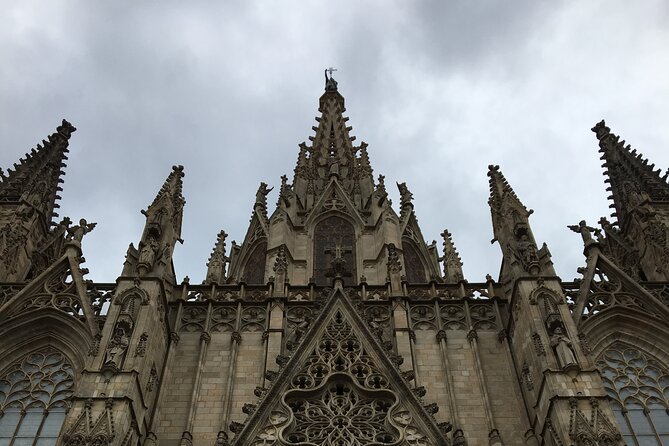
Barcelona Cathedral is the first major stop. It was built on the site of the city’s first Christian basilica, and part of the Roman wall nearby points back to the city’s earliest foundations. You get two layers of Barcelona in a single view: Roman defensive stone and a grand Gothic church.
The cathedral courtyard is known for its thirteen white geese. Their presence is tied to local legends and to Saint Eulalia, Barcelona’s patron saint. The tour uses the geese as a way into stories about miracles and holy relics, rather than treating the cathedral as just another impressive facade.
You have about 15 minutes here, with no separate admission charge listed for the stop. That is enough for the guide’s explanation and some photographs against the ancient wall, but it is not a full cathedral visit. If you want to study the interior, chapels, or art at length, plan separate time before or after the walk.
I like this opening because it gives you a strong historical frame right away. You are not simply looking at Gothic architecture. You are seeing how one religious building and one section of Roman wall mark different chapters of the same city.
Plaça del Rei and the old royal court
From the cathedral area, the walk continues to Plaça del Rei. This elegant square was linked to the Counts of Barcelona and the Kings of Aragon. The surrounding buildings help you picture Barcelona when royal authority, ceremony, and trade shaped the city’s public life.
The guide explains important events tied to Catalonia’s rulers and tells stories of feasts held in this area. Those details are useful because they turn a formal square into a place where people once ate, governed, celebrated, and displayed power.
The square also connects with the underground Roman remains of Barcino, shown through a museum. The stop is listed as about 15 minutes and includes no separate admission charge. As with the cathedral, the time is designed for orientation and storytelling, not a full museum visit.
This is one of the tour’s better transitions. You move from Roman foundations to medieval monarchy without having to cross half the city. You also see how Barcelona’s old center contains several periods at once, often with Roman stone beneath medieval buildings.
The executioner’s house and medieval fears
The Antigua Casa del Verdugo Municipal offers a different sort of history. This old building is associated with Barcelona’s official executioner and with a period when public punishment formed part of city life.
The guide shares dark legends and local folklore connected to the executioner’s role. It is not a cheerful stop, but it gives the tour some honest edge. Medieval cities were not only places of churches, palaces, and trade. They also had public systems of punishment and people whose jobs carried fear and social isolation.
You spend about 15 minutes here. The value lies less in a grand architectural view and more in the story. If you prefer tours that focus only on art and beautiful buildings, this stop may feel grim. I think it adds useful balance, showing how ordinary life once included public violence as well as religious ceremony and royal display.
Same city, a completely different century:
- Barcelona: Sagrada Familia Entry Ticket with Audio Guide
★ 4.6 · 105,312 reviews - Barcelona: Casa Batlló Entry with Self-Audioguide Tour
★ 4.7 · 25,359 reviews - Barcelona in 1 Day: Sagrada Familia, Park Guell,Old Town & Pickup
★ 5.0 · 13,541 reviews - Barcelona: Sagrada Familia Skip-the-Line Entry Ticket & Tour
★ 4.8 · 12,789 reviews
Plaça de Sant Jaume and Catalonia today
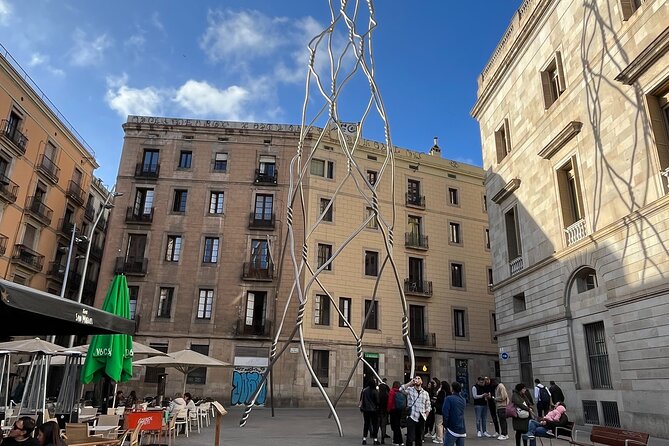
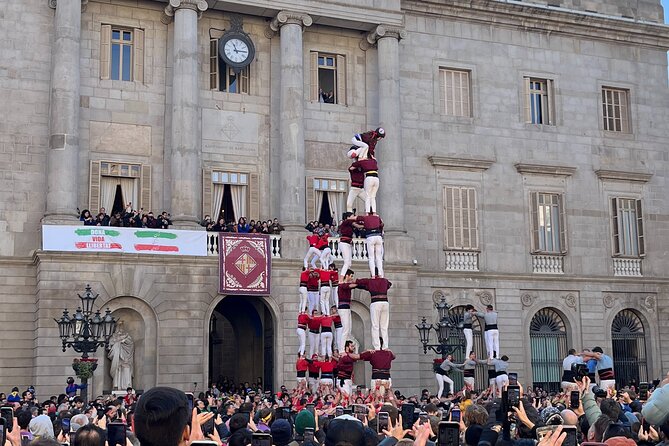
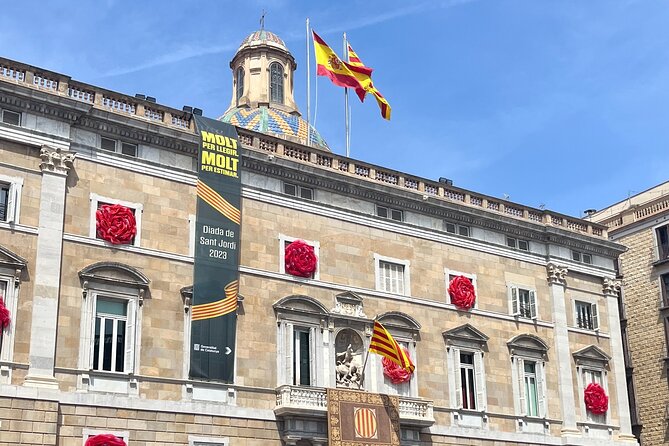
Plaça de Sant Jaume brings the tour into Barcelona’s political present. The square is home to the Ajuntament, or City Hall, and the Palau de la Generalitat, the seat of the Government of Catalonia.
The guide explains Catalonia’s autonomous status and the way the region maintains its distinct culture. That context is especially helpful because political identity is part of how Barcelona presents itself. You are not just passing a government building. You are looking at the center of local civic power.
The stop lasts about 15 minutes. It is a good place to pause and watch the square’s steady public activity, though the tour does not promise entry into either government building. The experience is about the setting, the institutions, and the stories attached to them.
I like that the tour does not freeze Barcelona in the Middle Ages. After Roman ruins, royal courts, and medieval punishment, you reach a square where Catalan political life is still visible. It makes the old quarter feel like a living part of the city rather than a museum district.
Narrow lanes of the former Jewish Quarter
The route then enters Barcelona’s former Jewish Quarter, known for its narrow streets and old stone buildings. The guide discusses the everyday customs, trades, and traditions of the medieval Jewish community that once lived here.
One of the oldest surviving synagogues in Europe is associated with this area. The tour gives you a chance to understand the community through the people who lived and worked here, not only through religious buildings. That human focus matters. A few tight lanes can otherwise seem mysterious but empty of meaning.
The stop lasts around 15 minutes and is listed with no separate admission charge. Because the quarter is made up of small streets rather than one single viewpoint, listen closely to the guide’s explanations. The significance is easy to miss if you only look at the architecture.
This section should suit you if you want more than the usual church-and-palace circuit. It adds a part of Barcelona’s past that many short city walks leave out. The short time also means you should not expect a long study of the synagogue or a detailed museum visit.
Saint Philip Neri and the marks of war
The Church of Saint Philip Neri sits beside a quiet square that feels very different from the nearby political and royal spaces. The church walls still show shrapnel marks from the Spanish Civil War.
The guide explains the wartime atmosphere and the lives of people who sought shelter in this part of the city. The square has also appeared in films including Perfume and Vicky Cristina Barcelona, giving the stop a second identity as a film location.
You spend about 20 minutes here, the longest planned pause on the route. That makes sense. The square calls for a slower look, especially at the damage in the walls and the contrast between the peaceful setting and its painful past.
For photography, this is one of the strongest stops. Still, I would encourage you to look beyond the cinematic appeal. The marks are not decorative. They are physical evidence of violence, and the guide’s explanation helps keep the place grounded in real events.
Pont del Bisbe and the skull legend
Pont del Bisbe is one of the Gothic Quarter’s most recognizable sights. This neo-Gothic bridge links the Government building with a neighboring Episcopal structure and creates a dramatic overhead passage above the narrow street.
The bridge is especially popular for photographs, but the tour adds the story of a hidden skull worked into its decoration. Local legends often grow around old city details, and this one gives you a playful mystery to look for as you stand beneath the bridge.
The planned stop is about 10 minutes. That is enough for the explanation and a photograph, though it can feel brief if you want to wait for a clear view or take several pictures. The bridge is small, so your guide’s timing helps keep the group together without lingering too long.
This is a good example of the tour’s overall style: solid history mixed with folklore. You hear about government buildings and medieval church connections, then look for a carved skull. Barcelona’s old center is full of that contrast.
Casa de l’Ardiaca and the final good-luck ritual
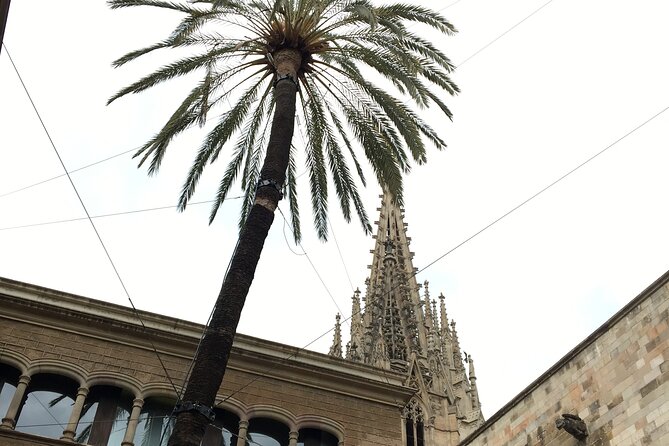
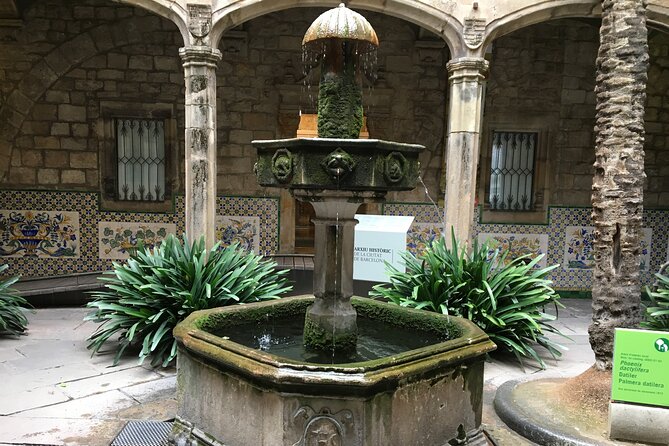
The tour returns to Casa de l’Ardiaca, the starting point. This historic building has a charming courtyard with a fountain and Barcelona’s oldest palm tree. A small stone turtle beside the fountain is treated as a traditional good-luck charm.
You are invited to touch the old palm and rub the turtle for luck. The gesture is lighthearted, but it also gives the tour a memorable ending. After hearing about royal power, religious relics, punishment, political identity, Jewish life, and wartime damage, you finish with a local custom linked to peace and prosperity.
The guide also explains the building’s ties to church and secular authorities. That makes Casa de l’Ardiaca more than a pretty courtyard. Its setting reflects the overlapping institutions that shaped Barcelona’s old center.
Because the tour ends back at the meeting point, you are returned to a familiar location rather than left in another part of the quarter. You can then continue exploring on your own or use the nearby public transportation connections.
What the $29.57 price gives you
At $29.57 per person, this is priced as an affordable guided orientation rather than a premium private tour. Admission is listed as free at each stop, so your payment mainly covers the local guide, the route planning, and the stories that connect the sites.
That can be good value if you are visiting Barcelona for the first time or if you tend to miss details when walking alone. Roman walls, old courtyards, and Gothic facades are easy to admire without understanding their place in the city’s story. A guide gives you a clearer thread.
The value is less obvious if you already know the Gothic Quarter well or prefer to linger inside museums and churches. The schedule moves through eight stops, and several pauses last only 10 to 15 minutes. You are paying for breadth and context, not long independent visits at each site.
The group limit of 20 is another practical plus. It is not a private walk, but it should be easier to hear the guide and stay together than on a very large city tour. The experience currently has a 4.6 rating from five reviews, and Victoria receives specific praise for making the area’s history clear and interesting.
Who should book this Gothic Quarter walk?
I would choose this tour if you want a structured first look at Barcelona’s old center. It suits couples, families, and solo visitors who want help finding the significant courtyards and lanes without spending time guessing where to turn.
It is also a good fit if you enjoy a mix of serious history and small local legends. The thirteen geese, the executioner’s house, the carved skull, and the lucky turtle keep the walk from becoming a string of dates and names.
You should think twice if you need a slow, detailed architectural tour or extensive interior access. The cathedral, synagogue, museum, and government buildings are part of the route, but the supplied schedule does not promise long indoor visits. The experience is mainly a guided walk through the quarter.
The tour is available to anyone at least 150 centimeters tall, and most people can participate. Service animals are allowed. It requires good weather and a minimum number of participants, so poor conditions or insufficient bookings can lead to a new date or a full refund. You can cancel for a full refund up to 24 hours before the start time.
Should you book it?
Book this walk if you want a compact, story-led introduction to the Gothic Quarter with Roman remains, royal history, Jewish heritage, Civil War traces, film locations, and local customs in one route. The price is reasonable for a guided orientation, and Victoria’s clear storytelling is a strong reason to consider it.
Skip it if your priority is unhurried museum time, detailed church interiors, or a private experience. For most first-time visitors, though, the route offers a useful framework. Afterward, you will know which corners deserve a second look and why the old stones matter.
FAQ
How long does the Barcelona Gothic Quarter tour last?
The tour lasts approximately two to three hours. It includes eight stops and walking time between them.
What language is the tour offered in?
The tour is offered in English.
Where does the tour start and finish?
It starts at the Roman aqueduct beside La Casa de l’Ardiaca at Carrer de Santa Llúcia 1 in Barcelona’s Ciutat Vella. It ends back at the same meeting point.
What is included in the price?
A local guide is included. The listed stops have no separate admission charge.
How large is the tour group?
The maximum group size is 20 people.
Can I cancel for a full refund?
Yes. You can cancel at least 24 hours before the experience start time for a full refund. Changes or cancellations made less than 24 hours before the start time are not accepted for a refund.
Just added around Barcelona
- Love in the Gothic Quarter Barcelona: Self-Guided Romantic Walk★ 4.5 · 9 reviews
- Walking tour of the Gothic Quarter of Barcelona + Cathedral★ 5.0 · 8 reviews
- Wine tasting with a view of the Sagrada Familia★ 4.5 · 13 reviews
- Visit to the Modernist houses of the Americans★ 5.0 · 2 reviews
- Barcelona Jewish & Gothic Tour★ 5.0 · 18 reviews
- Roman & Gotic & Gaudi in Barcelona: private walking tour★ 4.5 · 2 reviews
- Self-Guided Audio Tour-The Surrealist Barcelona of Dalí and Gaudí★ 3.5 · 8 reviews
- Barcelona Gaudi Tour: Sagrada Familia, Casa Batllo & Casa Mila★ 5.0 · 4 reviews
Gothic Quarter Tours, compared.
Barcelona all included: Sagrada, Park Güell, Montjuic & Gothic
Read our review →
Barcelona Gothic Quarter Tapas & Taverns Food & Wine Tour
Read our review →
Barcelona: Gothic Quarter Ghosts and Legends Walking Tour
Read our review →
Barcelona: Old Town and Gothic Quarter Walking Tour
Read our review →
Barcelona Old Town & Gothic Quarter Small Group Tour
Read our review →
Ramblas, Old Town, Gothic and Gaudi Architecture Walking Tour
Read our review →
Barcelona: El Born and Gothic Quarter Wine & Tapas Bar Tour
Read our review →
Kids and Family Gothic Quarter Walking Tour in Barcelona
Read our review →Browse the lists this tour appears in