
Review · BARCELONA
Gothic Quarter & Beyond: Leisurely Local Discoveries
Barcelona’s Gothic Quarter is more than narrow lanes and crowded cathedral squares. This 3.5-hour walk takes you to Roman columns, medieval chapels, and quiet corners that many first-time visitors pass without noticing. You finish near the Frederic Marès Museum after tracing a compact slice of the old city.
I like the small group of no more than 12, which gives you room to ask questions. I also like the practical local touch: you get a traditional snack, plus useful ideas for lunch and shopping. Laura, one of the named guides, is described as clear and easy to understand.
The main drawback is pace. Seven stops in roughly three and a half hours means several visits last only 5 or 10 minutes. You will get a well-shaped introduction rather than long museum visits or detailed interior tours.
Key points at a glance
- Seven old-city stops: Visit former convent buildings, Roman columns, medieval churches, a concert hall, and a museum courtyard.
- A small walking group: The maximum is 12 people, a good size for questions and conversation.
- A traditional snack: Food is part of the experience, though the exact snack is not specified.
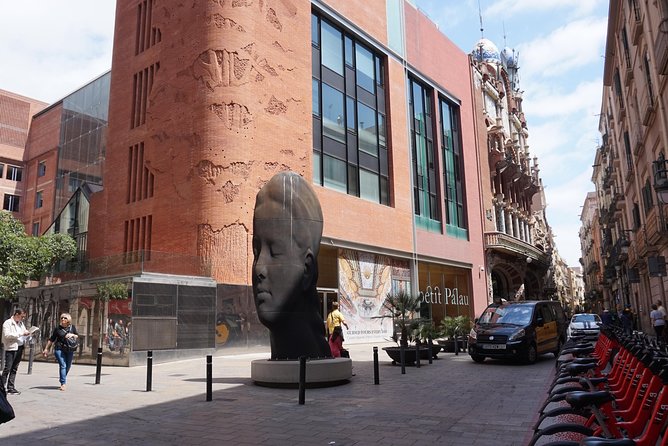
- A useful starting point: The walk begins by the Palau de la Música Catalana and ends near the Frederic Marès Museum.
- A quieter view of Barcelona: The route focuses on lesser-known corners rather than only the Gothic Quarter’s headline sights.
- Flexible cancellation: You can cancel for a full refund up to 24 hours before the start time.
Why this walk gives you more than the usual Gothic Quarter loop
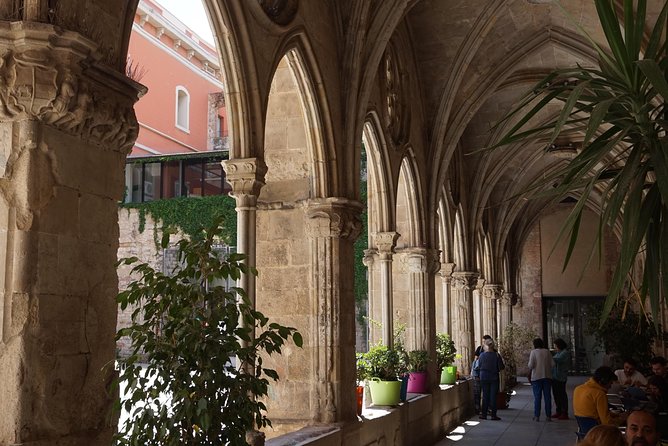
Many Gothic Quarter walks concentrate on the cathedral, Roman walls, and the busiest lanes. This route takes a different angle. It connects small religious buildings, old civic spaces, Roman remains, and Catalan modernist architecture.
That mix matters. You are not simply looking at old stone and hearing dates. You see how Barcelona changed from Roman settlement to medieval city, then into a modern cultural capital. The stops are short, but together they create a useful outline of the city’s past.
The group size helps. With up to 12 people, you can usually hear the guide and ask about details that catch your eye. That is especially useful in the Gothic Quarter, where a plain doorway or small courtyard can carry more meaning than a grand facade.
The walk is offered in English. Laura is specifically noted for speaking clearly and explaining things in an easy-to-follow way. That makes a difference when you are dealing with Roman, medieval, and Catalan terms in one outing.
More Gothic quarter walks in Barcelona:
- Barcelona all included: Sagrada, Park Güell, Montjuic & Gothic
★ 5.0 · 2,169 reviews - Barcelona Gothic Quarter Tapas & Taverns Food & Wine Tour
★ 5.0 · 1,470 reviews - Barcelona: Old Town and Gothic Quarter Walking Tour
★ 4.8 · 1,393 reviews
Start near the Palau de la Música
The meeting point is on Carrer del Palau de la Música, by the Palau de la Música Catalana. This is a strong place to begin because the building gives you an immediate look at Barcelona’s modernist side before the walk moves into older streets.
The Palau was designed by Lluís Domènech i Montaner for the Orfeó Català choir. It was funded through public donations and is recognized as a UNESCO World Heritage Site. The tour allows about 10 minutes here, so expect an introduction or exterior-focused look rather than a full concert hall visit.
That time limit is worth keeping in mind. The Palau deserves a longer visit if you care about stained glass, sculpture, tilework, and the concert interior. On this walk, its value is mainly as a quick architectural marker and a reminder that Barcelona’s cultural identity did not stop in the Middle Ages.
Arrive ready to walk. The route links several stops in the old center, and some locations may be close together while others require a short walk through city streets. Comfortable shoes will make the experience easier, even though the total duration is not a full-day outing.
Sant Agustí and the story of a relocated convent
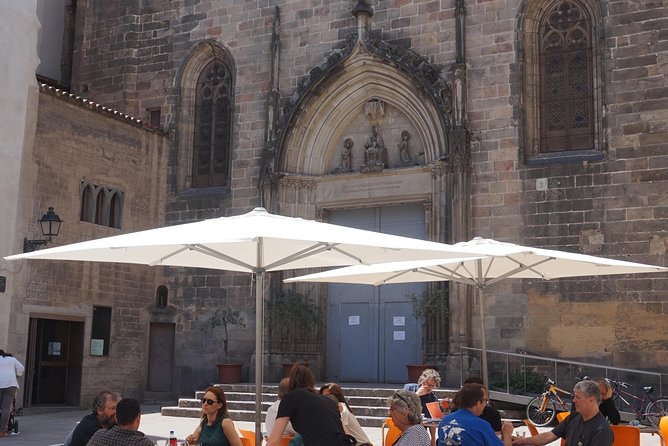
The first listed stop is the Centre Cívic Convent de Sant Agustí. The original Convent of Sant Agustí Vell began in 1349, but the Augustinians later had to leave because of the construction of the Fortress of the Ciutadella.
A new convent and church were created between 1728 and 1750. Today, much of the former convent serves modern civic and cultural uses, including the Ciutat Vella Civic Centre, the Barcelona Photographic Archive, and the Chocolate Museum.
The surviving Gothic convent elements include part of the sanctuary and a side section of the church. You get about 10 minutes here, enough to understand the site’s changing role and take photographs, but not enough for a full museum visit.
I find this kind of stop useful because it shows how Barcelona’s old buildings have been reused. A former religious complex is now tied to community life, photography, and food culture. It gives you a more grounded view of the city than a simple list of dates.
Sant Pere de les Puelles and a vanished convent community
The stop at Sant Pere de les Puelles reaches back to 945, when the monastery was consecrated as Barcelona’s first Benedictine convent for nuns. The original Romanesque building stood outside the city walls, which tells you something about how small and contained medieval Barcelona once was.
The monastery endured attacks by Arab troops, fires, and major changes to its religious community. In the 19th century, the nuns were expelled, and in 1879 they moved to a permanent site in Sarrià-Sant Gervasi.
You have about 10 minutes here. That is enough for a focused explanation of the building and its past, but you should not expect a long architectural study. The appeal is the story of change: a religious foundation from the 10th century was shaped by war, fire, urban growth, and political upheaval.
This stop also helps break up the standard Gothic Quarter narrative. You are not only hearing about kings and grand churches. You are hearing about a women’s religious community and the forces that eventually pushed it out of its original home.
Same city, a completely different century:
- Barcelona: Sagrada Familia Entry Ticket with Audio Guide
★ 4.6 · 105,312 reviews - Barcelona: Casa Batlló Entry with Self-Audioguide Tour
★ 4.7 · 25,359 reviews - Barcelona in 1 Day: Sagrada Familia, Park Guell,Old Town & Pickup
★ 5.0 · 13,541 reviews - Barcelona: Sagrada Familia Skip-the-Line Entry Ticket & Tour
★ 4.8 · 12,789 reviews
Capella d’en Marcús, a small chapel with a practical purpose
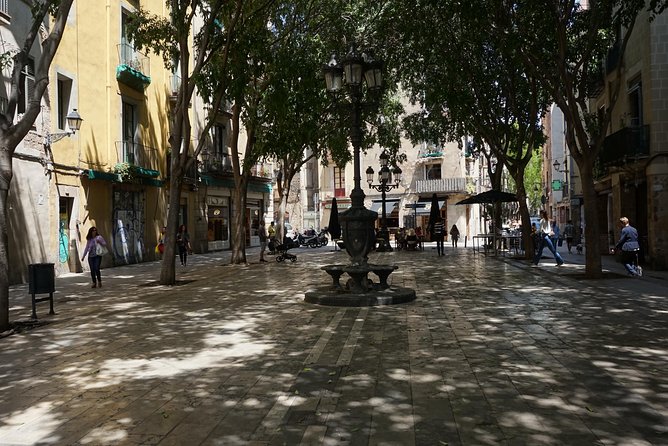
Capella d’en Marcús is one of the shortest stops, at about five minutes. That sounds brief, but the chapel itself is small, and its original purpose gives it real interest.
Bernat Marcús, an influential Barcelona citizen, sponsored the chapel in 1166. It was built to shelter travelers and serve as a hospital for the city’s poorest people. Its original name was Capella de la Mare de Déu de la Guia, or Chapel of Our Lady of Guidance.
The chapel stood along the old Roman road leading toward France. That location explains why travelers needed a place of guidance, shelter, and care. It was not built only for ceremony. It served people moving through the city and people who had little protection within it.
This is a good example of why a guide adds value in the Gothic Quarter. Without context, a small Romanesque chapel can be easy to overlook. With the story, you can read it as part of Barcelona’s old road system and social services.
Sant Just i Pastor and the city’s oldest-church claim
The Basilica dels Sants Màrtirs Just i Pastor is traditionally considered Barcelona’s oldest church. The claim is a matter of tradition, but the present 14th-century building is still an important Gothic Quarter stop.
The church sits in one of the area’s less explored corners. You have about 10 minutes to take in its setting and hear how it fits into medieval Barcelona. It is another place where the tour favors atmosphere and context over a long interior visit.
I like the balance here. The guide does not need to prove an absolute claim for the church to matter. Its age, location, and connection to the medieval city make it a worthwhile pause, especially if you have already seen the Gothic Quarter’s more famous religious buildings.
Photography is another strength of this route. Small churches and side streets often give you more distinctive pictures than the main squares, where crowds can dominate the frame.
Roman Barcelona at the Temple of Augustus
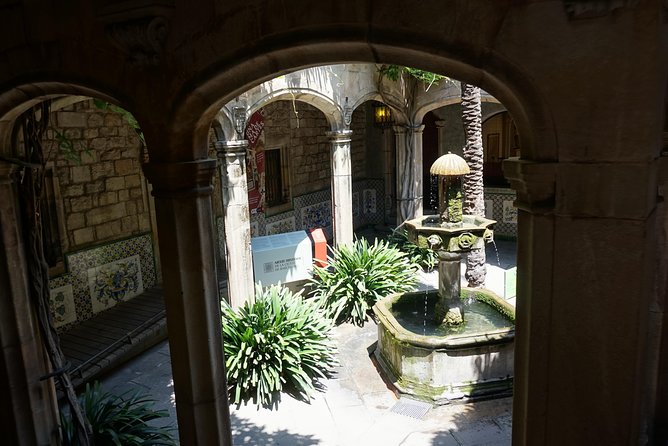
At MUHBA Temple d’August, four columns from the Temple of Augustus survive inside a small medieval courtyard on Carrer Paradís. They are more than 2,000 years old and belong to the Roman foundation of Barcelona.
This is likely to be one of the most surprising stops. The remains are not presented in a vast open ruin. They are tucked inside a later building, which makes the encounter feel sudden and compact. You move from a medieval street into a courtyard and find major Roman columns still in place.
The tour allows around 10 minutes. That is enough to see the columns and understand their importance, but not enough for an extended archaeological visit. If Roman Barcelona is a priority for you, you may want separate time for the city’s other Roman remains and museums.
Even with that limitation, the stop is valuable because it changes your sense of the Gothic Quarter. The neighborhood is not only medieval. Roman Barcelona lies beneath and within the later city.
The Palau de la Música in a wider Barcelona story
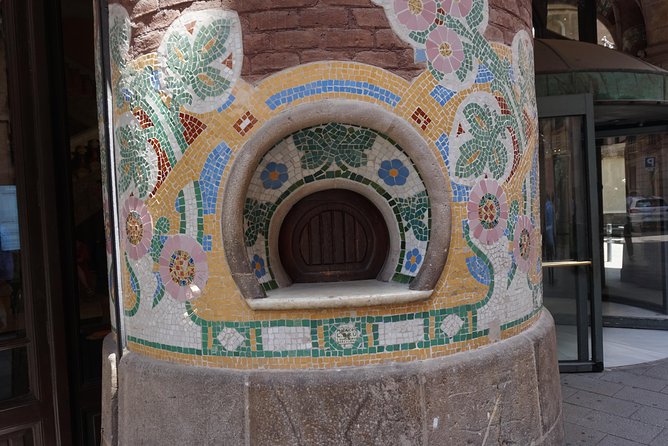
The Palau appears as one of the seven stops, with about 10 minutes assigned to it. The building was created as a home for the Orfeó Català choir and funded by public donations, giving it a strong connection to civic life as well as music.
Its UNESCO status makes it one of Barcelona’s major architectural sights. Yet this walk treats it as one piece of a larger route, not the central event. That is helpful if you want variety, but less suitable if you want a detailed architectural tour.
I would think of this stop as a preview. You can note the building’s style, hear why it matters, and decide if you want to return for a longer visit. The route does not promise a concert, performance, or full guided tour inside.
Finish at the Frederic Marès Museum area
The final stop is the Museu Frederic Marès, located in part of the former royal palace associated with the Counts of Barcelona. The museum holds the extensive collection assembled by sculptor and collector Frederic Marès.
The walk ends at Plaça Sant Iu, near the museum. About 10 minutes is allocated here, so the tour appears designed to introduce the location rather than provide a full museum visit. If you enjoy sculpture, historic objects, and collectors’ museums, you may want to return with more time.
Ending here is practical. You finish in the heart of the Gothic Quarter, surrounded by major old-city sights and places to continue on foot. The walk does not leave you at an isolated edge of town.
The route’s food advice also becomes useful at this point. The guide can point you toward lunch and shopping ideas, and the traditional snack gives the tour a small taste of local food culture along the way. The exact snack is not specified, so do not book this expecting a full meal.
What $61.54 means in practical value
At $61.54 per person, this is not the cheapest way to walk around the Gothic Quarter. You can see many streets and exterior buildings for free. The price is paying for the guide’s organization, explanations, small-group setting, and snack rather than for admission tickets.
That distinction matters because all listed stops have free admission. You are not buying a package of museum entries. You are paying for a person to connect places that can otherwise feel unrelated.
I think the price makes the most sense for a first visit, a short stay, or anyone who prefers a guided introduction before exploring alone. It is less compelling if you already know Barcelona’s Roman and medieval center well, or if you want long visits inside each museum and church.
The group discount may improve the value for larger parties. Since the maximum is 12 people, the experience should remain more personal than a large coach-style walk, though the exact discount is not provided.
Who should book this walk
I would recommend it to you if you want:
- A first orientation to Barcelona’s old center
- A route that includes lesser-known religious and Roman sites
- A guide who can explain local history in clear English
- A small group where questions are possible
- Practical suggestions for lunch and shopping
- A mixture of architecture, archaeology, food, and city stories
It may not suit you if you want a slow museum day. Several stops last only five or 10 minutes, and the total route covers seven locations. Families and most people with ordinary walking ability can participate, but anyone who dislikes city walking should check the route’s demands before booking.
Service animals are allowed, and the tour is near public transportation. Confirmation is provided at booking. The experience needs good weather and a minimum number of participants. If poor weather or low enrollment cancels it, you can choose another date or receive a full refund.
Free cancellation is available until 24 hours before the start time. After that point, the amount paid is not refunded, and changes are not accepted.
My take: a smart choice for context and local flavor
Book this walk if you want Barcelona’s Gothic Quarter explained through small places rather than only famous monuments. The combination of a Benedictine convent, a Romanesque chapel, Roman columns, a medieval basilica, the Palau de la Música, and the Frederic Marès Museum gives you a broad view in a manageable three and a half hours.
The strongest reasons to choose it are the maximum group size of 12, the clear English guidance associated with Laura, and the practical food and shopping advice. The main tradeoff is short stop time. You will see many places, but you will not study any one of them at length.
For a first visit, I think the route offers good value if you want a thoughtful introduction and plan to explore further on your own. If you prefer deep museum visits or a relaxed pace at each sight, choose a more focused tour instead.
FAQ
How long does the tour last?
The experience lasts approximately 3 hours and 30 minutes.
What is the price?
The listed price is $61.54 per person. Group discounts are available.
How large is the group?
The tour has a maximum of 12 participants.
What language is the tour offered in?
The tour is offered in English.
Where does the tour start?
It starts at Carrer del Palau de la Música, near the Palau de la Música Catalana in Barcelona’s Ciutat Vella.
Where does the tour end?
It ends at the Museu Frederic Marès, at Plaça Sant Iu, 5.
Is food included?
The experience includes a traditional snack. The specific type of snack is not stated.
Can I cancel for a refund?
Yes. You can cancel at least 24 hours before the start time for a full refund. Cancellations or changes made less than 24 hours before the start time are not refunded or accepted.
Just added around Barcelona
- Love in the Gothic Quarter Barcelona: Self-Guided Romantic Walk★ 4.5 · 9 reviews
- Walking tour of the Gothic Quarter of Barcelona + Cathedral★ 5.0 · 8 reviews
- Wine tasting with a view of the Sagrada Familia★ 4.5 · 13 reviews
- Visit to the Modernist houses of the Americans★ 5.0 · 2 reviews
- Barcelona Jewish & Gothic Tour★ 5.0 · 18 reviews
- Roman & Gotic & Gaudi in Barcelona: private walking tour★ 4.5 · 2 reviews
- Self-Guided Audio Tour-The Surrealist Barcelona of Dalí and Gaudí★ 3.5 · 8 reviews
- Barcelona Gaudi Tour: Sagrada Familia, Casa Batllo & Casa Mila★ 5.0 · 4 reviews
Gothic Quarter Tours, compared.
Barcelona all included: Sagrada, Park Güell, Montjuic & Gothic
Read our review →
Barcelona Gothic Quarter Tapas & Taverns Food & Wine Tour
Read our review →
Barcelona: Gothic Quarter Ghosts and Legends Walking Tour
Read our review →
Barcelona: Old Town and Gothic Quarter Walking Tour
Read our review →
Barcelona Old Town & Gothic Quarter Small Group Tour
Read our review →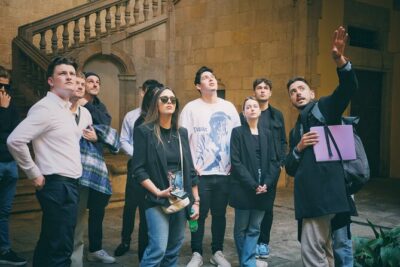
Ramblas, Old Town, Gothic and Gaudi Architecture Walking Tour
Read our review →
Barcelona: El Born and Gothic Quarter Wine & Tapas Bar Tour
Read our review →
Kids and Family Gothic Quarter Walking Tour in Barcelona
Read our review →Browse the lists this tour appears in